
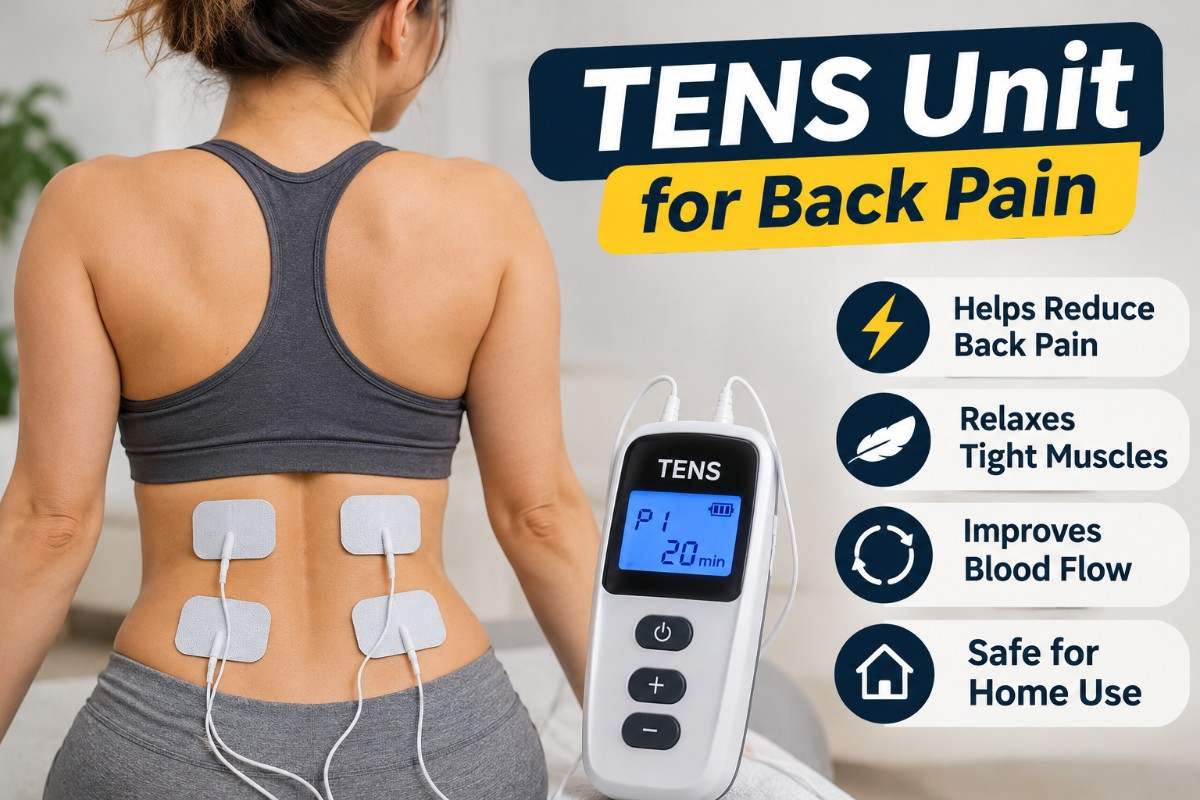
Back pain can make everyday activities such as sitting, walking, exercising, and sleeping uncomfortable. Some people consider a TENS unit as a non-invasive way to manage pain without medication.
TENS stands for Transcutaneous Electrical Nerve Stimulation. It uses low-voltage electrical pulses delivered through adhesive electrode pads placed on the skin. Although some people experience temporary relief, research does not establish TENS as an effective routine treatment for chronic lower back pain.
Understanding how the device works, how to use its electrode pads safely, and what clinical guidelines say can help you make a more informed decision.
What Is a TENS Unit for Back Pain?
A TENS unit for back pain is a portable electrical stimulation device that sends controlled electrical pulses through adhesive electrode pads attached to the skin.
TENS stands for Transcutaneous Electrical Nerve Stimulation. The device stimulates sensory nerves and may influence how the nervous system processes pain signals.
A typical TENS machine includes:
- A portable electrical stimulation controller.
- Two or more electrode pads.
- Connecting wires or wireless electrodes.
- Adjustable intensity controls.
- Different stimulation programs or settings, depending on the model.
TENS may provide temporary symptom relief for some people, but it does not repair damaged spinal structures or cure the underlying cause of back pain.
what is a TENS unit and how does it work
Can TENS Therapy Help With Back Pain?
TENS may provide short-term pain relief for some individuals, but research has not established clinically meaningful benefits for routine treatment of chronic primary low back pain.
People experiencing back discomfort often look for non-invasive options that may help them manage symptoms while continuing appropriate daily activities and rehabilitation.
Potential advantages of TENS include:
- Non-invasive electrical stimulation.
- Portable equipment for home use.
- Adjustable stimulation intensity.
- No medication required for the electrical stimulation itself.
- Temporary symptom relief for some individuals.
However, these potential advantages do not mean TENS is suitable or effective for everyone.
What Do Medical Guidelines Say About TENS for Back Pain?
The evidence and recommendations deserve careful attention:
World Health Organization (WHO): The 2023 WHO guideline recommends that TENS should not be used as part of routine care for adults with chronic primary low back pain. The recommendation is conditional and based on very low-certainty evidence.
National Institute for Health and Care Excellence (NICE): NICE guideline NG59 advises against offering TENS for low back pain with or without sciatica. The recommendation remains in the guidance following its July 2026 review.
2026 expert consensus: A multidisciplinary consensus published in Bone Research suggests that a short TENS trial may be weakly considered as an additional therapy for selected patients. However, it reports that the immediate reduction in pain found in the reviewed research was small and did not reach the threshold for a clinically important difference.
The practical message is that TENS should not be presented as a proven treatment for back pain. Discuss its suitability with a healthcare professional rather than relying on it instead of recommended care.
Sources: WHO, 2023; NICE, 2016, updated 2026; Bone Research, 2026.
How Does a TENS Unit Work for Back Pain?
A TENS machine delivers controlled electrical pulses through electrodes attached to the skin. These pulses stimulate sensory nerves and may influence how pain signals are processed.
Researchers commonly discuss two possible mechanisms.
1. Pain Signal Modulation
Electrical stimulation activates sensory nerve fibres that may influence the transmission and perception of pain signals within the nervous system.
This effect is commonly explained through the gate control theory of pain. The theory suggests that activity in certain sensory pathways can influence how pain signals are processed.
2. Natural Pain-Modulating Chemicals
TENS stimulation may also influence the body’s natural pain-modulating systems, including pathways involving endorphins.
These proposed mechanisms may help explain why some people report temporary relief during or after stimulation. However, the exact effects depend on stimulation settings, individual response, and the condition being treated.
TENS does not correct structural problems in the spine or remove the underlying cause of back pain.
Source: NCBI Bookshelf, 2023.
TENS Unit Pad Placement for Back Pain
TENS electrode pads should be positioned according to the device manufacturer’s instructions and, when necessary, guidance from a physiotherapist or other qualified healthcare professional.
There is no single electrode arrangement suitable for every type of back pain or every TENS machine.
1. Lower Back Pain
For lower back discomfort, a healthcare professional may recommend positioning electrode pairs around the painful lumbar region.
The exact arrangement depends on the device, electrode configuration, and individual’s symptoms.
Do not copy a placement diagram from another device without checking whether it applies to your machine.
2. Upper Back Pain
For upper back discomfort, electrode placement may involve the surrounding muscular region when the device instructions permit it.
Avoid placing electrodes on the front or sides of the neck or arranging them so that electrical current passes across the chest.
3. Middle Back Pain
For middle back discomfort, electrode placement should be selected according to the painful area and the manufacturer’s instructions.
A physiotherapist can help identify an appropriate arrangement and explain which areas should be avoided.
Important TENS Electrode Placement Precautions
Follow these general precautions:
- Use electrodes only on clean, dry, intact skin.
- Switch off the device before attaching or removing pads.
- Keep electrodes separated according to the manufacturer’s instructions.
- Never place electrodes across the chest.
- Avoid the front and sides of the neck, eyes, and mouth.
- Do not use electrodes over numb, infected, irritated, or damaged skin.
- Do not use TENS while driving, bathing, sleeping, or operating machinery.
- Seek professional guidance if you are unsure about electrode placement.
People with pacemakers or other implanted electronic devices, epilepsy, pregnancy-related concerns, or reduced skin sensation should consult a healthcare professional before using TENS. Source: NHS, 2017.
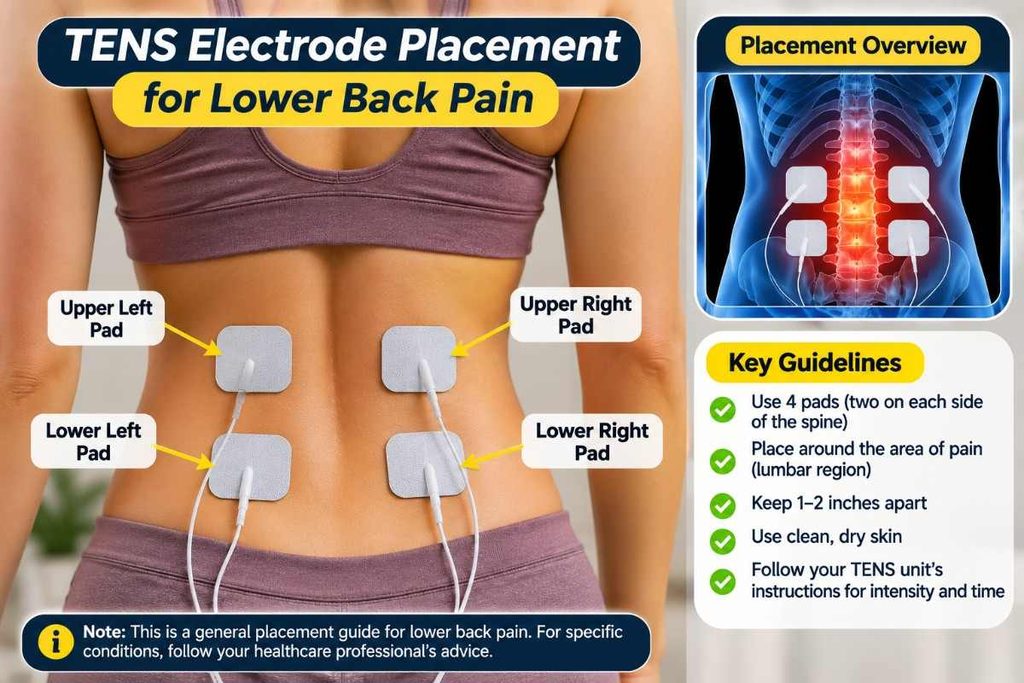
TENS unit pads: types, uses and placement
How to Use a TENS Unit for Back Pain
A TENS machine should be used according to its manufacturer’s instructions and any recommendations provided by your healthcare professional.
Follow these general steps:
- Prepare your skin: Clean the treatment area and allow it to dry completely.
- Check the electrode pads: Make sure the adhesive and conductive gel surfaces are in good condition.
- Switch off the device: Never attach or remove electrodes while stimulation is active.
- Position the pads: Place the electrodes in the recommended arrangement around the treatment area.
- Connect the device: Attach the wires or wireless electrodes as instructed.
- Start with low intensity: Turn on the device and gradually increase the stimulation.
- Find a comfortable setting: You should feel a noticeable tingling sensation, not pain or burning.
- Monitor your skin: Stop if you experience irritation, discomfort, or unusual symptoms.
Do not increase the intensity to the point where stimulation becomes painful. If you experience burning, significant redness, or persistent discomfort, switch off the device and remove the pads.
Do not use a TENS unit while sleeping, driving, bathing, or operating machinery.
Source: NHS, 2017.
Can a TENS Unit Help With Different Types of Back Pain?
TENS may be considered by some people experiencing different forms of back discomfort, but its effectiveness depends on the underlying condition and individual response. Evidence for specific back-pain conditions is limited.
TENS for Lower Back Pain
Lower back pain affects the lumbar region between the lower ribs and pelvis.
Some people try TENS for temporary symptom relief. However, the WHO does not recommend it as part of routine care for chronic primary low back pain.
Persistent or recurring lower back pain should be assessed to identify appropriate management options.
TENS for Upper Back Pain
Upper back discomfort affects the area around the thoracic spine and may involve muscles, joints, and other structures.
Some individuals may find electrical stimulation comfortable, but evidence specifically supporting TENS for upper back pain is limited.
TENS for Sciatica
Sciatica refers to pain associated with irritation or compression of the sciatic nerve or its nerve roots.
Symptoms may travel from the lower back through the buttock and down one leg. Some people may try TENS for temporary symptom relief, but it does not treat the underlying cause of nerve irritation or compression.
Persistent, worsening, or unexplained symptoms require medical assessment.
TENS for Muscle-Related Back Discomfort
Muscle-related back discomfort may occur after physical activity, prolonged positions, or muscular strain.
Some people may find electrical stimulation comfortable, but it should not replace appropriate movement, rehabilitation, or medical assessment when needed.
How to Choose the Best TENS Unit for Back Pain
The right TENS machine depends on your requirements, preferred electrode arrangement, budget, and device compatibility. A more expensive machine is not automatically more effective for back pain.
Consider these features before purchasing:
| Feature | What to look for |
|---|---|
| Channels | Dual-channel operation if recommended for your electrode arrangement |
| Electrode pads | Compatible pads with suitable dimensions |
| Intensity | Gradually adjustable settings |
| Display | Easy-to-read controls |
| Power | Rechargeable or replaceable battery |
| Programs | Clearly explained stimulation modes |
| Portability | Compact controller for convenient handling |
| Safety | Clear instructions and manufacturer support |
Wired vs. Wireless TENS Units
Wired devices connect the controller to electrode pads through cables, while wireless devices use separate stimulation modules.
Wired machines may offer flexibility in electrode positioning, while wireless models can reduce cable clutter. The better option depends on your preferences and the electrode arrangement supported by the device.
Electrode Pad Compatibility
Check whether replacement electrode pads are available for your device.
The connector type, dimensions, and conductive material should match the manufacturer’s specifications. Not all TENS electrodes are universal.
Battery and Charging Options
Rechargeable devices can be convenient for frequent home use. Battery-powered models may suit people who prefer replaceable batteries.
Compare charging requirements, battery life, and replacement availability before purchasing.
Remember that device features do not establish clinical effectiveness for back pain.
TENS Unit vs. Other Back Pain Relief Methods
TENS is one of several approaches people may consider when managing back discomfort. Different methods have different purposes, and suitability depends on the underlying condition.
| Method | Main purpose | Important consideration |
|---|---|---|
| TENS therapy | Electrical nerve stimulation | Evidence for routine chronic low back pain treatment is limited |
| Heat therapy | Temporary comfort | Avoid excessive heat and burns |
| Exercise therapy | Improve strength, mobility, and function | Exercises should match individual ability |
| Physiotherapy | Assessment and guided rehabilitation | Treatment depends on the condition |
| Massage | Temporary symptom management | Not suitable for every condition |
For many people with low back pain, staying active and following an appropriate exercise programme are important parts of management.
The WHO recommends a person-centred approach to chronic primary low back pain rather than relying on a single passive treatment.
Source: WHO, 2023.
back pain exercises for strength and mobility
Is a TENS Unit Safe for Back Pain?
TENS is a non-invasive electrical stimulation method, but it is not suitable for everyone. Incorrect electrode placement or inappropriate use can cause skin irritation and other problems.
Possible side effects include:
- Skin irritation.
- Adhesive-related allergic reactions.
- Uncomfortable tingling sensations.
- Skin burns caused by inappropriate electrode use.
Consult a healthcare professional before using TENS if you:
- Have a pacemaker or another implanted electronic device.
- Have epilepsy.
- Are pregnant.
- Have reduced skin sensation.
- Have a heart condition or another relevant medical condition.
- Have damaged or fragile skin around the intended treatment area.
Avoid placing electrodes over the front of the neck, eyes, mouth, broken skin, or other restricted areas.
Stop treatment if you experience burning, significant redness, dizziness, or unusual symptoms.
Always read the safety instructions supplied with your device.
Sources: NHS, 2017; Cambridge University Hospitals, 2024.
When Should You See a Doctor for Back Pain?
Back pain should not automatically be treated as a minor muscular problem. Medical assessment is important when symptoms are persistent, worsening, unexplained, or interfering with everyday activities.
Seek medical advice if you experience:
- Back pain that does not improve.
- Pain that becomes progressively worse.
- Pain following a significant injury.
- Back pain accompanied by fever or unexplained weight loss.
- Persistent numbness, tingling, or weakness.
Seek emergency medical attention if back pain occurs with:
- New difficulty passing urine or loss of bladder or bowel control.
- Numbness around the genitals, anus, or inner thighs.
- New or worsening weakness or numbness in both legs.
These symptoms can indicate serious spinal nerve compression and require urgent assessment.
Can You Combine TENS Therapy With Exercise?
TENS should not replace exercise-based back rehabilitation. Appropriate physical activity and strengthening exercises can help improve mobility, physical function, and the ability to perform everyday activities.
Depending on your condition and physical abilities, a physiotherapist may recommend:
- Gentle walking.
- Pelvic tilts.
- Bird-dog exercises.
- Modified bridges.
- Core stability exercises.
- Gradual strengthening exercises.
Start with movements appropriate for your abilities and follow professional guidance if you have persistent back pain.
Stop exercises that cause significant or worsening symptoms.

core strengthening exercises for beginners
Conclusion
A TENS unit for back pain is a portable electrical stimulation device that may provide temporary symptom relief for some individuals. However, research does not support its routine use for chronic primary low back pain, and it should not replace appropriate medical assessment or rehabilitation.
If you are considering TENS therapy, speak with a healthcare professional about whether it is suitable for your condition. Choose a compatible device, follow electrode placement instructions, and take an individualized approach to physical activity and back-pain management.
FAQs
Does a TENS unit really work for back pain?
TENS may provide temporary relief for some people, but research shows limited and inconsistent benefits. The WHO does not recommend it as part of routine care for chronic primary low back pain.
Where do you put TENS pads for lower back pain?
A healthcare professional may recommend positioning electrode pairs around the lumbar region. Follow your device’s placement instructions rather than copying a universal placement diagram.
How long should you use a TENS unit for back pain?
Session duration depends on the device and individual circumstances. Follow the manufacturer’s instructions and your healthcare professional’s recommendations.
Can I use a TENS unit every day for back pain?
Daily use should be discussed with a healthcare professional, particularly if you have persistent pain or an underlying medical condition. TENS is not recommended as routine care for chronic primary low back pain by the WHO.
Can a TENS unit help with sciatica?
Some people try TENS for temporary symptom relief, but it does not treat the underlying cause of sciatica. Evidence supporting its effectiveness is limited.
Is a TENS unit better than a heating pad for back pain?
Neither is universally better. They work differently, and suitability depends on the cause of discomfort and individual response.
Can I sleep with a TENS unit on?
No. The NHS advises against using a TENS machine while sleeping.
Can a TENS unit damage your back?
TENS does not normally damage spinal structures when used appropriately. However, incorrect electrode placement or excessive stimulation can cause skin irritation or burns.
Should I use a TENS unit for chronic lower back pain?
The WHO recommends against using TENS as part of routine care for chronic primary low back pain because the available evidence has not demonstrated clinically important benefits.
Sources
- World Health Organization. (2023). WHO Guideline for Non-Surgical Management of Chronic Primary Low Back Pain in Adults. Source: WHO, 2023.
- NHS. Transcutaneous Electrical Nerve Stimulation (TENS). Source: NHS, 2017.
- Cambridge University Hospitals. Advice on Using a TENS Machine. Source: Cambridge University Hospitals, 2024.
- NCBI Bookshelf. Transcutaneous Electrical Nerve Stimulation. Source: NCBI Bookshelf.
- Gao et al. Multidisciplinary Expert Consensus on Clinical Diagnosis and Therapies for Low Back Pain. Source: Bone Research, 2026.
Medical disclaimer: This article is for informational and educational purposes only. It is not a substitute for personalized medical advice, diagnosis, or treatment. Consult a qualified healthcare professional before using a TENS machine if you have a medical condition, an implanted electronic device, or concerns about electrode placement or safety.
3 thoughts on “TENS Unit for Back Pain: Benefits, Pad Placement & Safety Guide”