
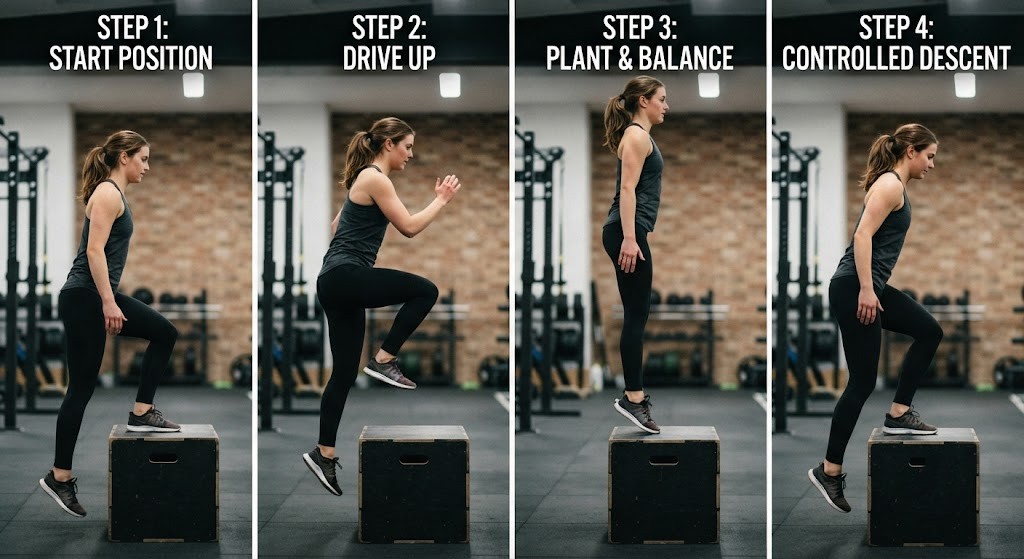
If you’ve already been doing squats, lunges, strength training, or cardio workouts, you may feel like you’ve covered the basics of fitness. However, there is another important quality that traditional slow-strength exercises may not fully develop: explosive power, or the ability to produce force quickly.
A plyometric workout focuses on rapid, powerful movements that challenge your muscles to generate force in a short period. From squat jumps and broad jumps to lateral bounds and plyometric push-ups, these exercises can help develop power, coordination, agility, and athletic performance.
In this guide, you’ll learn what a plyometric workout is, how the stretch-shortening cycle works, the best beginner and advanced plyometric exercises, how to build a home routine, how often to train, and how to progress safely.
What Is a Plyometric Workout and How Does It Work?
A plyometric workout is a form of explosive exercise that uses rapid muscle stretching and contraction to produce powerful movements. Common examples include jump squats, box jumps, broad jumps, lateral bounds, and plyometric push-ups.
Plyometric training relies heavily on the stretch-shortening cycle, in which muscles and tendons rapidly absorb force before producing force. For example, bending your knees before jumping creates a quick loading phase that helps prepare your body for a more powerful takeoff.
Unlike traditional strength exercises, plyometric movements emphasize both force and speed. A slow squat primarily develops strength, while a fast jump squat trains your ability to express strength explosively.
How Does the Stretch-Shortening Cycle Work?
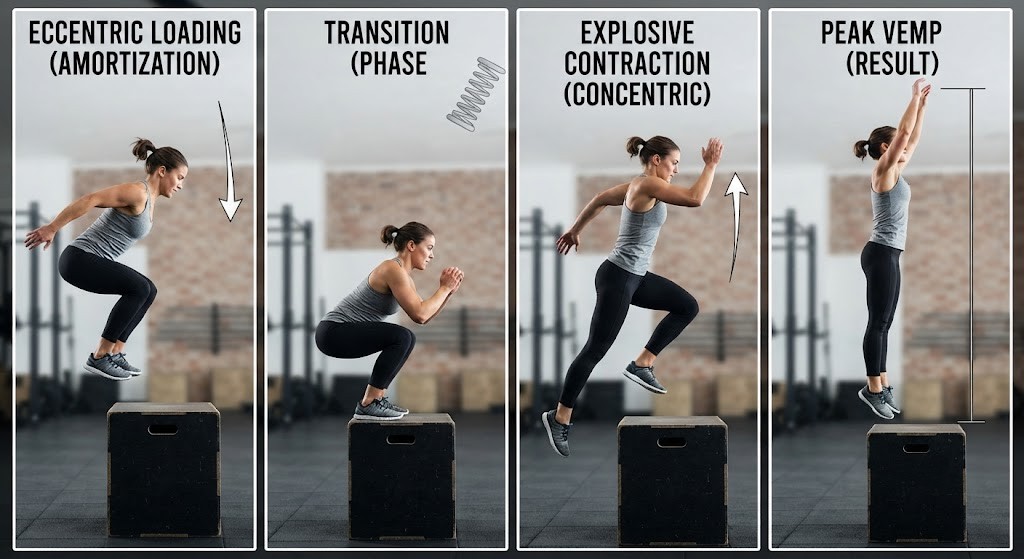
The stretch-shortening cycle is a rapid sequence of muscle lengthening, transition, and shortening that supports explosive movement. For example, your legs bend quickly when absorbing a landing before extending during the next jump.
The cycle has three primary phases:
- Eccentric phase: The muscles lengthen while absorbing force.
- Transition phase: A brief transition occurs between loading and movement reversal.
- Concentric phase: The muscles shorten rapidly to produce explosive movement.
This mechanism explains why effective jump training requires more than simply trying to jump as high as possible. The ability to load, transition, and produce force quickly and efficiently is an important part of explosive movement.
Why Are Plyometric Workouts Good for Explosive Power?
A plyometric workout can improve explosive power, coordination, speed, agility, and the ability to produce force quickly. Research involving healthy adults has found small-to-moderate improvements in jumping, sprint performance, and lower-body strength after plyometric training lasting approximately 4–12 weeks. — Source: Journal of Science and Medicine in Sport, 2019
Moreover, a systematic umbrella review covering 29 meta-analyses found that plyometric training was associated with improvements across several physical-performance measures, although the authors noted limitations in the quality of some underlying evidence. — Source: Sports Medicine – Open, 2023
For recreational athletes, adding controlled movements such as jump squats and lateral jumps can therefore train qualities that traditional slow-strength exercises may not emphasize as strongly.
Plyometric Training Benefits
The main plyometric training benefits include:
- Improved explosive power
- Better jumping ability
- Faster force production
- Improved coordination
- Enhanced agility and change-of-direction ability
- Greater lower-body power
- Improved sport-specific movement
- More dynamic conditioning
Furthermore, one meta-analysis of healthy adults found a moderate effect of traditional plyometric training on vertical jump height compared with non-plyometric training. — Source: Journal of Sports Science and Medicine, 2020
What Are the Best Plyometric Exercises for Beginners?
The best plyometric exercises for beginners are low-to-moderate impact movements that develop jumping mechanics, coordination, and controlled landings. Examples include squat jumps, low pogo jumps, skater steps, and controlled broad jumps.
Before progressing to high jumps or demanding reactive drills, beginners should learn how to land quietly and under control. For example, practicing a small squat jump allows you to focus on keeping your feet stable and your knees aligned with your feet.
1. Squat Jumps
Squat jumps are a beginner-friendly explosive exercise that trains vertical power through the hips, knees, and ankles.
Start in a comfortable squat position. Drive through your feet, jump upward, and land softly with bent hips and knees before resetting.
Aim for 2–3 sets of 5–8 repetitions. Keep each repetition powerful and controlled rather than turning the movement into a high-repetition cardio exercise.
2. Skater Jumps
Skater jumps train lateral power, balance, and coordination through side-to-side movement.
Push from one leg and travel laterally toward the opposite side. Land on the opposite leg while maintaining control before repeating the movement.
Start with short lateral movements and gradually increase the distance as your balance and stability improve. A beginner legs workout can also help build the strength and stability required for these movements.
3. Broad Jumps
Broad jumps are horizontal plyometric exercises that train explosive hip and leg extension.
Start with your feet approximately hip-width apart. Swing your arms, drive through your legs, jump forward, and absorb the landing with bent hips and knees.
Use 3–5 repetitions per set because each jump requires substantial explosive effort. Reset between repetitions rather than immediately jumping again.
4. Low-Impact Plyometric Progressions
Low-impact plyometric progressions help beginners develop explosive movement without immediately using high jump heights or landing forces.
Useful options include:
- Pogo hops
- Snap-downs
- Line hops
- Small squat jumps
These movements can work particularly well during the first few weeks of training. Progress only when you can maintain stable landings and consistent technique.
What Are the Best Advanced Plyometric Exercises?
Advanced plyometric exercises require greater strength, coordination, landing control, or reactive ability than beginner movements. Examples include depth jumps, tuck jumps, bounding variations, advanced lateral bounds, and high box jumps.
Advanced movements should be earned through progression rather than selected simply because they look difficult. You should be comfortable with basic jumping, landing, and horizontal movements before introducing more demanding reactive exercises.
| Exercise | Primary Focus | Suggested Level |
|---|---|---|
| Squat jump | Vertical power | Beginner |
| Skater jump | Lateral power | Beginner |
| Broad jump | Horizontal power | Beginner–Intermediate |
| Split jump | Single-leg power | Intermediate |
| Tuck jump | Explosive vertical power | Intermediate |
| Box jump | Jumping power | Intermediate |
| Lateral bound | Lateral/reactive power | Intermediate–Advanced |
| Depth jump | Reactive strength | Advanced |
| Plyometric push-up | Upper-body power | Intermediate–Advanced |
Moreover, research on athletes has found significant improvements in vertical jump performance following plyometric jump training, with a pooled effect size of 0.49 across 22 studies. — Source: Sports Medicine, 2021
Plyometric Push-Ups
Plyometric push-ups are upper-body explosive exercises that train rapid force production through the chest, shoulders, and triceps.
Begin in a standard push-up position and lower your body under control. Then push forcefully enough for your hands to leave the floor before landing and preparing for the next repetition.
Beginners can start with explosive incline push-ups before progressing to floor-based versions. Pairing them with a core and abs workout can also help develop trunk control during full-body explosive movements.
How Do You Build a Plyometric Workout Routine?
A plyometric workout routine should place the most explosive exercises first, use low-to-moderate repetition volume, and provide enough rest to maintain movement quality.
A practical session can include:
- Dynamic warm-up: 5–10 minutes
- Main explosive exercise: 3 sets
- Secondary plyometric exercise: 2–3 sets
- Lateral or upper-body movement: 2–3 sets
- Optional conditioning: 5–10 minutes
- Cool-down and recovery
Begin with a dynamic warm-up to prepare your joints and muscles. Then perform the most demanding explosive movement while you are fresh, followed by secondary exercises that require slightly less intensity.
Finally, remember that a plyometric workout typically prioritizes quality and explosiveness over high repetition volume. Adequate rest is therefore an important part of the workout rather than wasted time.
How Many Plyometric Exercises Should You Do in One Workout?
Most recreational exercisers can start with 2–4 plyometric exercises in one workout. The appropriate number depends on exercise intensity, training experience, total weekly workload, and recovery capacity.
For example, a beginner might perform squat jumps, skater jumps, and low pogo hops. An advanced athlete may use depth jumps, bounds, lateral jumps, and sport-specific movements with longer recovery periods.
The objective is not to perform as many exercises as possible. A smaller selection performed explosively is usually more useful than a long circuit performed with declining technique.
How Many Sets and Reps Should You Do for Plyometric Exercises?
Plyometric exercises generally work best with small sets of high-quality repetitions rather than long sets performed to fatigue. A useful starting range is approximately 2–4 sets of 3–8 repetitions for many jumping exercises.
For example, you could perform 3 sets of 5 broad jumps with 60–120 seconds of rest between sets. More demanding exercises may require longer recovery.
Research in soccer players has specifically identified training volume and rest intervals as factors that can influence plyometric jump-performance outcomes. — Source: Data in Brief, 2017
Can You Do a Plyometric Workout at Home?
You can do an effective plyometric workout at home using bodyweight exercises and a safe, unobstructed training area.
Exercises such as squat jumps, lateral jumps, broad jumps, split jumps, burpees, and plyometric push-ups require little or no equipment.
Before starting, clear the floor and remove objects that could cause you to trip. Choose a surface that provides adequate traction and avoid environments that make controlled landings difficult.
Beginner Home Plyometric Workout
A beginner home plyometric workout can combine four simple movements for approximately 15–20 minutes.
Try this routine:
- Squat jumps: 3 × 5
- Skater jumps: 3 × 6 per side
- Broad jumps: 3 × 4
- Explosive incline push-ups: 2 × 5
Rest for 60–120 seconds between demanding sets. Stop a set when jumping height, landing control, or movement quality noticeably declines.
For a broader fitness plan, you can combine plyometrics with a full body workout or a full body functional training workout
How Often Should You Do Plyometric Training?
Most beginners can perform plyometric training about 1–2 times per week, while more experienced athletes may use it more frequently depending on their overall program.
Recovery should determine training frequency rather than a desire to perform explosive exercises every day.
For example, combat-sport research has examined plyometric programs using 2–3 sessions per week over 4–12 weeks, with small-to-moderate improvements in several performance measures. — Source: BMC Sports Science, Medicine and Rehabilitation, 2023
Avoid placing demanding plyometric sessions on consecutive days if your legs remain fatigued or sore. A dedicated workout recovery strategy can help you manage training stress and maintain movement quality.
How Can You Make Plyometric Exercises Safer and More Effective?
Plyometric training becomes safer and more effective when you control exercise intensity, master landing mechanics, use appropriate surfaces, and progress gradually.
Explosive training should challenge you without forcing you to sacrifice control.
Start With a Proper Warm-Up
Begin with dynamic movements that prepare your body for jumping and explosive activity. Useful options include:
- Marching
- Skipping
- Bodyweight squats
- Ankle hops
- Controlled lunges
A targeted injury prevention exercises routine can also complement your preparation.
Master Your Landing Mechanics
Landing technique is just as important as jumping technique. Your hips and knees should bend naturally, your feet should remain stable, and your knees should generally track in line with your feet.
Rather than focusing only on jump height, focus on landing quietly and maintaining balance. Good control provides a stronger foundation for more advanced movements.
Control Training Volume
Beginners should start with lower-impact plyometric exercises and develop controlled landing mechanics before progressing to higher-intensity jumps.
If your technique deteriorates because of fatigue, reduce the number of repetitions or increase your recovery time.
Common Plyometric Training Mistakes
Common plyometric mistakes include excessive volume, poor landing mechanics, insufficient recovery, and progressing too quickly.
Avoid these mistakes:
- Jumping maximally on every repetition
- Training through significant pain
- Using unstable or slippery surfaces
- Adding advanced exercises too soon
- Turning every plyometric session into a cardio circuit
- Ignoring strength and mobility foundations
- Performing high-impact sessions without adequate recovery
Furthermore, lower-leg strength can support jumping mechanics because the calves and ankles contribute to force transmission during takeoff and landing. Consider a calf workout exercises routine as part of a balanced lower-body program.
What Is a Good Full-Body Plyometric Workout?
A full-body plyometric workout combines lower-body jumps, lateral movements, and upper-body explosive exercises to train power across multiple movement patterns.
A balanced session should still prioritize quality over exhaustion.
Try this intermediate routine:
| Exercise | Sets | Reps | Rest |
| Box jumps | 3 | 5 | 90 sec |
| Lateral bounds | 3 | 5/side | 90 sec |
| Split jumps | 2 | 6/side | 90 sec |
| Plyometric push-ups | 3 | 5 | 90 sec |
| Burpees | 2 | 6 | 60 sec |
For conditioning-focused readers, a HIIT workout can provide a useful comparison. HIIT emphasizes repeated high-intensity efforts, whereas plyometric training places greater emphasis on explosive movement quality.
How Should You Progress Your Plyometric Training?
Plyometric progression should increase movement difficulty, intensity, speed, or complexity gradually instead of simply adding unlimited repetitions.
Progression should match your ability to maintain explosive technique.
A practical progression can look like this:
Level 1: Snap-downs → pogo hops → squat jumps
Level 2: Broad jumps → skater jumps → split jumps
Level 3: Box jumps → lateral bounds → tuck jumps
Level 4: Advanced bounds → depth jumps → sport-specific reactive drills
Start by improving control and consistency. Then gradually increase jump distance or height before introducing more complex movement patterns or reactive exercises.
The most important progression is better explosive quality, not simply more fatigue. If your jump height decreases sharply or your landings become uncontrolled, reduce the volume rather than forcing additional repetitions.
Conclusion
Plyometric workouts train the ability to produce force quickly through explosive movements such as jumps, bounds, and powerful push-ups. They can improve jumping ability, lower-body power, sprint performance, coordination, and other aspects of physical performance when appropriately programmed.
Effective plyometric training involves choosing exercises that match your fitness level, performing explosive repetitions with proper technique, and allowing enough recovery between sessions. Beginners should start with simple movements, master their landing mechanics, and gradually progress toward more demanding exercises.
Ultimately, quality beats quantity in explosive training. Build your plyometric workout around controlled progression, powerful repetitions, appropriate rest, and consistent recovery to develop a stronger foundation for speed, power, agility, and athletic performance.
FAQs
What is a plyometric workout?
A plyometric workout uses explosive movements to develop power, speed, coordination, and agility.
What are plyometric workouts for?
Plyometric workouts are designed to improve explosive power, jumping ability, speed, agility, and athletic performance.
What is the 3-3-3 rule for workout?
The 3-3-3 rule can have different meanings depending on the workout program, so it is not a universal plyometric rule.
What is a disadvantage of plyometric training?
Plyometric training can place extra stress on muscles and joints if performed with poor technique or excessive volume.
Can I train plyometrics every day?
It is generally better to allow recovery between demanding plyometric sessions rather than training every day.
Are plyometric workouts good for beginners?
Yes, beginners can start with low-impact plyometric exercises and gradually increase intensity.
How many plyometric exercises should I do in one workout?
Most people can start with 2–4 plyometric exercises per workout.
How many sets and reps should I do for plyometrics?
A common starting range is 2–4 sets of 3–8 quality repetitions.
Can I do a plyometric workout at home?
Yes, many plyometric exercises require only bodyweight and enough safe space.
How often should I do a plyometric workout?
Beginners can start with 1–2 plyometric sessions per week.
Are plyometric exercises good for building explosive power?
Yes, plyometric exercises are designed to improve rapid force production and explosive power.
What should I do before a plyometric workout?
Start with a dynamic warm-up to prepare your muscles and joints for explosive movements.
Are box jumps a beginner plyometric exercise?
Box jumps are usually introduced after mastering basic jumping and landing techniques.
Can plyometric training improve jumping ability?
Yes, plyometric training can improve vertical jump performance and lower-body power.
1 thought on “Plyometric Workout: Build Explosive Power, Speed & Athletic Performance”