
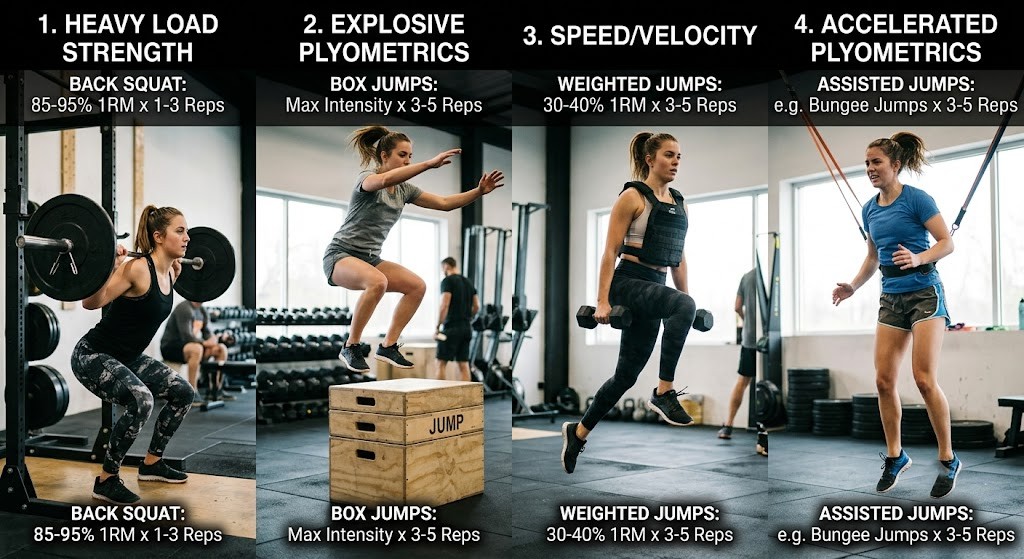
You’ve probably already learned that heavy lifting builds strength, while explosive exercises help develop speed and power. However, combining these movements in the wrong order or training without enough recovery can reduce performance and limit the quality of your workout.
That’s where French contrast training comes in. This advanced strength and conditioning method combines heavy resistance training with three explosive movements in a structured sequence to help athletes develop rapid force production and explosive athletic power.
Whether your goal is to improve your vertical jump, accelerate faster, enhance sprint performance, or develop upper-body explosiveness, understanding how French contrast training works can help you structure your training more effectively.
In this guide, you’ll learn what French contrast training is, how its four stages work, which exercises to combine, how many sets and reps to perform, and how to incorporate this method into an athletic training program safely.
What Is French Contrast Training and How Does It Work?
French contrast training is an advanced power-training method that combines one heavy resistance exercise with three explosive movements performed in a specific sequence. The primary goal is to develop maximal strength, explosive power, and the ability to produce force rapidly.
Unlike traditional strength training, which often focuses on lifting progressively heavier weights, French contrast training combines different types of muscular effort within a single training complex.
The four stages typically include:
- Heavy strength exercise: A squat, deadlift, or another heavy compound movement.
- Plyometric exercise: A box jump, countermovement jump, or another explosive bodyweight movement.
- Light loaded explosive exercise: A jump squat performed with a light external load.
- Assisted or high-velocity plyometric exercise: A suitable band-assisted jump or another fast-reactive movement.
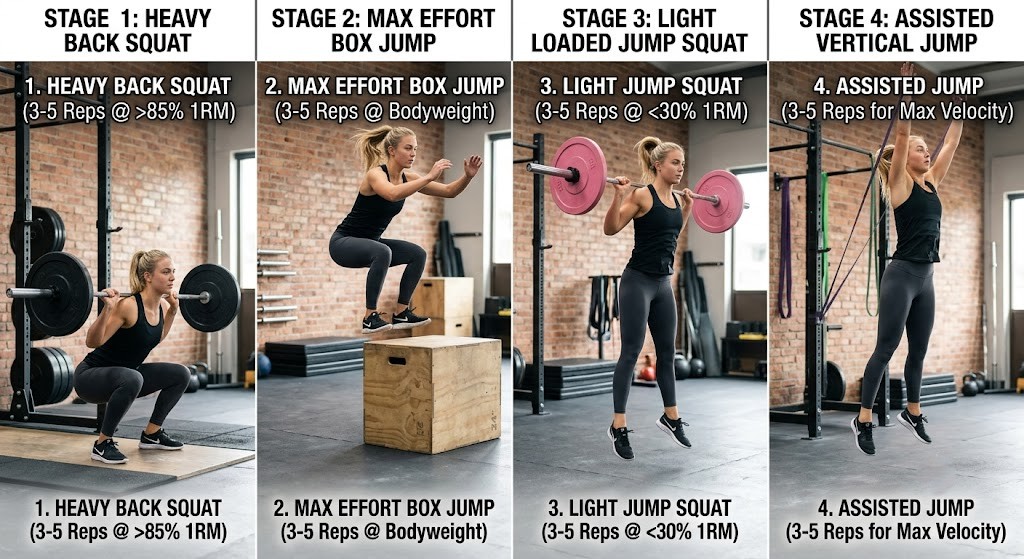
Each exercise serves a different purpose. A squat develops strength, a box jump emphasizes explosive movement, a light jump squat adds external resistance, and an appropriately selected assisted jump emphasizes rapid movement.
Coaches may modify the fourth exercise, exercise selection, and loading scheme according to the athlete’s needs. However, the movements should generally share a relevant movement pattern, and every repetition should maintain excellent technique.
Why Is French Contrast Training Important for Athletic Performance?
French contrast training aims to improve explosive power and rapid force production by combining heavy resistance work with fast, sport-specific movements.
Athletes need more than maximal strength to perform explosive actions. They must also be able to apply force quickly, coordinate their movements efficiently, and maintain technique when performing at high speeds.
French contrast training brings these qualities together within a structured sequence.
1. Improve Vertical Jump Performance
Vertical jumping requires athletes to produce substantial force in a short period. Combining squats with countermovement jumps, box jumps, and other suitable explosive movements provides opportunities to train both strength and jumping ability.
For example, a basketball player might use a squat-based French contrast complex to complement regular jumping practice.
2. Develop Sprint Acceleration
Sprint acceleration depends on an athlete’s ability to apply force effectively against the ground. Strength exercises, broad jumps, and other horizontal power movements can help train qualities relevant to acceleration.
However, exercise selection matters. Sprinters should prioritize movements that complement their sprint mechanics rather than automatically copying a vertical-jump workout.
3. Enhance Rate of Force Development
Rate of force development refers to how quickly an athlete can produce force.
Explosive actions such as jumps, throws, and rapid presses train the ability to apply force quickly. French contrast training combines these actions with heavy resistance exercises to address complementary strength and power qualities.
4. Develop Explosive Upper-Body Power
French contrast training can also be adapted for upper-body performance.
For example, an athlete might combine a heavy bench press with medicine-ball chest passes, a suitable light explosive pressing movement, and a fast medicine-ball throw.
These exercises may be relevant to sports involving throwing, pushing, or other explosive upper-body actions.
5. Explore Post-Activation Performance Enhancement
One possible mechanism associated with contrast-based training is post-activation performance enhancement (PAPE). This describes a situation in which a previous muscular conditioning activity may temporarily improve subsequent performance.
However, the response varies according to training experience, loading, rest intervals, and individual characteristics. An improvement is not guaranteed after every heavy exercise, and excessive fatigue can reduce explosive performance.
Research on strength training, plyometrics, and complex training supports several underlying principles of French contrast training. Nevertheless, these findings do not establish that every French contrast protocol produces superior results compared with other well-designed training methods.
plyometric exercises for explosive power
What Are the Four Stages of French Contrast Training?
The four stages of French contrast training progress from heavy resistance work toward increasingly explosive movements. Each stage contributes to the overall training objective, but movement quality remains the priority throughout the complex.
1. Heavy Compound Strength Exercise
The first stage uses a heavy compound exercise to develop the force-producing capacity relevant to your athletic goal.
Common options include:
- Back squat
- Front squat
- Trap-bar deadlift
- Bench press
For example, an experienced athlete might perform two or three controlled squat repetitions using a challenging but technically manageable load.
The weight should be heavy enough to challenge strength without requiring a maximal effort. Avoid grinding repetitions or maximal attempts that generate excessive fatigue before the explosive exercises.
2. Bodyweight Plyometric Exercise
The second stage introduces a fast bodyweight movement that emphasizes explosive force production.
Suitable lower-body exercises include:
- Box jumps
- Countermovement jumps
- Broad jumps
- Vertical jumps
For example, perform three box jumps with controlled takeoffs and landings. Choose a box height that allows you to jump confidently instead of pulling your knees excessively high to reach the platform.
Focus on producing a powerful jump while maintaining balance and landing control.
3. Light Loaded Explosive Exercise
The third stage introduces a light external load to an explosive movement.
A jump squat performed with light dumbbells or a suitable barbell load is one possible option. The resistance should allow you to move quickly without compromising takeoff mechanics or landing safety.
For example, perform three fast jump squats using a load that permits consistent movement speed.
Avoid using so much weight that the exercise becomes a slow strength movement. If your takeoff speed or landing control deteriorates, reduce the load or stop the set.
4. Assisted or High-Velocity Plyometric Exercise
The fourth stage emphasizes rapid movement through an appropriately selected assisted or high-velocity exercise.
Band-assisted jumps are one option for experienced athletes who understand the setup and can control the movement. Properly selected fast-reactive drills may also be suitable, depending on the athlete’s goal.
For example, an experienced athlete might perform three assisted jumps with light band assistance.
Assistance should support rapid movement without disrupting body control. Avoid excessive band tension, unstable setups, or landing positions that you cannot control consistently.
How Do You Perform a French Contrast Training Workout?
A French contrast training workout starts with a thorough warm-up, follows a planned four-exercise sequence, and prioritizes explosive movement quality over total repetitions.
Follow these steps to organize your session.
Step 1: Complete a Thorough Warm-Up
Prepare your muscles, joints, and nervous system for heavy lifting and explosive movement.
Your warm-up can include:
- Light aerobic activity
- Dynamic mobility exercises
- Movement-specific preparation
- Progressive practice jumps
- A few progressively heavier warm-up sets for the main strength exercise
Avoid starting with heavy lifting or maximal jumps before preparing for the session.
Step 2: Choose Your Main Athletic Goal
Decide which movement pattern you want to develop.
Examples include:
- Vertical jumping for basketball or volleyball
- Horizontal power for sprint acceleration
- Upper-body explosiveness for throwing or pushing
Your main goal should determine the exercise selection rather than choosing exercises simply because they are popular.
Step 3: Select Four Compatible Exercises
Choose one heavy strength exercise followed by three explosive movements.
The exercises should complement one another and match your technical ability, available equipment, and sport-specific requirements.
For example, a lower-body vertical-jump complex might include a squat, countermovement jump, light jump squat, and assisted jump.
Step 4: Perform the Exercises in Sequence
Complete the heavy movement first, followed by the three explosive exercises.
Keep repetitions low enough to maintain speed, coordination, and proper technique. Take brief recovery periods between exercises whenever necessary to preserve explosive performance.
Step 5: Recover Between Complexes
Allow several minutes of recovery between complete four-exercise sequences.
Your recovery needs will depend on the intensity of the heavy lift, the difficulty of the plyometric exercises, and your training experience.
Step 6: Monitor Your Performance
Pay attention to jump height, movement speed, landing control, and technique.
Stop the complex if your explosive performance declines noticeably. The goal is to train power, not to accumulate as much fatigue as possible.
Additionally, schedule French contrast training early in your workout, when you are relatively fresh. This helps preserve the speed and coordination needed for high-quality explosive movements.
What Is a Sample French Contrast Training Workout?
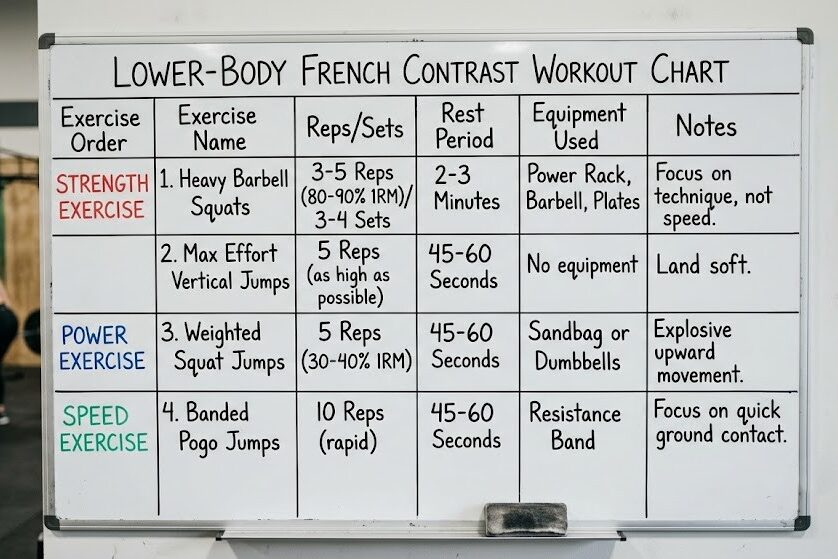
A lower-body French contrast training workout combines a squat, box jump, light jump squat, and assisted jump. The following example is an illustrative starting point for experienced, healthy athletes who already have a foundation in strength training and plyometrics.
| Exercise order | Exercise | Repetitions |
|---|---|---|
| 1 | Squat at an appropriate heavy load | 2–3 |
| 2 | Box jump | 3 |
| 3 | Light loaded jump squat | 3 |
| 4 | Assisted jump | 3 |
Recommended Starting Volume
Begin with two complete complexes. Consider progressing to three only when your movement quality and recovery remain consistently good.
Allow approximately three to five minutes of recovery between complete complexes. You may also need brief recovery periods between individual exercises to preserve explosive performance.
How Heavy Should the Squat Be?
Use a challenging but manageable load that allows you to complete every repetition with good technique.
The objective is to develop strength without creating so much fatigue that the following jumps become slower or less coordinated. You do not need to test your maximum squat to perform this workout effectively.
How Should You Progress the Workout?
Progress gradually instead of automatically increasing the number of sets or the weight.
A sensible approach is to:
- Establish consistent technique across all four exercises.
- Record your loads, repetitions, and explosive performance.
- Maintain the same volume until you recover well between sessions.
- Adjust one training variable at a time when appropriate.
- Reduce the workload if performance or recovery deteriorates.
The appropriate progression depends on your training experience, sport schedule, and response to the exercises.
What Are the Best French Contrast Training Exercises for Different Goals?
The best French contrast training exercises match the athlete’s target movement, sport, and technical ability. A volleyball player training for vertical jumps needs a different exercise combination from a sprinter working on acceleration or an athlete developing upper-body power.
The following table provides illustrative combinations.
| Training goal | Heavy exercise | Plyometric movement | Loaded explosive movement | Final movement |
|---|---|---|---|---|
| Lower-body power | Squat | Box jump | Light jump squat | Assisted jump |
| Vertical jump | Squat variation | Countermovement jump | Loaded jump | Assisted jump |
| Sprint acceleration | Trap-bar deadlift | Broad jump | Light loaded jump | Fast-reactive drill |
| Upper-body power | Bench press | Medicine-ball chest pass | Light explosive press | Fast medicine-ball throw |
These combinations are examples, not universal prescriptions. Coaches should select movements based on the athlete’s experience, available equipment, movement mechanics, and performance objectives.
Best Exercises for Vertical Jump Training
Athletes targeting vertical-jump performance can consider squat variations, countermovement jumps, light loaded jumps, and assisted jumps.
The focus should remain on powerful takeoffs, consistent technique, and controlled landings.
best exercises to increase vertical jump
Best Exercises for Sprint Acceleration
Sprinters may benefit from strength exercises such as trap-bar deadlifts paired with broad jumps and other suitable horizontal power drills.
The final movement should complement the athlete’s acceleration goals. A vertical jumping complex is not automatically the best choice for every sprinting athlete.
Best Exercises for Upper-Body Power
Athletes developing upper-body explosiveness can use a heavy bench press followed by medicine-ball chest passes, a suitable light explosive pressing movement, and a fast medicine-ball throw.
The movements should be performed with appropriate equipment, safe technique, and enough recovery to maintain speed.
How Many Sets and Reps Should You Do in French Contrast Training?
French contrast training typically uses low repetitions and a small number of complexes to preserve explosive performance.
For experienced athletes, two or three complete complexes can provide a starting point, depending on the exercises, training intensity, and recovery capacity.
A practical approach is to perform:
- Heavy strength exercise: 2–3 repetitions
- Plyometric exercise: 3 repetitions
- Light loaded explosive exercise: 3 repetitions
- Assisted or high-velocity exercise: 3 repetitions
- Total complexes: Start with 2; progress to 3 if appropriate
These are illustrative guidelines rather than fixed requirements. Different athletes may need different repetition schemes depending on their goals and exercise selection.
Why Are Low Repetitions Important?
Explosive training depends on producing force quickly while maintaining efficient movement mechanics.
As fatigue increases, jump height, movement speed, coordination, and landing quality may deteriorate. Adding repetitions after these qualities decline can undermine the purpose of the workout.
For example, two controlled squats followed by three high-quality jumps may be more appropriate than performing extra repetitions after your jump height begins to fall.
Prioritize the quality of every repetition instead of training to exhaustion.
How Much Rest Do You Need Between French Contrast Training Complexes?
French contrast training generally requires several minutes of recovery between complete complexes to help maintain movement speed and technical quality.
An illustrative starting guideline is three to five minutes of recovery between complete four-exercise sequences.
However, rest between individual exercises depends on the athlete’s conditioning, loading, and the complexity of the movements. Some athletes may need additional recovery before performing the next explosive exercise.
Use these principles to manage rest:
- Recover enough to perform the next movement with good technique.
- Avoid rushing from a heavy lift into a jump if fatigue is excessive.
- Extend rest periods when movement speed or coordination declines.
- Stop the session if you cannot maintain safe, high-quality repetitions.
For more guidance, explore recovery strategies for athletic performance.
Is French Contrast Training Better Than Traditional Contrast Training?
Traditional contrast training generally pairs a heavy resistance exercise with an explosive movement, whereas French contrast training typically expands the sequence to four exercises.
Both methods combine strength and power training, but they differ in complexity, exercise selection, and programming demands.
| Feature | Traditional contrast training | French contrast training |
|---|---|---|
| Exercise sequence | Usually two related exercises | Typically four exercises |
| Training complexity | Simpler | More complex |
| Equipment | Often minimal | May require additional equipment |
| Fatigue management | Relatively straightforward | Requires careful monitoring |
| Best suited for | Broad strength and power development | Experienced athletes targeting specific power qualities |
Which Method Should You Choose?
Traditional contrast training may be appropriate for athletes who need a simpler program or are learning to combine strength and explosive exercises.
French contrast training may suit experienced athletes who can manage a more elaborate sequence while maintaining high movement quality.
Neither method is universally superior. Your training history, performance goals, available equipment, and recovery capacity should determine which approach is most suitable.
Can Beginners Do French Contrast Training?
French contrast training is best suited to athletes who already have a foundation in strength training and plyometrics and can perform explosive movements with sound technique.
Beginners should first develop basic strength, jumping mechanics, landing control, and exercise coordination before attempting a complex involving heavy lifts and multiple explosive movements.
A simpler squat-and-jump pairing may provide a more appropriate introduction.
What Should Beginners Learn First?
Before progressing to French contrast training, focus on:
- Learning basic compound lifting techniques.
- Developing consistent squat and hinge mechanics.
- Practicing controlled jumping and landing.
- Building tolerance for introductory plyometric exercises.
- Learning to recognize fatigue and maintain movement quality.
Once these foundations are established, a qualified strength and conditioning coach can help determine whether a four-exercise complex is appropriate.
strength training for beginners
How Often Should You Do French Contrast Training Each Week?
You can begin with one French contrast training session per week when it fits your existing strength and sports schedule.
Some trained athletes may tolerate more frequent sessions, but the appropriate frequency depends on recovery, total training volume, competition demands, and the intensity of other workouts.
How Can You Decide Your Weekly Frequency?
Consider these factors when scheduling your sessions:
- Training experience: Experienced athletes may tolerate demanding power sessions better than beginners.
- Sports practice: Account for jumping, sprinting, and other explosive work already included in practice.
- Recovery: Monitor soreness, fatigue, sleep, and changes in performance.
- Training quality: Avoid increasing frequency when explosive movement quality is declining.
Track jump height, sprint times when relevant, perceived effort, and soreness to evaluate your response.
Progress gradually using progressive overload in strength training rather than automatically adding more sets or sessions every week.
What Are the Most Common French Contrast Training Mistakes?
The most common French contrast training mistakes involve excessive loading, insufficient recovery, poor exercise selection, and progressing before developing adequate strength and coordination.
Avoid the following errors to maintain the quality of your training.
1. Using Excessive Weight
Heavy exercises should challenge your strength without compromising technique or the explosive movements that follow.
Avoid maximal attempts or loads that force you to grind through repetitions.
2. Continuing When Fatigued
Explosive training requires speed and coordination. Stop or adjust the workout when jump height, movement speed, landing control, or technique deteriorates noticeably.
Do not confuse greater fatigue with a better power-training session.
3. Choosing Unrelated Exercises
The exercises in a complex should align with your athletic objective.
For example, an athlete focused on sprint acceleration should consider horizontal power drills rather than selecting vertical jumps automatically.
4. Adding Too Much Training Volume
More complexes do not necessarily produce better results.
Excessive volume can create fatigue that reduces movement quality and interferes with recovery from other training sessions. Begin conservatively and progress only when appropriate.
5. Skipping the Warm-Up
Heavy resistance work and explosive jumping place substantial demands on movement coordination.
Use dynamic warm-up exercises before training and practice safe landing mechanics before beginning the complex.
6. Ignoring Recovery
French contrast training should fit into your overall athletic program.
Account for sports practice, other strength sessions, additional plyometric work, and sleep when deciding how much training you can tolerate.
7. Attempting Advanced Exercises Without Guidance
Athletes who are inexperienced with heavy lifting, assisted jumps, or complex plyometrics should seek guidance from a qualified strength and conditioning coach.
Proper exercise selection, loading, and technique can help make the training process more manageable and reduce avoidable risks.
How Can You Add French Contrast Training to Your Routine?
French contrast training works best when integrated into a broader athletic development program rather than treated as a complete training plan by itself.
Your overall routine should still address foundational strength, sport-specific skills, conditioning when required, and recovery.
Use the following steps to incorporate French contrast training into your program.
- Start with one weekly session. Use a conservative training volume and evaluate how you respond.
- Warm up thoroughly. Prepare for heavy resistance work and explosive movements before starting the complex.
- Choose sport-specific exercises. Select movements that support your main performance goal.
- Record your training. Track repetitions, loads, jump performance, and recovery.
- Progress gradually. Increase training demands only when technique and performance remain consistent.
- Reassess your progress. Review your results after a consistent training block and adjust the program when necessary.
For example, a basketball player could schedule a lower-body power session early in the week while allowing adequate recovery before demanding practices or games.
How Do You Know Whether Your Program Is Working?
Evaluate your progress using measurements that relate to your training goal.
Depending on your sport, these might include vertical-jump performance, sprint times, movement quality, or the ability to maintain explosive output across training sessions.
Also consider your recovery and consistency. If performance repeatedly declines, review your loading, exercise selection, rest periods, and total weekly training volume.
The objective is to develop athletic power over time while maintaining the quality of your training.
Conclusion
French contrast training combines a heavy strength exercise, a plyometric movement, a light loaded explosive exercise, and an assisted or high-velocity movement in one structured complex.
This advanced training method can complement athletic development by combining strength work with movements that emphasize rapid force production. It may be useful for athletes targeting jumping ability, sprint acceleration, and upper-body power when the exercises match their goals.
Ultimately, quality matters more than quantity. Choose sport-specific exercises, use manageable loads, recover adequately, and stop when explosive performance declines.
Start with a conservative training volume, build a solid foundation in strength and plyometrics, and progress according to your performance and recovery. With thoughtful programming and consistent practice, French contrast training can become a useful component of a broader strength and conditioning routine.
FAQs
What is French contrast training?
French contrast training combines one heavy strength exercise with three explosive movements to develop power.
What are the four stages of French contrast training?
Heavy strength exercise, plyometric exercise, light loaded explosive exercise, and assisted or high-velocity movement.
How to do French contrast training?
Warm up, perform four related exercises in sequence, and rest adequately between complexes.
What is an example of a French contrast training workout?
Squats (2–3 reps), box jumps (3 reps), light jump squats (3 reps), and assisted jumps (3 reps).
How many sets should you do in French contrast training?
Start with two complexes and increase gradually if recovery and technique remain good.
How long should you rest between French contrast training sets?
Rest approximately three to five minutes between complete complexes.
Is French contrast training good for vertical jump improvement?
It may improve explosive qualities that support vertical jumping.
Can French contrast training improve sprint speed?
It may develop strength and power relevant to sprint acceleration.
Can beginners do French contrast training?
Beginners should first develop basic strength, jumping technique, and landing control.
How often should you do French contrast training?
One session weekly is a reasonable starting point for trained athletes.
Is French contrast training better than traditional contrast training?
Neither is universally better. French contrast training involves a more complex four-exercise sequence.
What equipment do you need for French contrast training?
You may need weights, a jump box, dumbbells, resistance bands, or a medicine ball.
Should you train to failure during French contrast training?
No. Stop when speed, technique, or landing control declines.
Is French contrast training suitable for every sport?
No. Choose exercises according to your sport and performance goals.
Can French contrast training replace regular strength training?
No. It should complement foundational strength training.
What is the 3-3-3 rule for training?
The term has different interpretations and is not a standard rule of French contrast training.
What is the queen of all exercises?
The squat is often called the queen of exercises because it develops lower-body strength and supports athletic movements.