
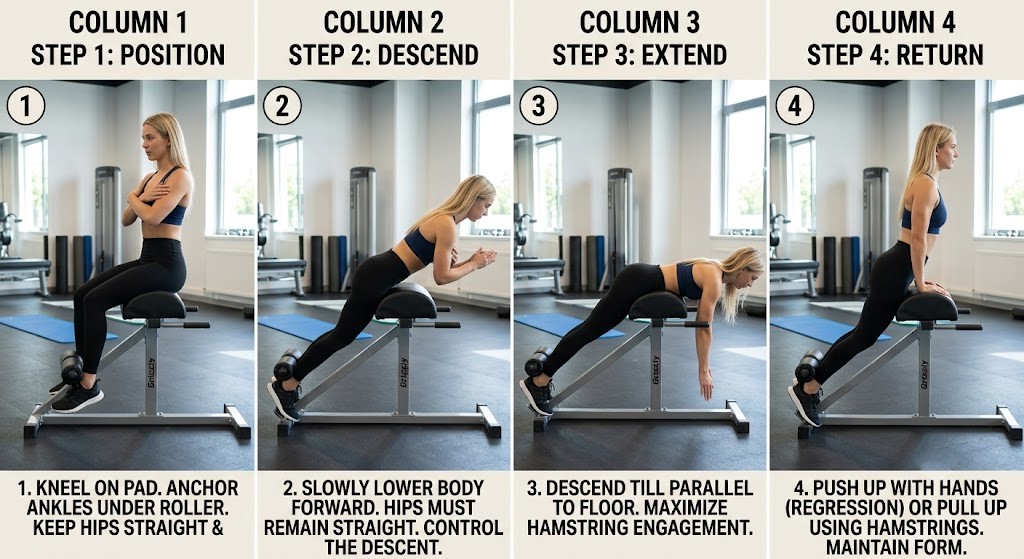
You’ve probably trained your hamstrings with leg curls or Romanian deadlifts, but the Nordic hamstring curl challenges these muscles differently. This demanding bodyweight exercise develops eccentric hamstring strength and can support injury-prevention programs when performed consistently.
In this guide, you’ll learn how to perform Nordic hamstring curls correctly, understand their benefits, explore beginner-friendly variations, and incorporate them into your workout routine.
What Is a Nordic Hamstring Curl?
The Nordic hamstring curl is a bodyweight exercise in which you kneel with your ankles secured and slowly lower your torso forward while your hamstrings control the movement.
It emphasizes eccentric muscle strength, which refers to producing force while a muscle lengthens under load. Unlike conventional leg curls, Nordic curls require your hamstrings to resist gravity as your body moves toward the floor.
You can perform the exercise at home or in the gym using a training partner or a secure, purpose-built ankle anchor.
What Muscles Do Nordic Hamstring Curls Work?
Nordic hamstring curls primarily target the three muscles at the back of your thighs.
- Biceps femoris: Helps control knee movement and contributes to hamstring strength.
- Semitendinosus: Supports knee flexion and lower-leg control.
- Semimembranosus: Contributes to knee flexion and coordinated leg movement.
Your core and other supporting muscles help stabilize your body during the exercise. However, the Nordic curl primarily targets the hamstrings rather than directly developing the glutes.
For a broader lower-body routine, explore our best hamstring exercises.
What Are the Benefits of Nordic Hamstring Curls?
1. Improve Eccentric Hamstring Strength
Nordic curls train your hamstrings to resist force while lengthening. This ability is especially relevant during sprinting, when the hamstrings help control the lower leg during the late swing phase.
2. Support Hamstring Injury Prevention
A systematic review and meta-analysis published in 2019 reported that programs incorporating Nordic hamstring exercises reduced hamstring injury rates by approximately 51% compared with control conditions in the included studies.
Source: British Journal of Sports Medicine, 2019.
Individual results vary depending on training adherence, program design, and sporting context. Nordic curls can support injury prevention but cannot guarantee that injuries will be avoided.
3. Provide Convenient Bodyweight Training
You do not need a leg-curl machine to perform Nordic curls. A padded surface, secure ankle anchor, and suitable assistance may be enough to get started at home.
4. Improve Lower-Body Training Variety
Nordic curls complement Romanian deadlifts, lunges, and conventional leg curls. Combining exercises that challenge the hamstrings through different movement patterns can help create a balanced strength-training routine.
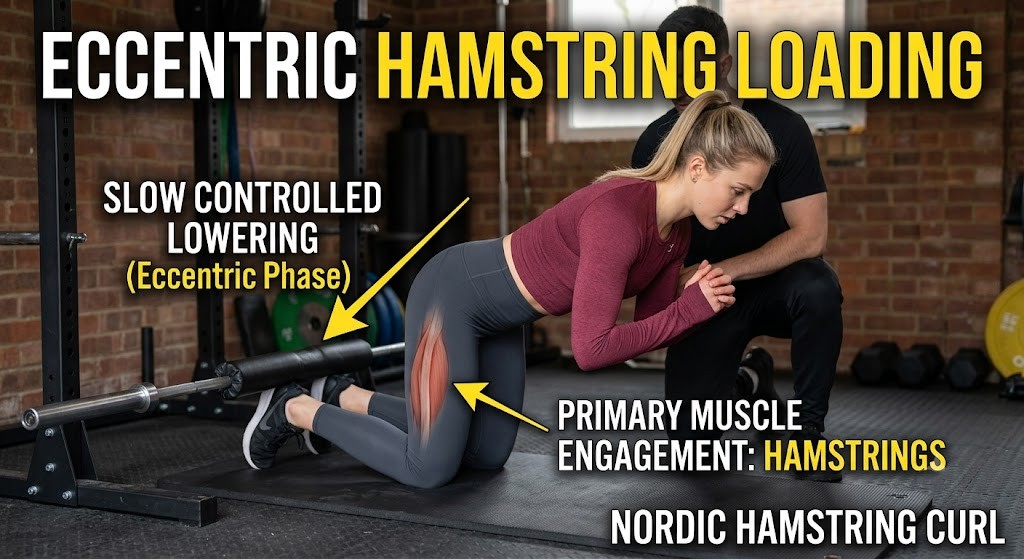
How to Perform a Nordic Hamstring Curl With Proper Form
The Nordic hamstring curl requires secure ankles, stable hips, and a controlled forward descent.
Step-by-Step Instructions
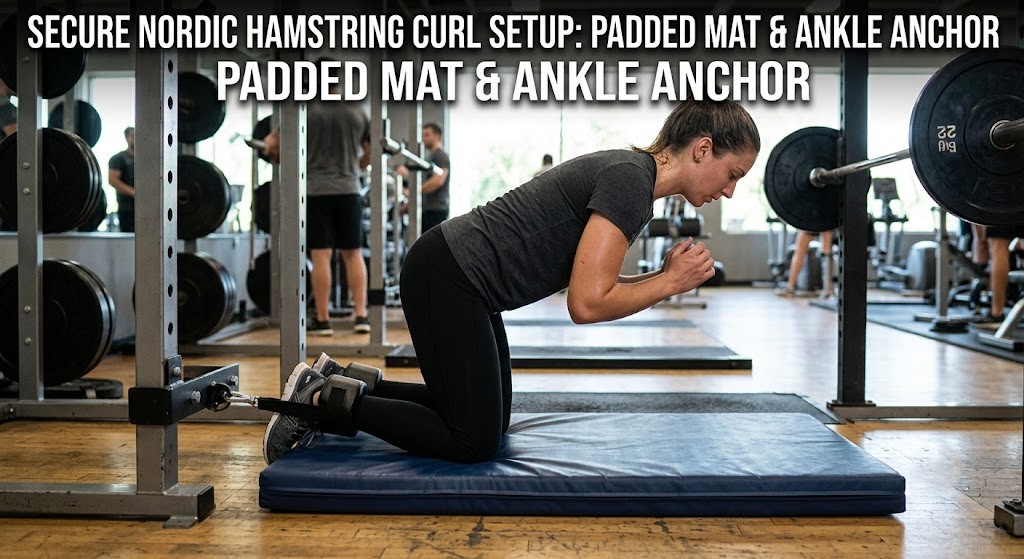
- Secure your ankles: Kneel on a padded mat with your ankles held firmly by a partner or secured beneath a suitable anchor.
- Align your body: Maintain a straight line from your knees through your hips to your shoulders.
- Brace your core: Tighten your abdominal muscles and keep your hips extended.
- Lower slowly: Lean forward while your hamstrings control the descent.
- Catch yourself: Use your hands to catch your body before losing control.
- Return to kneeling: Push gently with your hands or use assistance rather than forcing a difficult return.
Common Mistakes to Avoid
| Mistake | How to Correct It |
|---|---|
| Bending at the hips | Keep your hips extended |
| Dropping too quickly | Lower your torso slowly |
| Using an unstable anchor | Check your setup before every set |
| Attempting full repetitions too early | Begin with assisted or partial repetitions |
| Increasing volume too quickly | Progress gradually according to recovery |
Stop if you experience sharp pain around your hamstrings or knees. Normal muscular effort differs from sudden or worsening pain.
Are Nordic Hamstring Curls Good for Beginners?
Yes, but the full exercise can be too challenging for beginners. Start with an easier variation that allows you to control your descent.
Best Beginner-Friendly Variations
- Partner-assisted Nordic curl: A partner provides support at your ankles to help you control the movement.
- Resistance-band Nordic curl: A securely attached band assists your torso as you lean forward.
- Partial-range Nordic curl: Lower your torso only as far as you can maintain control.
- Hands-assisted Nordic curl: Use your hands to catch yourself and help return to the starting position.
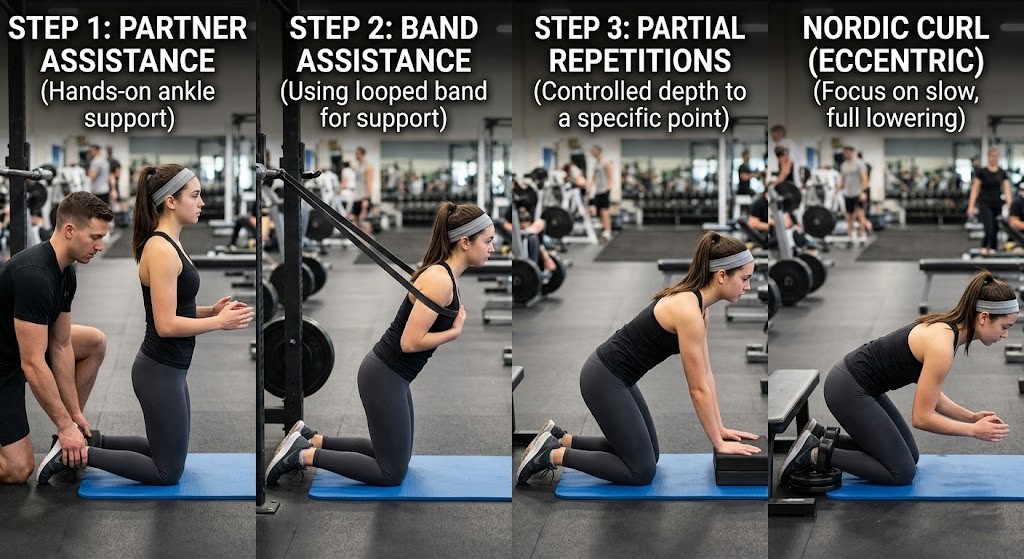
Focus on technique rather than the number of repetitions. Increase the range of motion and reduce assistance only when you can maintain proper alignment.
How Many Nordic Hamstring Curls Should You Do?
Your ideal training volume depends on your experience, strength, and recovery.
| Experience Level | Suggested Starting Volume |
|---|---|
| Beginner | 1–2 sets of 3–5 assisted repetitions |
| Intermediate | 2–3 sets of 4–6 repetitions |
| Advanced | 2–4 sets of 4–8 repetitions, as tolerated |
These are practical starting ranges rather than universal prescriptions.
Beginners can start with one session per week and consider progressing to two sessions when technique and recovery are consistent. Reduce your workload if soreness affects your walking, running, or other exercises.
Can Nordic Hamstring Curls Prevent Injuries?
Nordic hamstring curls can help reduce hamstring injury rates when included consistently in appropriate injury-prevention programs.
A 2019 systematic review and meta-analysis found an approximately 51% reduction in hamstring injury rates across the included studies.
Source: British Journal of Sports Medicine, 2019.
However, results depend on factors such as adherence, previous injuries, training workload, and sporting demands. Nordic curls should complement warm-ups, progressive running exposure, overall strength training, and recovery.
Athletes returning from a hamstring injury should follow an individualized rehabilitation plan from a qualified healthcare professional.
For practical preparation, use our 5-minute warm-up routine.
What Are the Best Nordic Hamstring Curl Alternatives?
If you cannot perform Nordic curls comfortably or lack a secure ankle anchor, consider these alternatives.
| Exercise | Main Benefit | Equipment |
|---|---|---|
| Romanian deadlift | Trains hamstrings through hip extension | Dumbbells or barbell |
| Lying leg curl | Trains knee flexion against resistance | Leg-curl machine |
| Seated leg curl | Trains knee flexion while seated | Leg-curl machine |
| Stability-ball hamstring curl | Challenges knee flexion and body control | Stability ball |
| Glute-ham raise | Challenges the posterior chain | Glute-ham developer |
Romanian Deadlift
The Romanian deadlift complements Nordic curls by training the hamstrings through a hip-hinge movement.
Lying and Seated Leg Curls
These exercises allow you to adjust resistance and perform controlled knee-flexion repetitions, making them useful for beginners and experienced trainees.
Stability-Ball Hamstring Curls and Glute-Ham Raises
Stability-ball curls are useful when you have limited equipment, while glute-ham raises require a dedicated apparatus. Choose the variation that matches your strength and available equipment.
Nordic Hamstring Curl vs. Leg Curl
Both exercises strengthen the hamstrings, but they differ in resistance and execution.
| Feature | Nordic Hamstring Curl | Conventional Leg Curl |
|---|---|---|
| Equipment | Secure ankle anchor or partner | Usually a machine |
| Resistance | Body weight with assistance as needed | Adjustable external load |
| Main emphasis | Eccentric hamstring strength | Controlled knee flexion |
| Difficulty | Often challenging for beginners | Easier to scale initially |
| Home use | Possible with a safe setup | Requires suitable equipment |
Neither exercise is universally superior. Nordic curls emphasize eccentric control, while machine leg curls make it easier to adjust resistance and perform additional repetitions.
For balanced hamstring development, combine both with a hip-hinge exercise such as the Romanian deadlift.
How to Progress to a Full Nordic Hamstring Curl
Building toward a full Nordic hamstring curl requires gradual progression.
- Start with assistance: Use your hands or a partner to control the movement.
- Increase your range: Lower your torso farther while maintaining alignment.
- Reduce assistance: Use less support as your strength improves.
- Improve control: Focus on a smooth descent instead of dropping suddenly.
- Attempt full repetitions: Progress only when you can control the movement safely.
- Increase volume gradually: Adjust sets or repetitions one variable at a time.
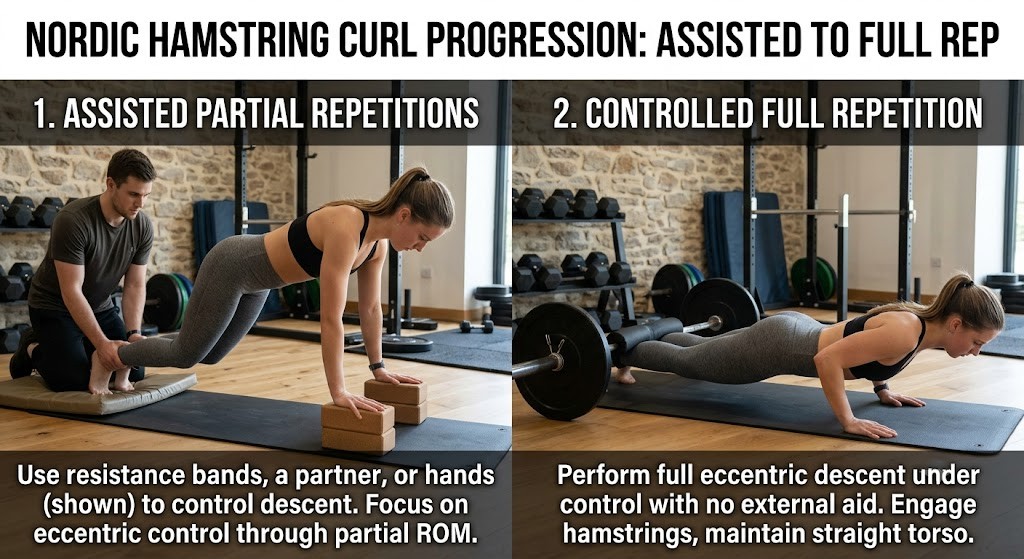
Progressive overload does not always mean adding weight. You can increase your range of motion, improve lowering control, or reduce assistance as your strength develops.
For more guidance, read our how to build muscle with progressive overload.
Do You Need Equipment for Nordic Hamstring Curls?
You need a padded surface for your knees and a reliable way to secure your ankles.
A training partner or purpose-built Nordic curl bench can provide support. Always check the setup before starting.
Never rely on unstable furniture or an improvised anchor that could slip or tip over.
Are Nordic Hamstring Curls Enough to Build Bigger Hamstrings?
Nordic curls can contribute to hamstring muscle growth, but they may not be sufficient to maximize development on their own.
Muscle growth depends on training effort, progressive overload, adequate nutrition, and recovery. Combining Nordic curls with Romanian deadlifts and leg curls helps train the hamstrings through different movement patterns.
Should You Feel Sore After Nordic Hamstring Curls?
Some delayed-onset muscle soreness is common when you first introduce eccentric training. Your hamstrings may feel tender during everyday movements the following day.
However, sharp pain, significant swelling, sudden weakness, or worsening symptoms should not be treated as normal soreness. Stop exercising and seek appropriate medical advice if these symptoms occur.
Recovery also depends on adequate sleep, nutrition, hydration, and sensible training volume. Read our workout recovery techniques for muscle soreness for additional guidance.
Example Nordic Hamstring Curl Workout
You can incorporate Nordic curls into a balanced lower-body routine alongside complementary exercises.
| Exercise | Sets | Repetitions |
|---|---|---|
| Bodyweight squats | 3 | 8–12 |
| Romanian deadlifts | 3 | 8–10 |
| Assisted Nordic hamstring curls | 2 | 3–5 |
| Calf raises | 3 | 12–15 |
Beginners should use assisted Nordic curls and reduce the overall workload as needed. Maintain controlled technique and avoid increasing volume when your recovery is insufficient.
For additional lower-body training, see our calf workout exercises and best lower back exercises.
Conclusion
The Nordic hamstring curl is a valuable bodyweight exercise for developing eccentric hamstring strength and supporting injury-prevention programs.
To get the most from this movement, prioritize proper form, secure ankle support, and gradual progression. Beginners can build strength with assisted variations before attempting full repetitions.
Combine Nordic curls with complementary hamstring exercises, monitor your recovery, and progress patiently to build stronger, more resilient hamstrings.
FAQs
What is a Nordic hamstring curl?
A bodyweight exercise that strengthens the hamstrings through controlled lowering.
What muscles do Nordic hamstring curls work?
They target the biceps femoris, semitendinosus, and semimembranosus.
Are Nordic hamstring curls good for beginners?
Yes. Start with assisted or partial repetitions.
How many Nordic hamstring curls should I do?
Beginners can start with 1–2 sets of 3–5 assisted repetitions.
How often should I do Nordic hamstring curls?
Start once weekly and increase gradually as recovery improves.
Do Nordic hamstring curls prevent injuries?
They can reduce hamstring injury rates when included in suitable prevention programs.
Are Nordic curls better than leg curls?
Nordic curls emphasize eccentric strength, while leg curls offer adjustable resistance.
Can I do Nordic hamstring curls at home?
Yes, with a padded mat and a secure ankle anchor or reliable partner.
Can Nordic curls build bigger hamstrings?
Yes. Combine them with Romanian deadlifts and leg curls for balanced development.
Why are Nordic hamstring curls so difficult?
They require substantial hamstring strength to control your body weight.
Should I feel sore after Nordic hamstring curls?
Mild soreness is common, but sharp or worsening pain needs attention.
What is the best Nordic hamstring curl alternative?
Romanian deadlifts, lying leg curls, seated leg curls, and stability-ball curls are useful alternatives.