
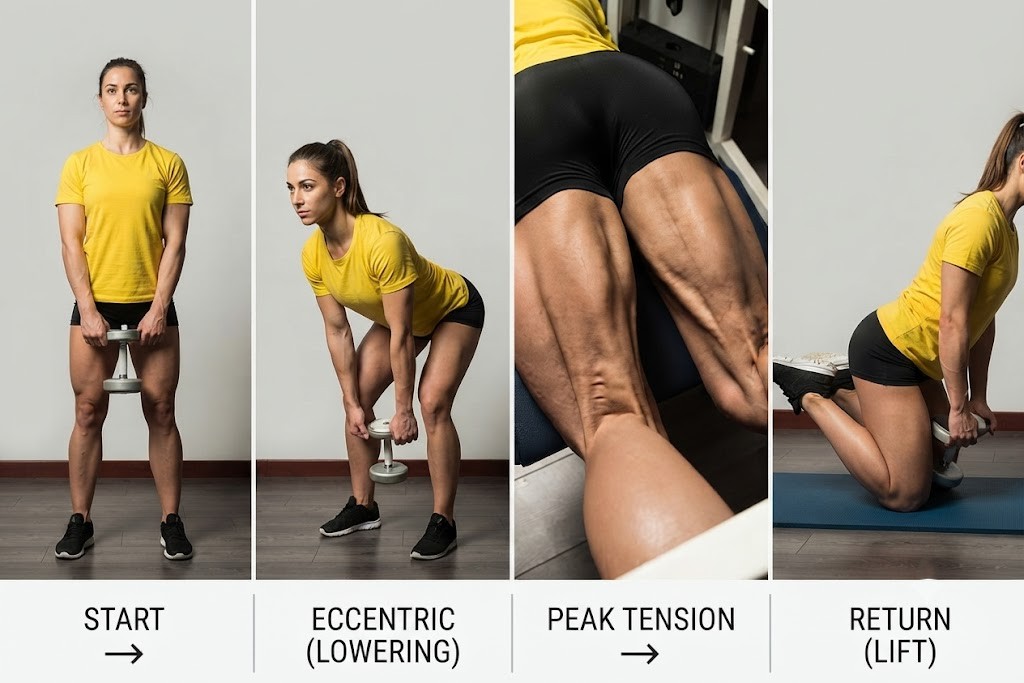
Most people spend hours perfecting squats, leg presses, and lunges while overlooking one of the most important muscle groups in the body—the hamstrings. This imbalance can lead to weaker athletic performance, poor posture, knee pain, and an increased risk of muscle strains.
A well-designed hamstring muscle workout strengthens the muscles at the back of your thighs, helping you run faster, jump higher, lift heavier, and maintain healthy knees. Whether you’re a beginner looking to improve overall fitness or an athlete aiming for explosive performance, dedicated hamstring training should be part of your weekly routine.
In this comprehensive guide, you’ll learn everything about the hamstring muscle workout, including hamstring anatomy, the benefits of stronger hamstrings, injury prevention, and the most effective exercises for building strength and muscle.
What Is a Hamstring Muscle Workout?
A hamstring muscle workout is a structured training routine designed to strengthen the three muscles located at the back of your thighs through a combination of hip-hinge and knee-flexion exercises.
Unlike the quadriceps, which extend (straighten) the knee, the hamstrings perform two major functions:
- Bend the knee (knee flexion)
- Extend the hip (hip extension)
Because they cross both the hip and knee joints, the hamstrings are involved in nearly every lower-body movement, including:
- Walking
- Running
- Sprinting
- Jumping
- Climbing stairs
- Squatting
- Deadlifting
During explosive movements like sprinting or jumping, your hamstrings generate force while stabilizing both the hips and knees. This makes them one of the most important muscle groups for sports performance and everyday movement.
For complete development, an effective hamstring workout combines heavy compound lifts like Romanian deadlifts with isolation exercises such as leg curls.
Which Muscles Make Up the Hamstrings?
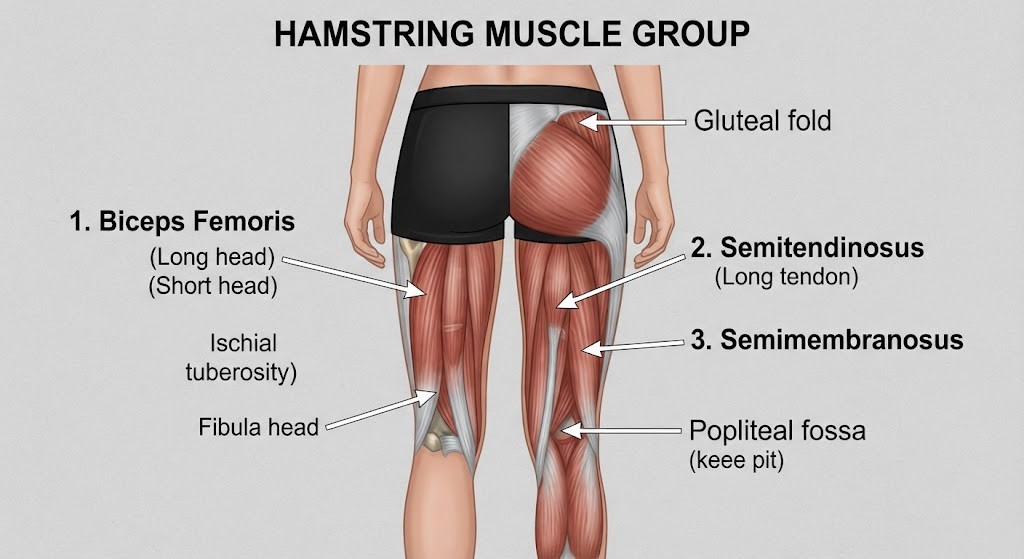
The hamstrings are made up of three primary muscles located on the back of the thigh.
1. Biceps Femoris
The biceps femoris is the largest and most visible hamstring muscle.
Its primary responsibilities include:
- Knee flexion
- Hip extension
- Rotational stability
- Sprinting power
This muscle works especially hard during running and explosive athletic movements.
2. Semitendinosus
The semitendinosus assists with:
- Hip extension
- Knee flexion
- Running efficiency
- Athletic movement
It also contributes to flexibility and smooth lower-body mechanics.
3. Semimembranosus
Located underneath the semitendinosus, this muscle supports:
- Knee stability
- Hip movement
- Posture
- Lower-body balance
Together, these three muscles work alongside the glutes, calves, and lower back to create a powerful posterior chain responsible for strength and movement.
Statistic: Hamstring strains account for approximately 12–16% of all sports injuries, making them one of the most commonly injured muscle groups in athletes.
Source: British Journal of Sports Medicine, 2023.
Why Do Hamstrings Matter?
Strong hamstrings provide benefits that extend far beyond aesthetics. They improve movement quality, enhance athletic performance, and help protect your joints from injury.
A strong set of hamstrings helps you:
- Run faster
- Jump higher
- Lift heavier weights
- Improve posture
- Protect your knees
- Reduce injury risk
- Generate greater hip power
- Improve overall lower-body balance
When your hamstrings are properly developed, they work in harmony with your glutes, calves, and lower back, making everyday movements more efficient and powerful.
For complete lower-body development, combine hamstring training with the best glute workout routine to strengthen your entire posterior chain.
Why Is Hamstring Training Important for Strength and Injury Prevention?
Hamstring training plays a critical role in improving lower-body strength, athletic performance, posture, knee stability, and long-term injury resistance.
Many people unknowingly develop powerful quadriceps while neglecting the muscles on the back of the thighs. This muscle imbalance increases stress on the knees and hips, making injuries much more likely during activities such as sprinting, jumping, or changing direction quickly.
A balanced lower body produces more force while reducing unnecessary strain on joints and connective tissues.
Prevents Hamstring Injuries
One of the biggest benefits of a hamstring muscle workout is injury prevention.
Hamstring strains are among the most common injuries in athletes because these muscles experience enormous force during high-speed movements.
One exercise consistently recommended by sports scientists is the Nordic Hamstring Curl, which emphasizes eccentric strength—the muscle’s ability to resist force while lengthening.
Research has shown that eccentric hamstring training significantly lowers injury rates across many sports.
Statistic: Nordic Hamstring Exercise programs can reduce hamstring injury rates by up to 50% in athletes.
Source: British Journal of Sports Medicine, 2023.
Adding eccentric exercises to your weekly training routine can dramatically improve muscle resilience while lowering the likelihood of future injuries.
Improves Athletic Performance
Powerful hamstrings are essential for explosive movement.
Every sprint, jump, and rapid acceleration depends heavily on the posterior chain, especially the hamstrings.
Athletes with stronger hamstrings often demonstrate:
- Faster sprint speeds
- Better acceleration
- Greater vertical jump height
- Improved agility
- More explosive power
If your goal is improved sports performance, combine your routine with our explosive leg workout for athletes for advanced lower-body power development.
Supports Knee Stability
Your hamstrings serve as natural stabilizers for the knee joint.
Strong hamstrings counterbalance the pulling force created by the quadriceps, helping reduce excessive stress on important ligaments like the ACL.
Benefits include:
- Improved knee alignment
- Better joint stability
- Lower injury risk
- Increased movement efficiency
This is particularly valuable for runners, soccer players, basketball players, football players, and anyone involved in sports requiring quick changes of direction.
Builds a Strong Posterior Chain
The hamstrings don’t work alone.
They function together with:
- Glutes
- Lower back
- Calves
- Core
Collectively, these muscles form the posterior chain, one of the most important systems for strength, posture, and athletic movement.
A stronger posterior chain helps you:
- Lift heavier weights
- Improve squat performance
- Deadlift more safely
- Increase jumping ability
- Maintain better posture
- Reduce lower-back stress
For balanced lower-body growth, include a calf workout exercises alongside your weekly leg routine.
What Are the Best Hamstring Muscle Workout Exercises?
The most effective hamstring muscle workout combines both hip-dominant and knee-flexion movements.
Hip-hinge exercises strengthen the hamstrings while lengthened, whereas knee-flexion exercises isolate the muscles through a shorter range of motion.
Training both movement patterns results in better strength, muscle growth, and athletic performance.
Statistic: Resistance training performed twice weekly significantly improves lower-body strength and muscle hypertrophy in healthy adults.
Source: American College of Sports Medicine, 2024.
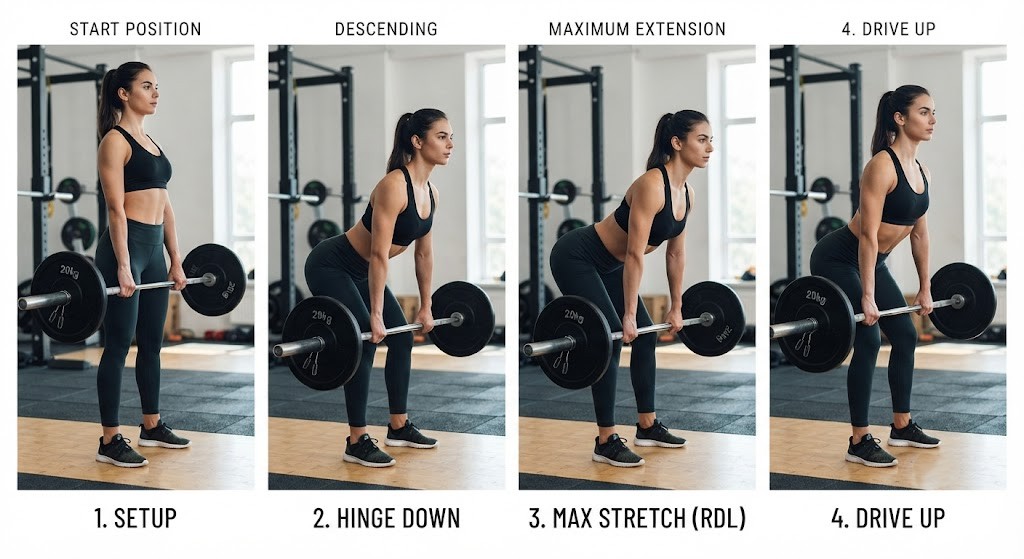
1. Romanian Deadlift (RDL)
The Romanian Deadlift is widely regarded as the gold standard for hamstring development.
It emphasizes controlled hip hinging and places significant tension on the hamstrings throughout the movement, especially during the lowering phase.
How to Perform
- Hold a barbell or pair of dumbbells.
- Stand tall with feet hip-width apart.
- Keep your back neutral.
- Push your hips backward.
- Lower the weights until you feel a deep hamstring stretch.
- Drive your hips forward to return to the starting position.
Recommended Sets: 3–4
Recommended Reps: 8–12
A properly executed Romanian deadlift develops stronger hamstrings through a long range of motion while also strengthening the glutes and lower back.
2. Stiff-Leg Deadlift
The Stiff-Leg Deadlift is another outstanding posterior-chain exercise that increases hamstring tension by minimizing knee bend throughout the movement.
Because the knees remain only slightly bent, the hamstrings stay under constant tension, making this exercise particularly effective for building strength and improving flexibility.
It is best suited for intermediate and advanced lifters who already have solid hip-hinge mechanics.
Benefits
- Greater hamstring stretch
- Improved posterior-chain strength
- Increased flexibility
- Better deadlift performance
3. Good Morning
The Good Morning is an excellent posterior-chain exercise that strengthens the hamstrings, glutes, and lower back while improving hip mobility and stability. Because the movement places the load across your upper back, it teaches proper hip hinging and reinforces good lifting mechanics.
Beginners should start with an empty barbell or a light resistance band before gradually increasing the weight.
How to Perform
- Place a barbell across your upper back.
- Stand with your feet shoulder-width apart.
- Keep your chest up and core engaged.
- Push your hips backward while maintaining a neutral spine.
- Lower until your torso is nearly parallel to the floor or until you feel a hamstring stretch.
- Drive your hips forward to return to the starting position.
Recommended Sets: 3–4
Recommended Reps: 8–12
4. Nordic Hamstring Curl
The Nordic Hamstring Curl is one of the most effective bodyweight exercises for building eccentric hamstring strength and preventing injuries. It challenges the hamstrings by resisting gravity during the lowering phase.
Beginners can use resistance bands or push off the floor slightly with their hands to reduce the difficulty.
Benefits
- Improves eccentric strength
- Reduces hamstring injury risk
- Increases sprint performance
- Builds powerful hamstrings without gym equipment
Recommended Sets: 3
Recommended Reps: 5–8
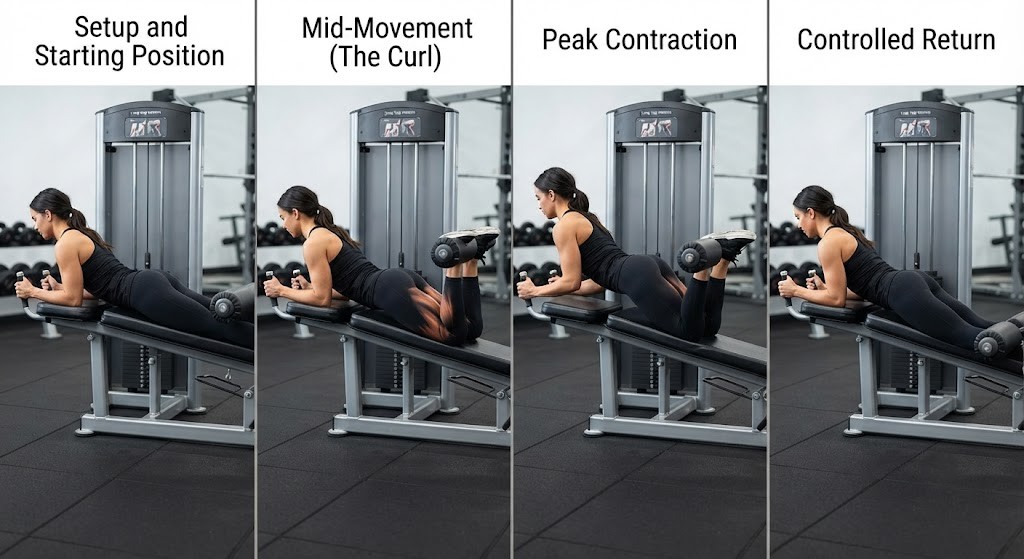
5. Leg Curl Machine
The Leg Curl Machine is one of the best isolation exercises for directly targeting the hamstrings through knee flexion. Unlike compound lifts, nearly all the resistance is focused on the hamstring muscles, making it highly effective for muscle growth.
How to Perform
- Adjust the machine so your knees align with the pivot point.
- Place your ankles under the roller pad.
- Curl the pad toward your glutes.
- Pause and squeeze your hamstrings.
- Slowly lower the weight to maximize eccentric tension.
Recommended Sets: 3–4
Recommended Reps: 10–15
6. Stability Ball Leg Curl
The Stability Ball Leg Curl strengthens the hamstrings while simultaneously engaging the glutes and core. Because the ball creates instability, your stabilizing muscles work harder throughout the movement.
How to Perform
- Lie on your back with your heels on a stability ball.
- Lift your hips off the floor.
- Roll the ball toward your glutes.
- Slowly extend your legs back to the starting position.
Recommended Sets: 3
Recommended Reps: 12–15
7. Kettlebell Swing
The Kettlebell Swing develops explosive hip power and strengthens the entire posterior chain. It is a dynamic movement that improves power, conditioning, and muscular endurance.
Focus on driving the movement with your hips rather than lifting the kettlebell with your arms.
Recommended Sets: 3
Recommended Reps: 15–20
8. Single-Leg Romanian Deadlift
The Single-Leg Romanian Deadlift improves unilateral strength, balance, coordination, and hip stability. It also helps identify and correct muscle imbalances between your left and right legs.
Benefits
- Improves balance
- Strengthens stabilizing muscles
- Corrects muscular imbalances
- Enhances athletic performance
Recommended Sets: 3
Recommended Reps: 8–12 per leg
9. Resistance Band Hamstring Curl
The Resistance Band Hamstring Curl is an excellent home workout exercise requiring minimal equipment. It keeps constant tension on the hamstrings and is ideal for beginners or anyone training outside the gym.
How to Perform
- Secure a resistance band to a sturdy object.
- Attach the other end around your ankle.
- Curl your heel toward your glutes.
- Slowly return to the starting position.
Recommended Sets: 3
Recommended Reps: 15–20
How Can Beginners Start a Hamstring Workout Safely?
If you’re new to resistance training, focus on learning proper movement patterns before increasing weight. Good technique builds a solid foundation and reduces the risk of injury.
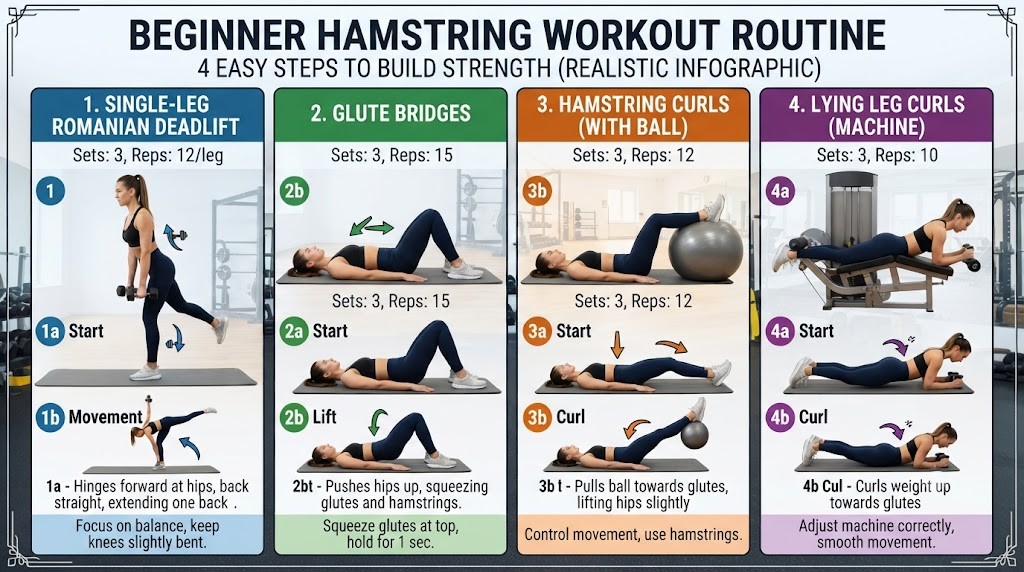
A simple beginner routine includes:
| Exercise | Sets | Reps |
|---|---|---|
| Romanian Deadlift | 3 | 10 |
| Leg Curl Machine | 3 | 12 |
| Stability Ball Curl | 3 | 12 |
| Resistance Band Curl | 2 | 15 |
Training Tip: Rest 60–90 seconds between sets and perform each repetition with slow, controlled movement.
Before every workout, perform warm-up exercises to prepare your muscles and joints.
Hamstring Workout Routines
Beginner Hamstring Workout
- Romanian Deadlift – 3 × 10
- Leg Curl Machine – 3 × 12
- Glute Bridge – 3 × 15
- Stability Ball Curl – 2 × 12
Train 1–2 times per week with at least 48 hours between sessions.
Intermediate Hamstring Workout
- Romanian Deadlift – 4 × 8
- Stiff-Leg Deadlift – 3 × 10
- Leg Curl – 4 × 10
- Nordic Curl – 3 × 6
- Kettlebell Swing – 3 × 20
Advanced Hamstring Hypertrophy Workout
- Romanian Deadlift – 5 × 6
- Good Morning – 4 × 8
- Nordic Curl – 4 × 8
- Leg Curl – 4 × 12
- Single-Leg Romanian Deadlift – 3 × 10
- Kettlebell Swing – 3 × 20
Advanced lifters should progressively increase weight while maintaining excellent form.
Hamstring Workout at Home
You don’t need a fully equipped gym to build stronger hamstrings. Progressive overload and consistency are far more important than expensive equipment.
A simple home routine includes:
- Resistance Band Curl
- Single-Leg Romanian Deadlift
- Glute Bridge
- Stability Ball Curl
- Assisted Nordic Curl
Minimal equipment can produce excellent results when paired with consistent training.
Hamstring Workout at the Gym
A commercial gym offers more exercise variety, allowing you to challenge your hamstrings from multiple angles.
Recommended routine:
- Romanian Deadlift
- Leg Curl Machine
- Good Morning
- Nordic Curl
- Cable Hamstring Curl
For complete lower-body development, combine these exercises with our Beginner Legs Workout.
Dumbbell Hamstring Workout
If you only have dumbbells, you can still build impressive hamstring strength.
Recommended exercises:
- Dumbbell Romanian Deadlift
- Dumbbell Single-Leg Romanian Deadlift
- Dumbbell Good Morning
- Dumbbell Swing
Barbell Hamstring Workout
Barbells allow greater progressive overload, making them ideal for building long-term strength and muscle.
Recommended exercises:
- Romanian Deadlift
- Stiff-Leg Deadlift
- Good Morning
- Rack Pull
What Are the Most Common Hamstring Workout Mistakes to Avoid?
Avoiding these common mistakes helps improve muscle activation, reduces injury risk, and accelerates progress.
Using Too Much Weight
Lifting heavier than you can control often compromises technique. Prioritize proper form before increasing resistance.
Poor Hip Hinge
Bending through your lower back instead of pushing your hips backward shifts tension away from the hamstrings and increases injury risk.
Limited Range of Motion
Lower the weight until you feel a comfortable hamstring stretch while maintaining a neutral spine.
Ignoring the Eccentric Phase
Slowly lowering the weight increases muscle tension and stimulates greater hypertrophy.
Skipping Warm-Ups
Dynamic warm-ups improve blood flow, activate muscles, and reduce injury risk.
Neglecting Recovery
Muscles grow during recovery—not while you’re training. Prioritize sleep, hydration, and rest days.
Equipment, Progression & Practical Tips
The right equipment and progressive overload strategy are essential for long-term success.
Useful Equipment
- Dumbbells
- Barbells
- Resistance Bands
- Cable Machines
- Leg Curl Machine
- Stability Ball
- Kettlebells
Progressive overload, excellent technique, proper recovery, and adequate protein intake are the primary drivers of hamstring growth.
Recommended Rep Ranges
| Goal | Reps |
|---|---|
| Strength | 4–6 |
| Muscle Growth | 8–12 |
| Muscular Endurance | 15–20 |
Weekly Training Frequency
Training your hamstrings 1–2 times per week supports:
- Better lower-body strength
- Increased athletic performance
- Balanced muscle development
- Reduced injury risk
What’s Next?
A consistent weekly training plan, proper recovery, and good nutrition are essential for long-term hamstring development.
Weekly Training Schedule
| Day | Workout |
|---|---|
| Monday | Hamstrings & Glutes |
| Tuesday | Upper Body |
| Wednesday | Recovery |
| Thursday | Legs |
| Friday | Push Workout |
| Saturday | Pull Workout |
| Sunday | Mobility & Stretching |
Recovery Tips
To maximize muscle growth and reduce soreness:
- Sleep 7–9 hours each night.
- Stay well hydrated.
- Stretch after every workout using.
- Foam roll tight muscles.
- Take at least one full recovery day every week.
Nutrition for Hamstring Growth
Nutrition plays a major role in muscle recovery and development. Resistance training creates microscopic muscle damage, and protein provides the building blocks needed for repair and growth.
Aim for 1.6–2.2 grams of protein per kilogram of body weight per day if your goal is muscle growth.
Support recovery with our high protein diet plan and enjoy a protein coffee for workout after training.
If your goal is building muscle while reducing body fat, also read our body recomposition guide.
Conclusion
A hamstring muscle workout is one of the most effective ways to build stronger legs, improve athletic performance, and reduce injury risk. By combining hip-hinge exercises like Romanian deadlifts with knee-flexion movements such as leg curls and Nordic curls, you can develop balanced, powerful hamstrings that support every lower-body movement.
Consistency is the key to long-term success. Focus on proper technique, apply progressive overload gradually, prioritize recovery, and fuel your body with enough protein. Over time, stronger hamstrings will improve your lifting performance, running speed, p
FAQs
What is a hamstring muscle workout?
A hamstring muscle workout is a training routine that strengthens the muscles at the back of your thighs using hip-hinge and knee-flexion exercises.
What workout is best for hamstrings?
Romanian Deadlifts, Nordic Hamstring Curls, and Leg Curls are among the best exercises for building strong and powerful hamstrings.
How do I strengthen my hamstring muscles?
Strengthen your hamstrings by training them 1–2 times per week with exercises like Romanian deadlifts, leg curls, and glute bridges while progressively increasing resistance.
Is 2 exercises enough for hamstrings?
Yes. Combining one hip-hinge exercise and one knee-flexion exercise is enough for an effective hamstring workout.
What is a hamstring exercise?
A hamstring exercise targets the muscles at the back of your thighs through hip extension or knee flexion, such as Romanian deadlifts and leg curls.
How often should I train my hamstrings?
Most people benefit from training their hamstrings 1–2 times per week with adequate recovery between sessions.
Which exercise builds hamstrings the fastest?
Romanian Deadlifts and Nordic Hamstring Curls are among the most effective exercises for increasing hamstring strength and muscle growth.
Can I train hamstrings without gym equipment?
Yes. Resistance bands, glute bridges, stability ball curls, and Nordic curls are excellent home workout options.
Should I train hamstrings and glutes together?
Yes. Training hamstrings and glutes together improves posterior chain strength, hip power, and lower-body balance.
How long does it take to strengthen hamstrings?
Most people notice strength improvements within 6–8 weeks of consistent training and proper recovery.
2 thoughts on “Hamstring Muscle Workout: Build Stronger Legs & Prevent Injuries”