
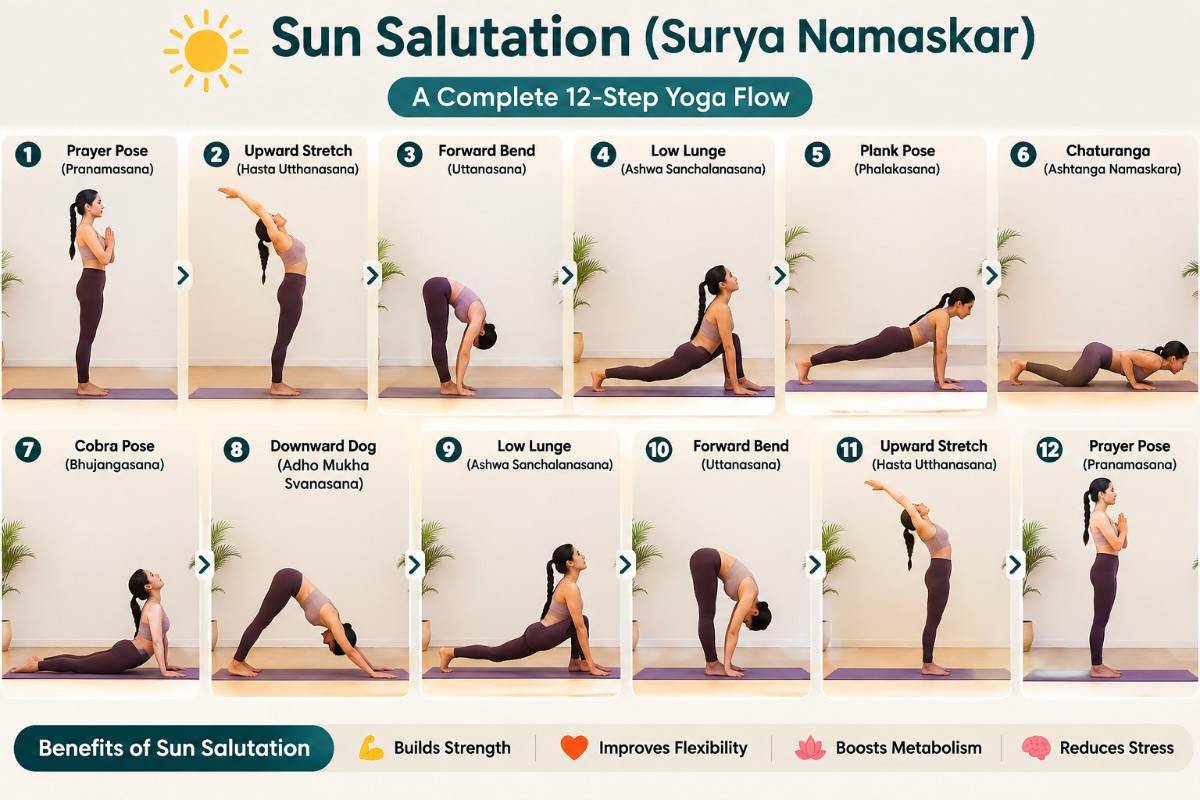
Sun Salutation, also known as Surya Namaskar, is a traditional yoga sequence that combines flowing movements, breathing, and mindful awareness. Whether you are a beginner or an experienced practitioner, learning the correct Sun Salutation steps can help you develop flexibility, strength, balance, and a consistent yoga routine. This guide explains the traditional yoga Sun Salutation sequence, including its poses, breathing pattern, and beginner-friendly modifications.
What Is Sun Salutation (Surya Namaskar)?
Sun Salutation, also called a yoga Sun Salutation or Surya Namaskar, is a sequence of yoga postures performed in a continuous flow while coordinating each movement with breathing. The practice is associated with honoring the sun and is commonly used as a morning yoga routine. The plural term sun salutations is often used when referring to repeated rounds of the sequence.
A traditional sun salutation sequence generally contains 12 positions that combine standing stretches, forward bends, lunges, plank variations, and backbends. Different yoga traditions may use slightly different movements, breathing patterns, and transitions. The phrase yoga sun salutations is also commonly used when discussing repeated rounds of this traditional practice.
Sun Salutation, sometimes called sun salute yoga, can be practised independently or included in a broader yoga session. It is also a useful starting point for people interested in learning Hatha Yoga and developing a regular yoga practice.
If you want to explore the Ashtanga variation, read our Sun Salutation A: Steps, Benefits, Breathing & Beginner’s Guide, which explains its nine vinyasa counts, breathing pattern, and step-by-step sequence.
Why Does Sun Salutation Matter?
Sun Salutation matters because it combines several movements into one flowing sequence that engages different muscle groups while encouraging controlled breathing.
Regular, appropriately modified practice may support:
- Flexibility: Forward folds, lunges, and backbends move the hips, shoulders, spine, and legs through different ranges of motion.
- Muscular strength: Plank, lunging, and weight-bearing positions engage the arms, shoulders, legs, and core.
- Body coordination: Connecting movements with breathing encourages better movement awareness.
- Physical activity: A continuous sequence can provide a moderate physical workout depending on its pace and intensity.
- Mindfulness: Paying attention to breathing and movement can help create a more focused practice.
Sun Salutation is not a guaranteed treatment for medical conditions or a substitute for other forms of exercise. Its effects depend on consistency, technique, intensity, and individual fitness levels.
For a broader practice that combines different movements, explore Full Body Yoga.
12 Sun Salutation Steps: How to Do Surya Namaskar
A traditional yoga Sun Salutation follows 12 positions performed in a particular order, with breathing coordinated throughout the sequence. Below is a beginner-friendly explanation of the commonly practised Sun Salutation sequence, often called Surya Namaskar.
Step 1: Pranamasana (Prayer Pose)
Breathing: Exhale or breathe naturally.
- Stand upright with your feet together or comfortably close.
- Distribute your body weight evenly between both feet.
- Bring your palms together in front of your chest.
- Keep your shoulders relaxed and spine naturally straight.
- Focus your attention on your breathing.
This starting position helps establish balance and prepares you for the movements ahead.
Step 2: Hasta Uttanasana (Raised Arms Pose)
Breathing: Inhale.
- Raise both arms overhead.
- Keep your upper arms close to your ears if comfortable.
- Lengthen your spine and lift your chest.
- Gently extend your upper back without forcing your lower back.
- Keep your feet firmly grounded.
The movement stretches the front of the body and encourages shoulder mobility.
Step 3: Padahastasana (Standing Forward Bend)
Breathing: Exhale.
- Slowly bend forward from your hips.
- Bring your hands towards the floor or your feet.
- Allow your head and neck to relax.
- Bend your knees slightly if your hamstrings feel tight.
- Avoid forcing your forehead towards your knees.
This position stretches the back of the legs and encourages hip flexibility.
Step 4: Ashwa Sanchalanasana (Equestrian Pose or Low Lunge)
Breathing: Inhale.
- Place both hands on the floor beside your feet.
- Step your right leg backward.
- Lower your right knee towards the mat.
- Keep your left foot between your hands.
- Lift your chest and look forward comfortably.
This movement stretches the hip flexors and engages the muscles supporting your lower body.
Step 5: Dandasana (Plank Pose)
Breathing: Exhale.
- Bring your left foot backward beside your right foot.
- Extend both legs behind you.
- Position your shoulders approximately over your wrists.
- Keep your body in a straight line.
- Engage your abdominal muscles without holding your breath.
Plank helps engage your shoulders, arms, legs, and core.
Step 6: Ashtanga Namaskara (Eight-Limbed Salutation)
Breathing: Exhale.
- Lower both knees to the mat.
- Slowly bring your chest and chin towards the floor.
- Keep your hips slightly raised.
- Allow your elbows to remain close to your body.
- Maintain controlled movement rather than dropping suddenly.
In this posture, eight body points traditionally make contact with the floor: two feet, two knees, two hands, chest, and chin.
Step 7: Bhujangasana (Cobra Pose)
Breathing: Inhale.
- Slide your chest forward.
- Place your palms beneath or slightly ahead of your shoulders.
- Gently lift your chest from the floor.
- Keep your shoulders away from your ears.
- Avoid pushing into an uncomfortable backbend.
Cobra Pose encourages spinal extension and stretches the front of the torso.
Step 8: Parvatasana (Mountain Pose or Downward-Facing Position)
Breathing: Exhale.
- Place your palms firmly on the mat.
- Lift your hips upward and backward.
- Straighten your arms.
- Allow your head to relax between your upper arms.
- Keep your knees slightly bent if necessary.
Your body should form an inverted V shape. This position stretches the shoulders, calves, and hamstrings.
Step 9: Ashwa Sanchalanasana (Equestrian Pose)
Breathing: Inhale.
- Bring your right foot forward between your hands.
- Lower your left knee towards the mat.
- Keep your right foot stable.
- Lift your chest and look forward.
- Use your hands for balance.
This is the opposite-leg variation of Step 4.
Step 10: Padahastasana (Standing Forward Bend)
Breathing: Exhale.
- Bring your left foot forward beside your right foot.
- Bring your hands towards the floor.
- Fold forward from your hips.
- Relax your neck and shoulders.
- Keep your knees slightly bent if needed.
This returns you to the forward-bending position.
Step 11: Hasta Uttanasana (Raised Arms Pose)
Breathing: Inhale.
- Slowly rise from the forward fold.
- Extend both arms overhead.
- Lengthen your spine.
- Gently lift your chest.
- Avoid excessive arching through your lower back.
This movement brings you back into the raised-arms position.
Step 12: Pranamasana (Prayer Pose)
Breathing: Exhale.
- Bring your palms together in front of your chest.
- Stand upright.
- Relax your shoulders.
- Return your breathing to a natural rhythm.
- Pause before beginning another round.
You have now completed one side of the Sun Salutation sequence. Repeat the sequence with the opposite leg leading in the lunge positions to practise both sides evenly.
How to Coordinate Breathing With Sun Salutation
Breathing is an essential part of Sun Salutation because it helps connect each movement into a controlled sequence.
A common breathing pattern is:
| Yoga movement | Breathing |
|---|---|
| Prayer Pose | Exhale or natural breathing |
| Raised Arms Pose | Inhale |
| Forward Bend | Exhale |
| Low Lunge | Inhale |
| Plank | Exhale |
| Eight-Limbed Salutation | Exhale |
| Cobra Pose | Inhale |
| Downward-Facing Pose | Exhale |
| Return to Lunge | Inhale |
| Forward Bend | Exhale |
| Raised Arms Pose | Inhale |
| Prayer Pose | Exhale |
Breathing patterns may differ between traditional schools and modern yoga classes. Avoid forcing breath retention, especially when you are new to the practice.
If you want to improve your breathing awareness, read Yoga Breathing Techniques for Beginners.
Sun Salutation Benefits for Physical and Mental Wellness
Sun Salutation yoga offers several potential benefits because it combines stretching, muscular engagement, balance, and controlled movement.
1. Supports Flexibility
The sequence moves your body through forward bends, backbends, and lunges. These movements can help maintain flexibility in the hamstrings, hips, shoulders, and spine.
You can complement this practice with Yoga for Flexibility.
2. Builds Functional Strength
Plank, Cobra, and Eight-Limbed Salutation engage different muscle groups. Repeated practice can help develop muscular endurance and body control.
3. Encourages Better Movement Coordination
Synchronizing breathing with posture changes encourages smoother transitions and greater awareness of body positioning.
4. Supports Cardiovascular Fitness
When performed continuously at a moderate or faster pace, Sun Salutation can increase physical activity and raise your heart rate. The intensity depends on the number of rounds, speed, and individual fitness.
5. Helps Develop a Mindful Routine
Focusing on breathing and movement may help you become more attentive to your physical sensations and reduce distractions during practice.
6. Provides a Convenient Full-Body Routine
Sun Salutation requires minimal equipment and can be practised in a relatively small space. It can serve as a warm-up or part of a longer workout.
For additional practice ideas, explore Morning Yoga.
How Many Sun Salutations Should Beginners Do?
Beginners can start with 2–4 comfortable rounds of Sun Salutation and gradually increase the number as their coordination, mobility, and stamina improve.
There is no universal number that everyone needs to complete. Your starting point should depend on your fitness level and ability to maintain proper technique.
| Experience level | Suggested starting practice |
|---|---|
| Complete beginner | 1–2 slow rounds |
| Beginner with some yoga experience | 2–4 rounds |
| Intermediate practitioner | 4–8 rounds |
| Experienced practitioner | Individualized practice based on fitness and recovery |
These are practical starting suggestions, not medically established exercise prescriptions.
Allow yourself to rest between rounds when needed. Quality of movement is more important than completing a high number of repetitions.
Best Time to Practice Sun Salutation
Sun Salutation is traditionally practised in the morning, often around sunrise, but it can also be performed at other suitable times.
Consider these options:
- Morning: A convenient time to establish a consistent yoga routine.
- Afternoon: A movement break after prolonged sitting.
- Evening: A gentle version can be useful for mobility, provided the intensity does not interfere with your relaxation or sleep.
Practise on a comfortable surface and avoid doing the sequence immediately after a heavy meal.
Beginner Modifications for Sun Salutation
Beginners do not need to perform every posture in its most demanding form. Modifications can make the sequence more comfortable and accessible.
Bend Your Knees During Forward Folds
If your hamstrings feel tight, bend your knees rather than forcing your hands to touch the floor.
Use Yoga Blocks
Place yoga blocks beneath your hands during lunges and forward bends to reduce the distance you need to reach.
Lower Your Knees During Plank
If a full plank is too challenging, place your knees on the mat while maintaining a controlled body position.
Use a Gentle Cobra
Keep your backbend small and avoid pushing your chest too high. Your movement should remain comfortable.
Practise Slowly
Learn each posture individually before connecting all 12 movements into a continuous flow.
You can also explore Gentle Yoga Easy Poses for Relaxation, Flexibility & Wellness for a lower-intensity approach.
Common Sun Salutation Mistakes to Avoid
Avoiding common technique errors can make your practice more comfortable and help you maintain better movement control.
1. Rushing Through the Sequence
Moving too quickly can make it difficult to coordinate breathing and maintain proper alignment. Start slowly and focus on each transition.
2. Forcing Your Body Into Deep Stretches
Do not force your hands to reach the floor or your chest to move deeply into a backbend. Work within your comfortable range of motion.
3. Locking Your Knees
Keep a slight bend in your knees when necessary, especially during forward folds.
4. Placing Too Much Pressure on Your Wrists
Keep your hands comfortably spread and distribute your weight evenly during plank and other hand-supported positions.
5. Holding Your Breath
Maintain steady breathing throughout the sequence. Stop and rest if you feel dizzy or uncomfortable.
How to Add Sun Salutation to Your Daily Yoga Routine
Sun salutations can be incorporated into a daily yoga routine as a warm-up, standalone movement sequence, or preparation for other yoga poses.
Here is a simple beginner-friendly routine:
| Activity | Duration |
|---|---|
| Gentle warm-up | 3 minutes |
| 1–2 slow Sun Salutation rounds | 3–5 minutes |
| Rest between rounds | 1 minute |
| Gentle stretching | 3 minutes |
| Relaxation | 2 minutes |
Adjust the duration according to your fitness level and available time.
Once you become comfortable with regular Sun Salutation practice, you can explore our 108 Sun Salutations: Benefits, Meaning, Preparation & Safety Guide to understand the preparation, pacing, and precautions involved in completing 108 rounds.
For a more structured practice, explore 15 Minute Daily Yoga Routine. If you want to progress towards more structured traditional sequences, Ashtanga Yoga for Beginners is another useful topic to explore.

Sun Salutation Safety Tips and Precautions
Sun Salutation is a physically demanding sequence for some beginners, so it is important to consider your health, mobility, and exercise experience before starting.
Follow these precautions:
- Warm up gently before practising.
- Use a non-slip yoga mat.
- Avoid forcing deep forward bends or backbends.
- Modify lunges and plank positions when necessary.
- Stop if you experience sharp pain, dizziness, or unusual discomfort.
- Avoid practising through an injury.
- Seek guidance from a qualified yoga instructor if you are unfamiliar with the movements.
People with significant back or spinal problems, hernia, cardiovascular conditions, or other medical concerns should seek appropriate professional guidance before starting. Pregnancy requires individualized modifications and guidance from a qualified prenatal yoga professional.
If you are recovering from physical strain, consider a gentler practice such as Recovery Yoga instead of immediately performing repeated Sun Salutations.
Sun Salutation vs. Other Yoga Practices
A yoga Sun Salutation is a flowing sequence, whereas other yoga practices may emphasize sustained postures, flexibility, strength, or relaxation.
| Yoga practice | Main focus | Typical approach |
|---|---|---|
| Sun Salutation | Full-body movement and coordination | Flowing sequence |
| Hatha Yoga | Posture, breathing, and alignment | Controlled poses |
| Vinyasa Yoga | Movement and breath synchronization | Dynamic flow |
| Yin Yoga | Flexibility and relaxation | Longer-held poses |
| Restorative Yoga | Relaxation and support | Supported postures |
For readers exploring different yoga approaches, Yin and Yang Yoga provides another perspective on balancing gentle and dynamic movement.
For a more challenging Ashtanga sequence that includes Chair Pose and Warrior I, explore our Sun Salutation B: Steps, Benefits, Breathing & Beginner’s Guide to learn the 17 vinyasa counts and correct movement transitions.
Conclusion
Sun Salutation (Surya Namaskar), also known as a yoga sun salutation or sun salute yoga practice, is a versatile sequence that combines 12 traditional positions with coordinated breathing. It can help develop flexibility, muscular endurance, balance, and movement awareness when practised consistently and with proper technique.
Beginners should start with a few slow rounds, learn the individual poses, and gradually increase their practice as their comfort and fitness improve. Focus on controlled movements rather than the number of repetitions.
FAQs
What are the 12 steps of Sun Salutation?
The 12 steps are Pranamasana, Hasta Uttanasana, Padahastasana, Ashwa Sanchalanasana, Dandasana, Ashtanga Namaskara, Bhujangasana, Parvatasana, Ashwa Sanchalanasana, Padahastasana, Hasta Uttanasana, and Pranamasana.
How many Sun Salutations should beginners do daily?
Beginners can start with 1–2 slow rounds and gradually increase to 3–4 rounds as their fitness and technique improve.
Is Sun Salutation good for weight loss?
Sun Salutation can contribute to daily physical activity and energy expenditure. However, weight loss depends on overall calorie balance, nutrition, activity levels, and consistency.
Can I do Sun Salutation every day?
Many healthy individuals can practise a suitable version daily. However, intensity, recovery, and individual health conditions should be considered.
What is the best time to perform Sun Salutation?
Morning is a traditional and convenient time, but Sun Salutation can be practised at other times when your body is comfortable and sufficiently prepared.
Is Sun Salutation suitable for beginners?
Yes. Beginners can start with modified postures, fewer rounds, and slower movements while learning the correct technique.
Does Sun Salutation improve flexibility?
Regular practice may help maintain or improve flexibility in the hips, hamstrings, shoulders, and spine.
Should I perform Sun Salutation on an empty stomach?
Traditionally, it is practised before meals. Avoid performing a demanding sequence immediately after eating a heavy meal.
Sources
- Morarji Desai National Institute of Yoga, Ministry of AYUSH. Yoga for Adolescents – Surya Namaskara.
- Yoga Certification Board, Ministry of AYUSH. Surya Namaskar: Steps and Contraindications.
- Cleveland Clinic. (2025). A Step-By-Step Guide to Sun Salutations.
- National Institute of Open Schooling. Yogic Practice and Training: Surya Namaskar.
- Sivananda Yoga. The Sun Salutation: 12 Positions and Breathing Sequence.
Disclaimer: This article is for informational and educational purposes only and is not a substitute for personalized medical advice. Consult a qualified healthcare professional before making significant changes to your diet, exercise routine, or supplement use.
2 thoughts on “Sun Salutation (Surya Namaskar): Steps, Benefits, Poses & Beginner’s Guide”