
You’ve probably stretched after a hard workout, but effective recovery involves more than simply holding a few stretches. Recovery Yoga combines gentle movement, mobility, breathing, and relaxation to help you transition out of exercise without turning recovery into another demanding workout.
Whether you’re dealing with post-workout stiffness, spending long hours sitting, or simply looking for a low-intensity way to move on recovery days, Recovery Yoga can be a practical addition to your routine. In this guide, you’ll learn what Recovery Yoga is, which poses are best for beginners, when to practice them, how it differs from Restorative Yoga, and how to build a simple 10–15 minute routine.
What Is Recovery Yoga and How Does It Work?
Recovery Yoga is a gentle form of yoga that uses controlled movement, stretching, breathing, and relaxation to support physical and mental recovery. Unlike vigorous yoga styles, it emphasizes comfortable ranges of motion and low physical demand.
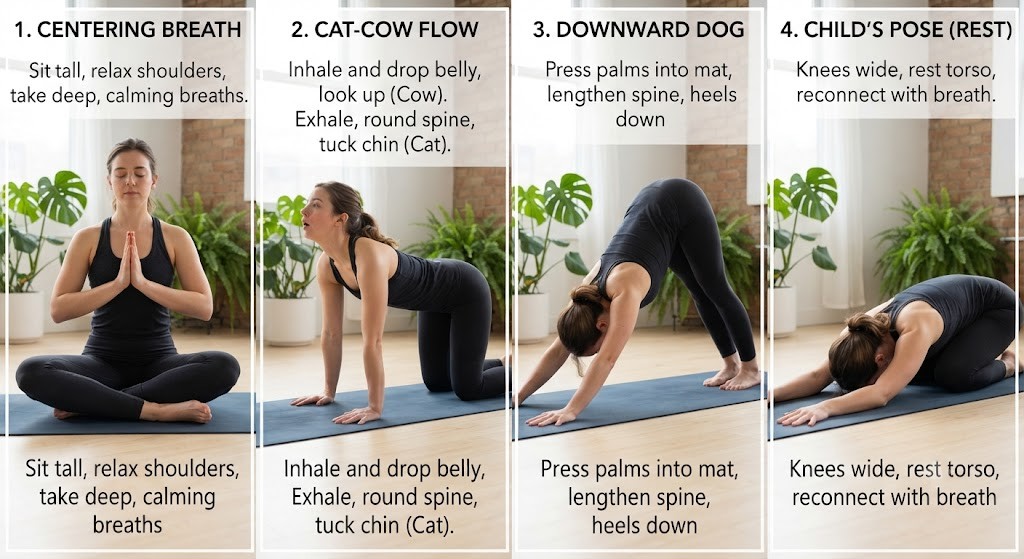
A typical Recovery Yoga session combines gentle mobility, comfortable stretches, focused breathing, and relaxation rather than strenuous poses. For example, five slow Cat-Cow repetitions followed by Child’s Pose can encourage comfortable movement without creating another demanding training stimulus.
Yoga generally combines physical postures, breathing techniques, and meditation, while different yoga styles can range from gentle to physically demanding. — Source: NCCIH, 2026.
The key is intensity. Recovery Yoga should leave you feeling calmer and more comfortable rather than exhausted. You should be able to move slowly, maintain control, and breathe normally throughout the practice.
Why Is Recovery Yoga Important After Exercise?
Recovery Yoga can complement relaxation, mobility, and overall recovery without replacing the fundamentals of recovery. It can be especially useful when you want to move after training but don’t want to add another intense workout.
Recovery Yoga works best alongside:
- Adequate sleep
- Proper nutrition
- Sufficient hydration
- Rest days
- Appropriate training volume
- A well-structured exercise program
For example, a 10-minute gentle yoga session may help you incorporate comfortable movement after training, but it cannot compensate for consistently poor sleep or excessive training.
Does Stretching Prevent Post-Workout Soreness?
It’s important to keep expectations realistic. Evidence does not support promising that stretching alone eliminates post-workout soreness.
A 2021 systematic review included 11 randomized trials and 229 participants and found insufficient evidence that post-exercise stretching improves strength recovery or delayed-onset muscle soreness. — Source: PubMed, 2021.
Therefore, think of Recovery Yoga as a tool for comfortable movement, relaxation, and mobility, rather than a guaranteed solution for muscle soreness.
What Are the Best Recovery Yoga Poses for Beginners?
The best Recovery Yoga poses are movements that encourage comfortable mobility and relaxation without causing pain or significantly increasing fatigue. Beginners should prioritize control over depth and breathe normally throughout each position.
Here are several beginner-friendly options that can form the foundation of a Recovery Yoga routine.
Child’s Pose and Cat-Cow
Child’s Pose provides a gentle resting position, while Cat-Cow introduces controlled spinal movement.
For example:
- Hold Child’s Pose for 30–60 seconds.
- Move into Cat-Cow.
- Perform 5–8 slow repetitions.
- Keep the movement smooth and comfortable.
Rather than forcing your spine into a large range of motion, focus on slow, controlled movement. This makes the combination useful after workouts or long periods of sitting.
Supine Twist
Supine Twist provides gentle rotational movement while keeping the body supported by the floor.
Lie comfortably on your back and allow your knees to move gently toward one side. Keep the movement within a comfortable range and avoid forcing the rotation.
A practical starting point is 20–30 seconds per side.
Low Lunge
Low Lunge can provide a gentle way to work through hip mobility, particularly around the front of the hip.
Keep the position controlled and avoid pushing aggressively into the stretch. Hold for approximately 20–30 seconds per side, adjusting the range to your comfort level.
Low Lunge can be particularly useful after activities involving repetitive leg movement, such as walking or running.
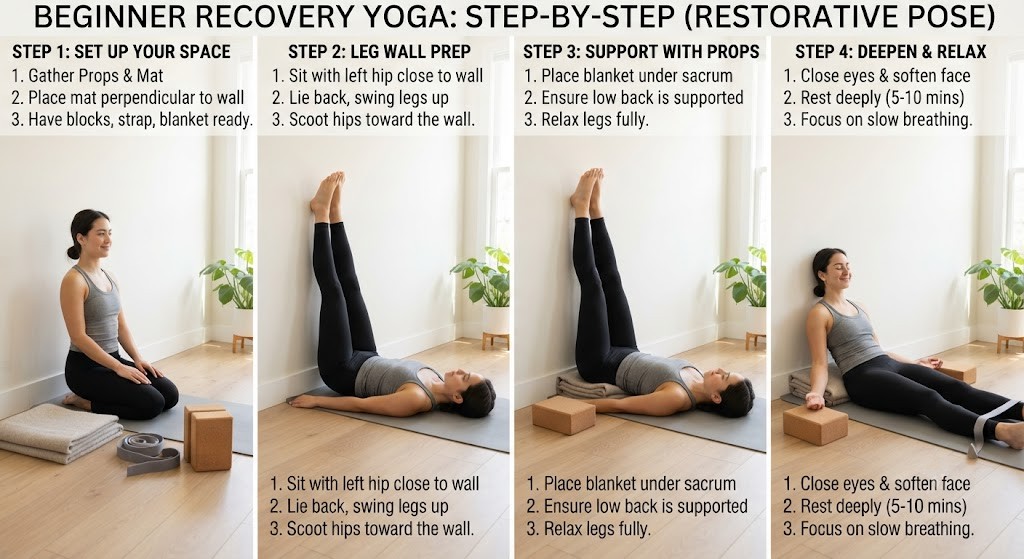
Legs-Up-the-Wall
Legs-Up-the-Wall is a quiet finishing position that can help you transition toward relaxation.
Use a wall for support and remain in the position for approximately 1–3 minutes while gradually slowing your breathing.
If any position causes sharp pain, numbness, dizziness, or unusual discomfort, stop and adjust or discontinue the pose.
Recovery Yoga Pose Guide
| Recovery Yoga Pose | Suggested Time | Primary Focus |
|---|---|---|
| Cat-Cow | 1 minute | Spinal mobility |
| Child’s Pose | 30–60 sec | Relaxation |
| Low Lunge | 20–30 sec/side | Hip mobility |
| Supine Twist | 20–30 sec/side | Gentle rotation |
| Reclined Bound Angle | 1–2 min | Relaxation |
| Legs-Up-the-Wall | 1–3 min | Downshifting |
How Do You Do a 10-Minute Recovery Yoga Routine?
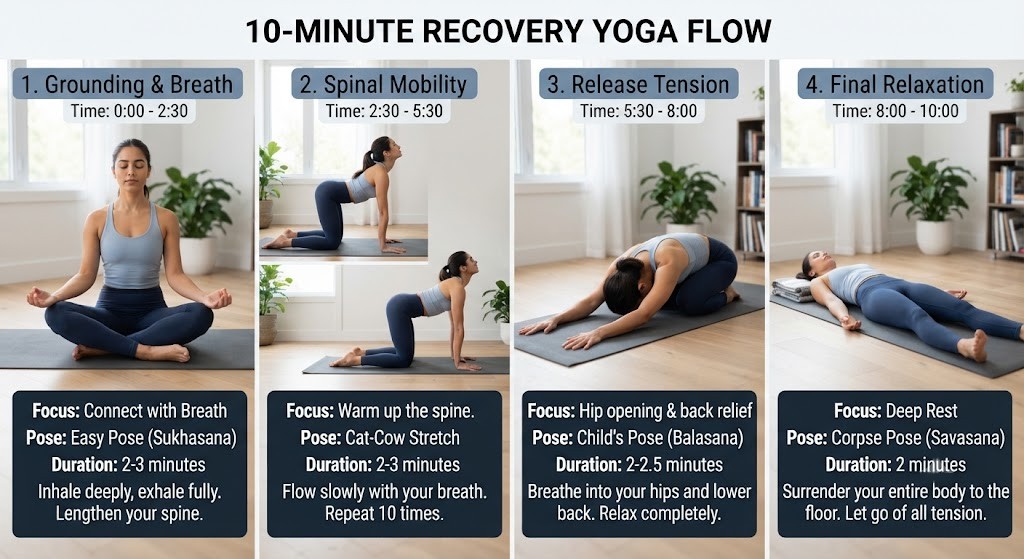
A 10–15 minute Recovery Yoga session provides a simple way to incorporate gentle movement into a post-workout or active-recovery routine. The objective isn’t to work harder. Instead, you should finish feeling calmer, looser, and more comfortable.
A Simple 10-Minute Recovery Yoga Sequence
1. Start with slow breathing — 1 minute
Begin in a comfortable seated or lying position. Breathe gently through your nose and allow your exhale to become relaxed.
2. Cat-Cow — 1 minute
Move slowly between the two positions. Focus on controlled spinal movement rather than achieving maximum range.
3. Child’s Pose — 1 minute
Allow your body to settle into a comfortable resting position. Keep the pose gentle rather than trying to force a deeper stretch.
4. Low Lunge — 2 minutes
Spend approximately 60 seconds on each side. Adjust the depth so the position remains comfortable.
5. Supine Twist — 2 minutes
Spend approximately 60 seconds per side, moving only through a comfortable range.
6. Reclined Bound Angle or Legs-Up-the-Wall — 3 minutes
Finish with a relaxed position. Let your breathing slow naturally and use the final minutes to transition toward rest.
By keeping the entire sequence gentle, you can use it immediately after an easier workout or later in the day when your body feels stiff.
Is Yoga Good for Muscle Recovery After a Workout?
Yoga can support recovery by encouraging gentle movement and relaxation, but it should not be presented as a guaranteed treatment for muscle soreness. Its practical value is as a low-demand mobility and relaxation practice.
A 2025 umbrella review examined 29 systematic reviews covering 863 unique randomized controlled trials and 24 physiotherapy treatments for delayed-onset muscle soreness. The review concluded that evidence for stretching and exercise-based approaches remained weak compared with several other recovery interventions. — Source: Sports Medicine, 2025.
This means Recovery Yoga is best used with realistic expectations. Use it to feel better and move comfortably, rather than expecting it to completely erase soreness.
If soreness is severe, worsening, associated with an injury, or unusually persistent, seek appropriate medical or professional advice.
When Is the Best Time to Do Recovery Yoga?
The best time to practice Recovery Yoga depends on your workout, soreness, energy level, and recovery goals. A short routine can work immediately after exercise, while a slower session may be more appropriate later in the day.
Recovery Yoga After Different Types of Exercise
- After running: Use Low Lunge, gentle hamstring stretches, and Child’s Pose.
- After walking: Use Cat-Cow, Low Lunge, and Supine Twist.
- After strength training: Focus on comfortable mobility for the muscles trained.
- After cycling: Emphasize the hips, quadriceps, hamstrings, and spine.
- After HIIT: Keep the session especially gentle and prioritize breathing.
- On rest days: Use a longer 15–20 minute restorative-style session.
The important distinction is that Recovery Yoga should complement your training rather than replace it.
Adults are generally advised to accumulate at least 150 minutes of moderate-intensity activity and two days of muscle-strengthening activity each week. Recovery Yoga can complement that training rather than replace it. — Source: CDC, 2025.
What Is the Difference Between Recovery Yoga and Restorative Yoga?
Recovery Yoga is an informal approach focused on post-exercise or fatigue-related recovery, while Restorative Yoga is a slower yoga style that emphasizes supported poses and deep relaxation.
The two approaches can overlap, but their purposes aren’t exactly the same.
For example, a Recovery Yoga session might include Cat-Cow and Low Lunge after running. A Restorative Yoga session may instead use blankets, bolsters, and longer supported positions with an emphasis on relaxation.
| Recovery Yoga | Restorative Yoga |
|---|---|
| Often follows exercise | Can be practiced independently |
| Focuses on mobility and recovery | Strong emphasis on relaxation |
| Usually short and practical | Often slower and longer |
| May include gentle movement | Uses supported, low-effort poses |
If your primary goal is gentle post-workout movement, Recovery Yoga may be a practical choice. If your priority is prolonged relaxation with minimal physical effort, a restorative-style practice may be more appropriate.
Can Recovery Yoga Help With Sore and Tight Muscles?
Recovery Yoga can help you move comfortably when muscles feel tight, but it shouldn’t be used to forcefully stretch painful or injured tissue.
Gentle movement can feel useful when stiffness is related to exercise or prolonged sitting. For example, if your hips feel stiff after a long walk, try a comfortable Low Lunge instead of pushing toward the deepest possible stretch.
The goal is not to maximize flexibility during recovery. Instead, focus on controlled movement and a comfortable range of motion.
Furthermore, yoga may support general wellness, including stress management, sleep, and balance, although research findings vary by population and yoga style. — Source: NCCIH, 2026.
What Tools Do You Need for Recovery Yoga?
Recovery Yoga requires very little equipment. Beginners can start with a mat and enough comfortable floor space to move safely.
Optional equipment can make certain positions easier to modify or support.
- Yoga mat: Provides cushioning and grip.
- Yoga blocks: Bring the floor closer during modified poses.
- Yoga strap: Helps with controlled positioning.
- Bolster or pillow: Supports restorative positions.
- Blanket: Adds comfort under the knees or hips.
- Wall: Supports Legs-Up-the-Wall.
You don’t need an elaborate home studio to begin. A comfortable space, a few minutes, and an appropriately gentle sequence are enough to establish a consistent practice.
How Often Should You Do Recovery Yoga?
Most people can use Recovery Yoga several times per week when sessions remain gentle and fit their overall training load. The appropriate frequency depends on how demanding your workouts are and how your body responds.
A simple approach is to:
- Practice 5–10 minutes after two or three demanding workouts.
- Add 10 minutes of mobility and relaxed stretching after easier workouts.
- Use a 15–20 minute session on one easier recovery day.
- Choose gentle breathing and supported poses before bed.
- Reduce intensity rather than adding more stretching after unusually hard sessions.
If Recovery Yoga consistently leaves you more fatigued, shorten the session or reduce its intensity.
Ultimately, consistency matters more than complexity. A short routine you can perform regularly is often more practical than an elaborate sequence you rarely complete.
How to Build a Recovery Yoga Habit
Building a Recovery Yoga habit means matching short, gentle sessions to your training schedule instead of treating recovery as another workout.
Start with movements that feel comfortable, then adjust the duration and sequence based on your training demands.
A Simple Weekly Recovery Yoga Framework
- After demanding workouts: Perform 5–10 minutes of gentle Recovery Yoga.
- After easy workouts: Add 10 minutes of mobility and relaxed stretching.
- On recovery days: Practice 15–20 minutes at an easy pace.
- Before bed: Choose breathing, supported poses, and relaxation.
- After unusually hard sessions: Reduce intensity rather than adding more stretching.
This approach helps make recovery part of your training routine without creating unnecessary physical stress.
Common Recovery Yoga Mistakes to Avoid
Recovery Yoga should feel restorative, so avoid turning it into another intense workout. A few simple principles can help keep the practice appropriate.
Stretching Too Aggressively
Deeper isn’t automatically better. Avoid forcing sore muscles into extreme positions or trying to maximize your range of motion immediately after demanding exercise.
Holding Your Breath
Breathing should remain comfortable and controlled. If you find yourself holding your breath to maintain a position, reduce the intensity.
Ignoring Pain
Normal stretching sensations and sharp or unusual pain aren’t the same. Stop any movement that causes sharp pain, numbness, dizziness, or unusual discomfort.
Treating Yoga as a Replacement for Recovery Basics
Recovery Yoga works alongside sleep, hydration, nutrition, rest, and appropriate training—not instead of them.
Doing Too Much
A recovery session doesn’t need to be long. Ten focused minutes can be more practical than an unnecessarily demanding routine.
How to Make Recovery Yoga More Effective
A few simple adjustments can make your Recovery Yoga practice more sustainable.
Keep the intensity low. Recovery should not feel like a competition to achieve deeper poses.
Match the routine to your workout. After running, emphasize comfortable hip and leg mobility. After cycling, spend more time with the hips, quadriceps, hamstrings, and spine.
Use breathing as a guide. Slow, relaxed breathing can help keep the session from becoming unnecessarily intense.
Prioritize consistency. A manageable 10-minute routine performed regularly can be easier to maintain than a complicated practice.
Listen to your body. Your mobility and energy can vary from day to day, so adjust the routine accordingly.
Conclusion
Recovery Yoga is a gentle practice that can complement training through comfortable movement, mobility, breathing, and relaxation. The most useful routine isn’t necessarily the longest or most challenging one. Instead, it’s the practice that helps you finish feeling better without adding unnecessary physical stress.
Recovery Yoga should also be viewed as one part of a broader recovery strategy. Adequate sleep, nutrition, hydration, rest, and appropriate training volume remain essential, while gentle yoga can provide a practical way to incorporate movement and relaxation into your routine.
Start with 10 minutes, stay within a comfortable range, and adapt your practice to what your body needs. With consistency and realistic expectations, Recovery Yoga can become a simple, sustainable part of your overall training routine.
FAQs
What is Recovery Yoga?
Recovery Yoga uses gentle movement, stretching, breathing, and relaxation to support recovery.
What is the best yoga for recovery?
Gentle Recovery Yoga supports mobility, relaxation, and comfortable movement.
Is yoga good for recovery?
Yes, yoga can support relaxation, flexibility, mobility, and gentle movement.
How can I recover from DOMS?
Rest, sleep, hydration, nutrition, and gentle movement can support DOMS recovery.
What are some good full-body active recovery workouts?
Walking, gentle yoga, light cycling, and mobility exercises are good active recovery options.
Is Recovery Yoga good after a workout?
Yes, it provides gentle movement and relaxation after exercise.
How long should a Recovery Yoga session be?
A 10–15 minute session is a simple starting point for recovery.
What are the best Recovery Yoga poses for beginners?
Cat-Cow, Child’s Pose, Low Lunge, Supine Twist, and Legs-Up-the-Wall are beginner-friendly poses.
Can Recovery Yoga reduce muscle soreness?
Recovery Yoga may support comfortable movement but does not guarantee relief from soreness.
Can I do Recovery Yoga every day?
Yes, gentle Recovery Yoga can be practiced regularly when it fits your training load.
Should Recovery Yoga hurt?
No, Recovery Yoga should feel comfortable and controlled.
What is the difference between Recovery Yoga and Restorative Yoga?
Recovery Yoga focuses on post-exercise recovery, while Restorative Yoga emphasizes relaxation.
Do I need equipment for Recovery Yoga?
No, a yoga mat is enough, although simple props can provide extra support.
1 thought on “Recovery Yoga: Gentle Poses for Mobility, Relaxation & Muscle Recovery”