
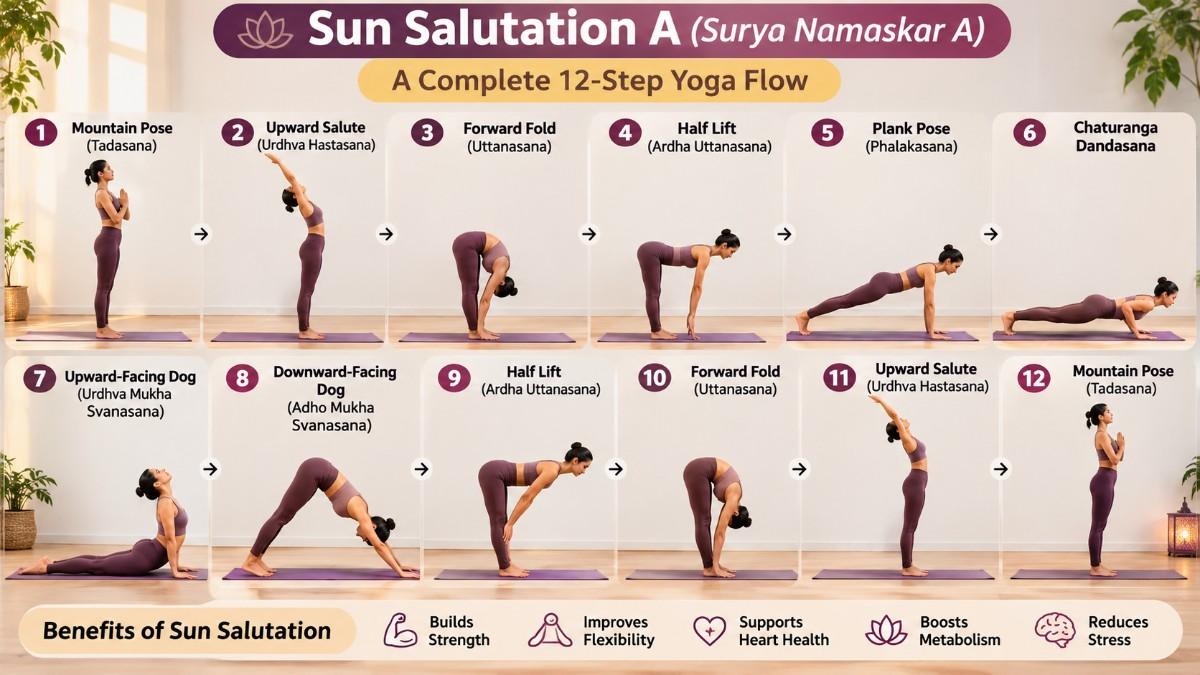
Sun Salutation A, also known as Surya Namaskar A, is a foundational sequence in Ashtanga Vinyasa Yoga that connects flowing movements with controlled breathing. This popular form of sun salutation yoga combines standing postures, forward folds, plank transitions, and backbends to develop flexibility, strength, coordination, and body awareness.
If you are searching for a traditional yoga sun salutation sequence or want to understand how Ashtanga Sun Salutation A differs from other sun salutations, this guide explains the movements, breathing pattern, benefits, and beginner modifications.
Whether you are new to Ashtanga Yoga or looking to improve your existing practice, understanding the correct Sun Salutation A steps can help you move more confidently and maintain proper technique.
What Is Sun Salutation A (Surya Namaskar A)?
Sun Salutation A is a flowing yoga sequence consisting of nine counted vinyasa movements that connect standing postures, forward folds, Chaturanga, Upward-Facing Dog, and Downward-Facing Dog. It is traditionally practised at the beginning of the Ashtanga Yoga Primary Series.
Unlike the commonly practised 12-position Surya Namaskar sequence, Ashtanga Sun Salutation A follows a specific movement and breathing pattern. Its primary purpose is to establish coordination between breath and movement while preparing the body for more demanding yoga sequences.
The sequence includes:
- Raised Arms Pose
- Standing Forward Fold
- Halfway Lift
- Chaturanga Dandasana
- Upward-Facing Dog
- Downward-Facing Dog
- Return to standing
This structured sun salutation sequence is one of the foundations of Ashtanga practice. It is also a useful starting point for learning the broader principles of yoga sun salutations, including how to coordinate movement with breathing.
Sun Salutation A is also a useful foundation for learning Ashtanga Yoga for Beginners.
Why Does Sun Salutation A Matter?
Sun Salutation A matters because it introduces the fundamental movement and breathing coordination used throughout Ashtanga Vinyasa Yoga.
Each movement follows a specific inhalation or exhalation, creating a continuous flow rather than a collection of separate yoga postures. This makes the sequence an important example of sun salute yoga, where movement and breathing work together.
Its importance includes:
- Breath coordination: Connects breathing with specific movements.
- Physical preparation: Introduces forward folds, backbends, and weight-bearing positions.
- Muscular engagement: Activates the arms, shoulders, core, legs, and back.
- Movement awareness: Encourages controlled transitions and attention to alignment.
- Practice consistency: Provides a repeatable sequence for developing a regular yoga routine.
Sun Salutation A can also be compared with the broader Sun Salutation (Surya Namaskar), which explains the traditional 12-position sequence.
9 Vinyasa Counts of Sun Salutation A
Sun Salutation A follows nine counted vinyasa movements, traditionally identified using Sanskrit numbers. Each count represents a specific transition coordinated with breathing.
The sequence begins and ends in Samasthiti, the equal standing position. Understanding these counts helps practitioners follow the traditional Ashtanga sun salutation sequence accurately.
| Count | Sanskrit count | Movement | Breathing |
|---|---|---|---|
| Starting | Samasthiti | Equal standing | Natural breathing |
| 1 | Ekam | Raised Arms Pose | Inhale |
| 2 | Dve | Standing Forward Fold | Exhale |
| 3 | Trini | Halfway Lift | Inhale |
| 4 | Chatvari | Chaturanga Dandasana | Exhale |
| 5 | Pancha | Upward-Facing Dog | Inhale |
| 6 | Sat | Downward-Facing Dog | Exhale |
| 7 | Sapta | Return to Halfway Lift | Inhale |
| 8 | Astau | Standing Forward Fold | Exhale |
| 9 | Nava | Rise with Arms Overhead | Inhale |
| Finishing | Samasthiti | Return to standing | Exhale |
In traditional Ashtanga practice, Downward-Facing Dog is held for five breaths before moving forward.
These nine counts describe the vinyasa transitions rather than nine completely separate static postures. This specific counting system distinguishes Ashtanga Sun Salutation A from other traditional sun salutations.
How to Do Sun Salutation A: Step-by-Step Instructions
Sun Salutation A begins in Samasthiti and moves through nine counted transitions before returning to the original standing position. Follow each step slowly when learning this yoga sun salutation so you can develop proper alignment and breathing coordination.
Starting Position: Samasthiti (Equal Standing Pose)
Before starting, stand upright with your feet together or comfortably positioned.
- Distribute your weight evenly across both feet.
- Keep your spine naturally extended.
- Relax your shoulders.
- Allow your arms to rest alongside your body.
- Focus on steady breathing.
This position establishes balance and prepares you for the sequence.
Step 1: Urdhva Hastasana (Raised Arms Pose)
Count 1 – Ekam | Inhale
- Stand upright with your feet grounded.
- Inhale and raise both arms overhead.
- Extend your fingers towards the ceiling.
- Lengthen your spine.
- Keep your shoulders relaxed.
- Look towards your thumbs if comfortable.
This movement lengthens the upper body and prepares the shoulders for the sequence.
Step 2: Uttanasana (Standing Forward Fold)
Count 2 – Dve | Exhale
- Exhale and fold forward from your hips.
- Bring your hands towards the floor.
- Allow your head and neck to relax.
- Keep your legs comfortably straight or slightly bent.
- Avoid forcing your chest against your thighs.
This position stretches the back of the legs and encourages hip mobility.
Step 3: Ardha Uttanasana (Halfway Lift)
Count 3 – Trini | Inhale
- Inhale and lift your chest.
- Place your fingertips on the floor, ankles, or yoga blocks.
- Extend your spine forward.
- Keep your back long and neck aligned.
- Look slightly forward or down.
The halfway lift creates spinal length and prepares the body for Chaturanga.
Step 4: Chaturanga Dandasana (Four-Limbed Staff Pose)
Count 4 – Chatvari | Exhale
- Exhale and step or jump both feet backward.
- Move into a plank position.
- Bend your elbows close to your ribs.
- Lower your body with control.
- Keep your shoulders and hips aligned.
Your body should remain stable rather than dropping towards the floor.
Beginners can modify this movement by lowering their knees before transitioning.
Step 5: Urdhva Mukha Svanasana (Upward-Facing Dog)
Count 5 – Pancha | Inhale
- Roll over your toes or transition according to your flexibility.
- Press your palms firmly into the mat.
- Straighten your arms comfortably.
- Lift your chest and thighs away from the floor.
- Keep your shoulders away from your ears.
- Look forward without compressing your neck.
Upward-Facing Dog encourages spinal extension and engages the muscles supporting the upper body.
Step 6: Adho Mukha Svanasana (Downward-Facing Dog)
Count 6 – Sat | Exhale
- Exhale and tuck your toes under.
- Lift your hips upward and backward.
- Straighten your arms.
- Allow your head to relax between your upper arms.
- Lengthen your spine.
- Keep your knees slightly bent if your hamstrings feel tight.
Hold this position for five steady breaths in the traditional Ashtanga sequence.
This posture stretches the shoulders, calves, hamstrings, and back of the body.
Step 7: Return to Ardha Uttanasana (Halfway Lift)
Count 7 – Sapta | Inhale
- Inhale and step or jump both feet forward between your hands.
- Lift your chest.
- Extend your spine.
- Place your fingertips on the floor or yoga blocks.
- Keep your gaze slightly forward.
Move carefully rather than forcing a jump if you are still developing coordination.
Step 8: Uttanasana (Standing Forward Fold)
Count 8 – Astau | Exhale
- Exhale and fold your torso over your legs.
- Relax your neck.
- Bring your hands towards your feet.
- Allow your knees to bend if needed.
- Keep your weight balanced across both feet.
This returns you to the standing forward fold.
Step 9: Urdhva Hastasana (Raised Arms Pose)
Count 9 – Nava | Inhale
- Inhale and rise from the forward fold.
- Sweep both arms overhead.
- Lengthen your spine.
- Lift your chest gently.
- Avoid excessive arching through your lower back.
After completing this movement, exhale and lower your arms to return to Samasthiti.
You have now completed one round of Sun Salutation A.

How to Breathe During Sun Salutation A
Breathing is central to Sun Salutation A because every counted transition is coordinated with an inhalation or exhalation.
Traditional Ashtanga practice commonly uses Ujjayi breathing, a controlled breathing technique performed through the nose. This breath-led approach is an essential feature of Ashtanga sun salutation yoga.
Sun Salutation A Breathing Sequence
| Movement | Breathing |
|---|---|
| Raise arms overhead | Inhale |
| Forward fold | Exhale |
| Halfway lift | Inhale |
| Chaturanga | Exhale |
| Upward-Facing Dog | Inhale |
| Downward-Facing Dog | Exhale |
| Five-breath hold | Continue steady breathing |
| Halfway lift | Inhale |
| Forward fold | Exhale |
| Raise arms | Inhale |
| Samasthiti | Exhale |
What Is Ujjayi Breathing?
Ujjayi breathing is a controlled breathing technique that creates a gentle sound as air passes through a slightly narrowed throat.
To practise comfortably:
- Stand or sit in a relaxed position.
- Breathe gently through your nose.
- Slightly narrow the back of your throat.
- Maintain a soft, steady breathing sound.
- Avoid creating excessive throat tension.
Beginners should first develop comfortable natural breathing before attempting more advanced breathing control.
For additional guidance, explore Yoga Breathing Techniques for Beginners.
Benefits of Sun Salutation A
Sun Salutation A combines dynamic movement, stretching, and muscular engagement. Its potential benefits depend on the quality, frequency, and intensity of practice.
Like other forms of yoga sun salutations, this sequence combines multiple movements into one continuous routine. However, its specific Ashtanga structure places particular emphasis on vinyasa counts and breathing coordination.
1. Improves Flexibility and Mobility
Forward folds, halfway lifts, and Downward-Facing Dog move several joints and muscle groups through different ranges of motion.
Regular practice may help maintain flexibility in:
- Hamstrings
- Calves
- Shoulders
- Hip muscles
- Spine
You can complement the sequence with Yoga for Flexibility.
2. Builds Upper-Body and Core Strength
Chaturanga and Upward-Facing Dog require muscular engagement throughout the upper body.
The sequence engages several muscle groups, including:
- Triceps
- Shoulders
- Chest
- Abdominal muscles
- Back muscles
- Legs
Repeated practice can help develop muscular endurance.
3. Develops Movement Coordination
Synchronizing each transition with breathing helps develop coordination and body awareness.
This is particularly useful for beginners learning to move smoothly between yoga positions.
4. Supports Cardiovascular Fitness
Repeated rounds performed continuously can increase heart rate and contribute to physical activity. However, cardiovascular intensity varies depending on pace, fitness level, and number of rounds.
5. Encourages Mindful Movement
Focusing on breathing, posture, and transitions can make Sun Salutation A a moving mindfulness practice.
It encourages practitioners to pay attention to their movements instead of rushing through the sequence.
6. Engages Multiple Muscle Groups
Sun Salutation A combines standing, bending, and weight-bearing movements in one routine. This makes it a convenient full-body movement sequence.
For additional practice ideas, explore Full Body Yoga.
How Many Rounds of Sun Salutation A Should You Do?
Beginners can start with 1–2 rounds of Sun Salutation A and gradually increase their practice as their technique and stamina improve.
Traditional Ashtanga practice commonly includes five rounds, but this is not a requirement for every practitioner. The number of rounds should depend on your comfort, experience, and ability to maintain controlled movement.
| Experience level | Suggested rounds |
|---|---|
| Complete beginner | 1–2 |
| Beginner | 2–3 |
| Intermediate | 3–5 |
| Experienced | 5 or more, depending on practice |
These are practical suggestions rather than fixed training requirements.
Once you become comfortable with regular Sun Salutation A practice, you can explore our 108 Sun Salutations: Benefits, Meaning, Preparation & Safety Guide to learn how to prepare for a longer yoga challenge safely.
Beginner recommendation: Prioritize correct alignment, comfortable breathing, and controlled transitions over completing more rounds.
Sun Salutation A vs. Sun Salutation B
Sun Salutation A and Sun Salutation B are two foundational sequences in Ashtanga Vinyasa Yoga. Both coordinate movement with breathing, but Sun Salutation B includes additional postures and transitions.
Understanding the difference between sun salutation a and sun salutation b can help you choose the appropriate sequence for your current practice level.
| Feature | Sun Salutation A | Sun Salutation B |
|---|---|---|
| Vinyasa count | 9 | 17 |
| Chair Pose | No | Yes |
| Warrior I | No | Yes |
| Complexity | Foundational | More involved |
| Traditional rounds | 5 | 3 |
To understand the complete sequence in more detail, read our Sun Salutation B: Steps, Benefits, Breathing & Beginner’s Guide, which explains all 17 vinyasa counts, including Chair Pose and Warrior I.
Sun Salutation A includes raised arms, forward folds, halfway lifts, Chaturanga, Upward-Facing Dog, and Downward-Facing Dog.
Sun Salutation B introduces Chair Pose (Utkatasana) and Warrior I (Virabhadrasana I) on both sides, creating additional transitions and muscular demands.
Both sequences are important components of traditional Ashtanga practice. If you want to learn the second sequence in more detail, a dedicated Sun Salutation B guide can explain its steps, breathing pattern, and benefits.
Sun Salutation A vs. Traditional Surya Namaskar
Sun Salutation A is not exactly the same as every traditional 12-position Surya Namaskar sequence.
Although both share the broader idea of saluting the sun through coordinated yoga movements, their structures differ. This distinction is useful when comparing Ashtanga sun salutations with the traditional forms of Surya Namaskar commonly taught in other yoga styles.
| Feature | Ashtanga Sun Salutation A | Traditional 12-position Surya Namaskar |
|---|---|---|
| Sequence | Nine counted vinyasas | Commonly 12 positions |
| Yoga tradition | Ashtanga Vinyasa | Various Hatha and traditional yoga approaches |
| Main movements | Chaturanga, Upward Dog, Downward Dog | Includes lunges and additional transitions |
| Breathing | Specific vinyasa coordination | Varies by tradition |
| Practice style | Dynamic flowing sequence | Traditional cyclical sequence |
The exact sequence can vary across yoga schools, so it is important to understand which version you are practising.
Beginner Modifications for Sun Salutation A
Beginners can modify Sun Salutation A to make the sequence more accessible without losing its essential movement pattern.
Bend Your Knees During Forward Folds
If your hamstrings are tight, slightly bend your knees during Uttanasana. This can make it easier to fold without pulling excessively on the back of your legs.
Use Blocks for Halfway Lifts
Place yoga blocks under your hands during Ardha Uttanasana to support your upper body and maintain a longer spine.
Modify Chaturanga
Lower your knees to the mat and practise a controlled transition instead of attempting a full Chaturanga before developing sufficient strength.
Practise Cobra Instead of Upward-Facing Dog
If Upward-Facing Dog feels uncomfortable, use a gentle Cobra variation with your thighs resting on the mat.
Step Instead of Jumping
You do not need to jump between positions. Step your feet forward and backward slowly until your coordination improves.
If you prefer a gentler practice, explore Gentle Yoga.
Common Sun Salutation A Mistakes to Avoid
Avoiding these mistakes can improve your technique and make your practice more comfortable.
- Rushing through transitions: Move at a pace that allows you to coordinate your breathing.
- Collapsing the lower back: Maintain controlled spinal movement during backbends.
- Dropping the hips in Chaturanga: Keep your body aligned and modify the pose if necessary.
- Forcing the heels down: Your heels do not need to touch the floor in Downward-Facing Dog.
- Holding your breath: Maintain a comfortable breathing rhythm.
- Overstretching the hamstrings: Bend your knees when needed.
- Ignoring wrist discomfort: Distribute pressure through your hands and modify weight-bearing positions when necessary.

How to Include Sun Salutation A in Your Morning Yoga Routine
Sun Salutation A can be included in a morning yoga routine as a movement sequence or as preparation for a longer Ashtanga practice.
Here is a simple beginner routine:
| Activity | Duration |
|---|---|
| Gentle joint warm-up | 3 minutes |
| Sun Salutation A | 3–5 minutes |
| Rest and natural breathing | 1 minute |
| Gentle stretching | 3 minutes |
| Relaxation | 2 minutes |
You can gradually build towards a longer routine as your flexibility and movement control improve.
For more structured practice ideas, explore Morning Yoga for Energy and Flexibility and 15 Minute Daily Yoga Routine.
As your practice develops, you may also explore other forms of sun salutation yoga, including Sun Salutation B and longer challenges such as 108 Sun Salutations. Build your experience gradually rather than jumping into demanding routines before you are ready.
Conclusion
Sun Salutation A (Surya Namaskar A) is a foundational Ashtanga Yoga sequence that connects nine counted vinyasa movements with controlled breathing. It combines forward folds, halfway lifts, Chaturanga, Upward-Facing Dog, and Downward-Facing Dog into a continuous flow.
Whether you call it Ashtanga Sun Salutation A, a yoga sun salutation, or part of the wider practice of sun salutations, the key is to understand its movement pattern and breathing coordination.
Beginners should focus on learning each movement, maintaining comfortable breathing, and developing proper alignment before increasing the number of rounds. With consistent and appropriate practice, Sun Salutation A can become a valuable part of a balanced yoga routine.
FAQs
How many poses are in Sun Salutation A?
Sun Salutation A contains nine counted vinyasa movements, connecting several yoga positions from standing through forward folds and plank transitions to Downward-Facing Dog and back to standing.
How many times should I perform Sun Salutation A?
Traditional Ashtanga practice commonly includes five rounds. Beginners can start with one or two rounds and gradually increase according to their ability.
Is Sun Salutation A suitable for beginners?
Yes. Beginners can learn the sequence with modifications such as bent knees, yoga blocks, stepping instead of jumping, and modified Chaturanga.
What is the difference between Sun Salutation A and B?
Sun Salutation A contains nine counted vinyasas, while Sun Salutation B contains seventeen and introduces Chair Pose and Warrior I.
Does Sun Salutation A help with weight loss?
It contributes to physical activity and energy expenditure, but weight loss depends on overall calorie balance, nutrition, activity levels, and consistency.
What breathing technique is used in Sun Salutation A?
Traditional Ashtanga practice uses Ujjayi breathing, coordinating inhalations and exhalations with individual movements.
Can I practise Sun Salutation A every day?
Many people can practise an appropriately modified version regularly. However, intensity, recovery, physical limitations, and individual health conditions should be considered.
What is the five-breath hold in Sun Salutation A?
The five-breath hold occurs in Downward-Facing Dog (Adho Mukha Svanasana), where practitioners maintain the posture while taking five steady breaths.
Is Sun Salutation A the same as traditional Surya Namaskar?
No. Ashtanga Sun Salutation A follows a specific nine-vinyasa sequence, whereas traditional Surya Namaskar commonly follows a 12-position sequence with different movements and transitions.
Sources
- Ashtanga Yoga. (2026). Sūrya Namaskāra A – The Count, the State and the Dṛṣṭi.
- Ashtanga Yoga. (2026). Primary Series – The Count, the Dṛṣṭi and the Grips.
- AshtangaYoga.info. Surya Namaskara A and B Practice Sheet.
- Ashtanga Yoga Denver. Sūrya Namaskāra A – Sun Salutation A.
- Religions. Modern Postural Yoga, Meditation, and Spiritual Seeking: Ashtanga Vinyasa Yoga and Moving Meditation.
Disclaimer: This article is for informational and educational purposes only and is not a substitute for personalized medical advice. Consult a qualified healthcare professional before making significant changes to your diet, exercise routine, or supplement use.