
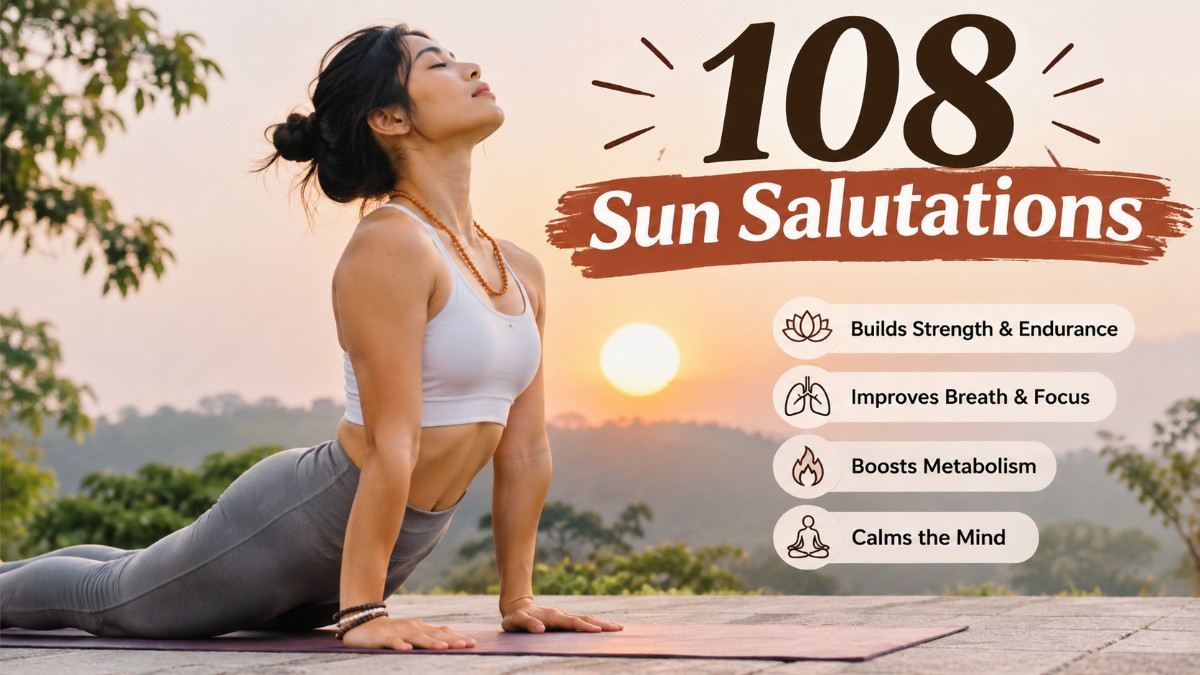
Practising 108 Sun Salutations is a traditional yoga challenge that involves repeating a Sun Salutation sequence 108 times in one session. It is often performed during seasonal transitions, yoga gatherings, personal milestones, and special spiritual occasions.
Also known as a 108 Sun Salutations challenge, this practice brings together physical movement, breathing, concentration, and discipline. Whether you follow traditional Surya Namaskar or an Ashtanga sun salutation sequence, completing 108 rounds requires stamina, mobility, and consistent breathing.
The practice can be physically demanding, requiring stamina, concentration, mobility, and consistent breathing. Whether you are considering your first challenge or want to understand its significance, proper preparation and pacing can help make the experience more manageable.
What Are 108 Sun Salutations?
108 Sun Salutations is a yoga practice in which practitioners complete 108 repetitions of a Sun Salutation sequence, commonly Surya Namaskar A, a traditional 12-position variation, or another sequence selected by the instructor.
The Sanskrit name Surya Namaskar translates to “Salutation to the Sun.” This traditional yoga sun salutation practice combines physical postures, breathing, and focused movement.
Unlike an ordinary short yoga warm-up, completing 108 rounds is an extended session that can take considerable time and physical effort. The exact duration depends on the sequence, breathing pace, rest periods, and experience level.
The practice may include:
- Standing and forward-folding postures
- Plank and Chaturanga transitions
- Upward-Facing Dog or Cobra
- Downward-Facing Dog
- Lunging movements in some Surya Namaskar variations
- Repeated breathing and movement coordination
The traditional sun salutations can be performed using different variations, depending on the practitioner’s experience and the yoga style being followed.
Sun Salutation: Steps, Benefits, Poses & Beginner’s Guide
Why Are 108 Sun Salutations Significant?
The number 108 has spiritual and symbolic significance in several Indian traditions, including yoga, Hinduism, and Buddhism. It is commonly associated with prayer beads, meditation practices, and traditional spiritual rituals.
In yoga communities, completing 108 Sun Salutations is often treated as a symbolic practice of dedication, discipline, reflection, and renewal.
Some traditional explanations connect the number 108 with:
- Mala beads: Traditional japa malas commonly contain 108 beads used for mantra repetition.
- Spiritual practice: The number is associated with prayer, meditation, and devotional rituals.
- Yoga traditions: Some yoga communities use 108 repetitions for special practices and ceremonies.
- Seasonal transitions: Group sessions are sometimes organised around the solstices and equinoxes as symbolic opportunities for reflection and change.
These associations are cultural and spiritual interpretations rather than scientifically established explanations of the number.
Benefits of 108 Sun Salutations
Completing 108 rounds involves repeated movement, muscular engagement, and sustained concentration. The potential benefits depend on the sequence, intensity, individual fitness, and recovery.
Like other forms of sun salutation yoga, this practice combines multiple movements into a continuous flow. However, completing 108 repetitions creates a much longer physical challenge than a regular yoga sun salutation routine.
1. Builds Muscular Endurance
Repeated Sun Salutations involve several muscle groups working continuously throughout the practice.
Depending on the variation, the sequence may engage:
- Quadriceps and hamstrings
- Glutes and calves
- Shoulders and triceps
- Chest and upper back
- Abdominal muscles
The repeated transitions can challenge muscular endurance, particularly in the legs, shoulders, and core.
2. Supports Cardiovascular Fitness
A continuous Sun Salutation practice can increase heart rate and breathing rate. Completing many rounds may provide a sustained period of physical activity.
However, the cardiovascular demand varies significantly according to pace, fitness level, and the chosen sequence. It should not automatically be treated as a replacement for a balanced cardiovascular exercise programme.
3. Improves Movement Coordination
Sun Salutations coordinate breathing with transitions between postures. Repeating the same sequence can help practitioners become more familiar with the movement pattern.
This may support body awareness, balance, and movement control.
4. Develops Flexibility and Mobility
The sequence moves the body through forward folds, spinal extensions, shoulder movements, and hip positions.
Regular practice may help maintain mobility in the:
- Hamstrings
- Shoulders
- Hips
- Ankles
- Spine
For additional flexibility-focused practice, explore Yoga for Flexibility
5. Encourages Focus and Mental Discipline
Completing 108 rounds requires attention and consistency. Practitioners often focus on breathing, counting, and maintaining a steady movement rhythm.
This repetitive structure can become a moving mindfulness practice. The experience may also encourage greater awareness of how the body responds during extended yoga sun salutations.
6. Creates a Sense of Personal Achievement
Finishing a demanding yoga challenge may provide a sense of accomplishment. Group sessions can also create a shared experience of commitment and encouragement.
Remember that completing all 108 rounds is not a measure of personal worth or yoga ability. Modifying the practice or stopping when needed is equally valid.
Which Sun Salutation Sequence Should You Use for 108 Rounds?
The sequence you choose matters because 108 repetitions can create substantial physical fatigue. A shorter, familiar sequence is generally easier to sustain than a more complicated flow.
Different sun salutations have different movements and physical demands. Choosing the right variation can make the challenge more manageable.
| Sequence | Main characteristics | Considerations |
|---|---|---|
| Traditional 12-position Surya Namaskar | Includes standing, lunging, forward-folding, and floor-based movements | Commonly used for repetitive practice |
| Sun Salutation A | Foundational Ashtanga sequence with Chaturanga and Downward-Facing Dog | Requires repeated upper-body weight-bearing |
| Sun Salutation B | Adds Chair Pose and Warrior I on both sides | More demanding and longer per round |
| Modified Sun Salutation | Uses simpler transitions and optional rest positions | Allows individual adjustments |
For a first attempt, choose a sequence you already know rather than learning a complicated variation during the challenge.
Understanding the differences between Sun Salutation A and Sun Salutation B can help you select a suitable sequence for your experience level.
Sun Salutation A: Steps, Benefits, Breathing & Beginner’s Guide
Sun Salutation B: Steps, Benefits, Breathing & Beginner’s Guide
How to Prepare for 108 Sun Salutations
Preparing for 108 rounds is important because the repeated movements can place considerable demands on your muscles and joints.
1. Build Your Practice Gradually
Do not make 108 rounds your first attempt at a long Sun Salutation session.
Start with a manageable number of rounds and increase gradually as your strength, coordination, and recovery improve.
A possible progression is:
| Practice stage | Suggested rounds |
|---|---|
| Initial practice | 5–10 |
| Building consistency | 15–20 |
| Developing endurance | 25–36 |
| Longer practice | 45–54 |
| Advanced challenge | 72–108 |
These are illustrative progression stages, not a validated training programme. Take as much time as necessary between stages.
2. Learn the Sequence Properly
Before attempting a high number of repetitions, become comfortable with the alignment and transitions in your chosen sequence.
Pay particular attention to:
- Forward folds and halfway lifts
- Plank and Chaturanga transitions
- Upward-Facing Dog or Cobra
- Downward-Facing Dog
- Breathing coordination
- Safe transitions between standing and floor positions
Understanding the movements in a traditional sun salutation sequence can help reduce unnecessary strain during repeated practice.
Practise Yoga Breathing Techniques for Beginners alongside your regular yoga sessions.
3. Develop Upper-Body and Core Strength
Repeated plank and Chaturanga movements can fatigue the shoulders, arms, and core.
Build strength gradually with suitable exercises and modified yoga postures. Avoid practising challenging weight-bearing movements to exhaustion before your 108-round session.
4. Practise Flexibility and Mobility
Spend time developing comfortable movement in your shoulders, hips, hamstrings, and ankles.
Gentle mobility work can help you move between postures without forcing your joints or muscles.
Explore Yoga for Ankle Mobility and Yoga for Hamstrings.
5. Plan Your Hydration and Meals
Begin your practice adequately hydrated. Eat familiar, easily tolerated meals and allow enough time for digestion before a demanding session.
Keep water accessible and take breaks when needed. Do not force yourself to continue if you feel dizzy, weak, or unwell.
How to Complete 108 Sun Salutations Without Rushing
Breaking 108 rounds into smaller sets can make the challenge easier to organise and mentally manage.
Here are three common counting approaches:
Option 1: Nine sets of 12
Set 1
12 rounds
Set 2
12 rounds
Set 3
12 rounds
Set 4
12 rounds
Set 5
12 rounds
Set 6
12 rounds
Set 7
12 rounds
Set 8
12 rounds
Set 9
12 rounds
9 × 12 = 108 rounds
Option 2: Twelve sets of nine
Set 1 — 9
Set 2 — 9
Set 3 — 9
Set 4 — 9
Set 5 — 9
Set 6 — 9
Set 7 — 9
Set 8 — 9
Set 9 — 9
Set 10 — 9
Set 11 — 9
Set 12 — 9
12 × 9 = 108 rounds
Option 3: Six sets of 18
Set 1 — 18
Set 2 — 18
Set 3 — 18
Set 4 — 18
Set 5 — 18
Set 6 — 18
6 × 18 = 108 rounds
Rest between sets according to your energy and physical condition. There is no requirement to finish the challenge within a particular time.
A Simple Round-Tracking Method
Use a written checklist, a counting app, or a yoga mala to track completed rounds. If you are practising with a group, an instructor can help maintain the count.
How Long Does It Take to Complete 108 Sun Salutations?
The time required depends on the sequence, pace, breathing, rest breaks, and experience of the practitioner.
For example, if one round takes an average of one minute, 108 rounds would take 108 minutes of active practice, excluding breaks.
| Average time per round | Active practice time |
|---|---|
| 30 seconds | 54 minutes |
| 45 seconds | 81 minutes |
| 1 minute | 108 minutes |
| 1.5 minutes | 162 minutes |
| 2 minutes | 216 minutes |
These are mathematical examples, not recommended target speeds. Do not rush movements to finish within a particular time.
Common Mistakes During 108 Sun Salutations
Repeated movements can make small technique problems more noticeable as fatigue develops.
1. Starting Too Quickly
Beginning at a fast pace can cause early fatigue. Start comfortably and maintain a rhythm that allows you to breathe normally.
2. Ignoring Pain
Muscle effort and fatigue can occur during exercise, but sharp or increasing joint pain should not be ignored. Stop or modify the movement if discomfort develops.
3. Forcing Chaturanga
Repeatedly lowering into Chaturanga without sufficient strength can place excessive demands on the shoulders and wrists. Use a knee-down modification or another suitable transition.
4. Locking the Knees During Forward Folds
Avoid forcing your legs straight. Slightly bending the knees can make forward folds more comfortable.
5. Forgetting to Rest
Rest periods are part of responsible practice. You do not need to complete all 108 rounds continuously.
6. Treating the Number as a Competition
The purpose of the practice can be reflection, discipline, or mindful movement. Completing fewer rounds does not make your practice unsuccessful.
Who Should Avoid or Modify 108 Sun Salutations?
108 Sun Salutations is a demanding physical challenge, not a suitable starting point for everyone. Some people may need to avoid the full practice or obtain professional guidance before participating.
Take particular care if you have:
- Recent wrist, shoulder, knee, hip, or back injuries.
- Persistent joint pain or restricted mobility.
- Cardiovascular or respiratory conditions that affect exercise tolerance.
- Balance difficulties or a history of exercise-related dizziness.
- Pregnancy-related movement restrictions.
- A medical condition that makes prolonged physical activity unsuitable.
Stop immediately if you experience chest pain, faintness, unusual shortness of breath, sharp pain, or significant dizziness. Seek medical advice when appropriate.
A modified practice with fewer rounds, gentle movements, and longer rest periods can be a better alternative.
What to Do After Completing 108 Sun Salutations
Recovery is an important part of a high-repetition yoga session. After completing the practice, give your body time to return to a comfortable resting state.
1. Rest in Child’s Pose
Practise Balasana (Child’s Pose) comfortably to relax after the repeated movements. Use a cushion or folded blanket if needed.
2. Practise Gentle Stretching
Choose comfortable stretches rather than forcing deep flexibility.
You may include:
- Gentle shoulder stretches
- Supine spinal twists
- Comfortable hip stretches
- Gentle hamstring stretches
3. Rehydrate
Drink water according to your thirst and replace fluids lost through sweating. Avoid forcing excessive amounts of water at once.
4. Eat a Balanced Meal
Choose a balanced meal containing carbohydrates, protein, and other nutrients to support recovery.
5. Allow Time for Recovery
Avoid immediately repeating another demanding session. Adjust your next workout according to soreness, fatigue, and how your body feels.
For additional recovery-focused practice, explore Recovery Yoga.

108 Sun Salutations During Seasonal Transitions
Many yoga communities organise 108 Sun Salutations around seasonal transitions, including the spring and autumn equinoxes and the summer and winter solstices.
These occasions provide an opportunity to reflect on change, set intentions, and practise together. The tradition is also used for personal milestones, yoga retreats, and community gatherings.
A seasonal practice does not need to involve completing all 108 rounds. You can participate with a smaller number of Sun Salutations, meditation, or gentle movement.
How to Make 108 Sun Salutations a Sustainable Yoga Practice
A demanding yoga challenge should fit into a balanced routine rather than become the only measure of your progress.
Consider these habits:
- Practise foundational Sun Salutation sequences regularly.
- Build endurance gradually.
- Include gentle and restorative yoga sessions.
- Develop strength outside repetitive flows.
- Prioritise sleep and recovery.
- Choose a practice pace that allows comfortable breathing.
You can complement your practice with Gentle Yoga, Morning Yoga, and 15 Minute Daily Yoga Routine.
Conclusion
108 Sun Salutations is a meaningful yoga challenge that combines repetitive movement, breathing, physical endurance, and mental focus. The number 108 carries spiritual significance in several Indian traditions, and yoga communities often use this practice to mark seasonal transitions and personal milestones.
Whether you practise traditional Surya Namaskar, Sun Salutation A, or another familiar sun salutation sequence, preparation and appropriate pacing are important.
However, completing all 108 rounds is not necessary to benefit from Sun Salutations. Choose a familiar sequence, prepare gradually, take appropriate breaks, and respect your physical limits. A mindful and safe practice is more valuable than completing a number at the expense of your well-being.
FAQs
What are 108 Sun Salutations?
108 Sun Salutations is a yoga practice involving 108 repetitions of a Surya Namaskar sequence. It is commonly performed during special yoga events, seasonal transitions, and personal challenges.
Why do yogis practise 108 Sun Salutations?
The practice combines physical movement with the symbolic significance of the number 108 in several Indian spiritual traditions. It is often associated with dedication, reflection, discipline, and renewal.
Why is the number 108 considered sacred in yoga?
The number 108 is traditionally associated with practices such as mantra repetition and prayer beads. A traditional japa mala commonly contains 108 beads, and the number appears in several Hindu and Buddhist traditions.
How long does it take to complete 108 Sun Salutations?
It depends on the sequence and pace. If each round takes one minute, the active practice takes 108 minutes, excluding rest breaks.
Can beginners do 108 Sun Salutations?
Beginners should not rush into completing all 108 rounds. Start with a smaller number, learn proper alignment, and gradually build endurance before considering a longer challenge.
Which Sun Salutation is best for 108 rounds?
A familiar, relatively simple sequence is generally more manageable for repeated practice. Traditional 12-position Surya Namaskar and Sun Salutation A are common options, while Sun Salutation B is more demanding.
Can I divide 108 Sun Salutations into smaller sets?
Yes. You can divide them into nine sets of 12, twelve sets of nine, or six sets of 18. Take rest breaks according to your needs.
Do 108 Sun Salutations help with weight loss?
The practice involves physical activity and energy expenditure, but weight loss depends on overall calorie balance, nutrition, activity levels, and consistency. Completing 108 rounds does not guarantee weight loss.
Can I practise 108 Sun Salutations every day?
It is generally not advisable to treat this demanding challenge as a daily requirement. Repeated high-volume sessions may increase fatigue and overuse risk. Allow adequate recovery and adjust the practice to your fitness level.
Is it necessary to complete all 108 rounds?
No. You can participate with fewer rounds or modified movements. The practice should respect your physical abilities rather than become a competition.
What should I eat before 108 Sun Salutations?
Choose a familiar, easily digested meal and allow enough time for digestion. Avoid experimenting with heavy meals or unfamiliar foods immediately before a demanding session.
What should I do after 108 Sun Salutations?
Rest, rehydrate, practise gentle stretches, eat a balanced meal, and allow your body to recover before another demanding workout.
Sources
- Yoga Journal – What’s So Sacred About the Number 108?
- IE Center for Health & Well-Being – Welcoming Fall with the 108 Sun Salutations
- Liforme – 108 Sun Salutations for the Summer Solstice
- Yoga With Sarah – Sun Salutations and Their Symbolism Around the Summer Solstice
Disclaimer: This article is for informational and educational purposes only and is not a substitute for personalized medical advice. Consult a qualified healthcare professional before attempting a demanding physical challenge, particularly if you have an injury or an existing medical condition.
1 thought on “108 Sun Salutations: Benefits, Meaning, Preparation & Safety Guide”