
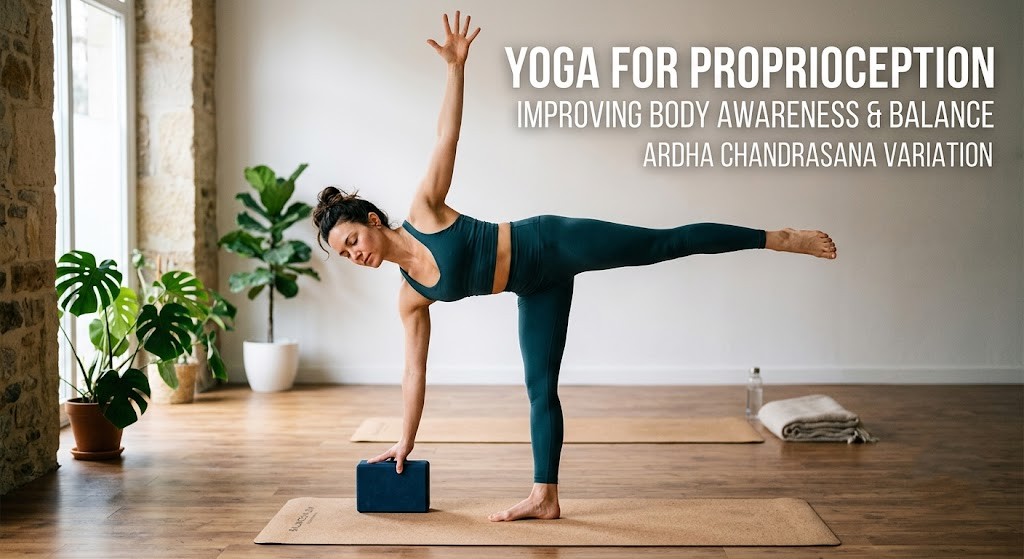
You’ve probably tried yoga to improve flexibility, strength, or relaxation, but it can also help you develop better body awareness. Proprioception is your body’s ability to sense the position and movement of its joints and limbs without relying entirely on vision.
Practising yoga for proprioception can help you become more aware of your posture, balance, and movement control. In this guide, you’ll learn six useful yoga poses, a simple beginner-friendly routine, and practical tips for practising safely at home.
What Is Yoga for Proprioception?
Yoga for proprioception involves controlled poses and movements that challenge your awareness of body position and joint movement. For example, Tree Pose requires you to sense the position of your standing foot while keeping your body upright.
Proprioception works alongside vision and the vestibular system, which helps your body understand head movement and orientation. Together, these systems support balance, coordination, and controlled movement.
Why Is Yoga for Proprioception Important?
Yoga for proprioception can support balance, coordination, posture, and movement awareness. These skills are useful for everyday activities such as walking on uneven ground, climbing stairs, exercising, and changing direction during sports.
For example, proprioceptive awareness helps you control your knee position during a squat and adjust your foot placement while walking. However, yoga cannot guarantee injury prevention or treat every balance problem.
How Does Yoga Improve Proprioception?
Yoga challenges proprioception through weight shifts, joint movements, balance poses, and controlled transitions. Holding a pose encourages you to notice your body’s position, while moving slowly helps you recognize changes in alignment.
For example, shifting your weight from both feet onto one foot in Tree Pose requires your ankle, hip, and trunk muscles to make small adjustments.
Regular practice may improve movement awareness, although results depend on your abilities, health, and consistency.
What Are the Best Yoga Poses for Proprioception?
The best yoga poses for proprioception encourage controlled movement, stable posture, and awareness of joint position. Beginners should start with simple poses before progressing to more challenging balance exercises.
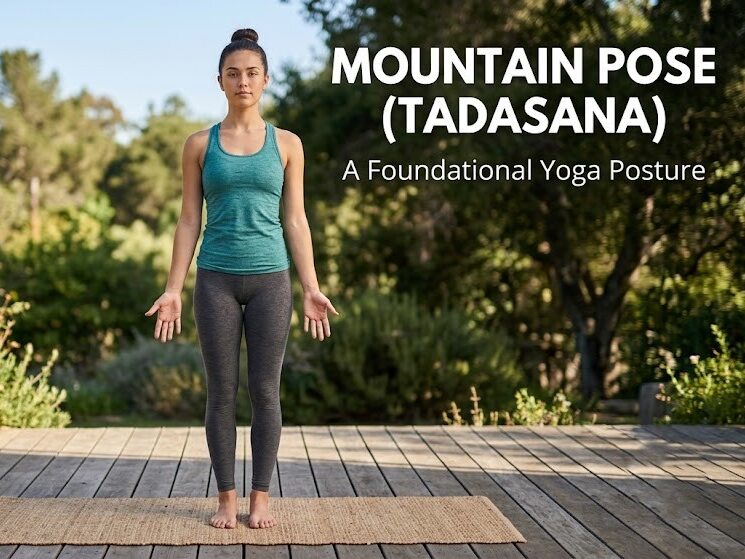
1. Mountain Pose (Tadasana)
Mountain Pose develops awareness of posture, alignment, and foot pressure.
How to do it:
- Stand with your feet comfortably apart.
- Keep your knees relaxed and your spine tall.
- Distribute your weight evenly across both feet.
- Breathe naturally and hold for 30 seconds.
Beginner tip: Stand near a wall if you feel unsteady.
2. Tree Pose (Vrksasana)
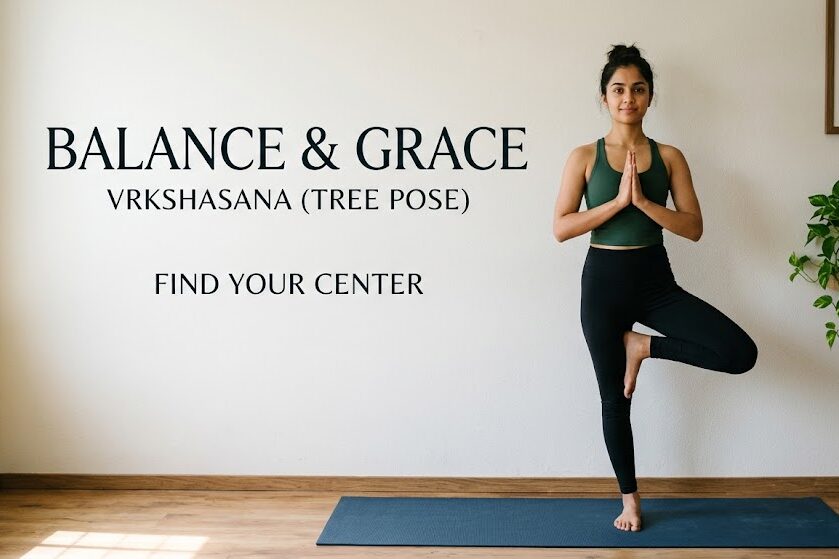
Tree Pose challenges single-leg balance and coordination by requiring you to maintain stability while standing on one foot.
How to do it:
- Stand tall and shift your weight onto one foot.
- Place the other foot against your calf or inner thigh.
- Keep your hips level and gaze at a fixed point.
- Hold for 15–30 seconds, then switch sides.
Beginner tip: Keep your raised toes on the floor or hold a sturdy chair for support.
3. Chair Pose (Utkatasana)
Chair Pose develops awareness of knee alignment, hip movement, and foot pressure. It also encourages controlled lower-body movement.
How to do it:
- Stand with your feet about hip-width apart.
- Bend your knees and move your hips backward.
- Keep your heels grounded and chest lifted.
- Hold for 15–30 seconds while breathing normally.
Beginner tip: Use a chair behind you as a reference for your squat depth.
4. Cat-Cow Pose (Marjaryasana-Bitilasana)
Cat-Cow Pose improves awareness of spinal movement by encouraging you to move your back slowly and deliberately.
How to do it:
- Start on your hands and knees.
- Inhale and gently lift your chest.
- Exhale and round your spine.
- Repeat slowly for 6–10 cycles.
Beginner tip: Place a folded towel under your knees if needed.
5. Warrior III (Virabhadrasana III)
Warrior III challenges single-leg stability, coordination, and body alignment. Because this pose can be difficult, beginners should practise it with support.
How to do it:
- Stand near a wall or sturdy chair.
- Shift your weight onto one foot.
- Lean forward from your hips while extending the other leg behind you.
- Keep your torso controlled and hold for 10–20 seconds.
- Repeat on the opposite side.
Beginner tip: Keep your hands on a stable support and focus on maintaining control rather than lifting your leg higher.
6. Triangle Pose (Trikonasana)
Triangle Pose develops awareness of hip positioning and trunk alignment while encouraging controlled movement through the torso.
How to do it:
- Stand with your feet wide apart.
- Turn one foot outward.
- Extend your arms and reach toward that leg.
- Rest your lower hand on your shin or a yoga block.
- Hold for 20–30 seconds on each side.
Beginner tip: Avoid forcing a deep stretch or locking your knees.
What Is a Simple Yoga Routine for Improving Body Awareness?
A beginner-friendly proprioceptive yoga routine combines stable standing poses, controlled movement, and supported balance exercises.
Try this sequence at home:
| Exercise | Duration | Main benefit |
|---|---|---|
| Cat-Cow Pose | 1 minute | Spinal awareness |
| Mountain Pose | 1 minute | Posture and foot pressure |
| Chair Pose | 1 minute | Joint positioning |
| Tree Pose | 2 minutes | Single-leg balance |
| Triangle Pose | 2 minutes | Hip and trunk alignment |
| Supported Warrior III | 2 minutes | Coordination and stability |
| Relaxed breathing | 1 minute | Recovery |
Allow extra time for transitions or rest if needed.
Start with Cat-Cow and Mountain Pose to prepare your body. Next, move through the standing poses slowly, using a wall or chair whenever necessary. Finish with relaxed breathing and notice how your body feels.
How Can You Make Proprioceptive Yoga More Effective?
You can improve your proprioceptive practice by moving slowly, focusing on alignment, and progressing gradually.
Follow these practical tips:
- Practise consistently: Start with 10 minutes two or three times per week.
- Move with control: Avoid rushing between poses.
- Use support: Keep a wall or sturdy chair nearby.
- Progress gradually: Increase hold times before trying harder variations.
- Breathe normally: Avoid holding your breath during balance exercises.
- Keep your eyes open: Beginners should avoid unsupported, eyes-closed balance challenges.
For additional mobility and balance practice, explore yoga for ankle mobility
What Equipment Do You Need for Proprioceptive Yoga?
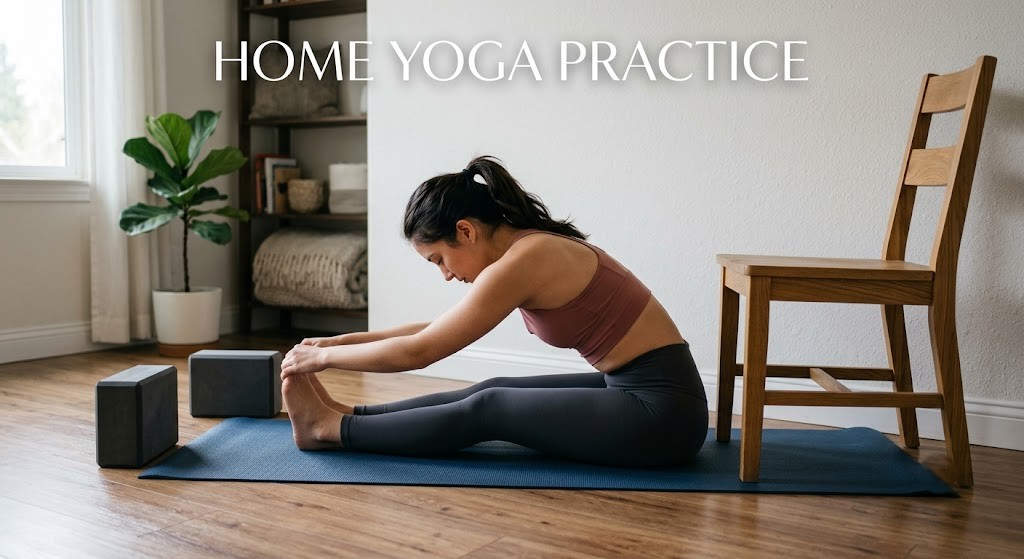
You need very little equipment to practise yoga for proprioception at home. A comfortable surface and stable support can make balance exercises more accessible.
| Equipment | Purpose |
|---|---|
| Yoga mat | Provides a comfortable practice surface |
| Wall | Offers support during balance poses |
| Sturdy chair | Helps with modified standing exercises |
| Yoga blocks | Make reaching the floor easier |
You can track your progress by recording how long you hold each pose, how much support you need, and how steady you feel. These measures help you monitor your practice but are not clinical assessments.
What Common Mistakes Should You Avoid?
The most common mistakes include rushing through poses, attempting advanced variations too early, and ignoring pain or dizziness.
Avoid these errors:
- Forcing your body into uncomfortable positions.
- Closing your eyes while balancing without suitable support.
- Holding your breath during difficult poses.
- Ignoring poor alignment or repeated loss of balance.
- Progressing before you can control the basic pose.
Stop exercising if you experience sharp pain, dizziness, or unusual instability. If you have persistent balance problems or frequent falls, seek professional guidance before continuing.
Is Yoga Enough to Improve Proprioception?
Yoga can contribute to proprioceptive training, but combining it with appropriate strength and balance exercises may provide a broader approach to movement training.
For example, you can combine yoga with functional fitness exercises,
Older adults and beginners can practise modified yoga poses. However, people with significant balance difficulties should consult a qualified healthcare professional before starting a challenging routine.
Conclusion
Yoga for proprioception offers a practical way to practise body awareness, balance, coordination, and controlled movement. Mountain Pose, Tree Pose, Chair Pose, and Warrior III provide useful starting points for beginners who want to improve their awareness of body position.
Start with 10 minutes of practice two or three times per week. Use support when needed, focus on slow movements, and increase difficulty gradually. Consistent practice and safe movement matter more than mastering advanced poses.
FAQs
What is proprioception in yoga?
Proprioception is your body’s ability to sense its position and movement without relying on vision.
Which yoga poses promote proprioception?
Tree Pose, Warrior III, Mountain Pose, Chair Pose, Cat-Cow Pose, and Triangle Pose help develop body awareness and balance.
What is the best exercise for improving proprioception?
Single-leg balance exercises, such as Tree Pose, are useful for improving balance and body awareness.
Which organ is responsible for proprioception?
Proprioception involves sensory receptors in muscles, tendons, and joints, along with the brain and spinal cord.
Is poor proprioception a symptom of ADHD?
Poor proprioception is not a defining symptom of ADHD, although some individuals may experience motor coordination difficulties.
Can yoga improve balance and coordination?
Yes, regular yoga practice can help improve balance, coordination, and movement control.
How often should I practise yoga for proprioception?
Beginners can start with 10 minutes two or three times per week.
Can beginners practise proprioceptive yoga at home?
Yes, beginners can practise simple poses at home using a wall or sturdy chair for support.
Does proprioceptive yoga prevent injuries?
Yoga may support balance and movement control, but it cannot guarantee injury prevention.
Is yoga enough to improve proprioception?
Yoga helps develop body awareness, but combining it with strength and balance exercises may provide additional benefits.
Should I close my eyes during yoga balance poses?
Beginners should keep their eyes open and use support to reduce the risk of falling.