
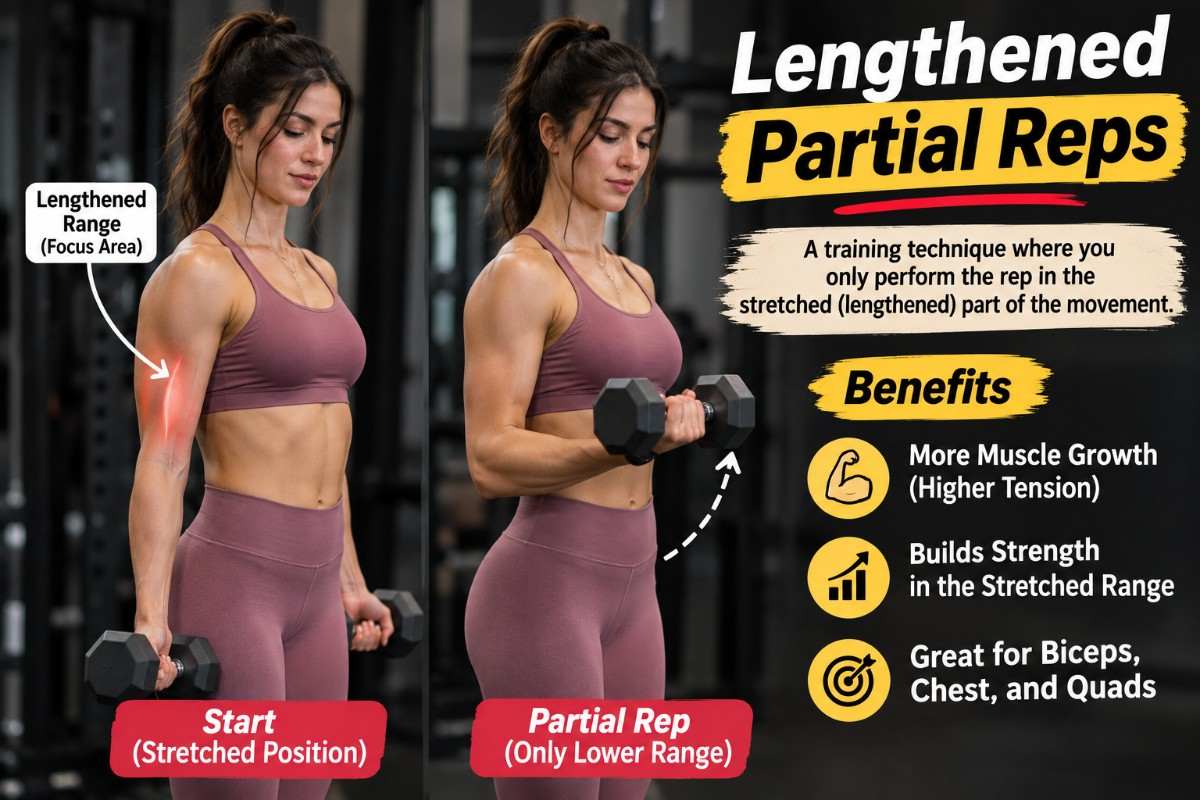
Lengthened partial reps are a strength-training technique that focuses on performing repetitions in the stretched portion of an exercise’s range of motion. This training method has gained attention among fitness enthusiasts because training muscles at longer lengths may support muscle growth. Whether you are building muscle, improving your workout routine, or looking for new training techniques, understanding lengthened partials can help you train more effectively.
What Are Lengthened Partial Reps?
Lengthened partial reps are repetitions performed through only part of an exercise’s range of motion, specifically the portion where the target muscle is in a relatively stretched position.
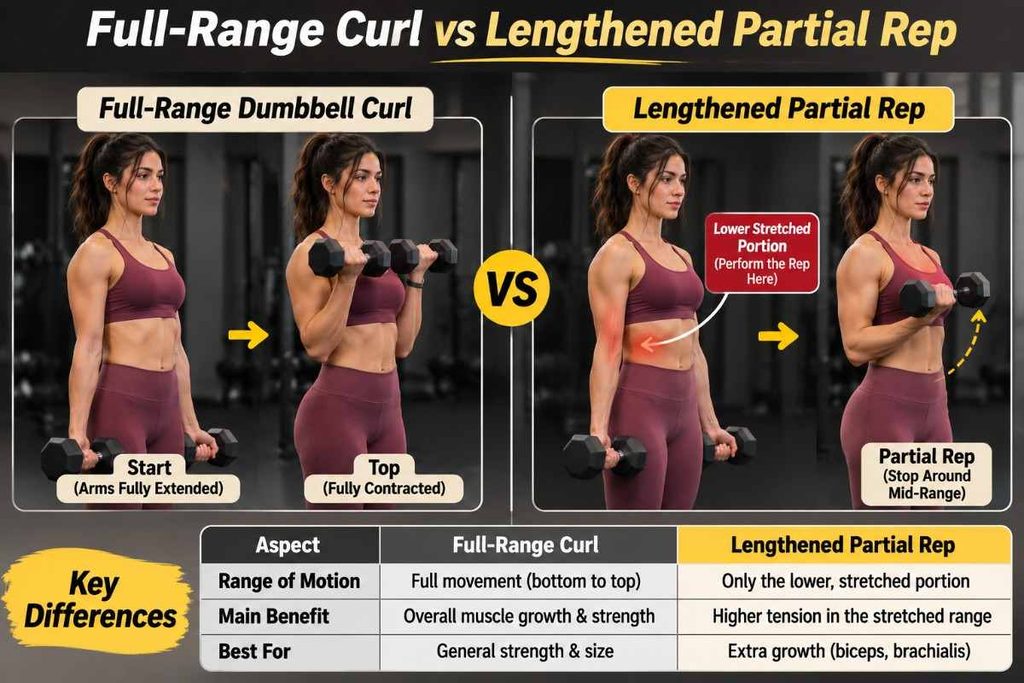
Unlike full-range repetitions, which move through both the stretched and contracted positions, lengthened partials emphasize the lengthened portion of the movement.
For example, during a dumbbell biceps curl, you perform repetitions through the lower portion of the movement, where your biceps are relatively stretched, rather than curling all the way to your shoulder.
This technique is sometimes called lengthened partial training or stretch-position partials.
Why Do Lengthened Partial Reps Matter?
Lengthened partial reps matter because training muscles at longer lengths may provide a useful stimulus for muscle growth.
Research suggests that exercises performed at longer muscle lengths can produce greater hypertrophy in certain muscles and training conditions. However, results depend on the exercise, muscle group, training programme, and individual.
Potential advantages include:
- Muscle growth: May provide an effective hypertrophy stimulus.
- Stretch-position loading: Emphasizes the portion of an exercise where the target muscle is lengthened.
- Training variation: Adds a different stimulus to conventional resistance training.
- Exercise flexibility: Can be incorporated into dumbbell, cable, and machine exercises.
- Workout intensity: Can make the stretched portion of a movement more challenging.
Lengthened partials are not automatically better than full-range repetitions. Both techniques can have a place in a well-designed strength-training programme.
How Do Lengthened Partial Reps Work?
Lengthened partial reps work by keeping the target muscle under resistance while it is in a relatively stretched position.
During a conventional repetition, the muscle generally moves through different lengths as you lift and lower the weight. Lengthened partials reduce the movement to emphasize the longer-muscle-length portion.
For example, during a seated leg curl, the hamstrings are relatively lengthened when the knees are more extended. Performing controlled partial repetitions near this position emphasizes the lengthened portion of the movement.
Three important factors influence this training technique:
- Muscle length: The target muscle should be relatively stretched during the selected portion.
- Resistance: The exercise must provide sufficient tension in that position.
- Control: Repetitions should be smooth and controlled rather than performed with momentum.
Best Exercises for Lengthened Partial Reps
Lengthened partial reps can be performed with several exercises that provide resistance while the target muscle is relatively stretched.
Here are some useful exercises to consider.
1. Dumbbell Biceps Curl
Dumbbell biceps curls can emphasize the stretched portion of the biceps movement.
How to perform:
- Stand upright holding dumbbells at your sides.
- Keep your elbows close to your body.
- Slowly curl the dumbbells upward.
- Lower the weights to the lower portion of the movement.
- Perform controlled partial repetitions through the stretched portion without swinging your arms.
2. Seated Leg Curl
Seated leg curls target the hamstrings while placing them at relatively long muscle lengths because the hips remain flexed.
How to perform:
- Adjust the machine and sit with your back supported.
- Position your legs against the machine pads.
- Extend your knees in a controlled manner.
- Perform partial repetitions near the more extended knee position.
- Avoid using momentum.
3. Dumbbell Lateral Raise
Dumbbell lateral raises can emphasize the lower portion of the movement, where the shoulder muscles are relatively lengthened.
How to perform:
- Stand upright holding dumbbells beside your thighs.
- Keep a slight bend in your elbows.
- Raise the dumbbells outward.
- Lower them slowly.
- Perform controlled partial repetitions in the lower portion.
4. Incline Dumbbell Curl
Incline dumbbell curls place the biceps in a relatively stretched position because your arms remain behind your torso.
How to perform:
- Set an incline bench at a comfortable angle.
- Sit back with your arms hanging naturally.
- Keep your upper arms relatively stationary.
- Curl the dumbbells through the lower portion of the movement.
- Maintain control without forcing the stretch.
5. Deep Squat
Deep squats train the quadriceps and glutes through substantial ranges of motion.
How to perform:
- Stand with your feet approximately shoulder-width apart.
- Brace your core.
- Lower into a comfortable deep squat.
- Maintain control near the bottom position.
- Perform small, controlled partial repetitions within the lower portion.
Only use a depth that your mobility and technique allow comfortably.
6. Standing Calf Raise
Standing calf raises can emphasize the stretched position of the calf muscles when performed with controlled ankle movement.
How to perform:
- Stand on a stable calf-raise platform.
- Rise onto your toes.
- Slowly lower your heels below the starting level if your equipment and mobility allow.
- Perform controlled partial repetitions near the bottom position.
- Avoid bouncing.
Lengthened Partial Reps vs Full Range of Motion Reps
Lengthened partial reps and full-range repetitions both have potential benefits for muscle development, but they differ in how much of the movement they cover.
| Feature | Lengthened partial reps | Full-range reps |
|---|---|---|
| Movement | Focus on stretched portion | Cover the full available range |
| Muscle position | Emphasizes longer muscle lengths | Includes different muscle lengths |
| Technique | Requires control in a specific range | Requires control throughout the movement |
| Training application | Additional hypertrophy technique | General strength and muscle development |
| Exercise flexibility | Depends on resistance profile | Suitable for most resistance exercises |
Which is better?
Neither technique is universally superior. A 2025 randomized study involving resistance-trained participants found similar muscle adaptations from lengthened partial and full-range training for the upper-body muscles examined. A 2026 systematic review, however, found greater hypertrophy from partial repetitions at longer rather than shorter muscle lengths across the studies included.
This suggests that training at longer muscle lengths can be useful, but it does not mean every exercise should be performed using partial repetitions.
How to Add Lengthened Partial Reps to Your Workout
You can introduce lengthened partials into your existing training programme without completely changing your exercise selection.
Follow these practical guidelines:
- Learn the exercise first: Understand the full movement before introducing partial repetitions.
- Choose suitable exercises: Start with stable dumbbell, cable, or machine exercises.
- Use manageable weights: Select a load that allows controlled movement.
- Focus on the stretched position: Perform repetitions within the appropriate lengthened portion.
- Avoid bouncing: Maintain control instead of using momentum.
- Monitor recovery: Pay attention to muscle soreness and overall training fatigue.
Beginners should prioritize proper exercise technique and consistent full-range training before experimenting with advanced variations.
How Many Sets and Reps Should You Perform?
There is no universally established set-and-repetition prescription specifically for lengthened partial reps. Your training volume should depend on your experience, exercise selection, recovery, and overall programme.
A practical starting point for experienced lifters is:
| Training variable | Practical starting point |
|---|---|
| Sets | 2–3 |
| Repetitions | 8–15 controlled partial reps |
| Rest | 60–120 seconds |
| Frequency | Based on weekly muscle-group training volume |
| Intensity | A manageable load that maintains good technique |
These are general programming suggestions rather than a scientifically established optimal protocol for every exercise.
Avoid adding excessive sets on top of your existing workout volume. Lengthened partials should complement your training rather than create unnecessary fatigue.
Common Mistakes to Avoid
Lengthened partial reps require good technique because the exercise focuses on a specific portion of the movement.
Avoid these common mistakes:
1. Using Excessively Heavy Weights
Heavy weights can make it difficult to control the stretched portion. Choose a load that allows smooth repetitions.
2. Confusing Short-Length and Long-Length Partials
Not all partial repetitions are lengthened partials. Repetitions performed near the contracted position emphasize shorter muscle lengths instead.
3. Using Momentum
Swinging weights or bouncing through repetitions reduces movement control and may increase injury risk.
4. Completely Ignoring Full-Range Training
Full-range exercises remain useful for developing strength, coordination, and muscle size. You do not need to replace every exercise with partial repetitions.
5. Forcing an Uncomfortable Stretch
A muscle stretch should not cause sharp pain or joint discomfort. Use a comfortable range and appropriate resistance.
What Does Research Say About Lengthened Partial Reps?
Research on lengthened partial training is growing, and recent findings provide useful insights.
- 2023 systematic review: Research suggested that training at longer muscle lengths through full or partial repetitions may benefit muscle growth in certain muscle groups.
- 2025 randomized controlled trial: Researchers compared lengthened partials with full-range training in 30 resistance-trained participants over eight weeks. Both approaches produced similar upper-body muscle adaptations.
- 2026 systematic review and meta-analysis: An analysis of eight studies found that partial repetitions performed at longer muscle lengths produced greater hypertrophy than partial repetitions performed at shorter muscle lengths.
Overall, the evidence supports considering longer-muscle-length training as one useful approach to muscle development. However, more research is needed across different exercises, muscle groups, and training populations.
Conclusion
Lengthened partial reps are a resistance-training technique that emphasizes the stretched portion of an exercise. They can be incorporated into exercises such as biceps curls, leg curls, lateral raises, squats, and calf raises.
Research suggests that training at longer muscle lengths can support muscle growth, although lengthened partials are not necessarily better than full-range repetitions in every situation.
For best results, prioritize proper technique, progressive training, adequate recovery, and a balanced workout programme.
FAQs
What are lengthened partial reps?
Lengthened partial reps are repetitions performed through the portion of an exercise where the target muscle is relatively stretched.
Are lengthened partial reps good for muscle growth?
Yes, they can support muscle growth by emphasizing training at longer muscle lengths, although results vary between exercises and muscle groups.
Are lengthened partials better than full-range repetitions?
Not necessarily. Both methods can produce muscle growth, and current research does not establish one as universally superior.
Can beginners perform lengthened partial reps?
Beginners can learn the technique, but they should first develop proper exercise form and consistent resistance-training habits.
Which exercises are best for lengthened partials?
Incline dumbbell curls, seated leg curls, dumbbell lateral raises, and calf raises are examples of exercises that can emphasize longer muscle lengths.
Do lengthened partial reps build more muscle?
They may provide an effective hypertrophy stimulus, particularly compared with partial repetitions performed at shorter muscle lengths. However, outcomes depend on training conditions.
Should I use lengthened partials in every exercise?
No. You can selectively include them in suitable exercises while maintaining full-range movements in your workout programme.
Can lengthened partial reps improve strength?
They can improve strength within the trained range of motion, but strength improvements may be specific to the movement and joint positions practised.
Sources
- Strey et al. (2026). Muscle Hypertrophy from Partial Repetition at Long vs. Short Muscle Length: A Systematic Review and Meta-Analysis. Sport Sciences for Health.
- Wolf et al. (2025). Lengthened Partial Repetitions Elicit Similar Muscular Adaptations as Full Range of Motion Repetitions During Resistance Training in Trained Individuals. PeerJ.
- Kassiano et al. (2023). Which ROMs Lead to Rome? A Systematic Review of the Effects of Range of Motion on Muscle Hypertrophy. Journal of Strength and Conditioning Research.
- McMahon et al. (2026). Moderate Intensity Resistance Training With Partial Range-of-Motion at Long Muscle Lengths Elicits Similar Hypertrophy and Architectural Adaptations as High Intensity Resistance Training Using Full Range-of-Motion.
Disclaimer: This article is for informational and educational purposes only and is not a substitute for personalized medical advice. Consult a qualified healthcare professional before making significant changes to your diet, exercise routine, or supplement use.