
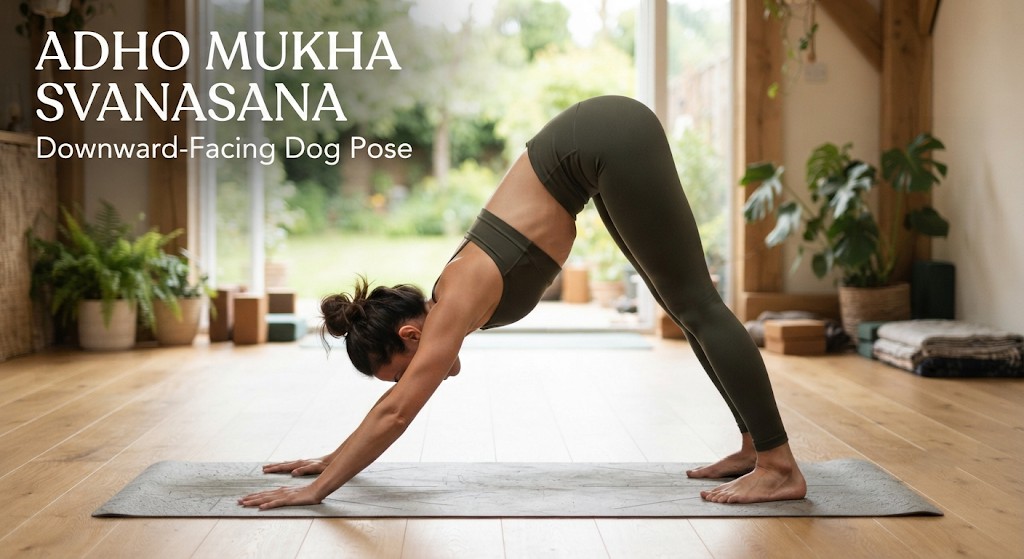
Downward dog looks simple, yet it asks your arms, back, and legs to work together while you hold a long inverted V. Done well, it stretches the back of your body and builds strength in your shoulders and arms. This guide covers the steps, the muscles involved, easy modifications, and the mistakes that cause most of the discomfort. If you are new to yoga, begin with our Walking Yoga for Beginners.
What is downward dog yoga?
Downward dog yoga refers to Downward-Facing Dog (Adho Mukha Svanasana), a foundational pose where your hands and feet press into the floor and your hips lift high to form an inverted V. It is often used as a transition between movements, such as in sun salutations. It also works as a resting pose in many vinyasa classes.
Key features of the pose:
- Hands shoulder-width apart, fingers spread
- Feet about hip-width apart
- Hips lifted up and back, with a long spine
- Head relaxed between the upper arms
Why does downward dog matter?
Downward dog matters because it combines a full-body stretch with strength work in one position. Cleveland Clinic notes that the pose builds the strength to control the flexibility it creates (Source: Cleveland Clinic). Queensland Government guidance describes it as a gentle-intensity pose that builds upper-body strength while stretching the back, hamstrings, calves, and ankles (Source: Queensland Government).
Common reasons people practice it:
- It stretches the backs of the legs after long periods of sitting.
- It builds shoulder and arm strength through weight-bearing.
- It is a quick reset between harder poses.
- It adds a short, low-impact bout of movement to a busy day.
Research on yoga in general suggests possible benefits for stress, mental and emotional health, sleep, and balance (Source: NCCIH). That evidence covers yoga as a whole, so no single pose should be expected to deliver any of these on its own. For a wider routine, see our guide to yoga for stress relief.
Which muscles does downward dog work?
Downward dog works the arms, shoulders, upper back, calves, glutes, and feet, and it stretches the hamstrings and calves at the same time (Source: Hinge Health). The table shows how the load is shared.
| Body area | Main action in the pose |
|---|---|
| Shoulders and arms | Strengthen by holding your body weight |
| Upper back | Strengthen and lengthen as the chest moves toward the thighs |
| Core | Engages to keep the spine long |
| Hamstrings | Stretch as the hips lift up and back |
| Calves and Achilles | Stretch as the heels reach toward the floor |
| Hands, wrists, and feet | Strengthen through steady pressure into the floor |
How do you do downward dog step by step?
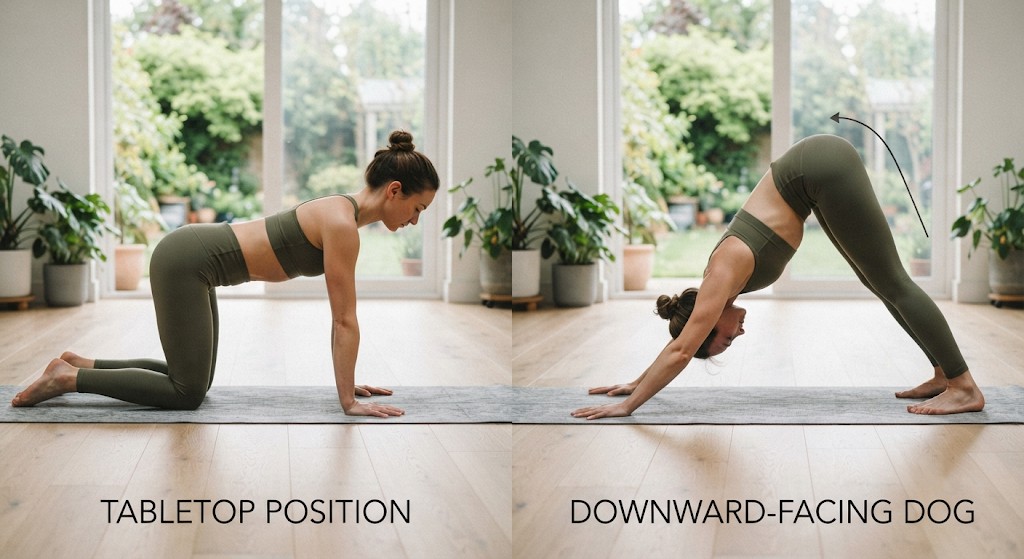
You get into downward dog by lifting your hips from a hands-and-knees position until your body forms an inverted V.
- Start on your hands and knees in a tabletop position, with wrists under shoulders and knees under hips.
- Spread your fingers wide and press evenly through your whole hand.
- Tuck your toes under and lift your knees off the floor.
- Send your hips up and back, and keep a slight bend in your knees at first.
- Press the floor away, lengthen your spine, and let your head hang between your upper arms.
- Lower your heels toward the floor without forcing them down.
- Breathe slowly for about 5 breaths, then lower your knees to rest.
Warm up your muscles and joints before you try it. A short routine of warm-up exercises before a workout works well, and so does child’s pose followed by cat-cow.
How can you modify downward dog?
You can modify downward dog by changing how much weight your wrists, hamstrings, and shoulders carry. If you cannot get down onto your hands and knees, a wall version is an option (Source: Cleveland Clinic).
Useful changes:
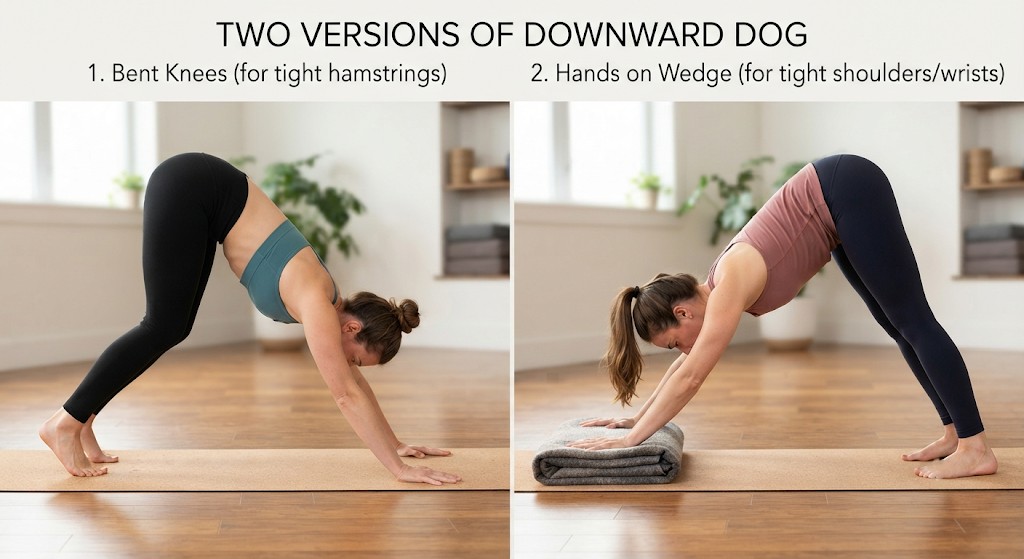
- Bend your knees as much as you need so your spine stays long.
- Place your hands on a wedge, a rolled mat, or a folded blanket to ease wrist strain (Source: Yoga International).
- Rest your forearms on blocks, keeping the blocks at their lowest height so the pose stays stable.
- Use a wall or a chair for support, placing your hands on the chair seat for a deeper stretch.
- Try dolphin pose, which is downward dog on the forearms, if your wrists are sore.
Downward dog can actually feel more comfortable on the wrists than table pose, because the arm angle changes For ongoing wrist care, add some forearm and wrist exercises.
What are the best downward dog variations?
The best variations make the pose either gentler or more demanding without changing its shape.
- Bent-knee downward dog, for tight hamstrings or a rounded back
- Wall downward dog, for people who cannot easily get to the floor
- Dolphin pose, for sore wrists
- Three-legged dog, where you lift one leg straight back to challenge your glutes, core, and balance (Source: Hinge Health)
Strengthening your trunk helps with the harder versions, so pair practice with some core strengthening exercises.
What mistakes should you avoid in downward dog?
The most common mistake is straightening the legs at the cost of a rounded back. Fix it by bending your knees and sending your hips up and back. Other frequent errors:
- Dumping weight into the wrists: spread your fingers and press through the whole hand.
- Hunching the shoulders toward your ears: draw them away from your ears and lengthen your neck.
- Forcing the heels down: let them hover if they do not reach the floor.
- Holding your breath: keep a steady inhale and exhale.
- Staying too long: if one body part feels excessive stress, you may be holding the pose for too long (Source: Cleveland Clinic).
- Setting your feet too close to your hands: step your feet back so your torso can lengthen.
To check your alignment, start from plank and make sure your shoulders sit over your wrists before lifting into the pose. A refresher on Puppy pose yoga (Uttana Shishosana) gives you a safe place to rest between rounds.
Who should be careful with downward dog?
Anyone with an injury to the wrists, shoulders, or ankles, or with high blood pressure, should avoid the pose unless a healthcare provider approves it (Source: Yoga Journal). This is because the weight sits on the arms and the head stays below the hips.
- Practice with a qualified instructor if you are new, since learning yoga without supervision has been linked with higher injury risk (Source: NCCIH).
- Yoga can be safe during pregnancy with appropriate precautions, but get evaluated by a healthcare provider first (Source: NCCIH).
- Stop if you feel sharp pain, numbness, or dizziness.
How do you fit downward dog into a routine?
You can fit downward dog into a routine by using it as a short transition or a brief hold between other poses. A simple sequence of about 5 minutes looks like this:
- Child’s pose, 5 breaths
- Cat-cow, 8 rounds
- Downward dog, 5 breaths
- Pedal your feet, bending one knee at a time, for 5 breaths
- Three-legged dog, 3 breaths per side
- Child’s pose to finish, 5 breaths
On rest days, pair it with a stretching routine for recovery.
Conclusion
Downward dog yoga works best when you keep your knees soft, spread your hands, and let your hips lift up and back. Hold the pose for about 5 breaths, and use a modification whenever your wrists, shoulders, or hamstrings need it.
- Warm up with child’s pose and cat-cow first.
- Start with bent knees and a long spine.
- Add one variation at a time once the basic pose feels easy.
For broader mobility, continue with our yoga for flexibility.
FAQs
What is downward dog good for?
Downward dog stretches your back, hamstrings, calves, and ankles and builds upper-body strength, according to Queensland Government guidance.
How long should you hold downward dog?
Hold it for about 5 breaths, which is the repetition suggested by Queensland Government, and build up gradually as it feels easier.
Should your heels touch the floor in downward dog?
No, your heels do not need to touch the floor. Let them reach toward it and bend your knees if your hamstrings or calves feel tight.
Why do my wrists hurt in downward dog?
Wrist discomfort often comes from putting too much weight into the hands or from alignment problems. Spread your fingers, press through the whole hand, or place your hands on a wedge or folded blanket, and see a healthcare provider if pain lingers.
Is downward dog good for beginners?
Yes, with modifications such as bent knees or a wall version. It can feel demanding at first because the arms and legs work together.
Is downward dog an inversion?
Yes, Yoga Journal lists it as an inversion, because your head sits below your hips. That is why people with high blood pressure should check with a healthcare provider first.
Sources
- Cleveland Clinic. (n.d.). Take a ‘Paws’ With Downward Dog.
- Queensland Government. (n.d.). Downward Dog.
- Hinge Health. (n.d.). How to do downward dog: a Hinge Health guide.
- Moonaz, S. (n.d.). Pose Modifications for Wrist Challenges. Yoga International.
- Yoga Journal. (n.d.). Downward-Facing Dog Pose.
- National Center for Complementary and Integrative Health. (n.d.). 5 Things You Should Know About Yoga.
Disclaimer: This article is for informational and educational purposes only and is not a substitute for personalized medical advice. Consult a qualified healthcare professional before making significant changes to your diet, exercise routine, or supplement use.