
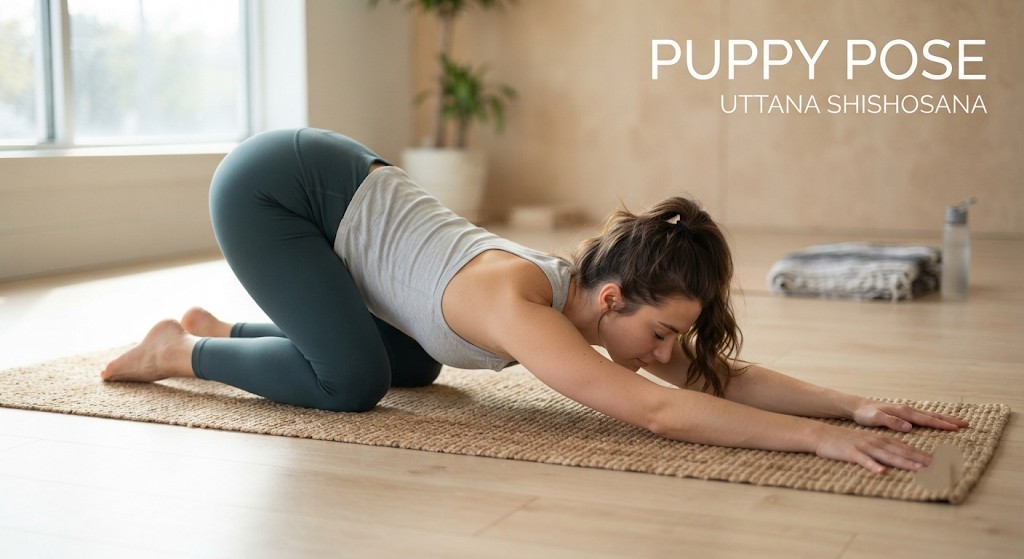
Puppy pose yoga is a gentle backbend that stretches the shoulders, chest, and upper back while your hips stay stacked over your knees. It is often recommended for the stiffness that builds up after hours at a desk or on a phone. This guide shows you how to do it step by step, which muscles it works, how to modify it, and what to check before you try it.
What is puppy pose yoga?
Puppy pose yoga, known in Sanskrit as Uttana Shishosana, is a kneeling pose where your arms reach forward and your chest lowers toward the floor while your hips stay high. “Uttana” means intense or extended, and “shisho” means puppy. It is classed as a beginner-level kneeling pose. (Source: Pizer, 2024)
Quick facts:
- Also called extended puppy pose, Anahatasana, and melting heart pose
- Pose type: kneeling, with a gentle backbend
- Level: beginner
- Typical hold: 30 seconds to 1 minute (Source: HealthLink BC)
- Helpful props: a folded blanket, a bolster, or yoga blocks
Think of it as a cross between downward-facing dog and child’s pose. You get the shoulder stretch of one and the calm, grounded feel of the other.
Why does puppy pose matter?
Puppy pose matters because it opens the shoulders, chest, and upper back, areas that tend to tighten with sitting and screen time. It also takes very little equipment or experience.
What it offers:
- A stretch for the back muscles, a lengthened spine, and open shoulders and chest (Source: Pizer, 2024)
- A beginner-friendly shape, since extended puppy pose is listed among the simple poses to start with if you have never done yoga (Source: MyHealth.Alberta.ca)
- A calm position for slow breathing, with the forehead resting down and the neck relaxed
- A quick reset you can fit between long stretches of sitting
Mobility in the upper back and shoulders also matters for overhead movements. Without enough flexibility there, extra pressure can land on structures around the shoulder joint. (Source: Hospital for Special Surgery)
What the research says
I did not find a study that tests puppy pose on its own, so the points below describe yoga in general.
- Harvard Health says it is hard to dispute that yoga builds strength and flexibility, though it remains unclear which styles work best and how often you need to practice. (Source: Harvard Health Publishing)
- The National Center for Complementary and Integrative Health lists stress management, mental and emotional health, sleep, and balance among the possible benefits of yoga. (Source: NCCIH)
Pigeon pose yoga (Eka Pada Rajakapotasana)
Which muscles does puppy pose work?
Puppy pose stretches the shoulders, chest, lats, and upper back, while the arms and core work lightly to hold the shape. Here is the breakdown.
| Body area | What happens in the pose |
|---|---|
| Rear shoulders (deltoids) | Stretch as your arms reach forward |
| Chest (pectorals) | Open as your chest lowers toward the mat |
| Lats and upper back | Lengthen as your hips stay high and back |
| Thoracic spine (mid back) | Bends gently into extension |
| Triceps and arms | Stretch and press lightly into the mat |
| Core | Keeps your hips stacked and your lower back supported |
If your shoulders feel tight in the pose, a few mobility drills beforehand can make the stretch more comfortable.
A short routine for the mid back works well alongside it.
How to do puppy pose step by step
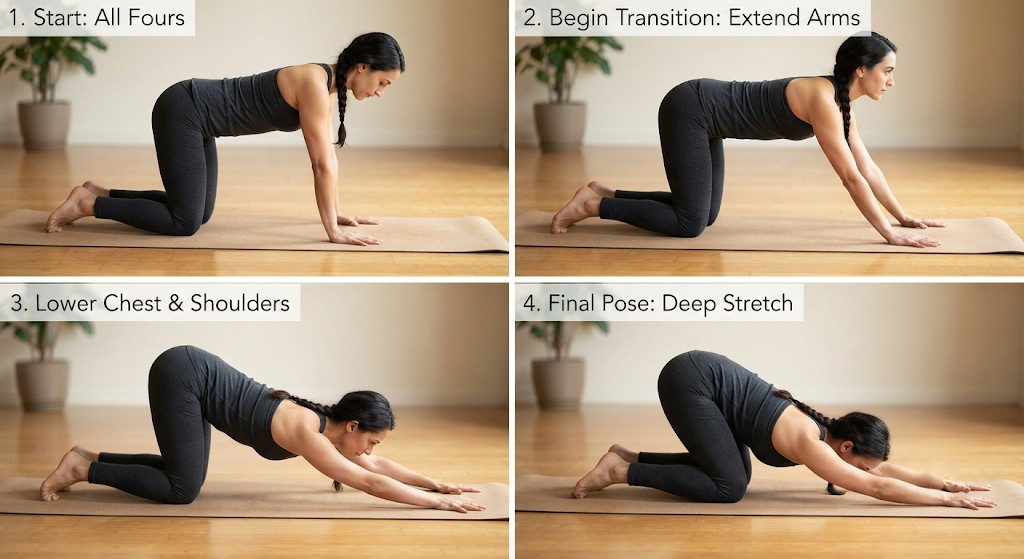
To do puppy pose, start on hands and knees, walk your hands forward, and lower your chest toward the mat while your hips stay above your knees. Warm up first with a few rounds of cat-cow so the spine moves easily.
- Come onto all fours with your shoulders over your wrists and your hips over your knees. Pad your knees with a folded blanket if the floor is hard.
- Walk your hands forward a few inches at a time, keeping your hips above your knees.
- Lower your chest toward the mat and let your upper back bend gently.
- Rest your forehead on the mat or a block and relax your neck. (Source: HealthLink BC)
- Press your palms into the floor, spread your fingers, and keep your upper arms active so your shoulders don’t collapse.
- Breathe normally and feel the stretch along your spine. Hold for 30 seconds to 1 minute. (Source: HealthLink BC)
- To come out, walk your hands back and sit your hips toward your heels.
Common mistakes to avoid
- Letting the hips sink back to the heels, which turns the pose into child’s pose and removes the backbend
- Pushing the hips forward of the knees, which can compress the lower back
- Collapsing the shoulders and elbows onto the mat
- Straining the neck by lifting the head or resting the chin hard on the floor
- Pushing through tingling in the hands or arms
- Holding your breath
Puppy pose variations and modifications
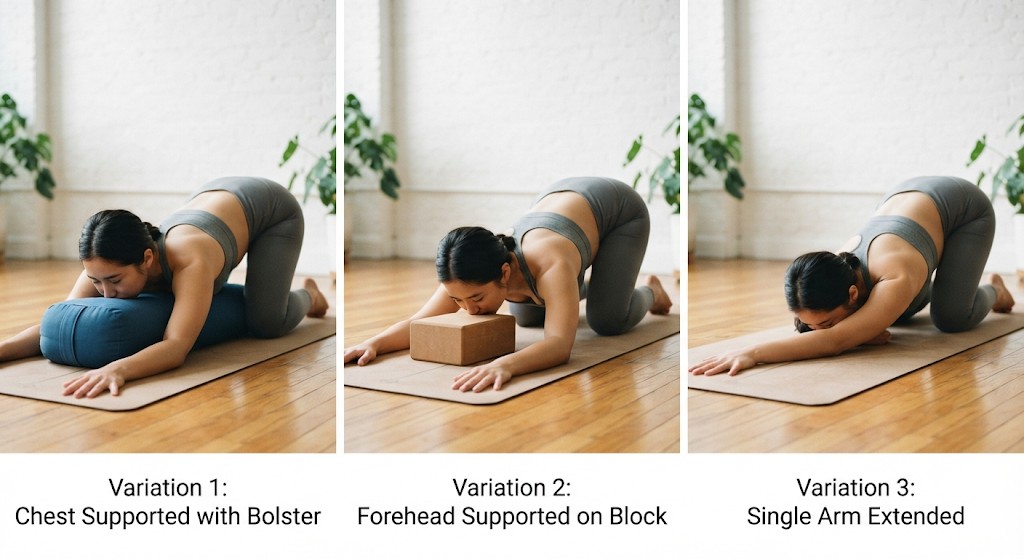
Puppy pose adapts easily with props and arm positions, so you can set the intensity to match your shoulders, neck, and knees.
| Variation | What changes | Best for |
|---|---|---|
| Supported puppy | A bolster or pillow sits lengthwise under your chest | Beginners or tight shoulders |
| Forehead on a block | A block or blanket supports your head | Neck comfort |
| Blocks under the forearms | Props raise your arms and change the angle of the stretch | Adjusting depth for tight shoulders |
| One arm at a time | One arm reaches forward while your head rests on the other forearm | Sensitive shoulders or neck |
| Standard extended puppy | Both arms stretch forward and the chest lowers | Most people |
Blocks and bolsters make the pose far more comfortable if your shoulders are stiff.
Poses to pair with puppy pose
Puppy pose pairs well with movements that warm up the spine beforehand and release it afterward.
- Cat-cow before the pose, to loosen the spine
- Downward-facing dog, which works the shoulders in a similar direction
- Child’s pose afterward, a mild forward fold that balances the backbend
Is puppy pose safe? Precautions to know
Puppy pose is gentle for most people, but it still loads the shoulders, neck, and knees, so a few precautions apply.
- Pad your knees, and skip the pose if kneeling hurts.
- Rest your forehead on a block if your neck feels strained.
- Change your arm position or come out if you feel tingling or numbness in your hands.
- Check with a clinician first if you have a shoulder injury or recent surgery.
- Stop if you feel sharp or lasting pain.
Harvard Health advises treating yoga as something you do alongside standard medical care, not instead of it, if you have a serious health condition. (Source: Harvard Health Publishing)
How long and how often should you practice?
Hold puppy pose for 30 seconds to 1 minute per round, and repeat once or twice. Two or three practices a week works as a starting rhythm, and a round or two between long stretches of sitting also helps.
A short routine afterward can help your body settle.
post-workout stretching routine
Firefly pose yoga (Tittibhasana)
Conclusion
Puppy pose yoga is a simple way to open the shoulders, chest, and upper back without a deep backbend. Keep your hips over your knees, let your neck relax, and use a block or bolster whenever the stretch feels too strong. Research backs yoga’s general benefits for flexibility and stress, though not this pose specifically. Try one or two rounds after your next long sitting session and see how your upper body feels.
FAQs
What is puppy pose good for?
It stretches the shoulders, chest, and upper back. Many people use it to ease tightness from sitting.
Is puppy pose good for beginners?
Yes. It is classed as a beginner pose, and props like a bolster or block make it more comfortable.
How long should I hold puppy pose?
Hold it for 30 seconds to 1 minute. Repeat once or twice if it feels good.
What is the difference between puppy pose and child’s pose?
In puppy pose your hips stay above your knees and your chest lowers with a gentle backbend. In child’s pose your hips sit back toward your heels in a forward fold.
What if puppy pose hurts my neck?
Rest your forehead on a block or blanket instead of hovering or pressing your chin down. You can also try one arm at a time.
Can puppy pose improve posture?
It may help by stretching the chest and shoulders that tighten with sitting. I found no study that tests it directly, so results will vary.
Sources
- Pizer, A. (2024). How to do Puppy Pose (Uttana Shishosana). Liforme.
- HealthLink BC. Yoga: Extended Puppy Pose.
- MyHealth.Alberta.ca. Stress Management: Practicing Yoga to Relax.
- Hospital for Special Surgery. Why Yoga Is Beneficial for Overhead Athletes.
- Harvard Health Publishing. Yoga offers range of health benefits.
- National Center for Complementary and Integrative Health. Yoga: Effectiveness and Safety.
Disclaimer: This article is for informational and educational purposes only and is not a substitute for personalized medical advice. Consult a qualified healthcare professional before making significant changes to your diet, exercise routine, or supplement use.
1 thought on “Puppy pose yoga (Uttana Shishosana): steps, benefits, and variations”