
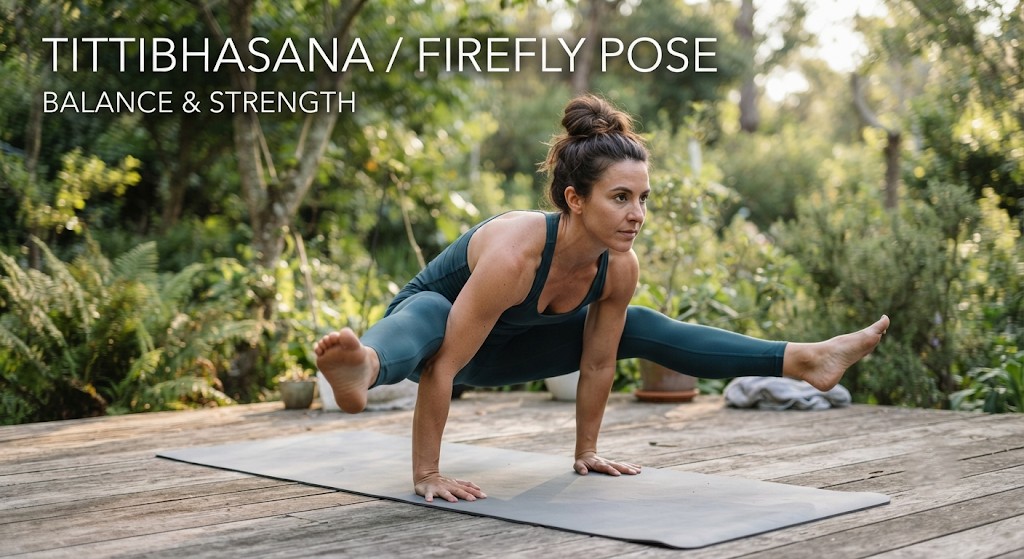
Firefly pose yoga looks like magic. You balance on your hands with your legs stretched wide and your body floating above the floor. It rewards deep hamstring flexibility, strong arms, and a steady core, so it takes patience to build toward. This guide breaks the pose into steps, shows which prep poses help most, and explains how to protect your wrists along the way.
What is firefly pose yoga?
Firefly pose yoga, or Tittibhasana, is an arm balance where you lift your body on your hands and extend both legs out to the sides. The Sanskrit “tittibha” means firefly, and the pose is usually placed at the intermediate to advanced level. (Source: Liforme)
Quick facts:
- Sanskrit name: Tittibhasana
- Pose type: arm balance that also opens the hips and works the core
- Level: intermediate to advanced
- Helpful props: yoga blocks, a wedge or rolled mat for the wrists, and a folded blanket behind you as a soft landing
Many people find the lift itself less daunting than the flexibility it demands. If your hamstrings are tight, expect to spend time on prep before the pose feels possible.
Why does firefly pose matter?
Firefly pose matters because it combines arm strength, core control, and flexibility through the hips and hamstrings in one shape. It also rewards slow, patient progress over forcing the lift.
What it offers:
- A deep stretch through the hamstrings, groin, and back, along with better hip flexibility and an open chest (Source: Yoga Journal)
- Strength in the core, legs, and arms (Source: Burke, Yoga International)
- Better balance and coordination (Source: Liforme)
- A clear goal that builds focus and patience
What the research says
I did not find a clinical study that tests firefly pose by itself. The benefits above come from yoga teachers and publications, so treat them as practice experience rather than proven results.
- UW Health points out that the upper body is not built for heavy weight bearing in the way the legs are, and that this can lead to wrist, neck, or shoulder pain. (Source: UW Health)
- That makes gradual progress and good warm-ups especially important for an arm balance like this one.
Which muscles does firefly pose work?
Firefly pose strengthens the arms, shoulders, and core while stretching the hamstrings, inner thighs, and hips. Here is the breakdown.
| Body area | What happens in the pose |
|---|---|
| Arms, shoulders, and wrists | Press into the floor and hold your body weight |
| Core (abdominals) | Lift the hips and keep the legs suspended |
| Hamstrings | Stretch deeply as the legs straighten |
| Inner thighs and groin | Stretch, and squeeze the upper arms for grip |
| Hips | Open to let the legs spread wide |
| Upper back | Spreads wide to support your shoulders |
Tight hamstrings are the most common obstacle, so a regular hamstring routine pays off.
A strong core makes the lift smoother and keeps your legs from dragging.
Poses that prepare you for firefly pose
The best prep poses open the hamstrings and hips and build arm and core strength. Yoga Journal lists standing forward bend and four-limbed staff pose among the helpful preparations. (Source: Yoga Journal)
Good warm-ups:
- Standing forward fold, to loosen the hamstrings
- Wide-legged forward fold, to stretch the hamstrings and inner thighs
- Garland pose, to open the hips
- Chaturanga, to practice the arm alignment you’ll use in the lift
- Crow pose, to learn the basic arm balance mechanics
Dancer pose yoga (Natarajasana)
Pigeon pose yoga (Eka Pada Rajakapotasana)
Puppy pose yoga (Uttana Shishosana)
How to do firefly pose step by step
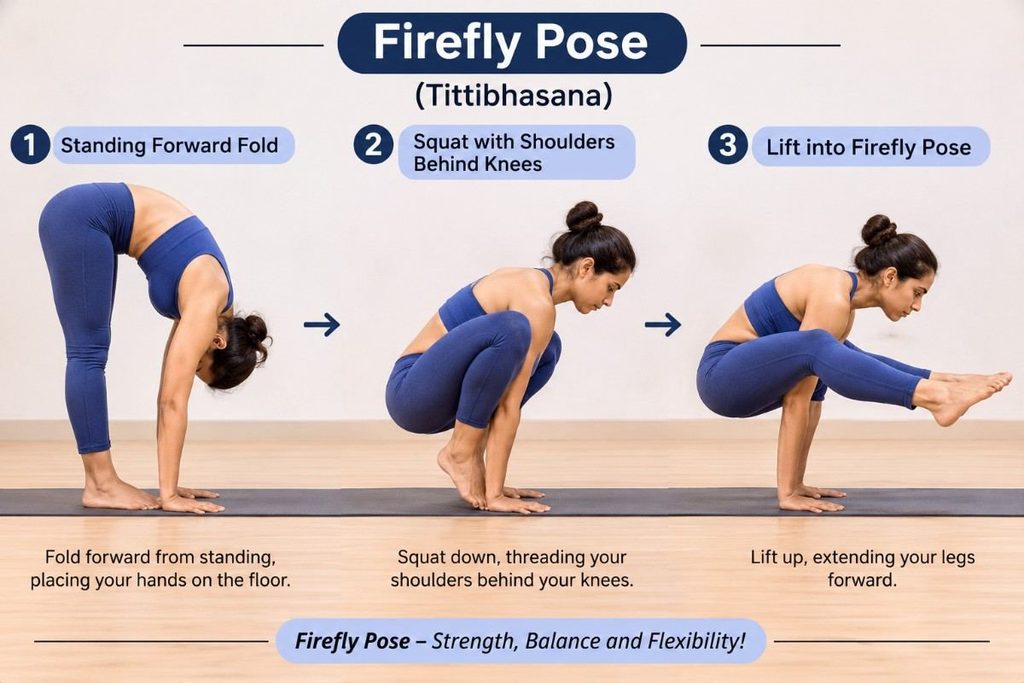
To do firefly pose, fold forward, thread your shoulders behind your knees, press into your hands, and lift your feet before extending your legs. Place a folded blanket behind you in case you tip backward.
- Begin in a standing forward fold with your feet slightly wider than hip-width apart.
- Bend your knees and lower your hips toward a squat, keeping your chest moving forward.
- Thread your shoulders behind your knees as far as you can so your upper arms sit under your thighs.
- Place your hands on the floor about shoulder-width apart, with your fingers spread.
- Keep your elbows slightly bent, in the same alignment you use in chaturanga.
- Pick a point on the floor ahead of you and keep your eyes there.
- Shift your weight forward and press into your hands, lifting your sit bones and feet off the floor.
- Once you feel balanced, straighten your legs out to the sides as far as your hamstrings allow. Don’t rush this part. Find balance first, then extend.
- Hold for a few breaths with your core engaged.
- Exhale and lower your feet to the floor.
Common mistakes to avoid
- Straightening the legs before you have found your balance
- Keeping the shoulders in front of the knees, which lets the thighs slide off your arms
- Dumping all your weight into the heels of your hands instead of spreading it across the whole palm and fingers
- Looking down at your feet
- Skipping the warm-up
- Holding your breath
Firefly pose variations and modifications
Firefly pose has gentler versions that let you practice the shape and build the prerequisites before attempting the full lift.
| Variation | What changes | Best for |
|---|---|---|
| Feet on the floor | You practice the setup without lifting | Learning the shape |
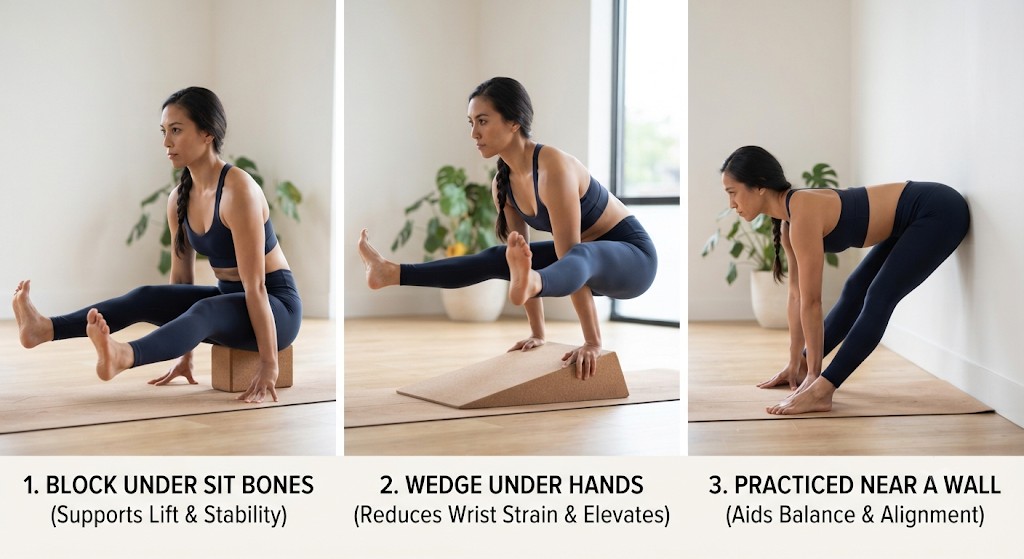
| Block under the sit bones | A block gives you a little extra height for lift-off | Early attempts at the lift |
| Block under the hands | Props raise the floor to your hands | Working on reaching and balance |
| Wedge under the heels of the hands | Reduces the wrist angle and eases pressure | Wrist sensitivity |
| At the wall | A wall gives support while you build strength | Building confidence |
| Shoulder pressing pose | Your legs cross at the ankles | A stepping stone toward firefly |
A wedge under the hands takes some pressure off the wrists, since the pose asks for more than 90 degrees of wrist extension. (Source: Yoga International)
Is firefly pose safe? Precautions to know
Firefly pose demands a lot from the wrists, shoulders, and hamstrings, so skip it if you have an injury in those areas. It requires a high degree of wrist flexion and hamstring openness, and it is not recommended if your wrists, elbows, shoulders, or lower back are injured or sensitive. (Source: Burke, Yoga International)
- Warm up your wrists and hamstrings before you try it.
- Skip the lift and practice the wide-legged forward fold instead if your wrists hurt.
- Cleveland Clinic advises doing wrist stretches only if you can move your wrist without significant pain, and seeing a healthcare provider if pain is higher than a 3 or 4 out of 10. (Source: Cleveland Clinic)
- Avoid the pose if you have a hamstring strain.
- Learn from a qualified teacher if arm balances are new to you.
Best Exercises to Improve Grip Strength
How long and how often should you practice?
Hold firefly pose for a few breaths at first, and practice it two or three times a week after a thorough warm up. Progress often takes weeks or months, so judge your improvement by how steady your setup feels, not just by whether your feet lift. Follow practice with some easy stretching to settle your hamstrings and wrists.
post-workout stretching routine
Conclusion
Firefly pose yoga is a rewarding goal because it blends strength with flexibility, and it teaches you to build skill slowly. Focus on your hamstrings, core, and wrist care before chasing the lift, and use blocks or a wall to make the early attempts safer. Research on this exact pose is thin, so go by how your body responds. Pick two prep poses from the list above and practice them this week.
FAQs
Is firefly pose hard?
Yes, it is usually classed as intermediate to advanced. It needs flexible hamstrings, strong arms, and a steady core.
What does Tittibhasana mean?
It means firefly pose. “Tittibha” is Sanskrit for firefly, and “asana” means pose.
Which muscles does firefly pose work?
It works the arms, shoulders, wrists, and core, and it stretches the hamstrings, inner thighs, and hips.
How can beginners prepare for firefly pose?
Build hamstring flexibility with forward folds and practice crow pose for arm balance basics. Work on your core and wrists as well.
Why can’t I lift off in firefly pose?
The usual causes are tight hamstrings, shoulders not far enough behind the knees, or a weak core. Try a block under your sit bones for the first attempts.
Is firefly pose bad for wrists?
It places heavy weight on flexed wrists, so skip it if you have a wrist injury. A wedge under the hands can ease the angle for sensitive wrists.
Sources
- Yoga Journal. Firefly Pose.
- Burke, A. Tittibhasana (Firefly Pose) Step by Step. Yoga International.
- Yoga International. How to Practice Firefly Pose at the Wall.
- Liforme. How to Do Firefly Pose (Tittibhasana).
- UW Health. Wrist Pain and Yoga.
- Cleveland Clinic. 11 Exercises and Stretches for Wrist Pain.
Disclaimer: This article is for informational and educational purposes only and is not a substitute for personalized medical advice. Consult a qualified healthcare professional before making significant changes to your diet, exercise routine, or supplement use.
1 thought on “Firefly pose yoga (Tittibhasana): steps, benefits, and variations”