
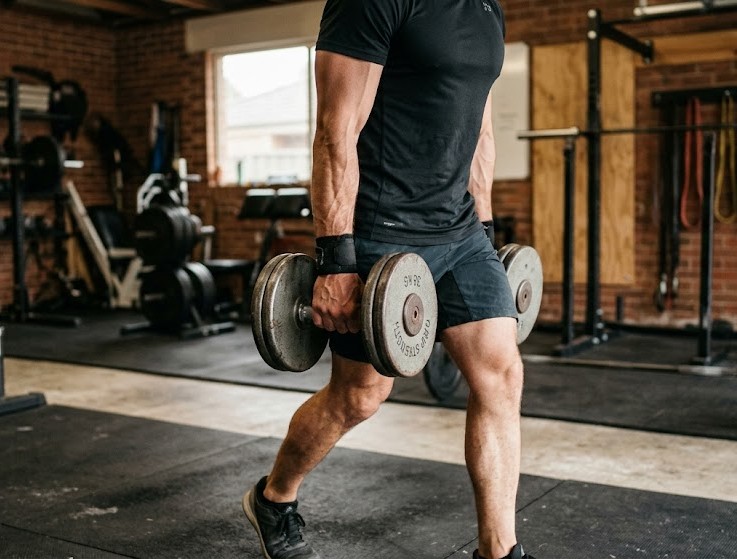
You may already be lifting weights, performing pull-ups, or following a structured strength-training routine, yet your hands often give out before your larger muscle groups do. This is a common problem among lifters, athletes, climbers, and even everyday fitness enthusiasts.
The truth is that grip strength is often the hidden factor limiting performance. Whether you’re deadlifting heavy weight, carrying groceries, climbing a wall, swinging a kettlebell, or playing sports, your hands are the critical connection between your body and the object you’re controlling.
In this complete guide, you’ll learn the best exercises to improve grip strength, understand the different types of grip strength, discover the benefits of grip training, and learn how to build stronger hands and forearms with a proven long-term approach.
What Is Grip Strength and Why Is It Important?
Grip strength refers to the ability of your hands, fingers, wrists, and forearms to generate and maintain force while holding, pulling, squeezing, or carrying an object.
Every pulling movement in fitness depends on grip strength. Deadlifts, pull-ups, rows, kettlebell carries, rope climbs, and many athletic movements require your hands to stay connected to resistance throughout the exercise.
Strong grip strength is not only valuable in the gym. It also supports everyday activities such as:
- Carrying shopping bags
- Opening jars
- Moving furniture
- Using tools
- Performing manual labor
Grip training develops several forms of hand strength, including crushing, supporting, pinching, and open-hand gripping abilities.
For example:
- Squeezing a hand gripper develops crush strength.
- Hanging from a pull-up bar develops support grip.
- Holding weight plates improves pinch grip.
- Using thick handles challenges open-hand grip strength.
According to research, lower grip strength is associated with reduced physical function and increased health risks in older adults.
Source: National Institute on Aging, 2024.
Types of Grip Strength Explained
Understanding the four primary grip categories helps you create a balanced grip-strength training program.
| Grip Type | Definition | Example Exercise |
|---|---|---|
| Crush Grip | Squeezing an object with maximum force | Hand grippers |
| Support Grip | Holding an object for time | Farmer’s carries |
| Pinch Grip | Gripping without fingers wrapping around | Plate pinches |
| Open-Hand Grip | Holding thick objects with a partially open hand | Fat grip training |
Each grip type contributes to overall hand strength and athletic performance.
Crush Grip
Crush grip measures your ability to squeeze something with maximum force.
Common examples include:
- Hand grippers
- Stress balls
- Tennis balls
- Grip trainers
This type of strength is heavily used in combat sports, manual labor, and activities requiring powerful hand contractions.
Support Grip
Support grip is your ability to hold an object for an extended period.
Examples include:
- Dead hangs
- Farmer’s carries
- Heavy barbell holds
- Suitcase carries
Support grip is often the limiting factor in deadlifts and pull-ups.
Pinch Grip
Pinch grip requires holding an object without fully wrapping the fingers around it.
Examples include:
- Plate pinches
- Pinch blocks
- Book holds
This grip strongly develops thumb and finger strength.
Open-Hand Grip
Open-hand grip training involves holding thick objects that prevent the fingers from fully closing.
Examples include:
- Fat grip attachments
- Thick barbells
- Thick dumbbell handles
This style of training significantly increases grip demands and forearm activation.
Why Does Grip Strength Matter for Weight Training and Sports?
Grip strength influences nearly every aspect of physical performance.
Improved Strength Training Performance
Many lifters fail a heavy deadlift because their grip gives out before their legs, back, or hips reach fatigue.
A stronger grip allows you to:
- Lift heavier loads
- Complete more repetitions
- Improve pulling exercises
- Increase training volume
Better Athletic Performance
Athletes in numerous sports depend heavily on grip strength.
These include:
- Wrestling
- Brazilian Jiu-Jitsu
- Rock climbing
- Gymnastics
- Baseball
- Football
- Martial arts
Stronger hands often translate into better control, power, and endurance.
Healthy Aging and Longevity
Research shows grip strength is frequently used as a marker of overall muscular health and physical function.
Source: Harvard Health, 2024.
Reduced Injury Risk
Strong forearms and wrists help improve joint stability and may reduce the likelihood of overuse injuries.
For more related training concepts, see our functional strength training exercises
Benefits of Grip Strength Training
Consistent grip-strength training provides numerous physical and performance benefits:
- Improved deadlift performance
- Better pull-up endurance
- Increased sports performance
- Enhanced climbing ability
- Stronger forearms
- Better wrist stability
- Improved injury resistance
- Greater functional fitness
- Enhanced muscular endurance
- Better control during heavy lifts
Best Exercises to Improve Grip Strength
The most effective grip-strength exercises challenge your ability to squeeze, support, pinch, or carry heavy loads.
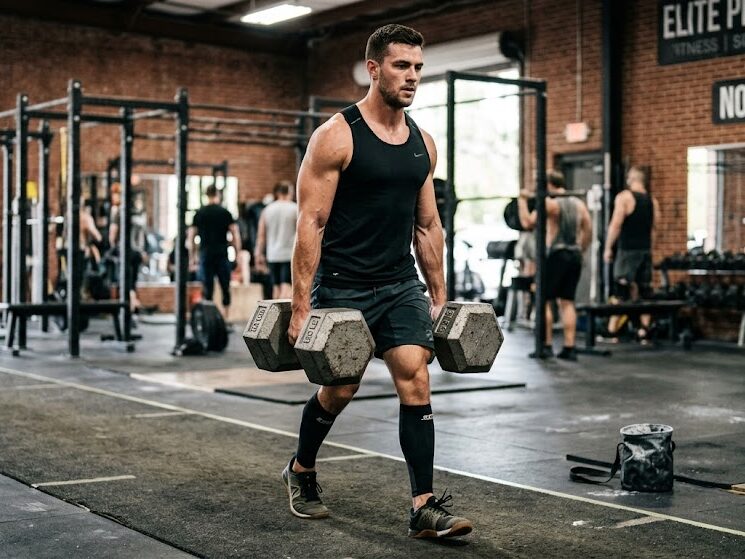
1. Farmer’s Carries
Farmer’s carries are among the most effective exercises for developing total grip strength.
Simply grab heavy dumbbells or kettlebells and walk for 20–60 seconds.
Benefits
- Builds support grip
- Improves core stability
- Enhances conditioning
- Strengthens the entire body
For more carrying variations, explore best kettlebell exercises for strength.
2. Dead Hangs
Dead hangs require your hands and forearms to support your entire body weight.
Hang from a pull-up bar for as long as possible.
Benefits
- Improves grip endurance
- Strengthens shoulders
- Enhances pull-up performance
- Builds forearm endurance
3. Pull-Ups
Pull-ups train both grip strength and upper-body pulling power.
Performing pull-ups without lifting straps forces your hands to remain active throughout every repetition.
Benefits
- Builds support grip
- Strengthens the back
- Improves relative strength
4. Towel Pull-Ups
Towel pull-ups increase grip difficulty by creating an unstable gripping surface.
They are widely used by climbers and combat athletes.
Benefits
- Strengthens hands and fingers
- Improves grip endurance
- Enhances forearm development
5. Plate Pinches
Plate pinches are one of the best exercises for developing pinch grip strength.
Hold two smooth weight plates together using only your fingertips and thumb.
Benefits
- Builds thumb strength
- Improves finger control
- Develops pinch grip endurance
6. Heavy Deadlifts
Heavy deadlifts challenge your support grip under significant loads.
Few exercises can match the grip demands of a heavy deadlift performed without straps.
Benefits
- Builds total-body strength
- Increases grip endurance
- Improves lifting performance
7. Wrist Curls
Wrist curls strengthen the forearm flexors responsible for gripping force.
Benefits
- Builds forearm size
- Improves hand strength
- Supports grip endurance
8. Reverse Wrist Curls
Reverse wrist curls target the forearm extensors.
Benefits
- Improves muscular balance
- Reduces injury risk
- Strengthens wrist stability
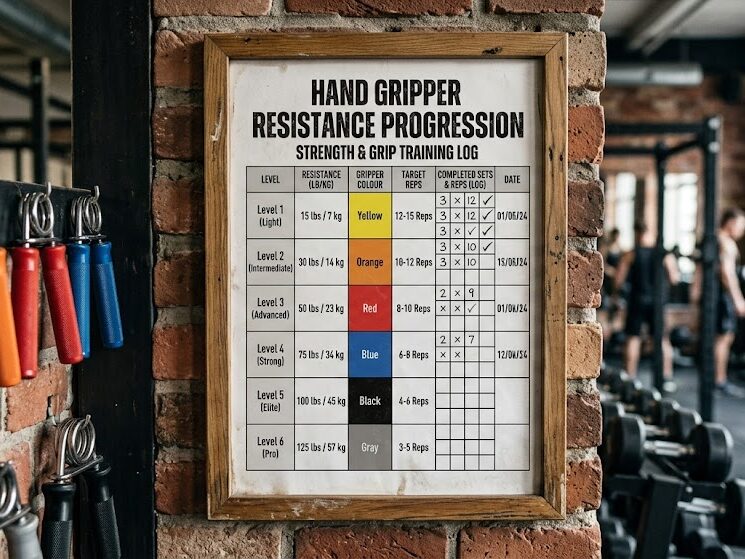
9. Hand Grippers
Hand grippers offer convenient crush-grip training at home or on the go.
Benefits
- Develops crushing strength
- Portable and affordable
- Easy to progress
10. Fat Grip Training
Fat grips increase handle thickness and force your hands to work harder.
Benefits
- Builds open-hand grip strength
- Increases forearm activation
- Improves carrying strength
11. Rope Climbs
Rope climbs combine grip endurance, upper-body strength, and coordination.
Benefits
- Develops functional grip strength
- Improves athletic performance
- Builds pulling power
12. Fingertip Push-Ups
Fingertip push-ups challenge the fingers, hands, and tendons.
Benefits
- Strengthens fingers
- Improves tendon resilience
- Develops hand stability
Beginner Grip Strength Workout Program
Beginners should train grip strength two to three times per week after their primary workout.
Beginner Grip Workout
| Exercise | Sets | Reps/Time |
|---|---|---|
| Farmer’s Carries | 3 | 30 seconds |
| Dead Hangs | 3 | Max time |
| Hand Grippers | 3 | 12–15 reps |
| Wrist Curls | 3 | 15 reps |
| Plate Pinches | 3 | 20 seconds |
Training grip after your main workout prevents hand fatigue from negatively affecting your primary lifts.
Weekly Grip Strength Training Plan
Day 1
- Farmer’s carries
- Dead hangs
Day 3
- Wrist curls
- Hand grippers
Day 5
- Plate pinches
- Towel hangs
This simple schedule develops all major grip-strength qualities while allowing adequate recovery.
How Often Should You Train Grip Strength?
Most people achieve excellent results by training grip strength two to four times per week.
Beginners
- 2 sessions weekly
- Focus on technique and consistency
Intermediate Lifters
- 3 sessions weekly
- Gradually increase volume
Advanced Athletes
- Up to 4 sessions weekly
- Rotate grip styles to manage recovery
Research suggests forearm muscles recover relatively quickly, although excessive volume can still impair performance.
Source: NSCA, 2024.
For scheduling guidance, review strength training frequency guide.
Common Grip Training Mistakes
Avoiding common mistakes can dramatically improve your results.
Overtraining the Forearms
Excessive grip work may lead to tendon irritation and prolonged soreness.
Neglecting Recovery
Recovery is when muscles and connective tissues adapt and become stronger.
Consider implementing recovery techniques for athletes.
Using Lifting Straps Too Often
While straps are useful for heavy lifts, excessive reliance may limit grip development.
Failing to Progress
Without progressive overload, gains eventually stall.
Ways to progress include:
- Increasing load
- Extending hold duration
- Using thicker handles
- Increasing training volume
Best Equipment for Grip Training at Home
Several tools can help you build stronger hands and forearms without needing a commercial gym.
Recommended Grip Training Tools
| Tool | Primary Benefit |
|---|---|
| Hand Grippers | Crush grip strength |
| Fat Grips | Open-hand grip |
| Pull-Up Bar | Support grip |
| Kettlebells | Carries and holds |
| Pinch Blocks | Pinch grip |
| Grip Trainers | General hand strength |
How to Measure Grip Strength Progress
Tracking progress helps ensure continuous improvement.
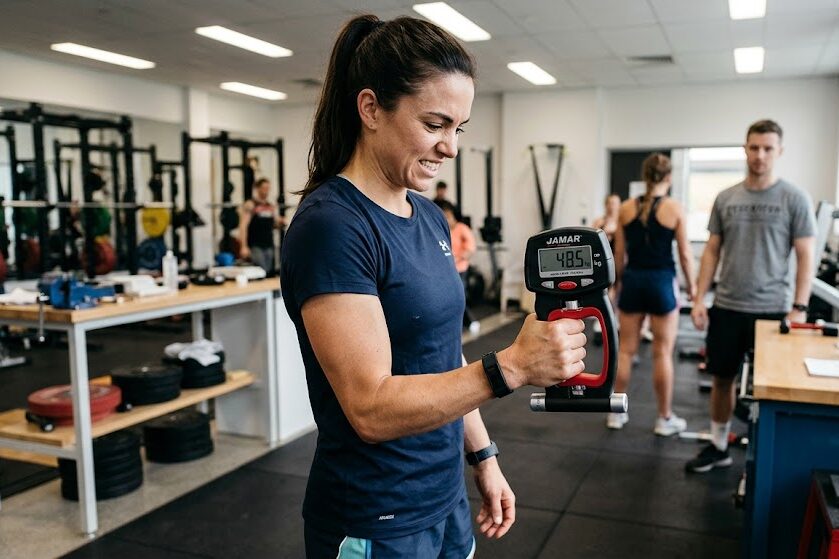
Dynamometer Testing
A hand dynamometer provides the most objective measure of grip strength.
According to Cleveland Clinic, 2024, grip dynamometers remain the gold standard for measuring hand strength.
Performance Benchmarks
Track:
- Dead hang duration
- Farmer’s carry distance
- Plate pinch hold time
- Gripper resistance level
Exercise Tracking
Record:
- Resistance used
- Hold duration
- Number of sets
- Weekly improvements
What Is a Good Grip Strength Score by Age and Gender?
Grip strength scores vary based on age, sex, body size, and training experience.
Generally:
| Group | Typical Grip Strength |
|---|---|
| Adult Men | 40–55 kg |
| Adult Women | 25–35 kg |
These values serve as general guidelines rather than strict standards.
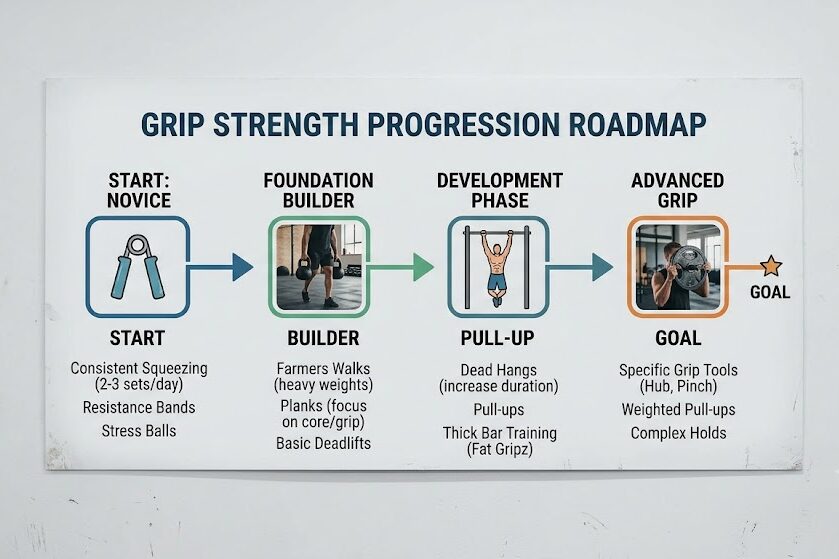
Building a Long-Term Grip Strength Program
Long-term success depends on progressive overload, consistency, and recovery.
Apply Progressive Overload
Gradually increase:
- Carrying weight
- Dead hang duration
- Gripper resistance
- Handle thickness
- Training volume
Train All Four Grip Types
A balanced program should include:
- Crush grip
- Support grip
- Pinch grip
- Open-hand grip
Prioritize Recovery
Maximize adaptation through:
- Quality sleep
- Proper nutrition
- Hydration
- Scheduled rest days
For additional guidance, review how progressive overload works
Practical Application Checklist
- Train grip 2–4 times weekly
- Progress loads gradually
- Include all four grip types
- Limit unnecessary strap use
- Track performance monthly
- Prioritize recovery
- Stay consistent
Conclusion
Developing grip strength is one of the most effective ways to improve athletic performance, lifting ability, injury resistance, and everyday functionality. Whether your goal is to lift heavier weights, perform more pull-ups, excel in sports, or simply build stronger hands and forearms, the right grip training program can deliver significant results.
The best exercises to improve grip strength include farmer’s carries, dead hangs, plate pinches, heavy deadlifts, hand grippers, and fat grip training. By consistently training all four grip types, applying progressive overload, and prioritizing recovery, you’ll steadily build stronger hands, wrists, and forearms over time.
Remember, grip strength is not built overnight. Stay consistent, track your progress, and focus on gradual improvement. Stronger hands today can lead to better performance, greater resilience, and improved physical capability for years to come.
FAQs
What are the best exercises to improve grip strength?
Farmer’s carries, dead hangs, plate pinches, and hand grippers are some of the best grip-strength exercises.
How often should I train grip strength?
Train grip strength 2–4 times per week for steady progress.
Do hand grippers improve grip strength?
Yes, hand grippers effectively build crush grip strength.
Can grip strength increase deadlift performance?
Yes, a stronger grip helps you hold heavier weights during deadlifts.
How long does it take to improve grip strength?
Most people see improvements within 4–8 weeks of consistent training.
Are wrist curls good for grip strength?
Yes, wrist curls strengthen the forearm muscles involved in gripping.
Is grip strength important for daily life?
Yes, it helps with carrying, lifting, opening jars, and other everyday tasks.
Should beginners use lifting straps?
Use straps sparingly so your grip can develop naturally.
1 thought on “Best Exercises to Improve Grip Strength: Hands, Wrists & Forearms”