
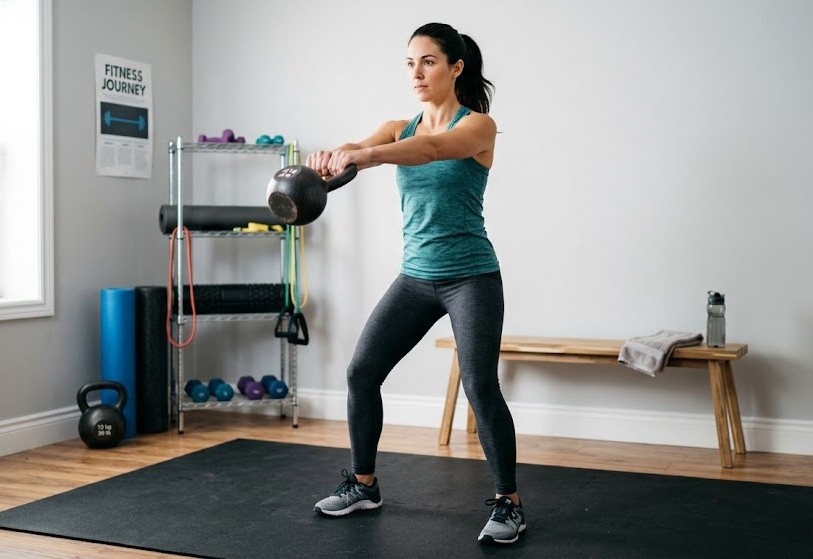
You’ve probably seen kettlebells at the gym or in home workout videos and wondered whether they’re worth adding to your fitness routine. What many beginners don’t realize is that a few simple kettlebell exercises can deliver strength, cardio, and mobility benefits at the same time. In this guide, you’ll learn exactly how to start kettlebell training safely, choose the right weight, and follow a beginner-friendly workout plan that produces results.
Key Takeaways
- Beginner kettlebell workouts combine strength training and cardio into efficient full-body exercise sessions.
- Proper kettlebell form reduces injury risk and improves workout effectiveness.
- Foundational exercises such as goblet squats, deadlifts, and swings build strength and movement skills.
- Consistent kettlebell training can support fat loss, muscular endurance, and functional fitness improvements.
- Appropriate kettlebell weight selection is essential for safe and effective training.
- Progressive overload helps beginners continue making strength gains over time.
- Structured workout plans improve consistency and long-term fitness results.
What Is a Beginner Kettlebell Workout and How Does It Work?
A beginner kettlebell workout is a structured strength and conditioning routine that uses kettlebell exercises to improve fitness, strength, and endurance.
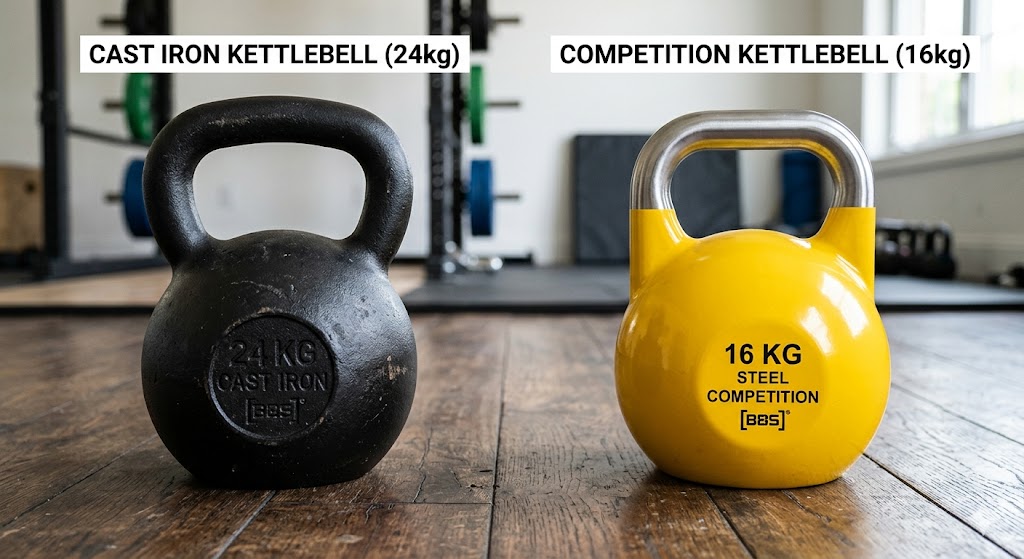
First, kettlebells are cast-iron or steel weights with a handle attached to the top. Unlike dumbbells, the weight sits below the handle, creating a unique center of gravity that challenges stability and coordination during movement.
Moreover, kettlebell training combines resistance exercise and cardiovascular conditioning within the same workout session. For example, a set of kettlebell swings elevates your heart rate while simultaneously strengthening your hips, glutes, and core.
According to the World Health Organization, adults should perform at least 150–300 minutes of moderate physical activity weekly and engage in muscle-strengthening activities twice per week — Source: WHO, 2024.
How Kettlebells Differ From Dumbbells
| Feature | Kettlebells | Dumbbells |
|---|---|---|
| Weight Distribution | Offset center of gravity | Balanced center |
| Movement Style | Dynamic and ballistic | Controlled and linear |
| Cardio Demand | Higher | Moderate |
| Functional Training | Excellent | Good |
| Full-Body Workouts | Highly effective | Effective |
Why Are Kettlebells Effective for Beginners?
Second, kettlebells allow beginners to train multiple fitness qualities simultaneously.
For example, a simple full body kettlebell workout may improve:
- Strength
- Balance
- Coordination
- Endurance
- Mobility
- Core stability
Consistent beginner kettlebell workouts can improve strength, balance, coordination, and muscular endurance over time.
Why Is Kettlebell Training Effective for Beginners?
Kettlebell training is effective for beginners because it develops strength, burns calories, improves cardiovascular fitness, and enhances functional movement patterns.
According to the American College of Sports Medicine, resistance training improves muscular strength, body composition, and overall health outcomes — Source: ACSM, 2024.
Strength Development
First, kettlebell exercises recruit multiple muscle groups simultaneously.
For example, a goblet squat works the quadriceps, glutes, core, and upper back in a single movement. This efficiency makes kettlebells ideal for people with limited workout time.
Fat Loss Benefits
Second, kettlebell workouts can increase calorie expenditure because they combine resistance training with cardiovascular activity.
For example, circuits involving swings, squats, and carries keep your heart rate elevated throughout the workout.
Research published by the American Council on Exercise found kettlebell workouts can produce significant cardiovascular and metabolic demands comparable to high-intensity exercise — Source: ACE, 2024.
how to lose weight with exercise
Functional Fitness Improvements
Moreover, kettlebell training improves movement patterns used in everyday life.
For example, lifting groceries, climbing stairs, or carrying luggage becomes easier when you regularly perform kettlebell deadlifts and farmer’s carries.
Home Workout Convenience
Finally, one kettlebell can support dozens of exercises. This makes kettlebell training one of the most space-efficient fitness solutions available.
How Heavy Should a Kettlebell Be for Beginners?
The ideal kettlebell weight for beginners is the lightest weight that allows proper form while still providing a challenge.
Selecting a kettlebell weight that allows proper technique is more important than lifting the heaviest weight possible.
Recommended Starting Weights
| Experience Level | Women | Men |
|---|---|---|
| Complete Beginner | 6–8 kg | 8–12 kg |
| Beginner with Exercise Experience | 8–12 kg | 12–16 kg |
| Athletic Beginner | 12–16 kg | 16–20 kg |
Factors That Affect Weight Selection
First, exercise selection matters.
For example, you may use a heavier kettlebell for deadlifts but need a lighter kettlebell for overhead presses.
Second, training goals matter.
For example:
- Strength goals often require heavier weights.
- Endurance goals may use lighter weights and higher repetitions.
- Technique practice should prioritize control over resistance.
Safety Considerations
Moreover, beginners should prioritize movement quality.
For example, if your lower back rounds during swings or deadlifts, the weight is likely too heavy.
What Essential Kettlebell Safety Tips Should Beginners Follow?
Kettlebell safety involves using proper form, appropriate weight selection, controlled progression, and adequate recovery.
Warm Up Before Every Session
First, warming up prepares muscles and joints for exercise.
For example, perform:
- Arm circles
- Hip hinges
- Bodyweight squats
- Walking lunges
- Dynamic stretches
Maintain Proper Posture
Second, proper kettlebell form involves maintaining a neutral spine, engaging the core, and generating power from the hips rather than the lower back.
For example, during a kettlebell swing, your spine should remain stable while your hips drive the movement.
Use Proper Grip Technique
Moreover, grip the handle firmly but avoid excessive squeezing.
For example, over-gripping often causes unnecessary forearm fatigue.
Avoid Common Beginner Errors
Finally, beginners should avoid:
- Using excessive weight
- Rounding the back
- Swinging with the arms
- Skipping warm-ups
- Training through pain
What Are the Best Beginner Kettlebell Exercises to Learn First?
The best beginner kettlebell exercises build foundational strength, coordination, and movement quality.
Kettlebell Deadlift
First, the kettlebell deadlift teaches the hip hinge pattern.
Steps:
- Place kettlebell between your feet.
- Push hips backward.
- Keep chest up.
- Stand tall while holding the kettlebell.
- Return under control.
Goblet Squat
Second, the goblet squat develops lower-body strength and posture.
Benefits include:
- Leg development
- Core activation
- Improved mobility
How Do You Perform a Kettlebell Swing Correctly?
A kettlebell swing involves a hip-hinge movement that develops lower-body power, cardiovascular fitness, and functional strength.
Steps:
- Stand shoulder-width apart.
- Hinge at the hips.
- Swing the kettlebell backward.
- Drive hips forward explosively.
- Allow momentum to lift the kettlebell.
The hips generate power during the swing, not the arms.
Overhead Press
Fourth, the overhead press strengthens shoulders and upper-body stability.
Bent-Over Row
Fifth, the row strengthens the upper back and improves posture.
Farmer’s Carry
Sixth, the farmer’s carry improves grip strength, core stability, and endurance.
Russian Twist
Finally, Russian twists target rotational core strength.
What Is the Best Beginner Kettlebell Workout Plan for Home Use?
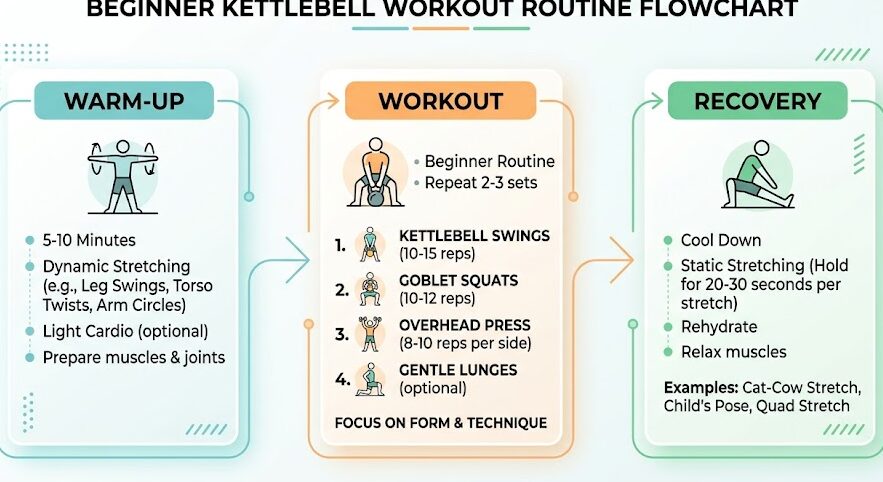
A beginner kettlebell workout plan should include a warm-up, foundational exercises, structured sets and reps, and a cool-down routine.
Step-by-Step Beginner Kettlebell Workout Routine
Warm-Up (5 Minutes)
- Bodyweight squats × 10
- Arm circles × 20
- Hip hinges × 10
- Walking lunges × 10
Main Workout
| Exercise | Sets | Reps |
|---|---|---|
| Deadlift | 3 | 10 |
| Goblet Squat | 3 | 10 |
| Kettlebell Swing | 3 | 15 |
| Overhead Press | 3 | 8 |
| Bent-Over Row | 3 | 10 |
| Farmer’s Carry | 3 | 30 seconds |
| Russian Twist | 3 | 15 |
Rest: 60–90 seconds between sets.
Cool-Down Routine
- Hamstring stretch
- Hip flexor stretch
- Shoulder stretch
- Deep breathing
How Often Should Beginners Do Kettlebell Workouts?
Beginners should perform kettlebell workouts two to three times per week while allowing adequate recovery between sessions.
Two-Day Beginner Plan
Day 1
- Full-body kettlebell workout
Day 2
- Full-body kettlebell workout
Three-Day Beginner Plan
Monday
- Strength focus
Wednesday
- Technique focus
Friday
- Conditioning focus
Four-Week Progression Model
| Week | Focus |
|---|---|
| Week 1 | Learn technique |
| Week 2 | Increase repetitions |
| Week 3 | Add sets |
| Week 4 | Increase weight if form remains excellent |
Can Beginners Build Muscle With Kettlebell Workouts?
Beginners can build muscle with kettlebell workouts when training is consistent and progressively challenging.
According to the National Strength and Conditioning Association, novice trainees often experience rapid improvements in strength and muscle development during the first months of resistance training — Source: NSCA, 2024.
For example, performing goblet squats, rows, presses, and deadlifts regularly can stimulate muscle growth throughout the body.
What Is Progressive Overload?
Progressive overload involves gradually increasing workout difficulty through additional weight, repetitions, sets, or training volume.
For example, you might progress from:
- 3 × 10 reps
- to 3 × 12 reps
- to a heavier kettlebell
Are Kettlebell Workouts Good for Weight Loss?
Kettlebell workouts support weight loss by increasing calorie expenditure while preserving muscle mass.
First, resistance training helps maintain lean tissue during calorie deficits.
Second, kettlebell circuits elevate heart rate and energy expenditure.
For example, combining swings, squats, carries, and presses creates a highly efficient kettlebell fat loss workout.
According to the CDC, combining physical activity with nutrition strategies improves long-term weight management outcomes — Source: CDC, 2024.
What Mistakes Should Beginners Avoid During Kettlebell Training?
The most common kettlebell mistakes involve poor technique, excessive loading, inadequate recovery, and inconsistent training.
Using Excessive Weight
First, heavy weights often compromise technique.
For example, struggling through a movement usually produces less benefit than using a lighter kettlebell correctly.
Poor Swing Mechanics
Second, swinging with the arms reduces effectiveness and increases injury risk.
For example, the swing should be driven by hip extension rather than shoulder effort.
Rounding the Back
Moreover, spinal position matters during all kettlebell movements.
For example, maintaining a neutral spine helps distribute force safely.
Skipping Recovery
Finally, recovery allows adaptation and progress.
What Tools and Equipment Are Useful for Beginner Kettlebell Training?
Beginner kettlebell training requires minimal equipment, but a few tools can improve results and consistency.
Recommended Kettlebell Types
- Cast iron kettlebells
- Competition kettlebells
- Adjustable kettlebells
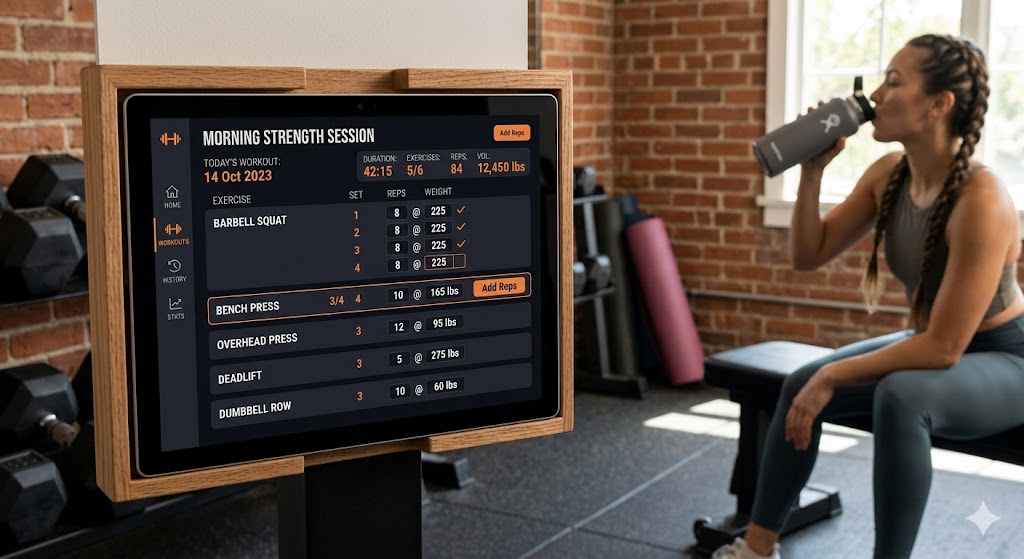
Workout Tracking Tools
You can track workouts using:
- Strong App
- Hevy App
- Google Sheets
- Training journals
Home Gym Setup
A simple setup includes:
- One kettlebell
- Exercise mat
- Water bottle
- Open training space
Custom Diagram Suggestion
What Should You Do After Completing a Beginner Kettlebell Program?
The next step after a beginner kettlebell program is gradually increasing training complexity while maintaining proper form.
First, continue applying progressive overload principles.
Second, learn new movement patterns.
Examples include:
- Clean
- Snatch
- Turkish Get-Up
- Front Squat
Strength Progression Roadmap
- Master technique.
- Increase repetitions.
- Increase sets.
- Increase resistance.
- Learn advanced exercises.
Small, consistent progress produces significant long-term fitness results.
How Long Does It Take to See Results From Kettlebell Training?
Most beginners notice improvements in strength, endurance, and coordination within four to eight weeks of consistent kettlebell training.
For example, many trainees report improved posture, easier daily activities, and increased workout confidence after their first month.
Consistency matters more than workout intensity during the beginner phase.
Conclusion
A beginner kettlebell workout is one of the most effective ways to build strength, improve fitness, and train your entire body with minimal equipment. By choosing the right weight, mastering foundational exercises, and following a structured workout plan, you can safely develop strength, endurance, mobility, and confidence.
Moreover, remember that fitness is a long-term process. Focus on proper technique, gradual progression, and consistent effort rather than chasing rapid results. Pair your training with to maximize progress.
The best beginner kettlebell workout is the one you perform consistently. Start small, stay patient, and build momentum one workout at a time.
FAQs
What is a beginner kettlebell workout?
A beginner kettlebell workout is a strength and conditioning routine that uses a kettlebell to improve fitness, build muscle, burn calories, and develop functional strength.
Are kettlebell workouts good for beginners?
Yes, kettlebell workouts can be beginner-friendly when proper technique, appropriate weight selection, and basic exercises are used.
What are the benefits of beginner kettlebell workouts?
Kettlebell training may help improve strength, endurance, balance, coordination, cardiovascular fitness, and overall body conditioning.
What weight kettlebell should a beginner use?
The ideal weight depends on fitness level, strength, and exercise selection, but beginners often start with a lighter kettlebell to learn proper form.
What are the best kettlebell exercises for beginners?
Popular beginner exercises include kettlebell deadlifts, goblet squats, swings, overhead presses, and farmer carries.
Can kettlebell workouts help with weight loss?
Yes, kettlebell workouts can burn calories and support fat loss when combined with a balanced nutrition plan.
How often should beginners do kettlebell workouts?
Many beginners start with 2–3 sessions per week to allow recovery and gradual progress.
Do kettlebell workouts build muscle?
Yes, kettlebell training can help build muscle and strength, especially when progressive overload is applied consistently.
Can you get a full-body workout with a kettlebell?
Yes, a single kettlebell can be used to train the upper body, lower body, core, and cardiovascular system.
Are kettlebell workouts better than traditional weight training?
Neither is universally better; kettlebells offer functional, dynamic movements, while traditional weight training may provide more exercise variety and precise progression.