
Doing yoga with another person adds shared balance and shared breathing, which can make familiar stretches feel new. This guide covers eight partner yoga poses with clear steps, plus safety tips and a 20-minute sequence. No experience is required, and the poses work for couples, friends, and family members alike. If you are completely new to yoga, start with our Restorative Yoga for Beginners.
What are yoga poses with a partner?
Yoga poses with a partner are postures that two people perform together, using touch, shared weight, or matching movement to deepen a stretch or hold a balance. Many are partner versions of solo poses, such as forward folds, twists, and Warrior III. In the United States, yoga usually centers on physical postures, breathing techniques, and meditation (Source: NCCIH), and partner yoga builds on the same elements.
Most partner poses fall into a few formats:
- Back to back, with your spines supporting each other
- Face to face, holding hands or forearms
- Side by side, for balance poses
- Assisted, where one partner stretches while the other offers light support
Partner yoga is not limited to couples. Friends, siblings, and a parent with an older child can practice together, as long as both people agree on pace and pressure.
Why do partner yoga poses matter?
Partner yoga poses matter because they add shared movement and communication to a practice that research links to better stress management, sleep, and balance. NCCIH reports that studies suggest yoga may help people manage stress and may improve mental and emotional health, sleep, and balance (Source: NCCIH).
- Yoga may help with day-to-day stress, and a shared session makes it easier to do together. See our guide to yoga for stress relief.
- In a study from the British Psychological Society, coordinated nonverbal movement helped couples feel more attuned to each other, and matching a partner’s moves was linked to more empathy and bonding (Source: Healthline).
- Because partners rely on each other to stay balanced, the poses give you practice in speaking up and listening (Source: Healthline).
- The WHO says that limiting sedentary time and staying physically active is good for health, and a gentle session counts as movement (Source: WHO, 2020).
- A partner can steady your balance or give a little extra support in a stretch.
The research has limits. Most of it covers yoga in general, and partner-specific work is smaller, such as a University of Ottawa study that gathered the experiences of 11 couples after four three-hour partner yoga sessions (Source: University of Ottawa). These studies describe experiences and associations, so they do not prove that partner yoga causes any specific result.
How do you prepare for partner yoga?
Preparing takes about five minutes and mostly means agreeing on how you will communicate.
- Pick a flat, open space with room to extend your arms and legs.
- Use a place two mats side by side so they do not slide apart.
- Wear stretchy, close-fitting clothes, and take off watches, rings, and belts that could scratch.
- Warm up for three to five minutes with shoulder rolls, hip circles, and cat-cow, following a short routine of warm-up exercises before a workout.
- Agree on a stop word, such as “pause,” and respond to it immediately.
- Let the person in the stretch decide how deep to go.
- Breathe slowly and audibly enough that you can match each other.
Easy yoga poses with partner for beginners
The easiest partner poses stay seated or close to the floor, so you can practice breathing and communication before adding balance. Hold each pose for about 3 to 10 breaths, and stay in a range where you can still talk comfortably.
1. Back-to-back breathing
This pose is a calm starting point because it needs no flexibility.
- Sit back to back in a comfortable cross-legged seat with your spines lightly touching.
- Rest your hands on your knees and close your eyes if that feels comfortable.
- Inhale and feel your partner’s back expand against yours, then exhale together.
- Continue for 8 to 10 breaths.
Sit on a folded blanket if your knees rise above your hips. To stretch the calm into a longer cool-down, try these Yoga Breathing Techniques for Beginners.
2. Seated twist
A seated twist rotates the spine gently and shows each of you how far you can turn comfortably.
- From the back-to-back seat, inhale and sit tall.
- Exhale and twist toward the same side, placing one hand on your own knee and the other on your partner’s knee.
- Hold for 3 to 5 breaths, using your hands for gentle leverage only.
- Return to center on an inhale and repeat on the other side.
Twist from the ribs and upper back, and never pull your partner deeper.
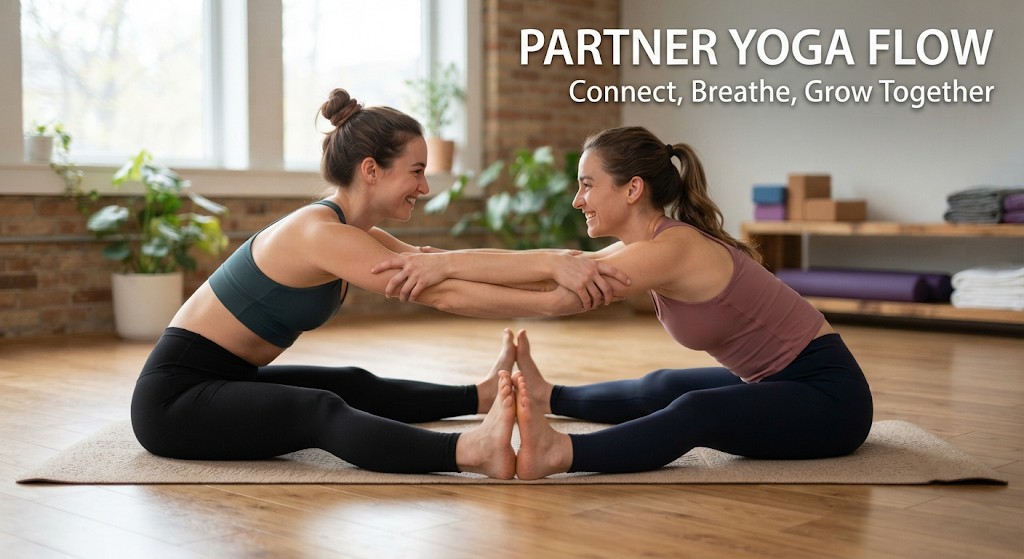
3. Seated forward fold
This fold stretches the hamstrings and lower back while the sitting partner acts as a steady anchor.
- Sit facing each other with your legs in a wide V and the soles of your feet touching.
- Hold each other’s forearms or wrists.
- One partner exhales and folds forward from the hips while the other sits tall and lets the arms lengthen.
- Hold for 5 breaths, then swap roles.
Bend your knees if your hamstrings feel tight. For more work on this area, see these Yoga for Hamstrings.
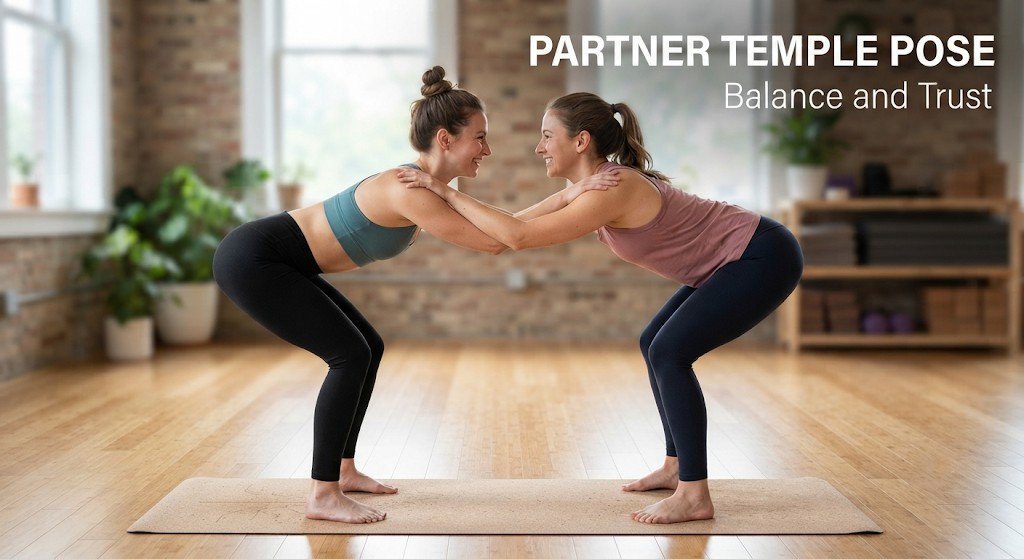
4. Temple pose
Temple pose is a standing forward fold that opens the shoulders and the backs of the legs.
- Stand facing each other with your feet hip-width apart.
- Hinge forward from the hips and rest your hands on your partner’s shoulders.
- Walk your feet back until your arms are straight and your torso is roughly parallel to the floor.
- Press lightly into each other’s shoulders, let your chest sink, and hold for 5 breaths.
- Walk your feet in slowly to come up.
Keep a soft bend in your knees. If your shoulders feel tight, add some Mobility Workout to your warm-up.
Intermediate yoga poses with partner
Intermediate partner poses add balance and shared weight, so they suit you once the beginner poses feel easy. Move slowly and talk through every transition.
5. Double tree pose
Double tree pose is a standing balance where your partner becomes a second point of support.
- Stand side by side with your shoulders touching, and wrap your inside arms around each other’s waists.
- Ground your outside foot and place the sole of your inside foot on your calf or inner thigh, never on the knee joint.
- Raise your outside arms overhead and bring your palms together.
- Fix your eyes on one spot and hold for 5 breaths, then switch sides.
Keep your toes on the floor if you wobble.
6. Back-to-back chair pose
This pose strengthens the thighs and glutes while you lean on each other for support.
- Stand back to back with your feet hip-width apart, then take a small step forward so you can lean into each other.
- Link elbows for stability.
- Bend your knees together and slide down as if sitting in chairs, stopping when your thighs are as close to parallel as feels comfortable.
- Press evenly into each other’s backs, hold for 3 to 5 breaths, and straighten your legs on a shared count.
Stop higher up if your knees hurt. For more thigh work, try Beginner Legs Workout.
7. Partner boat pose
Partner boat pose strengthens the core and hip flexors, and holding your partner’s hands helps you stay balanced.
- Sit facing each other with your knees bent and your toes touching.
- Hold each other’s forearms or hands.
- Lean back slightly and lift your feet one at a time until the soles meet.
- Straighten your legs only as far as you can without rounding your back, hold for 3 to 5 breaths, then lower with control.
Keep your knees bent if straight legs strain your back. You can build on this pose with other core strengthening exercises.
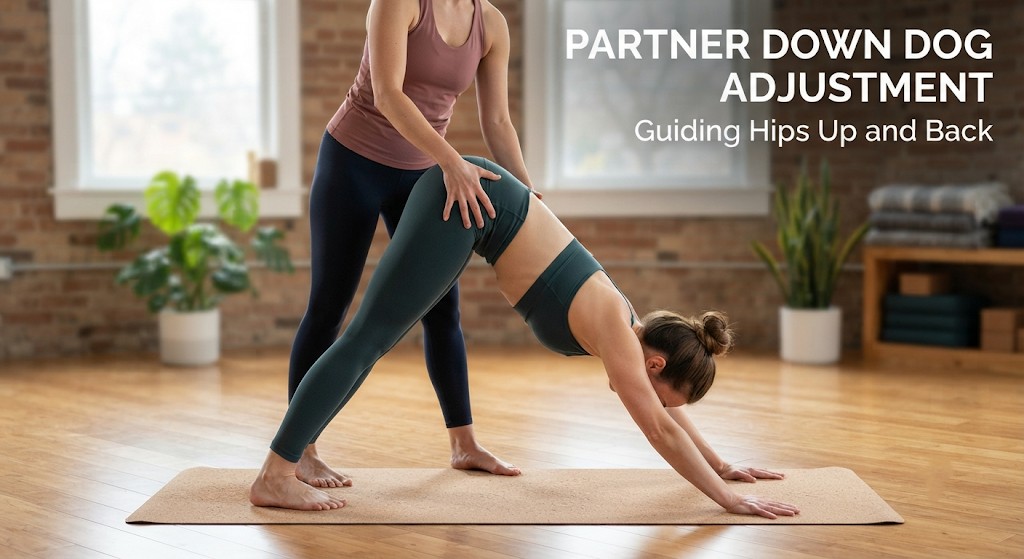
8. Assisted downward dog
Assisted downward dog lets one partner lengthen the spine and hamstrings while the other offers light support.
- Partner A comes into Downward-Facing Dog with hands shoulder-width apart and hips lifted.
- Partner B stands behind A with feet hip-width apart and knees soft.
- B places their hands on A’s hip creases, the folds at the tops of the thighs, and avoids the lower back.
- As A exhales, B gently draws the hips up and back while A presses the floor away.
- Hold for 5 breaths, then swap.
Stacked “double” versions, where one person rests weight on the other, are advanced and best learned with a qualified teacher. For a refresher on the solo shape.
Partner yoga poses at a glance
The eight poses fall into two levels, and beginners should start with the first four, which stay close to the floor or need little balance.
| Pose | Level | Main focus | Typical hold |
|---|---|---|---|
| Back-to-back breathing | Beginner | Calm, shared breathing | 8 to 10 breaths |
| Seated twist | Beginner | Spine rotation | 3 to 5 breaths per side |
| Seated forward fold | Beginner | Hamstrings, lower back | 5 breaths per partner |
| Temple pose | Beginner | Shoulders, hamstrings | 5 breaths |
| Double tree pose | Intermediate | Balance | 5 breaths per side |
| Back-to-back chair pose | Intermediate | Thighs, glutes | 3 to 5 breaths |
| Partner boat pose | Intermediate | Core, hip flexors | 3 to 5 breaths |
| Assisted downward dog | Intermediate | Hamstrings, shoulders, back | 5 breaths per partner |
What does a 20-minute partner yoga sequence look like?
A 20-minute partner yoga sequence moves from calm breathing to active poses and back to rest.
- Back-to-back breathing: 2 minutes
- Seated twist, both sides: 3 minutes
- Seated forward fold, each partner: 3 minutes
- Temple pose: 2 minutes
- Double tree pose, both sides: 2 minutes
- Back-to-back chair pose: 2 minutes
- Partner boat pose: 2 minutes
- Assisted downward dog, each partner: 2 minutes
- Rest lying side by side with your hands touching: 2 minutes
This works well as a light session between harder workouts. Pair it with a Assisted Stretching Benefits on rest days.
What mistakes should you avoid in partner yoga?
The most common partner yoga mistake is pushing deeper into a stretch than your partner has asked for. These slip-ups come up often too:
- Pulling or pressing without checking in first
- Copying your partner’s range instead of staying within your own
- Holding your breath
- Locking your knees or elbows in balance poses
- Skipping the warm-up
- Trying lifts or flying poses without training
Is partner yoga safe, and who should take extra care?
Partner yoga poses are usually low impact, but anyone with an injury, a health condition, or a pregnancy should talk with a healthcare provider before starting. NCCIH advises practicing under a qualified instructor to reduce injury risk, since learning yoga without supervision has been linked with higher risk (Source: NCCIH).
- Stop at sharp pain, numbness, or dizziness, and do not push through it.
- Yoga can be safe during pregnancy with appropriate precautions, and a healthcare provider should confirm that exercise is safe for you first (Source: NCCIH).
- Older adults can start with a gentle or seniors class to get individual guidance on form (Source: NCCIH, 2020).
- Skip lifts and acrobatic poses unless a trained teacher is present.
Conclusion
Partner yoga poses work best when you keep them simple and let the less flexible partner set the pace.
- Start this week with back-to-back breathing and the seated twist.
- Add one new pose per session once those feel easy.
- Run the 20-minute sequence once a week as a light, shared session.
If your goal is more mobility, pair these sessions with our yoga for flexibility.
FAQs
What are the easiest yoga poses to do with a partner?
Back-to-back breathing, the seated twist, and the seated forward fold are the easiest, because they stay on the floor and need little balance.
Can friends do partner yoga, or is it only for couples?
Friends, siblings, and family members can all practice partner yoga as long as both people agree on pace and pressure.
How long should you hold partner yoga poses?
Most poses in this guide work well for 3 to 10 breaths, and you can shorten any hold if you feel strain.
Do you need to be flexible to do partner yoga?
No, because every pose here can be modified, for example by bending the knees in forward folds or sitting on a folded blanket.
Is partner yoga safe during pregnancy?
Yoga can be safe during pregnancy with appropriate precautions, but NCCIH advises being evaluated by a healthcare provider first to make sure exercise is safe for you.
What if my partner and I are very different sizes?
A size difference is fine for most poses here, because they share support lightly instead of carrying weight. Avoid poses that rely on lifting, and let the smaller or less flexible partner set the depth.
Sources
- National Center for Complementary and Integrative Health. (n.d.). Yoga: Effectiveness and Safety.
- National Center for Complementary and Integrative Health. (n.d.). 5 Things You Should Know About Yoga.
- National Center for Complementary and Integrative Health. (2020). Yoga for Health. NCCIH Clinical Digest.
- World Health Organization. (2020). WHO Guidelines on Physical Activity and Sedentary Behaviour: At a Glance.
- Healthline. (n.d.). Benefits of Couples Yoga.
- University of Ottawa. (n.d.). Integrative Connection, a Discovery: Interpretative Phenomenological Analysis of Couple Experiences in a Traditional Partner Yoga Practice.
Disclaimer: This article is for informational and educational purposes only and is not a substitute for personalized medical advice. Consult a qualified healthcare professional before making significant changes to your diet, exercise routine, or supplement use.