
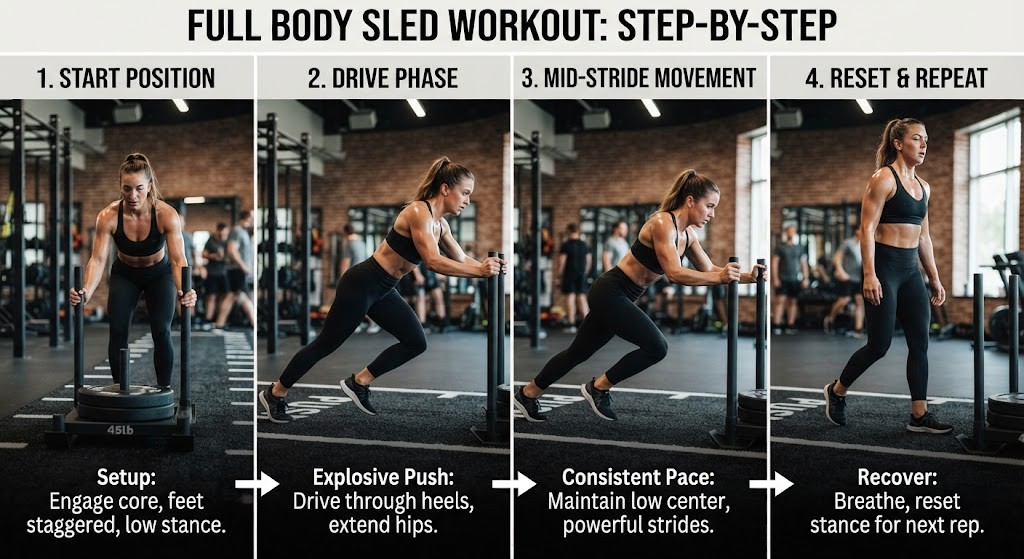
Most people think of the sled push as a brutal lower-body conditioning exercise. However, a sled can do far more than simply push weight across a turf lane. By combining pushes, pulls, drags, lateral movements, and different loading strategies, you can turn one piece of equipment into an effective full body sled workout.
A well-designed sled session can challenge your legs, glutes, core, shoulders, upper back, and arms while improving muscular endurance and conditioning. It can also be adapted for beginners, general fitness, athletic performance, strength-endurance, and HYROX preparation.
In this guide, you’ll learn what a full body sled workout is, which muscles it works, the best sled exercises to use, how much weight to choose, how to structure workouts for different goals, and how to progress safely.
What Is a Full Body Sled Workout?
A full body sled workout is a training session that combines weighted sled pushes, pulls, drags, and related movements to challenge multiple muscle groups while creating a conditioning stimulus.
For example, you might combine a sled push for the legs and trunk with a backward drag, forward drag, and hand-over-hand pull. This approach allows you to train several movement patterns during the same session.
A complete sled workout is different from simply performing repeated sled pushes. Pushing, pulling, dragging, and lateral movements allow you to train the body from different directions while adjusting the resistance to match your goal.
A 2025 systematic review and meta-analysis examined 14 studies involving 344 participants and found resisted sled training produced significant improvements in short-distance acceleration, particularly over 5 and 10 meters.
Source: PubMed, 2025.
For more movement variety, combine sled work with a full body functional training workout.
Why Is Sled Training Effective for Full-Body Conditioning?
Sled training combines resistance with continuous movement. This makes it possible to train strength, muscular endurance, work capacity, and conditioning within the same workout.
For example, a 20-meter sled push requires the lower body to repeatedly produce force while the trunk remains stable. As fatigue builds, you must continue producing force without allowing your technique to deteriorate.
Builds Work Capacity and Muscular Endurance
Repeated sled efforts can challenge your ability to produce force over multiple rounds. This makes sled training useful for athletes, functional fitness enthusiasts, and anyone who enjoys conditioning workouts with straightforward equipment.
Supports Functional Strength
Sled movements require you to apply force against external resistance while moving your body. A heavy sled push, for example, involves horizontal force production that can complement athletic training and acceleration-focused work.
A 2025 meta-analysis included 23 studies and 395 participants and reported an acute improvement in sprint performance following resisted sprint training.
Source: PubMed, 2025.
Can Be Adapted to Different Fitness Goals
One of the biggest advantages of sled training is its flexibility. You can change the resistance, distance, rest periods, movement direction, or number of rounds depending on whether you’re training for conditioning, strength-endurance, athletic performance, or HYROX.
Importantly, sled training does not automatically cause fat loss. Fat loss still depends largely on overall energy balance, nutrition, activity levels, and consistency.
What Muscles Does a Full Body Sled Workout Work?
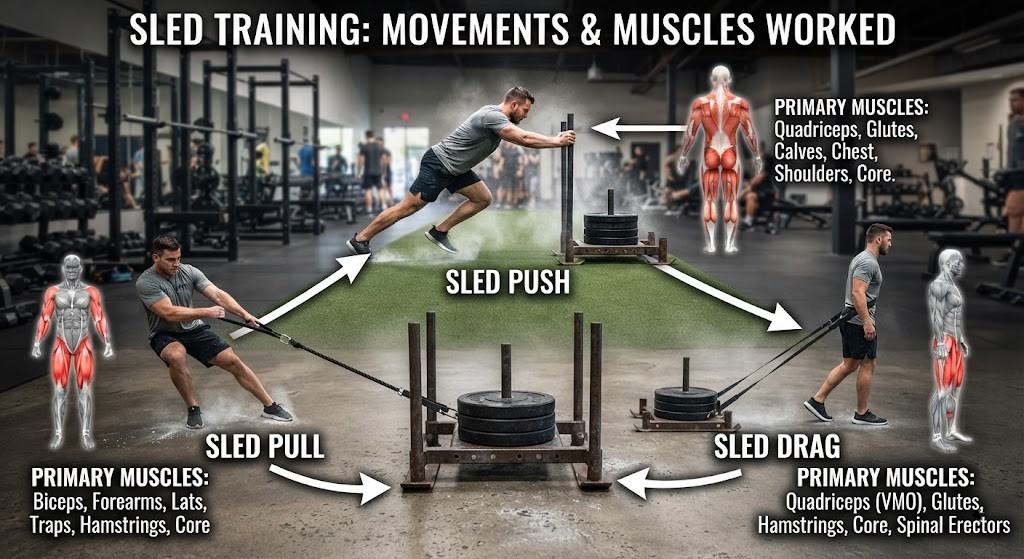
A full body sled workout can train the quadriceps, hamstrings, glutes, calves, core, shoulders, upper back, and arms. However, the muscles emphasized depend on the specific sled movement.
| Sled Movement | Primary Muscles | Main Training Focus |
|---|---|---|
| Sled push | Quads, glutes, calves, core | Strength-endurance |
| Backward drag | Quads, calves, glutes | Leg strength |
| Forward drag | Glutes, hamstrings, back | Full-body conditioning |
| Sled pull | Back, arms, core, legs | Pulling strength |
| Hand-over-hand pull | Upper back, biceps, core | Upper-body endurance |
| Lateral drag | Glutes, hips, core | Lateral strength |
Lower Body
The lower body performs much of the force production during sled pushing and dragging. The quadriceps, glutes, hamstrings, and calves can all contribute depending on the movement and direction.
Core
Your core acts as a stabilizer during almost every sled variation. Maintaining a braced trunk helps transfer force between your upper and lower body while you move the sled.
A core workout exercises routine can complement sled training when you want additional direct core work.
Upper Body
Pulling variations increase the contribution from the upper back, shoulders, biceps, and arms. Hand-over-hand pulls are particularly useful when you want to make a sled session more upper-body focused.
What Are the Best Full Body Sled Exercises?
The best full body sled exercises are movements that expose you to different directions and muscle actions instead of relying exclusively on the standard sled push.
A balanced session can include forward pushing, backward dragging, forward dragging, hand-over-hand pulling, and lateral dragging.
1. Sled Push
The sled push involves driving a weighted sled forward while maintaining a strong body position. Start with short, controlled steps and keep your arms firm on the handles.
Avoid allowing your hips to rise excessively as fatigue increases. Instead, focus on maintaining a consistent position and producing steady force through each step.
The sled push primarily challenges the lower body and trunk, making it one of the most useful movements for strength-endurance and conditioning.
2. Sled Backward Drag
A backward sled drag involves walking backward while pulling the sled toward you. This variation strongly challenges the quadriceps while also involving the calves and other lower-body stabilizers.
Keep your chest upright and take controlled steps. Rather than rushing, focus on maintaining consistent tension throughout the movement.
Backward drags are especially useful when you want a lower-body sled exercise without leaning aggressively into the handles.
3. Sled Forward Drag
A forward drag involves pulling the sled from the front while walking away from it. This movement can challenge the posterior chain and upper back while maintaining continuous involvement from the legs.
Use a rope or strap when appropriate and keep the movement smooth. Forward drags also work well in conditioning circuits because they allow you to transition easily between different sled exercises.
4. Hand-Over-Hand Sled Pull
A hand-over-hand sled pull requires repeatedly pulling a rope toward you as the sled moves across the floor. The upper back, biceps, shoulders, core, and legs can all contribute.
To perform the movement, establish a stable position, pull the rope toward your body, reset your grip, and repeat until the sled reaches you.
Because the exercise involves repeated pulling, it can be particularly useful for upper-body endurance and full-body conditioning.
5. Lateral Sled Drag
A lateral sled drag involves moving sideways while pulling resistance across the floor. This introduces frontal-plane training, which standard forward sled work does not emphasize as much.
Keep your feet controlled and avoid excessive crossing. Focus on maintaining your balance and controlling the sled throughout the movement.
Lateral dragging can be paired with a glute workout exercises routine for additional hip-focused training.
How Do You Do a Full Body Sled Workout?
A full body sled workout should begin with a warm-up, progress through controlled sled exercises, and finish with an appropriate cooldown.
For example, beginners can start with three movements for 15–20 meters each rather than immediately attempting a high-volume, maximal-effort circuit.
Step 1: Warm Up
Complete 5–10 minutes of general movement and dynamic preparation before loading the sled. Pay attention to the hips, knees, ankles, shoulders, and trunk.
Use warm-up exercises before a workout to prepare your body before the main session.
Step 2: Perform the Sled Movements
A practical full-body session can be structured as follows:
- Warm-up: 5–10 minutes.
- Sled push: 3 × 15–20 meters.
- Backward drag: 3 × 15–20 meters.
- Hand-over-hand pull: 2–3 × 15–20 meters.
- Lateral drag: 2 × 10–15 meters per side.
- Rest: 60–120 seconds between efforts.
- Cooldown: 5 minutes of easy movement.
The goal is to complete every repetition with controlled technique. If your posture or movement quality breaks down, reduce the resistance or increase your recovery time.
How Often Should Beginners Perform Sled Workouts?
For beginners, start with 2 sessions per week and allow adequate recovery between demanding sessions. Your overall weekly schedule should also account for other strength and conditioning workouts.
As your fitness improves, you can gradually increase the workload instead of making large jumps in resistance or volume.
How Much Weight Should You Put on a Sled?
There is no universal sled weight that works for everyone. The appropriate resistance depends on the exercise, sled design, surface, training goal, and fitness level.
For example, the same plate load can feel dramatically different on rubber flooring compared with turf because friction changes the resistance.
Choose Weight Based on Technique
Start with a load that allows you to maintain consistent technique and controlled movement speed. If the sled barely moves or your posture collapses, the resistance is probably too high for that particular goal or surface.
Research also demonstrates why universal loading rules can be misleading. One study used sled loads equivalent to approximately 44%, 89%, and 133% of body mass in different resisted sprint groups, showing that training effects vary substantially with loading strategy.
Source: PubMed, 2020.
Sled Weight Guide by Training Goal
| Training Goal | Suggested Effort | Loading Approach |
| Beginner conditioning | Easy–moderate | Light enough for clean technique |
| Muscular endurance | Moderate–hard | Maintain repeated quality efforts |
| Strength-endurance | Hard | Slower but controlled movement |
| Athletic acceleration | Fast and powerful | Use a load appropriate to speed training |
| HYROX preparation | Competition-specific | Practice relevant distances and resistance |
Avoid choosing a sled load simply because another athlete uses it. Effective resistance depends on the entire sled setup, including surface friction, sled construction, plates, handles, and movement direction.
Is a Sled Workout Good for Beginners?
Yes. A sled workout can be suitable for beginners when resistance, volume, and technique are scaled appropriately.
For example, a new trainee can perform three short sled pushes with light resistance instead of beginning with a maximal-effort circuit.
Beginners should focus on:
- Body position
- Controlled steps
- Breathing
- Consistent effort
- Safe movement mechanics
- Appropriate recovery
The goal is to understand how the sled responds before chasing heavier loads or faster times.
Simple Beginner Sled Workout
- Sled push: 3 × 15 meters
- Backward drag: 3 × 15 meters
- Forward drag: 2 × 15 meters
- Rest: 90 seconds between rounds
For additional leg preparation, combine sled training with a leg workout for beginners.
Can Sled Workouts Improve Strength and Conditioning?
Sled workouts can improve strength-endurance and conditioning by requiring repeated force production against external resistance.
For example, performing several 20-meter pushes with controlled recovery challenges your ability to repeatedly produce force while managing fatigue.
Resisted sled training has also been studied for acceleration. A 2025 systematic review found significant effects on 5-meter and 10-meter sprint performance, although evidence quality and training protocols varied between studies.
Source: PubMed, 2025.
What Are the Best Full Body Sled Workouts for Different Goals?
The same sled can be programmed in different ways depending on your objective. Changing load, distance, recovery, and exercise selection allows you to create sessions for conditioning, strength-endurance, athletic performance, or HYROX preparation.
Beginner Full Body Sled Workout
This session emphasizes manageable volume and controlled technique.
- Sled push: 3 × 15 meters
- Backward drag: 3 × 15 meters
- Forward drag: 2 × 15 meters
- Rest: 90–120 seconds
- Effort: Moderate
Focus on learning the movements rather than trying to complete the workout as quickly as possible.
Conditioning Sled Workout
This workout uses several sled movements to create a higher conditioning demand.
- Sled push: 20 meters
- Forward drag: 20 meters
- Backward drag: 20 meters
- Hand-over-hand pull: 15 meters
- Complete 3–4 rounds
- Rest: 60–90 seconds
Maintain consistent movement quality across every round. If your output drops significantly, increase recovery or reduce resistance.
Strength-Endurance Sled Workout
A strength-endurance session uses heavier resistance and longer recovery.
- Heavy sled push: 15 meters
- Heavy backward drag: 15 meters
- Forward sled pull: 15 meters
- Complete 4 rounds
- Rest: 2 minutes
Use functional strength training alongside this style of programming when strength is a primary goal.
Athletic Performance Sled Workout
Athletic sled training can emphasize short, powerful efforts with longer recovery periods.
A 2025 review found resisted sled training produced its strongest measured benefits at short acceleration distances rather than 20 meters.
Source: PubMed, 2025.
Try:
- Sled push: 4 × 10–15 meters
- Rest: 2–3 minutes
- Lateral drag: 3 × 10 meters per side
- Backward drag: 3 × 15 meters
HYROX-Style Sled Workout
A HYROX-style sled workout should reproduce the repeated pushing and pulling demands of the event while managing fatigue.
Official HYROX materials list sled push and sled pull distances and weights that vary by division, so competition-specific preparation should use the current rules for your category.
Source: HYROX, 2025/26.
Try:
- Sled push: 4 × 15 meters
- Sled pull: 4 × 15 meters
- 400-meter run or equivalent conditioning effort
- Repeat for 3 rounds
- Rest according to your training goal
For more race-specific preparation, use HYROX workout training.
How Many Times a Week Should You Do Sled Training?
Most recreational trainees can begin with one or two sled sessions per week, depending on training intensity and the rest of their program.
For example, one moderate sled circuit can fit after strength training, while two harder sessions may require additional recovery.
Higher-intensity sled work should not be treated as unlimited conditioning. Your legs, connective tissues, and nervous system still need time to recover between demanding sessions.
The broader U.S. physical activity guidelines recommend adults accumulate 150–300 minutes of moderate-intensity aerobic activity or 75–150 minutes of vigorous activity per week, plus muscle-strengthening activity on at least 2 days.
Source: U.S. Department of Health and Human Services, 2018.
Sled training can contribute to your overall workload, but it should be programmed alongside other forms of exercise rather than used as your only training method.
What Tools Do You Need for a Full Body Sled Workout?
A full body sled workout primarily requires a weighted sled, appropriate plates, and enough space to move safely.
A gym turf lane can support forward pushes, backward drags, lateral drags, and rope pulls within one session.
Useful equipment includes:
- Weighted sled
- Weight plates
- Sled straps or rope
- Turf or suitable training surface
- Stable handles
- Stopwatch or interval timer
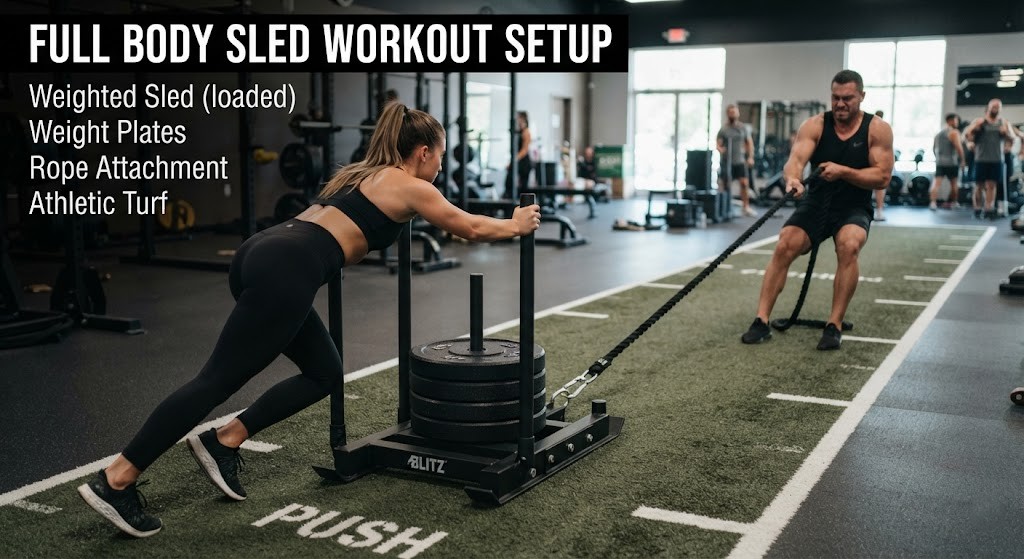
A practical setup should leave enough space for acceleration, turning, stopping, and safely returning the sled. Avoid crowded lanes and slippery surfaces, particularly when performing heavy drags.
How Do You Progress a Full Body Sled Workout?
You can progress a full body sled workout by increasing resistance, distance, rounds, movement complexity, or training density while maintaining good technique.
For example, increasing a sled push from 3 × 15 meters to 3 × 20 meters is a straightforward progression before adding more weight.
A Practical Sled Progression
Use the following progression order:
- Improve technique.
- Increase consistency.
- Add distance.
- Add rounds.
- Increase resistance gradually.
- Reduce rest when appropriate.
- Introduce more demanding variations.
Progression should remain gradual because sled resistance can become surprisingly demanding as fatigue accumulates.
Better technique and repeatable output are more valuable than simply loading more plates.
What Should You Track?
Record the following after each session:
- Sled weight
- Distance
- Number of rounds
- Rest periods
- Perceived effort
- Technique quality
Tracking these variables makes it easier to identify meaningful improvements and avoid increasing multiple training variables too quickly.
For broader training adaptation, include workout recovery as part of your weekly plan.
How Should You Build Your Sled Training Routine?
The best sled routine is the one that matches your current fitness level and training goal rather than simply copying an advanced athlete’s workout.
For example, beginners can start with two weekly sessions using short distances and moderate resistance. More experienced trainees can use heavier loads, more complex movement combinations, or shorter recovery periods when appropriate.
Choose Your Movements
Start by selecting three or four sled movements that cover different patterns.
A balanced combination could include:
- Sled push
- Backward drag
- Forward drag
- Hand-over-hand pull
- Lateral drag
You do not need to use every variation in every workout.
Select Manageable Resistance
Choose a resistance that allows you to maintain your intended movement quality. The right load should challenge you without causing your posture or technique to collapse.
Track Your Performance
After each workout, record:
- Sled weight
- Distance
- Number of rounds
- Rest periods
- Perceived effort
- Technique quality
This creates a simple record of your training progression.
Increase One Major Variable at a Time
Finally, increase only one major training variable at a time. You might add distance first, then increase rounds, and eventually raise the resistance.
This approach makes it easier to determine what is improving your performance while limiting unnecessary fatigue.
Conclusion
A full body sled workout is a versatile way to combine resistance training, repeated movement, muscular endurance, and conditioning using one primary piece of equipment. Depending on the movement, sled training can challenge the legs, glutes, core, shoulders, back, and arms.
The key is not simply pushing the heaviest sled possible. Instead, choose the right movement, resistance, distance, recovery, and progression strategy for your specific goal.
Sled training can be adapted for beginners, general conditioning, strength-endurance, athletic preparation, and HYROX-style training. Start with manageable resistance, learn the movement patterns, and gradually increase your workload as your technique and fitness improve.
A beginner sled workout should prioritize controlled technique and manageable resistance before increasing load, distance, volume, or intensity. Start simple, stay consistent, track your performance, and let your results guide your progression.
FAQs
What is a full body sled workout?
It combines sled pushes, pulls, and drags to train multiple muscle groups and improve conditioning.
What muscles does a full body sled workout work?
It targets the legs, glutes, core, back, shoulders, and arms.
Is a weight sled a good workout?
Yes, it can improve strength-endurance, conditioning, and work capacity.
Is sled training good for beginners?
Yes, beginners can start with light resistance and short distances.
What is the 3-3-3 rule in the gym?
The 3-3-3 rule can have different meanings depending on the training program.
Is a sled workout good for fat loss?
Yes, it can increase energy expenditure and support fat-loss goals.
How long should a sled workout be?
A typical sled workout can last about 20–40 minutes, including warm-up and cooldown.
How often should I do sled workouts?
One or two sled sessions per week can be a good starting point.
Can sled workouts build muscle?
They can improve muscular strength-endurance and complement resistance training.
Are sled pushes good for conditioning?
Yes, sled pushes can effectively improve conditioning and muscular endurance.
Are sled workouts good for HYROX training?
Yes, sled pushes and pulls can help prepare you for HYROX demands.
How do I progress a sled workout?
Gradually increase distance, rounds, or resistance as your fitness improves.