
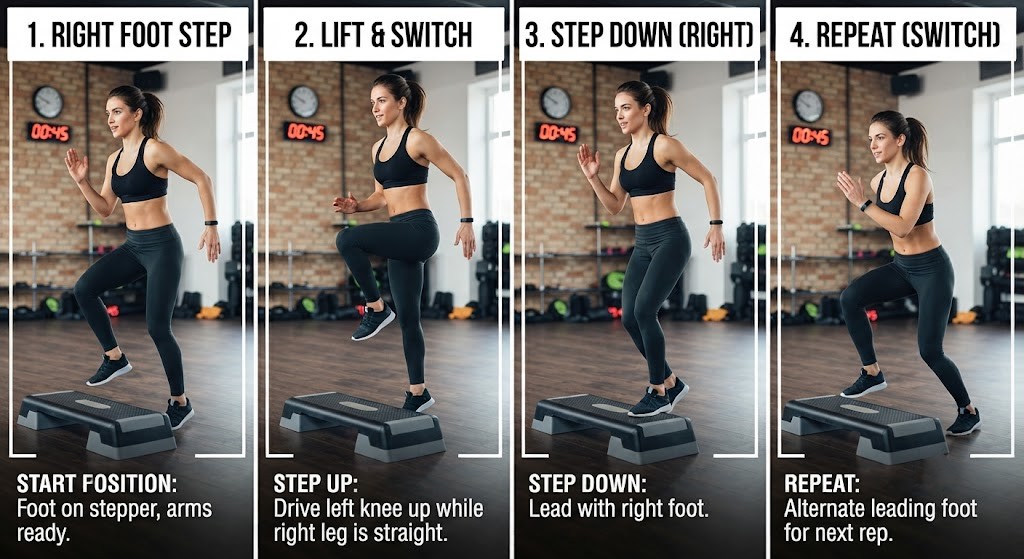
If you want a workout that delivers serious intensity in only a few minutes, a Tabata workout can be an effective option. But there is an important distinction: many workouts marketed as “Tabata” do not actually follow the original Tabata protocol.
A traditional Tabata workout follows a precise 20 seconds of intense exercise followed by 10 seconds of rest for 8 rounds. That creates a four-minute interval block, although modern Tabata-style workouts can include multiple blocks, different exercises, and additional recovery periods.
In this guide, you’ll learn exactly what a Tabata workout is, how the 20/10 format works, how Tabata differs from general HIIT, the best exercises to use, its potential benefits, beginner modifications, equipment options, workout duration, progression strategies, and how to build a routine that matches your fitness level.
What Is a Tabata Workout and How Does It Work?
A Tabata workout is a high-intensity interval training method that traditionally uses 20 seconds of intense exercise followed by 10 seconds of rest for eight consecutive rounds. A traditional Tabata protocol therefore contains eight work intervals and eight recovery periods, creating a 4-minute interval block. — Source: Tabata Research Protocol, 1996
The original Tabata protocol was designed around repeated high-intensity exercise rather than simply performing random movements for four minutes. For example, a cyclist could perform repeated hard efforts separated by short recovery periods while maintaining a structured 20/10 timing pattern.
Today, however, the term “Tabata” is often used more broadly to describe Tabata-style HIIT workouts. These may last 8, 12, 16, or more minutes and can include several different exercises.
These modern workouts can still be useful, but they should not automatically be considered identical to the original Tabata protocol.
What Is the 20/10 Tabata Workout Format?
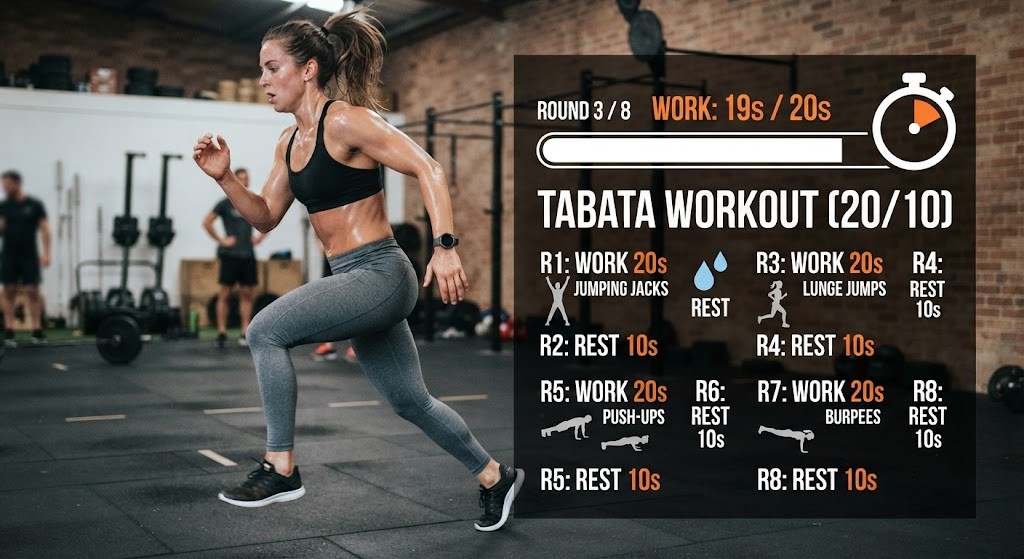
The 20/10 Tabata format means 20 seconds of work followed by 10 seconds of recovery, repeated for eight rounds. This produces 160 seconds of work and 80 seconds of rest within the 4-minute interval block. — Source: Tabata Research Protocol, 1996
The structure is simple, but the short recovery period can make the final rounds increasingly challenging.
For example, you could perform bodyweight squats during all eight rounds. Alternatively, you could alternate two exercises, such as squats and mountain climbers, while keeping the same 20-second work and 10-second recovery periods.
| Tabata Element | Traditional Format |
|---|---|
| Work interval | 20 seconds |
| Rest interval | 10 seconds |
| Number of rounds | 8 |
| Interval block | 4 minutes |
| Total work time | 160 seconds |
| Total rest time | 80 seconds |
How Is Tabata Different From HIIT?
Tabata is a specific interval format, while HIIT is a broader training category that includes many different work-to-rest structures.
For example, performing a 30-second sprint followed by 60 seconds of walking can qualify as HIIT, but it is not the traditional Tabata 20/10 protocol.
In other words, Tabata can be considered one form of high-intensity interval training, but not every HIIT workout is Tabata.
Understanding this distinction helps you select a workout based on its actual training structure rather than relying on the label alone.
Why Is Tabata Training Effective for Short Workouts?
Tabata training is useful for short workouts because it concentrates repeated high-intensity efforts into a compact interval structure. The traditional interval block requires only four minutes, making it easy to add to a larger training session.
Short workouts can also help address one of the most common barriers to exercise: limited time. The World Health Organization recommends adults accumulate 150–300 minutes of moderate-intensity aerobic activity or 75–150 minutes of vigorous-intensity activity each week. — Source: World Health Organization, 2020
However, a four-minute Tabata block should not be viewed as a complete replacement for all weekly physical activity.
Instead, you can combine Tabata with strength training, walking, cycling, recreational activities, or other forms of aerobic exercise throughout the week.
Short duration does not mean low difficulty. Because the work periods are intense and recovery periods are short, even a single four-minute block can feel demanding.
What Are the Best Exercises for a Tabata Workout?
The best Tabata exercises are movements you can perform safely, repeatedly, and with good technique at an appropriate intensity.
The right exercise depends on your fitness level, available equipment, movement skill, and tolerance for impact. Beginners may benefit from bodyweight squats and step jacks, while experienced trainees may choose kettlebell swings, cycling, rowing, or other demanding movements.
Best Bodyweight Tabata Exercises
Bodyweight exercises are practical Tabata choices because they require little or no equipment.
Useful options include:
- Bodyweight squats
- Step jacks
- Jumping jacks
- Mountain climbers
- Push-ups
- High knees
- Reverse lunges
- Burpees
- Plank variations
For beginners, the goal should not be to choose the hardest possible exercise. A controlled bodyweight squat performed consistently is more useful than a technically poor jump squat performed at excessive speed.
As fatigue builds, maintaining proper movement mechanics becomes increasingly important.
Equipment-Based Tabata Exercises
Equipment-based Tabata exercises can add resistance or provide a controlled way to perform high-intensity intervals.
Useful options include:
- Kettlebell swings
- Dumbbell thrusters
- Stationary cycling
- Rowing
- Ski-erg intervals
- Light-to-moderate dumbbell movements
Stationary bikes and rowing machines can be particularly useful when impact-heavy exercises are uncomfortable. They provide a way to increase intensity while keeping the movement relatively consistent.
The key is choosing resistance that allows you to maintain control throughout the interval. Increasing weight simply to make a workout harder can become counterproductive if your technique deteriorates.
What Are the Benefits of Tabata Training?
Tabata training can improve cardiovascular conditioning, muscular endurance, exercise efficiency, and tolerance for repeated high-intensity efforts.
Because Tabata combines repeated bursts of intense activity with short recovery periods, it can challenge multiple aspects of physical fitness within a compact training session.
Cardiovascular Conditioning
Tabata can challenge cardiovascular fitness by repeatedly elevating exercise intensity.
For example, cycling hard for 20 seconds followed by 10 seconds of recovery creates repeated changes in effort that challenge both aerobic and anaerobic energy systems.
A recent study involving 32 male university students with overweight or obesity examined different volumes of Tabata-style exercise and measured energy expenditure and fat oxidation during recovery. — Source: PubMed, 2025
However, this study should not be interpreted as proof that every person will lose a specific amount of body fat from Tabata.
Individual outcomes can vary depending on total physical activity, nutrition, fitness level, recovery, exercise volume, and other factors.
Muscular Endurance and Workout Efficiency
Tabata can improve muscular endurance when exercises repeatedly challenge the same or related muscle groups.
For example, repeated squat intervals can challenge the legs, while push-up intervals emphasize the chest, shoulders, and triceps.
Tabata can also make efficient use of limited training time. A single four-minute block can work as a conditioning finisher, or multiple appropriately designed blocks can be combined into a longer workout.
However, more volume is not automatically better. The quality and suitability of each interval matter more than simply extending the workout.
Calorie Expenditure
Tabata can contribute to calorie expenditure, but calorie burn varies substantially between individuals and workouts.
Factors that can influence energy expenditure include:
- Body size
- Exercise selection
- Exercise intensity
- Workout duration
- Fitness level
- Recovery periods
Therefore, there is no single calorie-burn number that applies to everyone completing a Tabata workout.
How Do You Do a Beginner Tabata Workout at Home?
A beginner Tabata workout should use simple movements, controlled intensity, and low-impact modifications when necessary.
You do not need advanced exercises to get started. For example, jumping jacks can be replaced with step jacks, while regular burpees can be modified into squat-to-reach movements.
Beginner 4-Minute Tabata Routine
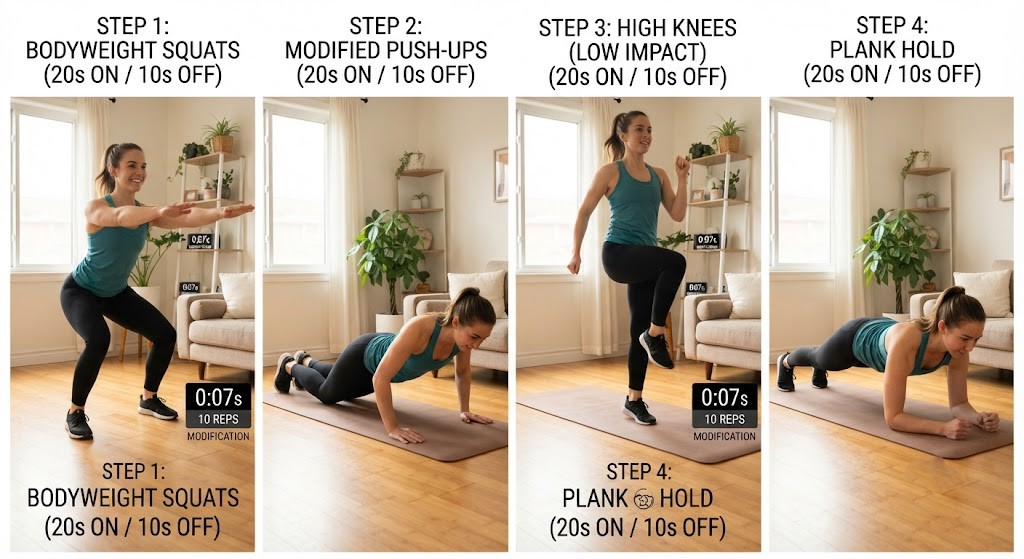
This beginner Tabata routine uses four simple exercises across eight 20/10 rounds.
Complete each exercise for 20 seconds, rest for 10 seconds, and move to the next exercise according to the schedule.
- Rounds 1–2: Bodyweight squats
- Rounds 3–4: Step jacks
- Rounds 5–6: Incline push-ups
- Rounds 7–8: Slow mountain climbers
Before starting the timer, complete a proper warm-up. A five- to ten-minute warm-up can include easy walking, marching, mobility drills, and gradual practice of the movements you’ll perform.
How Should Beginners Progress?
Beginners should progress Tabata by improving movement quality before increasing exercise difficulty or workout volume.
For example, practice controlled bodyweight squats consistently before progressing to jump squats.
You also do not need to reach an absolute maximum effort during every interval. If your technique begins to deteriorate, reduce impact, slow the movement, or switch to an easier variation.
A useful beginner progression is:
- Master the movement pattern.
- Maintain consistent technique during all eight rounds.
- Gradually increase exercise intensity.
- Introduce more challenging variations.
- Add resistance only when appropriate.
- Increase total training volume cautiously.
This approach makes progression more sustainable and reduces the temptation to sacrifice form for speed.
Can You Do a Tabata Workout Without Equipment?
You can perform a Tabata workout without equipment by using bodyweight movements and a reliable timer.
Exercises such as squats, mountain climbers, push-ups, high knees, and step jacks can create a challenging home-based interval session.
A Tabata timer is particularly useful because the 20-second work and 10-second rest periods are short enough that manually watching a clock can distract you from the workout.
A smartphone timer or dedicated interval timer can automatically signal the transitions between work and recovery.
For a lower-impact workout, replace jumping movements with stepping patterns. This allows you to preserve the interval structure without forcing unnecessary impact on your joints.
How Do You Build an Intermediate or Advanced Tabata Workout?
An intermediate or advanced Tabata workout can increase the challenge through exercise selection, resistance, movement complexity, or controlled intensity rather than simply adding endless rounds.
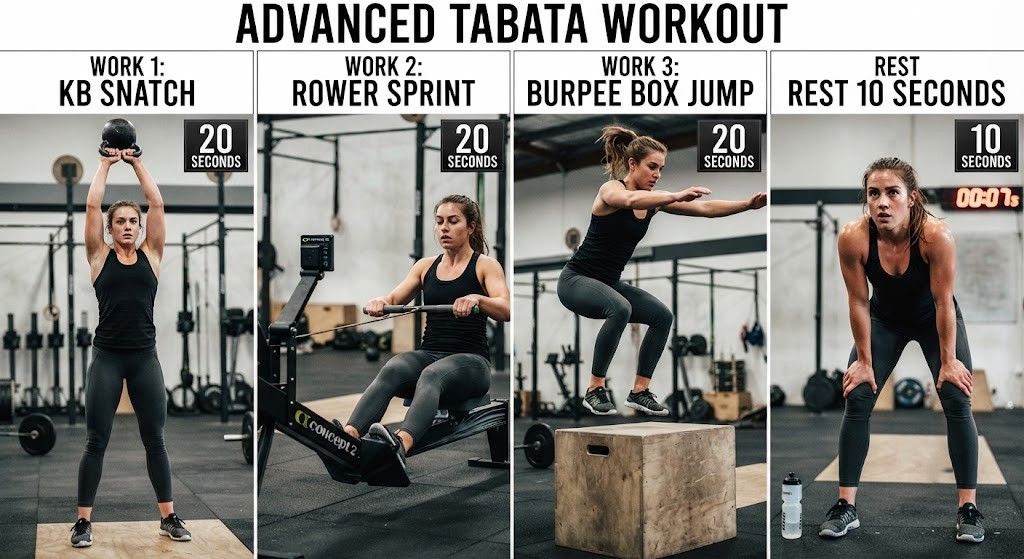
For example, an experienced trainee might use kettlebell swings, rowing intervals, cycling, or more demanding bodyweight movements.
However, exercise difficulty should always match technical ability. A challenging movement performed poorly under fatigue is not necessarily a better training choice.
Intermediate Full-Body Tabata
A full-body Tabata can combine lower-body, upper-body, core, and cardiovascular movements.
One practical structure is:
- Round 1: Squats
- Round 2: Push-ups
- Round 3: Mountain climbers
- Round 4: Reverse lunges
- Round 5: High knees
- Round 6: Push-ups
- Round 7: Squats
- Round 8: Mountain climbers
Changing exercises can distribute fatigue across different muscle groups. However, complex movements should only be included when you can perform them safely while fatigued.
Advanced Equipment Options
Advanced trainees can use cycling, rowing, kettlebells, or dumbbells when they already have sufficient conditioning and technical skill.
For example, a rowing machine can provide a high-output interval without requiring repeated jumping.
At the same time, heavier resistance is not automatically better for Tabata. The resistance should allow controlled movement throughout the work interval, particularly as fatigue increases.
How Long Should a Tabata Workout Last?
A traditional Tabata interval block lasts four minutes, but a complete Tabata workout can last longer when warm-up, cooldown, and additional blocks are included.
For example, a complete session could include:
- 7-minute warm-up
- 4-minute Tabata interval block
- 5-minute cooldown
The traditional structure contains 8 rounds of 20 seconds of work and 10 seconds of rest. — Source: Tabata Research Protocol, 1996
Modern Tabata-style sessions may include multiple four-minute blocks with longer recovery periods between them.
However, adding more blocks also increases the overall training demand. Additional volume should therefore match your current fitness level and recovery capacity.
What Equipment Do You Need for a Tabata Workout?
You need very little equipment for a basic Tabata workout because the protocol can be performed with bodyweight exercises.
For a simple home workout, an exercise mat and interval timer may be enough.
| Equipment | How It Can Help |
| Interval timer | Controls 20/10 intervals |
| Exercise mat | Adds comfort for floor exercises |
| Dumbbells | Adds resistance to selected movements |
| Kettlebell | Enables swings and loaded movements |
| Stationary bike | Provides controlled cardio intervals |
| Rowing machine | Provides high-intensity pulling intervals |
Equipment should expand your options rather than determine your workout.
A no-equipment Tabata workout can still be highly challenging when the exercise selection and intensity are appropriate.
How Often Should You Do Tabata Workouts?
Most people should treat Tabata as a demanding training method and allow adequate recovery between hard sessions.
For example, a beginner may start with one or two Tabata sessions per week while using easier cardio and strength-training sessions on other days.
The WHO recommends adults accumulate 150–300 minutes of moderate activity or 75–150 minutes of vigorous activity each week, alongside muscle-strengthening activity on at least two days. — Source: World Health Organization, 2020
Tabata does not need to provide all of your weekly physical activity.
Walking, cycling, resistance training, recreational sports, and lower-intensity cardio can complement high-intensity intervals and create a more balanced training routine.
Example Weekly Tabata Schedule
A practical weekly structure could look like this:
| Day | Training |
| Monday | Strength training |
| Tuesday | Tabata |
| Wednesday | Easy cardio or recovery |
| Thursday | Strength training |
| Friday | Tabata or moderate cardio |
| Saturday | Optional recreational activity |
| Sunday | Recovery |
This schedule is only an example, not a requirement. Your ideal training frequency should reflect your current fitness, recovery, other workouts, and personal circumstances.
What’s Next: How Should You Progress Your Tabata Training?
The best way to progress a Tabata workout is to master a manageable routine before increasing intensity, resistance, or training volume.
For example, you could perform the same beginner routine for several sessions and track your technique, perceived effort, and recovery before making it more difficult.
Useful progression strategies include:
- Improve technique: Make every repetition controlled and consistent.
- Increase exercise difficulty: Move from easier to harder variations.
- Add appropriate resistance: Introduce dumbbells or kettlebells when suitable.
- Increase intensity gradually: Push harder without sacrificing form.
- Add another block carefully: Increase volume only after adapting to the existing workload.
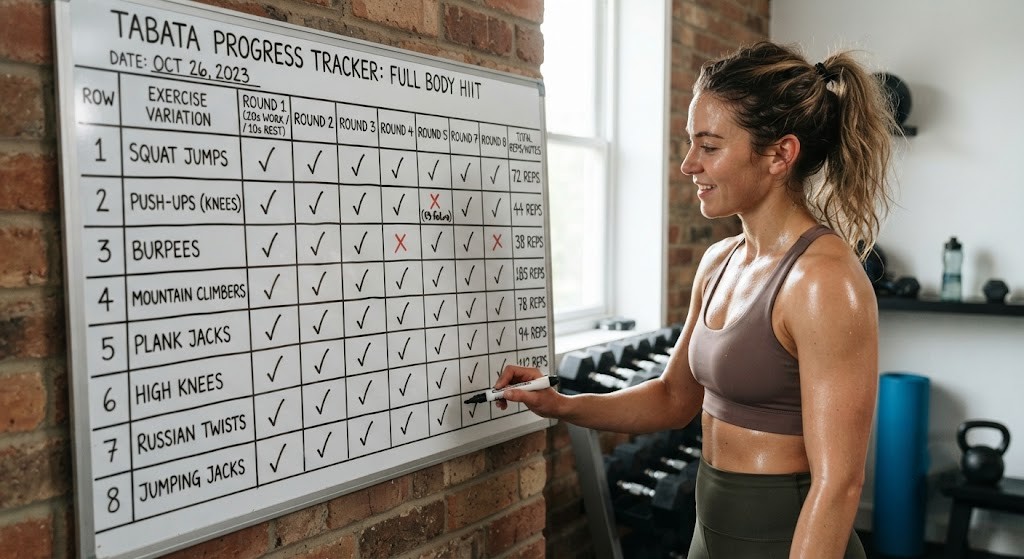
Tracking simple measures can also make progression easier to understand. Consider recording completed rounds, exercise variations, perceived effort, and how well you recover between sessions.
These measurements can help demonstrate progress without encouraging you to chase maximum intensity during every workout.
Safety Tips for Tabata Workouts
Because Tabata involves high-intensity intervals and limited recovery, exercise selection and technique are especially important.
Keep these principles in mind:
- Warm up before starting intense intervals.
- Choose exercises appropriate for your current fitness level.
- Prioritize technique over speed.
- Use low-impact alternatives when needed.
- Avoid increasing resistance simply to make the workout harder.
- Take additional recovery when your technique breaks down.
- Cool down after demanding sessions.
- Allow adequate recovery between hard workouts.
A Tabata workout should feel challenging, but difficulty should remain manageable enough that you can perform the selected movements with control.
If you are new to high-intensity exercise or have concerns about whether intense exercise is appropriate for you, consider getting guidance from a qualified fitness professional or healthcare professional.
Conclusion
A Tabata workout is a short, demanding interval-training method traditionally built around 20 seconds of intense work and 10 seconds of rest for eight rounds. The original structure creates a 4-minute interval block, while modern Tabata-style workouts can be expanded with additional blocks, exercises, and equipment.
Tabata can support cardiovascular conditioning, muscular endurance, and time-efficient training when programmed appropriately. However, the goal should not be to make every session as difficult as possible.
Beginners can start with simple bodyweight exercises, low-impact alternatives, and controlled intensity before progressing to more demanding movements or equipment. With appropriate exercise selection, recovery, and gradual progression, a Tabata workout can become a practical addition to a balanced fitness routine.
FAQs
What is a Tabata workout?
A Tabata workout uses 20 seconds of exercise and 10 seconds of rest for 8 rounds.
Is Tabata good for losing weight?
Yes, Tabata can support weight loss by increasing calorie expenditure.
What is the difference between Tabata and HIIT?
Tabata is a specific 20/10 HIIT format, while HIIT includes various interval structures.
What are 10 examples of exercises to use for Tabata?
Squats, jumping jacks, push-ups, burpees, lunges, high knees, mountain climbers, cycling, rowing, and kettlebell swings.
How long is a traditional Tabata workout?
A traditional Tabata interval lasts 4 minutes.
Can beginners do Tabata workouts?
Yes, beginners can use easier exercises and low-impact modifications.
Can I do a Tabata workout at home?
Yes, Tabata can be done at home with bodyweight exercises and a timer.
Do I need equipment for Tabata?
No, many Tabata workouts can be done without equipment.
How many times a week should I do Tabata?
Beginners can start with one or two Tabata sessions per week.
Can Tabata improve cardiovascular fitness?
Yes, Tabata can improve cardiovascular conditioning.
Can Tabata help burn calories?
Yes, Tabata can increase calorie expenditure during exercise.
Is 4 minutes of Tabata enough for a workout?
Four minutes is one traditional Tabata interval block, not necessarily the entire workout.
How should I progress a Tabata workout?
Improve your technique first, then gradually increase difficulty or intensity.