
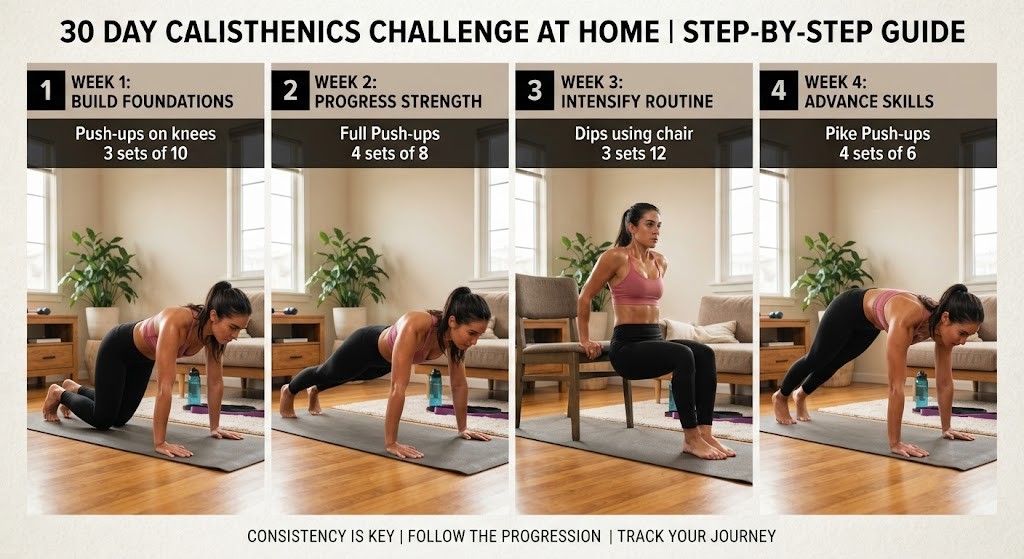
You don’t need a gym, expensive machines, or a room full of equipment to start getting stronger. Bodyweight exercises such as squats, push-ups, lunges, glute bridges, and planks can be performed almost anywhere—but doing random exercises each day is very different from following a structured training program.
A 30 Day Calisthenics Challenge at Home gives you a simple, progressive roadmap for building strength, muscular endurance, movement control, mobility, and consistency. This guide covers the complete 30-day workout schedule, beginner modifications, recovery days, progression strategies, optional equipment, and practical ways to measure your progress.
What Is a 30 Day Calisthenics Challenge at Home?
A 30-day calisthenics challenge is a structured bodyweight-training program that uses progressively challenging exercises over 30 days to develop strength, muscular endurance, movement skills, and exercise consistency.
Instead of performing the same workout every day, the challenge changes training volume, exercise difficulty, repetitions, sets, or movement variations throughout the month. For example, a beginner may begin with incline push-ups and bodyweight squats before progressing toward standard push-ups, reverse lunges, and longer plank holds.
Calisthenics is particularly convenient for home workouts because many foundational movements require little or no equipment. For a deeper introduction to the training style, see our guide to calisthenics for beginners.
What Exercises Are Included in a 30-Day Calisthenics Challenge?
A well-rounded 30 Day Calisthenics Challenge at Home can include exercises such as:
- Squats
- Push-ups
- Reverse lunges
- Split squats
- Glute bridges
- Planks
- Mountain climbers
- Dead bugs
- Pike push-ups
- Triceps dips
- Pull-up progressions
Beginners do not necessarily need to perform the hardest version of every exercise. For example, an elevated push-up can be used initially, with the height gradually reduced as upper-body strength improves.
A balanced routine should also train different movement patterns instead of repeatedly focusing on one exercise. This makes a full-body calisthenics workout more useful for developing balanced strength and movement ability.
Why Does a 30 Day Calisthenics Challenge Matter?
A 30-day challenge turns individual bodyweight exercises into a consistent and progressively structured home strength routine. Having a specific workout to complete each day can make training easier to follow than deciding what to do every time you exercise.
For example, completing several manageable workouts throughout the week can be more sustainable than attempting one extremely difficult workout and then taking several unplanned days off.
Regular physical activity also supports overall health, while muscle-strengthening activity contributes to muscular fitness. Adults are advised to complete at least 150 minutes of moderate-intensity activity per week and muscle-strengthening activity on at least 2 days — Source: [CDC, 2025].
The challenge therefore focuses not only on exercise difficulty but also on creating a repeatable habit. Recovery days are deliberately included so that the program does not require maximum-effort training every day.
Can You Build Strength With Calisthenics at Home?
Yes. Calisthenics can build strength at home when exercises provide an appropriate challenge and become progressively harder over time.
For example, a push-up progression could move from an incline push-up to a knee push-up and eventually to a standard push-up. Similarly, a basic squat can become more challenging through additional repetitions, slower tempo, greater range of motion, or a more demanding variation.
Strength progression does not require adding external weights during every workout. You can make bodyweight exercises harder by:
- Increasing repetitions
- Adding sets
- Reducing assistance
- Slowing the lowering phase
- Increasing range of motion
- Improving movement control
- Progressing to a harder variation
This gradual approach is especially useful for beginners who are still developing exercise technique.
How Do You Prepare for a 30 Day Calisthenics Challenge at Home?
Before starting your 30 Day Calisthenics Challenge at Home, assess your current fitness level and make sure you have enough clear space to exercise safely.
Choose exercise variations that you can perform with controlled technique. For example, if you cannot complete one standard push-up with good form, start with an incline or knee variation rather than forcing full repetitions.
How Many Minutes a Day Should You Do Calisthenics?
A beginner can usually start with 15–30 minutes per workout, including a short warm-up and cool-down.
A 20-minute session, for example, could include:
- 5 minutes: Warm-up
- 12 minutes: Strength and bodyweight exercises
- 3 minutes: Easy mobility or cool-down
However, the challenge does not mean that you need to train hard every day. Recovery and lower-intensity movement are part of the program.
WHO recommends 150–300 minutes of moderate-intensity aerobic activity per week for adults, plus muscle-strengthening activity on at least 2 days — Source: [World Health Organization, 2025].
Before each workout, use warm-up exercises before a workout to prepare your muscles and joints. Stop an exercise if you experience sharp or unusual pain.
How Many Days a Week Should You Do Calisthenics?
Beginners should combine training days with recovery and mobility days rather than performing demanding full-body workouts seven days a week.
This 30 Day Calisthenics Challenge at Home uses active-recovery and rest days to help manage fatigue. Adults are also advised to perform muscle-strengthening activities on 2 or more days per week — Source: [World Health Organization, 2025].
The goal is to build a routine you can sustain, not simply survive for 30 days.
What Is the Best 30-Day Calisthenics Workout Plan for Beginners?
The best beginner 30-day calisthenics plan starts with manageable movements, emphasizes technique, gradually increases training demands, and includes recovery.
The following schedule divides the challenge into four phases:
- Days 1–7: Build your foundation
- Days 8–14: Build volume
- Days 15–21: Introduce progressions
- Days 22–30: Complete the final challenge
Days 1–7: Build Your Foundation
The first week is about learning movement patterns and establishing consistency. Keep the intensity manageable and prioritize controlled repetitions.
| Day | Focus | Workout |
|---|---|---|
| 1 | Full body | 2 × 8 squats, 2 × 6 incline push-ups, 2 × 10 glute bridges, 2 × 20-sec plank |
| 2 | Mobility | 15–20 min easy mobility and walking |
| 3 | Lower body | 3 × 8 squats, 2 × 8 reverse lunges/side, 2 × 10 glute bridges |
| 4 | Recovery | 15–20 min easy walking and stretching |
| 5 | Upper body | 3 × 6 incline/knee push-ups, 2 × 8 bench dips, 2 × 20-sec plank |
| 6 | Full body | 3 rounds: 8 squats, 6 push-ups, 8 lunges, 20-sec plank |
| 7 | Recovery | Rest or gentle mobility |
During Week 1, avoid treating every set as a test of maximum strength. Leave a few controlled repetitions “in reserve” rather than training to complete failure.
The objective is to establish good movement patterns that you can build upon during the remaining weeks.
Days 8–14: Build Volume
Once the basic movements feel more comfortable, the second week increases training volume.
| Day | Focus | Workout |
|---|---|---|
| 8 | Full body | 3 × 10 squats, 3 × 6 push-ups, 3 × 10 glute bridges |
| 9 | Core | 3 × 20-sec plank, 3 × 8 dead bugs/side, 3 × 10 mountain climbers/side |
| 10 | Lower body | 3 × 10 reverse lunges/side, 3 × 12 squats, 3 × 12 calf raises |
| 11 | Recovery | Walking and mobility |
| 12 | Upper body | 3 × 8 push-ups, 3 × 8 pike push-ups, 2 × 10 triceps dips |
| 13 | Full body | 3 rounds: 10 squats, 8 push-ups, 10 lunges, 20-sec plank |
| 14 | Recovery | Rest and light stretching |
The main goal here is to increase workload without sacrificing technique. If your form deteriorates significantly, use an easier variation or reduce repetitions.
Days 15–21: Introduce Progressions
The third phase introduces more demanding movements and slightly greater volume.
| Day | Focus | Workout |
|---|---|---|
| 15 | Full body | 3 × 12 squats, 3 × 8 push-ups, 3 × 12 bridges |
| 16 | Upper body | 3 × 8 push-ups, 3 × 8 pike push-ups, 3 × 10 dips |
| 17 | Lower body | 3 × 10 split squats/side, 3 × 12 squats, 3 × 12 calf raises |
| 18 | Recovery | Walking and mobility |
| 19 | Core | 3 × 30-sec plank, 3 × 10 mountain climbers/side, 3 × 8 dead bugs/side |
| 20 | Full body | 4 rounds: 8 squats, 6–8 push-ups, 8 lunges, 20-sec plank |
| 21 | Recovery | Rest |
At this point, tempo can become another progression tool.
For example, lowering into a squat for three seconds increases the challenge of a familiar movement without requiring additional equipment. Controlled movement can also help you focus on technique instead of simply trying to complete repetitions as quickly as possible.
Days 22–30: Complete the Final Challenge
The final phase combines the movements and progressions developed throughout the month.
| Day | Focus | Workout |
|---|---|---|
| 22 | Full body | 3 × 12 squats, 3 × 8–10 push-ups, 3 × 12 lunges |
| 23 | Upper body | 3 × 10 push-ups, 3 × 8 pike push-ups, 3 × 10 dips |
| 24 | Recovery | Mobility and easy walking |
| 25 | Lower body | 3 × 12 split squats/side, 3 × 15 squats, 3 × 15 bridges |
| 26 | Core | 3 × 30–40-sec plank, 3 × 12 mountain climbers/side |
| 27 | Full body | 4 rounds: 10 squats, 8 push-ups, 10 lunges, 25-sec plank |
| 28 | Recovery | Complete rest or gentle mobility |
| 29 | Practice | Repeat your weakest workout at controlled intensity |
| 30 | Test | Retest selected movements and compare technique, reps, and endurance |
Day 30 is designed as a progress test rather than a punishment workout.
Instead of chasing as many repetitions as possible with poor form, compare your current performance with your Day 1 baseline. Better technique, more controlled repetitions, improved endurance, or a harder exercise variation can all represent meaningful progress.
How Should You Progress Through 30 Days of Calisthenics?
Progressive overload is the key to making a bodyweight program more challenging over time.
You do not need to increase everything simultaneously. Instead, adjust one variable at a time when your current workload becomes manageable.
Ways to progress include:
- Adding repetitions
- Adding a set
- Using a more difficult exercise variation
- Reducing assistance
- Increasing range of motion
- Slowing the eccentric or lowering phase
- Increasing workout volume
- Improving movement control
For example, you might progress from six incline push-ups to eight incline push-ups before lowering the surface and attempting a more difficult variation.
This approach allows the 30 Day Calisthenics Challenge at Home to remain adaptable for different fitness levels.
How Can Beginners Modify Calisthenics Exercises?
Beginners can modify exercises by reducing repetitions, using assistance, shortening the range of motion, or selecting an easier variation.
Useful progressions include:
- Push-up: wall → incline → knee → standard push-up
- Squat: assisted squat → partial squat → bodyweight squat
- Lunge: supported reverse lunge → reverse lunge
- Plank: elevated plank → knee plank → standard plank
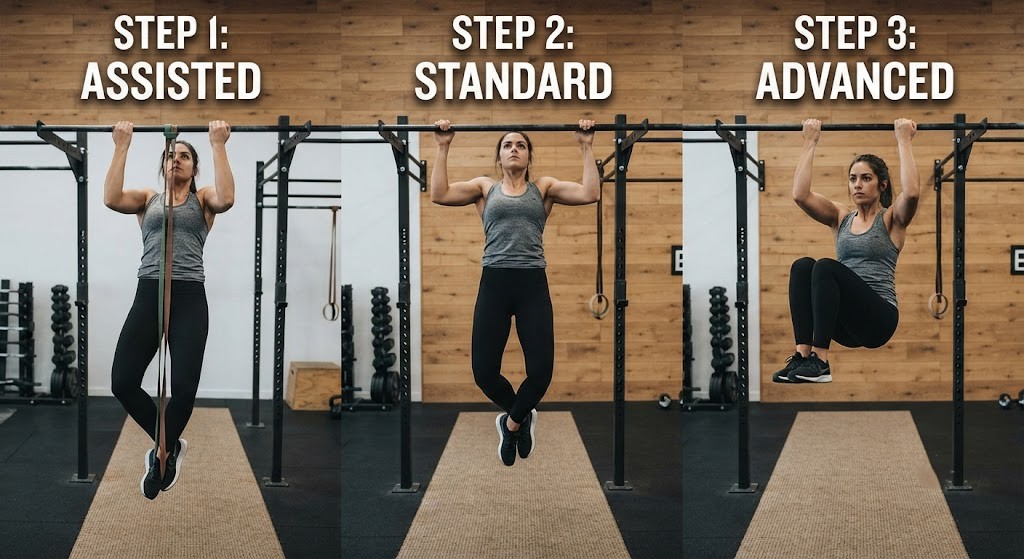
- Pull-up: resistance-band assistance → negative pull-up → assisted pull-up
- Dip: shallow supported dip → controlled bench dip
The right variation is the one that allows you to complete the prescribed movement with reasonable control.
For additional beginner-friendly programming, use a beginner workout plan as a foundation for adjusting training volume.
What Are Good Pull-Up Progressions for Beginners?
Pull-up progressions are exercises that help develop the strength and control needed for a full pull-up.
If you have access to a secure pull-up bar, beginners can use band-assisted repetitions or controlled negative repetitions as progression exercises.
Importantly, never improvise a pull-up bar using unstable household furniture. A secure, properly installed bar is safer than a loose doorframe or makeshift structure.
Can You Do Calisthenics Without Equipment?
Yes. You can perform many foundational calisthenics exercises without equipment.
Squats, push-ups, lunges, glute bridges, planks, dead bugs, and mountain climbers can all be incorporated into an equipment-free home workout. A beginner can therefore complete a basic session using only a small amount of clear floor space.
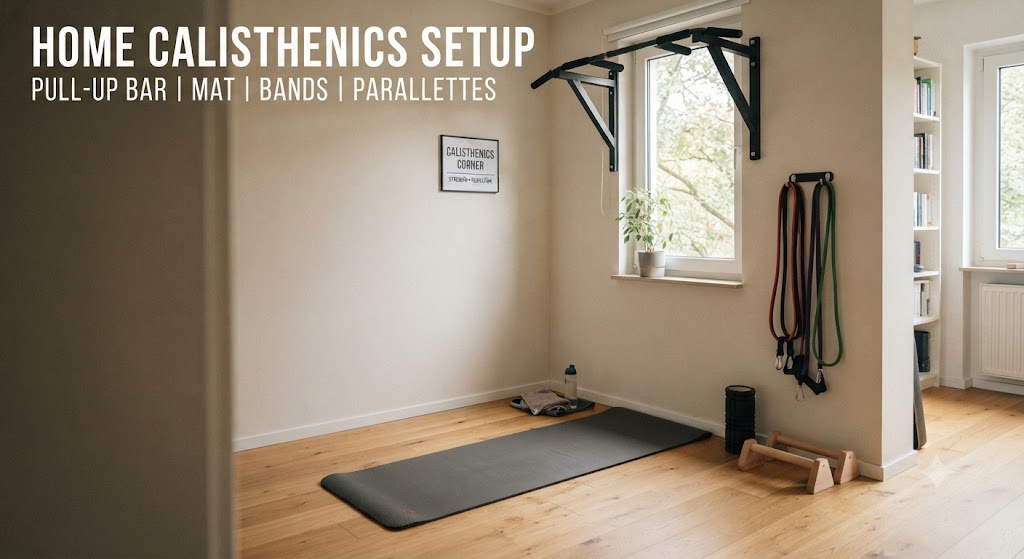
What Equipment Is Useful for Calisthenics at Home?
Equipment is optional, but a few inexpensive additions can expand your exercise options.
Useful equipment includes:
- Exercise mat: Provides additional comfort during floor exercises.
- Resistance bands: Can provide assistance or additional resistance.
- Pull-up bar: Enables vertical pulling exercises.
- Parallettes: Provide alternatives for push-ups and other upper-body movements.
- Stable elevated surface: Can be used for incline push-ups.
For a completely equipment-free routine, see no equipment home workout
Always check that furniture and equipment are stable and appropriate before using them for exercise.
What Results Can You Expect From 30 Days of Calisthenics?
Thirty days of calisthenics can improve exercise consistency, movement control, muscular endurance, and familiarity with bodyweight exercises, but it cannot guarantee a specific amount of muscle gain or fat loss.
For example, a beginner may discover that push-ups feel easier, squats feel more controlled, or plank duration increases without experiencing a dramatic visual transformation.
Physical activity also contributes to calorie expenditure, but body-weight change depends on overall energy balance and other factors. The CDC notes that physical activity combined with reduced calorie intake creates a calorie deficit associated with weight loss — Source: [CDC, 2026].
Therefore, avoid judging the success of your 30 Day Calisthenics Challenge at Home by appearance alone.
How Should You Measure Calisthenics Progress?
A better approach is to track several forms of progress simultaneously.
Consider recording:
- Maximum quality push-ups
- Controlled squat repetitions
- Plank duration
- Lunges completed with stable technique
- Workout completion rate
- Perceived effort
- Exercise variations achieved
You can also keep a simple workout log. Record the exercise variation, sets, repetitions, hold duration, and how the movement felt.
This creates a clearer picture of improvement than relying only on the mirror or scale.
What Should You Do After the 30-Day Calisthenics Challenge?
Completing 30 days should be the beginning of your training journey rather than the end.
After the challenge, retest your baseline movements and identify the areas that need the most attention. For example, if your push-ups improved substantially but your pulling strength remains limited, your next program can emphasize pull-up progressions.
You can choose one of three approaches:
- Repeat the challenge: Use harder exercise variations or slightly higher volume.
- Build a weekly routine: Train the full body approximately 2–4 times weekly with recovery between demanding sessions.
- Specialize: Focus on a specific goal such as pull-ups, push-ups, core strength, mobility, or lower-body endurance.
In addition, explore 75 Hard if you want another structured training goal.
Conclusion
A 30 Day Calisthenics Challenge at Home is a practical way to turn basic bodyweight exercises into a structured training routine. By progressing from manageable movements toward more challenging variations, you can develop strength, muscular endurance, movement control, and greater familiarity with calisthenics.
The most important goal is not to complete the hardest workout possible. Instead, focus on consistent training, controlled technique, gradual progression, and adequate recovery.
Whether you are starting with wall push-ups or already performing standard bodyweight exercises, use these 30 days as a foundation for longer-term home strength training. Track what you can do, recognize improvements in movement quality and endurance, and continue progressing at a pace you can sustain.
FAQs
Can I do a 30 Day Calisthenics Challenge at Home without equipment?
Yes. Exercises like squats, push-ups, lunges, bridges, and planks require little or no equipment.
Is a 30-day calisthenics challenge good for beginners?
Yes. Beginners can modify exercises and gradually increase the difficulty.
Does the 30 day calisthenics challenge work?
Yes. It can improve strength, endurance, movement control, and workout consistency.
What is the 30-Day Calisthenics Challenge plan?
It is a 30-day bodyweight workout program that gradually increases exercise volume and difficulty.
How long should a calisthenics workout take?
A beginner workout can take about 15–30 minutes, including warm-up and cool-down.
Can calisthenics build muscle at home?
Yes. Progressive bodyweight exercises can help build strength and muscular fitness.
What is the 3-3-3 rule gym?
The 3-3-3 rule is not a universally standardized gym method and can vary by program.
Can I get in shape in 30 days at home?
Yes. Consistent workouts can improve your strength, endurance, and overall fitness in 30 days.
Can I lose weight with a 30 Day Calisthenics Challenge at Home?
Yes, it can support calorie expenditure, but weight loss also depends on your overall energy balance.
How many days a week should beginners do calisthenics?
Beginners should combine workout days with recovery days rather than training hard every day.
What should I do if I cannot do a standard push-up?
Start with wall, incline, or knee push-ups and gradually progress to standard push-ups.
Do I need a pull-up bar for this 30-day challenge?
No. A pull-up bar is optional and can provide additional exercise options.
Should I train to failure during a 30-day calisthenics challenge?
No. Focus on controlled repetitions and good exercise technique.
How do I make calisthenics harder without weights?
Increase repetitions, sets, range of motion, tempo, or exercise difficulty.
What should I track during a 30-day calisthenics challenge?
Track repetitions, plank time, exercise variations, workout completion, and technique.
What should I do after completing 30 days of calisthenics?
Retest your progress and continue with harder variations or a structured weekly routine.