
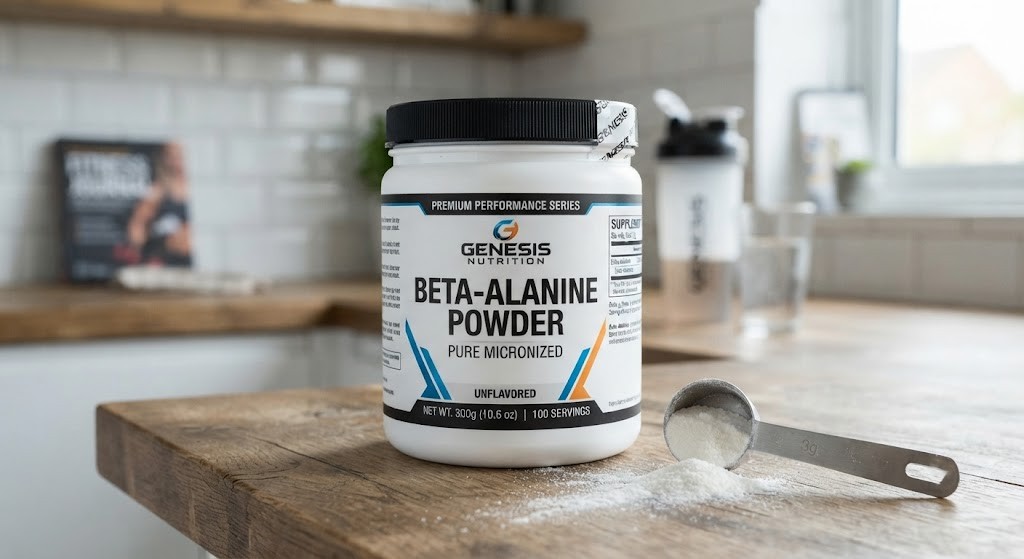
Most gym-goers know that pre-workout supplements can help them feel ready for intense training. However, a beta-alanine supplement works differently from typical energy-boosting ingredients because it does not primarily provide an immediate stimulant effect.
Instead, beta-alanine supports the body’s production of carnosine, a compound stored in skeletal muscle that helps buffer changes in muscle acidity during high-intensity exercise. This makes beta-alanine particularly interesting for people who regularly perform repeated hard efforts, intervals, or other demanding workouts.
But does beta-alanine actually work, and is it worth adding to your supplement routine?
In this guide, you’ll learn what beta-alanine does, its evidence-based performance benefits, recommended dosage, the best time to take it, how long it takes to work, why it causes tingling, how safe it is, and which types of workouts may benefit most.
What Is a Beta-Alanine Supplement?
Beta-alanine is a non-proteinogenic amino acid that acts as a precursor to carnosine, a compound stored primarily in skeletal muscle. Carnosine helps buffer changes in muscle acidity during high-intensity exercise.
When you consume beta-alanine, your body combines it with another amino acid to produce carnosine. The resulting carnosine is stored inside skeletal muscle and can contribute to the muscle’s buffering capacity during demanding exercise.
For example, during repeated sprint intervals or other intense efforts, exercise intensity can increase the accumulation of metabolites associated with changes in muscle acidity. Increased muscle carnosine may help muscles manage this environment.
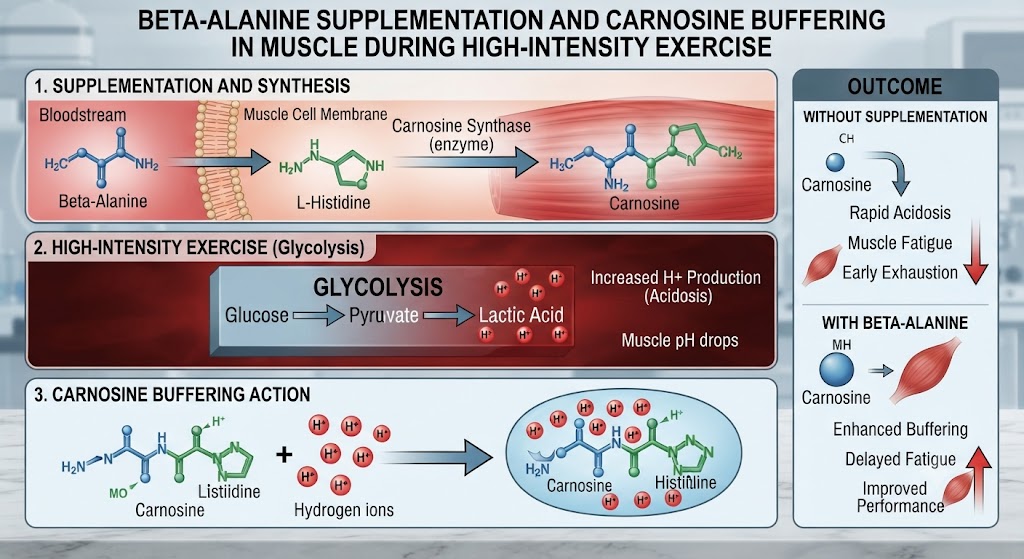
The important point is that a beta-alanine supplement is not designed to create an instant energy boost. Its purpose is to increase muscle carnosine stores progressively through consistent supplementation.
Why Does Beta-Alanine Matter for Exercise Performance?
Beta-alanine matters because increasing muscle carnosine may improve the muscles’ ability to buffer changes associated with demanding high-intensity exercise.
Carnosine functions as an intracellular buffer, which is why beta-alanine is particularly relevant when exercise intensity is high and repeated hard efforts place considerable metabolic demands on working muscles.
Beta-Alanine Is Not an Instant Energy Booster
One of the biggest differences between beta-alanine and common pre-workout ingredients is how they work.
For example, caffeine can produce an acute stimulant effect and may make you feel more alert before exercise. Beta-alanine, on the other hand, generally requires repeated daily intake to increase muscle carnosine.
That means taking beta-alanine immediately before one workout is not the primary factor determining whether it works. Consistent supplementation over time is more important.
What Does Research Say About Beta-Alanine?
Research suggests that the potential performance benefit depends strongly on the type and intensity of exercise.
A 2024 systematic review and meta-analysis analyzed 18 studies involving 331 trained young men and found an overall significant effect favoring beta-alanine during maximal-intensity exercise.
Source: International Journal of Sport Nutrition and Exercise Metabolism, 2024.
Beta-alanine works primarily through muscle carnosine rather than through an immediate stimulant-like effect.
What Are the Benefits of Beta-Alanine for Exercise?
A beta-alanine supplement may provide modest performance benefits during certain types of high-intensity exercise. However, its effects are not universal and can vary depending on exercise duration, training status, and the testing method used.
The potential benefits are generally most relevant when exercise is intense enough for muscle buffering capacity to become an important factor.
Can Beta-Alanine Improve High-Intensity Performance?
Beta-alanine can improve some measures of exercise capacity and performance, although the effect is not guaranteed for every workout or athlete.
One meta-analysis reported a median improvement of 2.85% across exercise outcomes in its included studies.
Source: Hobson et al., 2012.
The size of the benefit can vary considerably. Exercise duration, training status, intensity, and the characteristics of the activity can all influence the outcome.
The evidence is particularly relevant to activities that place substantial demands on anaerobic energy systems and muscle buffering.
Does Beta-Alanine Help Build Muscle?
Beta-alanine is not primarily a muscle-building supplement.
Its main established role is supporting high-intensity exercise capacity rather than directly stimulating muscle protein synthesis. Therefore, it should not be viewed as a replacement for adequate protein, calories, progressive resistance training, or recovery.
However, beta-alanine could indirectly support training quality if it helps someone tolerate demanding sessions.
For example, someone following a strength training workout may find beta-alanine more relevant for high-volume or conditioning-based work than for expecting a direct increase in muscle size.
Adequate protein and total calorie intake remain fundamental for hypertrophy. See our guide to protein intake for muscle growth for nutrition fundamentals.
How Much Beta-Alanine Should You Take Per Day?
A commonly studied beta-alanine protocol uses 4–6 grams per day in divided doses, generally continued for several weeks to increase muscle carnosine.
Source: NIH Office of Dietary Supplements, 2026.
Studies have also used doses ranging from approximately 1.6 to 6.4 grams per day for 4–8 weeks, while the ISSN position stand supports 4–6 grams daily for healthy individuals seeking potential performance benefits.
Source: NIH Office of Dietary Supplements, 2026.
Because larger individual doses can increase the likelihood of tingling, dividing the daily amount can make supplementation more comfortable.
A Practical Beta-Alanine Dosage Strategy
If you’re considering a beta-alanine supplement, a practical approach is:
- Start with smaller divided servings.
- Gradually build toward the commonly studied daily range.
- Take the doses consistently each day.
- Continue for several weeks before evaluating its effectiveness.
- Reduce individual doses if tingling becomes uncomfortable.
The goal is not to maximize the amount you take immediately before training. Instead, the objective is to consistently provide beta-alanine so muscle carnosine can increase over time.
When Should You Take Beta-Alanine Before or After a Workout?
A beta-alanine supplement does not need to be taken immediately before a workout because its primary effect comes from gradually increasing muscle carnosine.
This is an important distinction between beta-alanine and ingredients that are intended to produce acute effects.
For example, taking beta-alanine with breakfast and another serving later in the day can be more practical than consuming the entire daily amount immediately before lifting.
Should You Take Beta-Alanine With Food?
Dividing beta-alanine into smaller servings can improve tolerance. Taking divided doses with meals may also be a practical way to incorporate supplementation into your daily routine.
The most important factor is consistency rather than choosing a precise pre-workout window.
Beta-alanine timing is less important than consistent daily supplementation.
How Long Does Beta-Alanine Take to Work?
Beta-alanine generally takes weeks rather than minutes to produce its intended physiological effect.
That’s because supplementation gradually increases muscle carnosine rather than creating an immediate performance response after a single dose.
Research has found meaningful effects after approximately 4 weeks in some high-intensity exercise settings. A 2024 meta-analysis also found a significant effect at four weeks of supplementation.
Source: Georgiou et al., 2024.
For this reason, beta-alanine is better understood as a loading-style supplement rather than a one-time pre-workout ingredient.
What Should You Expect During the First Few Weeks?
A person should not necessarily expect to feel stronger or more energetic immediately after taking beta-alanine.
Instead, the relevant physiological change occurs progressively as muscle carnosine stores increase.
A sensible evaluation period therefore involves:
- Consistent daily supplementation
- Several weeks of use
- Regular training
- Tracking relevant performance measures
- Comparing performance over time rather than judging one workout
This approach makes it easier to determine whether beta-alanine is actually useful for your training.
Why Does Beta-Alanine Cause Tingling?
One of the most recognizable effects of beta-alanine is tingling.
Beta-alanine tingling is called paresthesia. It can feel like temporary prickling, tingling, or a burning sensation, particularly after consuming a relatively large individual dose.
The sensation can occur shortly after supplementation and is one of the main reasons some people dislike beta-alanine.
How Long Does Beta-Alanine Tingling Last?
The NIH notes that doses of 800 mg or more can cause moderate to severe paresthesia in some people, with symptoms potentially lasting 60–90 minutes.
Source: NIH Office of Dietary Supplements, 2026.
Although the sensation can be uncomfortable, paresthesia is generally not considered harmful.
How Can You Reduce Beta-Alanine Tingling?
If tingling becomes uncomfortable, several practical strategies can help:
- Divide the daily dose into smaller servings.
- Avoid taking a large amount at one time.
- Consider a sustained-release formulation.
- Gradually increase your daily intake rather than taking a large dose immediately.
The goal is to reach an effective daily intake while keeping individual doses comfortable.
Is Beta-Alanine Safe to Take Every Day?
Beta-alanine appears reasonably safe at recommended doses for healthy populations studied in research, with paresthesia being the main consistently reported side effect.
However, the evidence regarding long-term daily supplementation beyond several months is less established.
The NIH specifically notes that it is not known whether daily beta-alanine supplementation remains safe beyond several months.
Source: NIH Office of Dietary Supplements, 2026.
Therefore, people should avoid assuming that more beta-alanine is always better or that indefinite high-dose supplementation has been fully established as safe.
If you have a medical condition, take medication, are pregnant or breastfeeding, or are uncertain whether a performance supplement is appropriate for you, consult a qualified healthcare professional before use.
Which Workouts Benefit Most From Beta-Alanine?
A beta-alanine supplement appears most useful for high-intensity efforts that create substantial metabolic stress, particularly activities involving repeated hard efforts.
That makes the supplement more relevant to certain training styles than to low-intensity exercise.
Is Beta-Alanine Good for HIIT and HYROX?
Beta-alanine may be useful for high-intensity interval training, repeated sprint work, combat sports, swimming, team sports, and CrossFit-style training, although the strength of evidence differs between activities.
For example, a workout involving repeated rowing, running, burpees, and sled work may create the type of intense effort where increased muscle buffering could be relevant.
See our HIIT workout guide and HYROX training workout for practical training examples.
Can Beta-Alanine Improve Endurance?
Beta-alanine is not a universal endurance supplement, and evidence for long-duration endurance activities remains mixed.
The ISSN position stand specifically identifies stronger potential effects in efforts lasting approximately 1–4 minutes, while evidence beyond longer durations is less certain.
Therefore, a distance runner should not automatically expect the same benefit as someone who regularly performs intense intervals or repeated hard efforts.
A muscle endurance workout may provide a more relevant context for evaluating beta-alanine.
Who May Benefit Most From Beta-Alanine?
Beta-alanine may be particularly relevant for people whose training frequently includes:
- Repeated high-intensity intervals
- Short-duration maximal efforts
- High-intensity conditioning
- Repeated sprint work
- Certain competitive sports
- CrossFit-style workouts
- HIIT sessions
- Training involving substantial metabolic stress
On the other hand, people primarily performing easy, low-intensity exercise may have less reason to prioritize beta-alanine.
Beta-Alanine vs. Pre-Workout Supplements
Beta-alanine is often included in pre-workout formulas, but it is important to understand that being an ingredient in a pre-workout does not mean it needs to be consumed immediately before exercise.
A pre-workout product may contain several ingredients designed for different purposes. Caffeine, for example, is commonly used for acute stimulation, while beta-alanine is intended to increase muscle carnosine progressively.
This distinction is useful when deciding whether to use a standalone beta-alanine supplement or a multi-ingredient pre-workout.
Standalone Beta-Alanine
A standalone product can make it easier to control your daily beta-alanine intake.
Potential advantages include:
- Transparent dosage
- Easier dose splitting
- Greater control over total daily intake
- No requirement to consume other pre-workout ingredients
Beta-Alanine in a Pre-Workout
A pre-workout may be convenient if it already provides beta-alanine at a meaningful amount.
However, proprietary blends can make it difficult to determine exactly how much beta-alanine you’re consuming.
For that reason, label transparency is important when selecting a product.
How Should You Choose a Beta-Alanine Supplement?
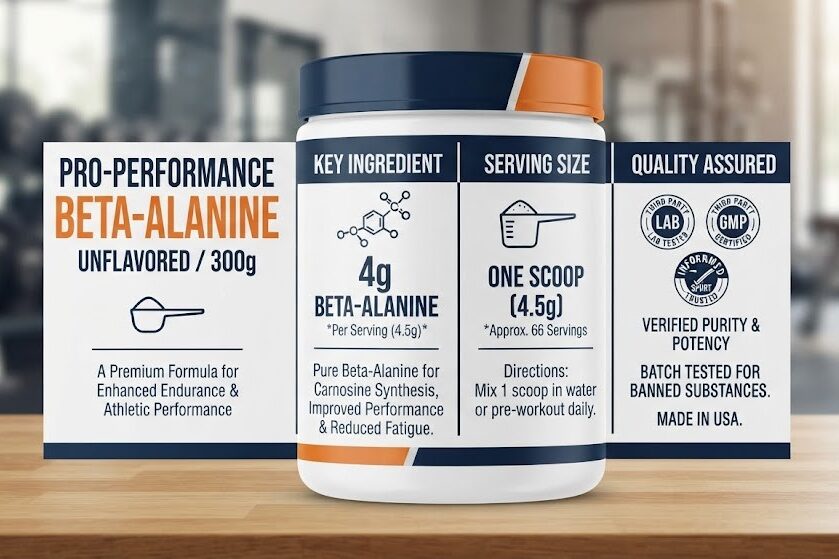
A good beta-alanine supplement should clearly state the actual beta-alanine amount per serving rather than hiding the ingredient inside a proprietary blend.
When comparing products, look for:
- Clearly disclosed beta-alanine dosage
- Simple ingredient labeling
- Appropriate serving information
- Third-party testing when available
- Minimal unnecessary proprietary blends
- Powder or capsules based on your preference
- Clear manufacturer and quality information
For example, if a pre-workout lists a “6,000 mg proprietary blend” without specifying how much beta-alanine it contains, you cannot accurately determine your beta-alanine intake.
What Should You Avoid?
Be cautious with products that make it difficult to determine the amount of beta-alanine they contain.
A transparent label allows you to track your intake and compare the product with the amounts used in research.
It also makes it easier to avoid unintentionally consuming large individual doses that may increase paresthesia.
How to Add Beta-Alanine to Your Training Plan
Adding beta-alanine works best when you match supplementation with your actual training demands rather than taking it simply because it is popular.
First, identify whether your training regularly includes repeated high-intensity efforts. HIIT, interval training, CrossFit-style workouts, and certain competitive sports may provide a more relevant use case than easy long-distance cardio.
Next, establish a consistent daily intake within the commonly studied range. Divide the dose if necessary to improve tolerance.
Finally, evaluate whether your performance actually changes after several weeks.
A Simple Beta-Alanine Supplement Checklist
Before adding beta-alanine to your routine, consider:
- Training type: Do you regularly perform high-intensity exercise?
- Daily consistency: Can you take it consistently for several weeks?
- Dosage: Are you using an evidence-based daily range?
- Tolerance: Does the amount cause uncomfortable tingling?
- Product quality: Is the actual beta-alanine content clearly disclosed?
- Training fundamentals: Are nutrition, hydration, recovery, and training already well managed?
For beginners, a structured beginner workout plan can provide a stronger foundation than adding multiple supplements at once.
Conclusion
A beta-alanine supplement can be worthwhile for people whose training involves frequent, demanding high-intensity efforts, but it is not essential for every exerciser.
Research suggests that its potential performance benefits are generally modest and are more relevant to specific exercise durations and formats, particularly activities involving repeated intense efforts and substantial metabolic stress.
The key to understanding beta-alanine is recognizing that it does not work like an instant energy booster. Instead, consistent supplementation increases muscle carnosine over time, which may improve the muscles’ buffering capacity during demanding exercise.
If you decide to try beta-alanine, use a transparent product, follow an evidence-based dosage strategy, divide doses if tingling becomes uncomfortable, and evaluate your performance over several weeks rather than judging the supplement based on a single workout.
Most importantly, beta-alanine should complement—not replace—adequate nutrition, hydration, structured training, and recovery. When your training actually matches the situations where beta-alanine may help, it can be a useful addition to a well-designed performance strategy.
FAQs
What is a beta-alanine supplement?
It is a supplement that helps increase muscle carnosine for high-intensity exercise.
What do beta-alanine supplements do?
They may improve performance during short, intense exercise.
What is beta-alanine taken for?
It is mainly taken to support high-intensity exercise performance.
What happens if I take beta-alanine every day?
It gradually increases muscle carnosine levels over several weeks.
How much beta-alanine should I take per day?
A commonly studied amount is 4–6 grams daily in divided doses.
Should you take beta-alanine before a workout?
Not necessarily. Consistent daily use matters more than timing.
How long does beta-alanine take to work?
It generally takes several weeks to produce noticeable effects.
Why does beta-alanine make you tingle?
It can cause temporary tingling called paresthesia.
How long does beta-alanine tingling last?
The tingling can last about 60–90 minutes in some people.
What are beta-alanine side effects?
The main reported side effect is temporary tingling or prickling.
Can you reduce beta-alanine tingling?
Yes, splitting the dose into smaller servings can reduce tingling.
Is beta-alanine safe to take every day?
It appears reasonably safe at recommended doses, but long-term safety is less established.
Is beta-alanine safe for kidneys?
Evidence is limited, so people with kidney problems should consult a healthcare professional.
Does beta-alanine build muscle?
Not directly. It mainly supports high-intensity exercise performance.
Is beta-alanine good for HIIT?
Yes, it may help with repeated high-intensity efforts.
Is beta-alanine good for HYROX?
It may support the repeated intense efforts involved in HYROX training.
Does beta-alanine improve endurance?
It may help certain high-intensity efforts, but evidence for long-duration endurance is mixed.
Is beta-alanine an energy supplement?
No. It works by increasing muscle carnosine rather than providing immediate energy.
Is creatine better than beta-alanine?
They serve different purposes. Creatine is better suited to strength and muscle growth, while beta-alanine targets high-intensity performance.
Is beta-alanine better than caffeine for workouts?
No. Caffeine provides acute stimulation, while beta-alanine works gradually.
Is beta-alanine worth taking?
It may be useful if your training regularly involves intense, repeated efforts.