

If you want to improve endurance, aerobic capacity, and workout performance without relying on stimulants, you may have come across PeakO2. This mushroom-based sports-performance supplement has attracted attention because of its combination of Cordyceps, Reishi, King Trumpet, Shiitake, Lion’s Mane, and Turkey Tail.
But what are the actual PeakO2 supplement benefits, how does the formula work, and what does the research say?
In this guide, we’ll break down the potential benefits of PeakO2, its mushroom ingredients, how it may affect exercise performance, recommended use considerations, possible side effects, safety concerns, and how it compares with popular supplements such as creatine, caffeine, beta-alanine, and electrolytes. We’ll also explain why research on the finished PeakO2 blend should be distinguished from research conducted on individual mushrooms.
What Is PeakO2 Supplement and What Is It Used For?
PeakO2 is a sports-performance supplement formulated with mushroom extracts and marketed to support exercise performance, endurance, and aerobic capacity. The branded ingredient is commonly made from six mushrooms: Cordyceps militaris, Reishi, King Trumpet, Shiitake, Lion’s Mane, and Turkey Tail.
Unlike many conventional pre-workout products, PeakO2 is generally positioned as a non-stimulant performance supplement. In other words, it is not designed to provide the caffeine-like stimulation, alertness, or immediate energy surge associated with stimulant-based pre-workouts.
Instead, PeakO2 is generally used as part of a longer-term exercise routine. For example, a runner, cyclist, or recreational athlete may be interested in its potential relationship with aerobic capacity and endurance rather than expecting an instant boost in energy.
natural pre-workout supplements
The distinction is important because supplements can have very different purposes. A stimulant may be selected for acute alertness before a workout, while a non-stimulant product such as PeakO2 may be considered for ongoing endurance-focused training.
Why Do PeakO2 Supplement Benefits Matter for Exercise?
PeakO2 supplement benefits matter because endurance performance depends heavily on how effectively the body consumes and uses oxygen during exercise. VO2 max measures the maximum amount of oxygen the body can use during intense exercise and is widely used as a marker of aerobic fitness.
Aerobic capacity can be especially relevant for activities that require sustained cardiovascular effort. Runners, cyclists, CrossFit athletes, and recreational exercisers may all pay attention to measures such as VO2 max, time to exhaustion, and workout capacity.
PeakO2 research has specifically examined outcomes such as VO2 max, time to exhaustion, lactate, and peak power. These measurements can provide a more objective way to evaluate whether a performance supplement is doing more than simply creating a subjective feeling of increased energy.
A human study involving PeakO2 reported an approximately 4 ml/kg/min improvement in VO2 max after supplementation compared with baseline in the treatment group.
Source: Compound Solutions, 2026.
However, this result should not be interpreted as a guarantee that every person taking PeakO2 will experience the same improvement. The available research remains relatively limited, and some studies have been industry-funded.
That distinction is particularly important when evaluating supplement claims. A promising finding can justify further research without establishing that the supplement will produce the same result across all populations, training levels, or sports.
What Are the Potential PeakO2 Supplement Benefits?
PeakO2 supplement benefits may include support for endurance and exercise capacity, but the strength of evidence depends on the specific ingredients, formulation, dose, and individual response.
The most relevant potential benefits discussed in research include:
- Aerobic capacity
- Endurance performance
- Time to exhaustion
- Workout capacity
- Selected markers of exercise performance
The evidence is more meaningful when research is conducted on the finished PeakO2 blend itself. Research on individual mushrooms can help explain possible biological mechanisms, but it does not automatically prove that the complete commercial formula will produce the same outcome.
Can PeakO2 Support Endurance and Aerobic Performance?
PeakO2 may support endurance and aerobic performance by influencing exercise-related measures such as oxygen consumption and time to fatigue. In one human study, participants using PeakO2 for 21 days showed improvements in several exercise-performance measures.
For example, the reported PeakO2 group increased time to exhaustion by about 70 seconds, while the placebo group improved by approximately 5 seconds.
Source: Koflex Nutrition, 2026.
Another study involving recreationally active adults reported VO2peak increasing from 40.2 to 41.1 ml/kg/min in the treatment group.
Source: Dudgeon et al., 2018.
These findings help explain why PeakO2 is marketed toward endurance and aerobic performance. However, they should still be considered within the limitations of the available research rather than interpreted as proof of a universal performance effect.
For people whose training already includes steady-state cardiovascular exercise, the potential relevance of aerobic capacity may be particularly interesting. Still, training consistency remains a much more fundamental driver of endurance development than any single supplement.
Can PeakO2 Help With Workout Recovery?
PeakO2 may support recovery indirectly by supporting exercise capacity and physiological responses to training, but recovery-specific evidence is less established than endurance evidence. Therefore, it should not be presented as a proven recovery treatment.
Recovery depends on several interconnected factors. Athletes and active individuals generally need adequate calories, protein, fluids, sleep, and appropriately programmed training to support recovery.
For example, someone who trains frequently may gain more from improving sleep and nutrition than from adding another supplement to an otherwise inconsistent recovery routine.
best supplements for workout recovery
This is why PeakO2 is better viewed as a possible complement to a well-structured training and recovery plan rather than a substitute for the fundamentals.
How Does PeakO2 Work for Exercise Performance?
PeakO2 is proposed to support exercise performance through the combined biological activity of its mushroom-derived ingredients. However, it is important to distinguish between research on individual mushrooms and evidence on the finished PeakO2 formula.
For example, Cordyceps has been investigated in relation to exercise performance and oxygen utilization, while Reishi, Turkey Tail, and other mushrooms contain different bioactive compounds.
Because the formula combines several mushroom extracts, its proposed effects cannot necessarily be attributed to one ingredient alone. The interaction between ingredients, their concentrations, extraction methods, and the final formulation can all influence how a finished supplement performs.
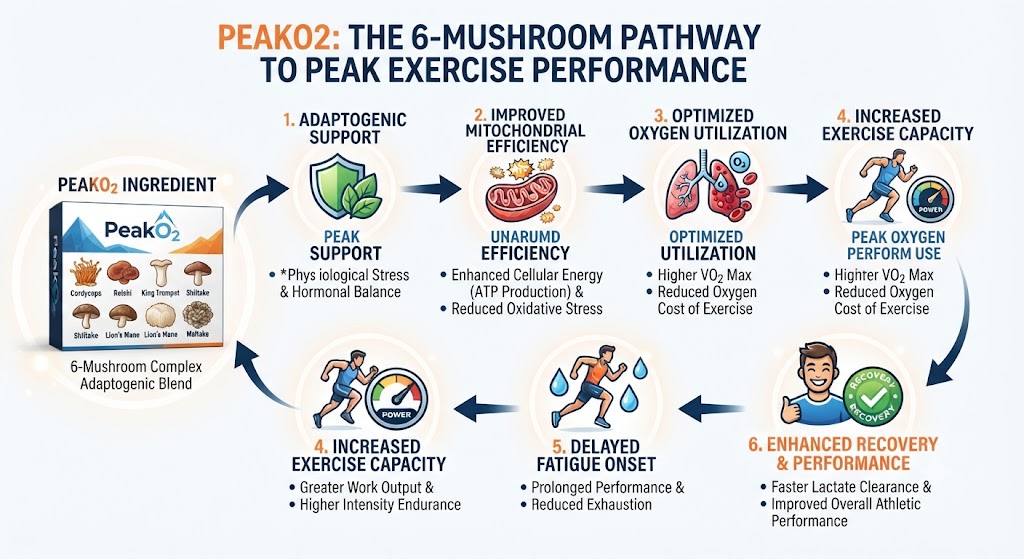
It is also useful to avoid assuming that a biological effect observed in laboratory research automatically translates into a meaningful improvement in athletic performance. Human exercise trials provide more relevant evidence for determining whether a supplement produces measurable benefits during actual physical activity.
What Ingredients Are in PeakO2?
PeakO2 commonly contains six mushroom extracts: Cordyceps, Reishi, King Trumpet, Shiitake, Lion’s Mane, and Turkey Tail. Current product listings identify these six ingredients as the PeakO2 blend.
| Ingredient | Commonly discussed role | Exercise relevance |
|---|---|---|
| Cordyceps | Exercise and oxygen-related research | Endurance |
| Reishi | Bioactive mushroom compounds | General wellness |
| King Trumpet | Nutrient and antioxidant compounds | Supporting role |
| Shiitake | Beta-glucan-containing mushroom | Supporting role |
| Lion’s Mane | Cognitive and nervous-system research | Indirect |
| Turkey Tail | Polysaccharide and beta-glucan research | Supporting role |
Cordyceps
Cordyceps is the ingredient most directly associated with exercise-performance research within this blend. Research involving Cordyceps has examined areas related to exercise performance and oxygen utilization.
For more details, read our guide on Cordyceps supplement benefits.
Reishi
Reishi has broader biological research rather than equally strong evidence specifically focused on athletic performance. Its presence in PeakO2 contributes to the overall mushroom-based formulation.
King Trumpet
King Trumpet is included as part of the six-mushroom PeakO2 blend. It contains nutrient and antioxidant compounds and serves a supporting role within the overall formulation.
Shiitake
Shiitake is a beta-glucan-containing mushroom included in the formula. While mushroom compounds such as beta-glucans have been studied for various biological effects, their presence does not by itself establish a direct exercise-performance benefit.
Lion’s Mane
Lion’s Mane has been studied in relation to cognitive and nervous-system research. Within PeakO2, its exercise relevance is considered more indirect compared with Cordyceps.
Turkey Tail
Turkey Tail contains polysaccharides and beta-glucan-related compounds and has been investigated in broader biological research.
How Should You Take PeakO2 for Exercise?
PeakO2 should be taken according to the specific product label because serving sizes and formulations can differ between products.
For example, one current capsule product lists 2 grams of PeakO2 per three-capsule serving, while another powder product lists 2 grams per scoop.
Research protocols have also varied. Studies have used 1–2 grams per day for longer periods and 4 grams per day in shorter protocols.
Because research dosing and commercial serving recommendations are not necessarily identical, research protocols should not automatically replace the manufacturer’s instructions.
A practical approach is to follow the specific product label and use the supplement consistently if you decide to test it. This makes it easier to evaluate whether your individual training performance changes over time.
However, supplement use should remain part of a broader strategy that includes structured training, sufficient nutrition, hydration, and recovery.
What Are the Potential PeakO2 Side Effects?
Potential PeakO2 side effects can include individual digestive reactions, mushroom allergies, or other ingredient-specific reactions. Product warnings commonly advise adults to avoid use during pregnancy or breastfeeding and to consult a healthcare professional when taking medications or managing medical conditions.
Individual tolerance can vary significantly. Someone with a known mushroom sensitivity, for example, should review the complete ingredient list before using a mushroom-based supplement rather than assuming that the product is automatically appropriate.
It is also important to consider supplement quality.
Athletes should pay attention to supplement quality and third-party testing because contamination or inaccurate labeling can create unnecessary risks. NADA India recommends that athletes consider batch-tested supplements from reliable third-party testing programs.
Source: NADA India, 2026.
For competitive athletes, this consideration can be especially important because the consequences of using a contaminated supplement may extend beyond ordinary product quality concerns.
Is PeakO2 Safe for Everyone?
PeakO2 is not automatically appropriate for everyone, particularly people who are pregnant, breastfeeding, taking medication, or managing a medical condition.
Supplement safety depends on several factors, including:
- Individual health status
- Ingredient profile
- Serving size
- Medication use
- Allergies or sensitivities
- Pregnancy or breastfeeding
- Potential ingredient interactions
For example, the NCCIH notes that many dietary supplements have not been adequately tested in pregnant or breastfeeding populations.
Source: NCCIH, 2026.
If you have a medical condition or take medications, discussing the product with a qualified healthcare professional can help determine whether it is appropriate for your circumstances.
Why Athletes Should Pay Attention to Supplement Testing
Competitive athletes have an additional concern: contamination.
Even when an athlete is not intentionally using a prohibited substance, contaminated or inaccurately labeled supplements can create anti-doping risks. For this reason, USADA recommends third-party certified products for athletes who choose to use supplements.
Quality assurance is therefore an important part of evaluating PeakO2 or any other sports supplement.
How Does PeakO2 Compare With Creatine, Caffeine, and Beta-Alanine?
PeakO2, creatine, caffeine, beta-alanine, and electrolytes target different aspects of exercise performance, so the best choice depends on your goal.
A mushroom-based, stimulant-free supplement should not be viewed as a direct replacement for supplements designed around strength, acute stimulation, high-intensity buffering, or hydration.
| Supplement | Main purpose | Best fit |
| PeakO2 | Aerobic and endurance support | Endurance-focused training |
| Creatine | High-intensity performance and strength | Resistance training |
| Caffeine | Alertness and acute performance | Pre-workout stimulation |
| Beta-alanine | High-intensity exercise buffering | Repeated hard efforts |
| Electrolytes | Fluid and electrolyte replacement | Sweaty or prolonged sessions |
PeakO2 vs. Creatine
Creatine is primarily associated with high-intensity performance and strength, making it particularly relevant for resistance training and activities involving repeated high-intensity efforts.
Someone focused on strength may therefore prioritize creatine for muscle performance.
PeakO2, by contrast, is positioned more toward aerobic and endurance support.
PeakO2 vs. Caffeine
Caffeine is commonly used for alertness and acute performance enhancement. It can provide the stimulant effect that many people associate with conventional pre-workout supplements.
Someone specifically looking for stimulation may therefore prefer a caffeine pre-workout.
PeakO2 is generally positioned differently because it is a non-stimulant supplement.
PeakO2 vs. Beta-Alanine
Beta-alanine has a different mechanism and use case, particularly in relation to high-intensity exercise and repeated hard efforts.
For that reason, comparing beta-alanine supplement with PeakO2 should focus on the individual’s training goal rather than declaring one supplement universally better.
PeakO2 vs. Electrolytes
Electrolytes are primarily used to support fluid and electrolyte replacement, particularly during sweaty or prolonged exercise sessions.
PeakO2 has a different purpose and should not be considered a replacement for appropriate hydration or electrolyte intake.
Is PeakO2 Worth Taking for Athletic Performance?
PeakO2 may be worth considering for athletes interested in a non-stimulant endurance supplement, but the evidence does not justify treating it as essential.
The human studies available so far are promising, but the overall evidence base remains smaller than for several established sports supplements.
For example, available research includes small studies rather than a large body of independent trials covering different sports, ages, training levels, and populations. As a result, real-world results may be smaller or absent for some users.
This is one of the most important points when interpreting PeakO2 supplement benefits: a promising research result is not the same thing as a guaranteed outcome.
Individual responses can vary based on training status, diet, recovery, baseline aerobic capacity, dosage, and other factors.
Moreover, NIH guidance emphasizes that supplements cannot replace a nutritious diet and regular physical activity, although some products may provide value for specific activities.
Source: NIH, 2018.
Therefore, PeakO2 is best considered an optional addition rather than a foundation of an effective exercise program.
What Should You Consider Before Taking PeakO2?
People considering PeakO2 should evaluate the product’s ingredient profile, evidence, serving instructions, potential interactions, and individual health circumstances before use.
A simple checklist can make the decision more objective.
- Define your goal: Decide whether you want endurance, aerobic capacity, workout capacity, or another outcome.
- Check the label: Confirm the exact PeakO2 serving size and complete ingredient list.
- Review the evidence: Separate research on PeakO2 itself from studies on individual mushrooms.
- Check your routine: Prioritize training, calories, protein, hydration, and sleep first.
- Assess safety: Consider allergies, medications, health conditions, pregnancy, or breastfeeding.
- Check quality: Competitive athletes should look for credible third-party testing.

These steps can help prevent a common mistake: evaluating a supplement based only on marketing claims or a single study.
Instead, consider whether the product addresses a specific need that remains after your training, nutrition, hydration, and recovery habits are already in place.
How to Evaluate Whether PeakO2 Is Working
If you decide to try PeakO2, tracking measurable outcomes can provide a more useful assessment than relying entirely on how the supplement feels.
For example, an endurance athlete could track:
- Weekly training volume
- Workout completion
- Perceived exertion
- Time to exhaustion
- Relevant performance markers
- Consistency across training sessions
Establishing a baseline before introducing the supplement can make changes easier to identify.
This approach is particularly useful because a non-stimulant supplement may not create an obvious immediate sensation. Instead of asking only whether you “feel” more energetic, it can be more useful to examine whether measurable training outcomes change over time.
What’s Next: How to Decide Whether PeakO2 Fits Your Routine
The next step is to compare PeakO2’s potential benefits with your specific training goal, budget, tolerance, and expectations.
If your fundamentals are already strong, a carefully evaluated supplement can be tested as one small component of your overall strategy.
For example, an endurance athlete could track weekly training volume, perceived exertion, workout completion, and performance markers before and after introducing a supplement. This creates a more useful personal comparison than relying only on whether a product feels effective.
At the same time, nutrition remains central to training adaptation and recovery. Adequate protein and overall dietary quality should be addressed before expecting a supplement to compensate for nutritional gaps.
high protein diet for muscle recovery
Conclusion
PeakO2 supplement benefits are most relevant to endurance, aerobic performance, and exercise capacity, but the evidence should be interpreted cautiously. Research on the finished mushroom blend has reported improvements in measures such as VO2-related performance, time to exhaustion, and peak power, while independent replication and broader research remain important.
PeakO2 contains a six-mushroom blend featuring Cordyceps militaris, Reishi, King Trumpet, Shiitake, Lion’s Mane, and Turkey Tail. Among these ingredients, Cordyceps has the most direct connection to exercise-performance research, while the other mushrooms contribute different compounds and areas of biological research.
Ultimately, PeakO2 should be viewed as one potential component of a broader performance strategy, not a replacement for progressive training, adequate nutrition, hydration, or quality sleep.
If you decide to try it, follow the product label, consider your individual circumstances, pay attention to product quality, and evaluate measurable training outcomes rather than relying solely on marketing promises.
FAQs
What are the main PeakO2 supplement benefits?
PeakO2 may support endurance, aerobic capacity, and exercise performance.
What is PeakO2 good for?
PeakO2 is mainly used to support endurance and aerobic performance.
What is PeakO2 made of?
PeakO2 contains Cordyceps, Reishi, King Trumpet, Shiitake, Lion’s Mane, and Turkey Tail.
Is PeakO2 a stimulant?
No, PeakO2 is generally considered a non-stimulant supplement.
When should you take PeakO2?
Take PeakO2 according to the product label and use it consistently.
Does PeakO2 improve VO2 max?
Research suggests PeakO2 may improve VO2-related performance measures.
Can PeakO2 help with endurance?
PeakO2 may support endurance and time to exhaustion.
Can PeakO2 help with workout recovery?
PeakO2 may support recovery indirectly, but evidence is limited.
What is the recommended PeakO2 dosage?
Dosage varies by product, so follow the manufacturer’s instructions.
Are there PeakO2 side effects?
Possible side effects include digestive reactions and mushroom-related allergies.
Who should avoid PeakO2?
People with allergies, medical conditions, or medication use should consult a healthcare professional.
Is PeakO2 better than creatine?
No, PeakO2 and creatine support different exercise goals.
Is PeakO2 better than caffeine?
No, they serve different purposes, with caffeine providing stimulation and PeakO2 supporting endurance.
Is PeakO2 worth taking?
PeakO2 may be worth considering for non-stimulant endurance support.