
You’ve probably already used squats, presses, rows, and other traditional exercises. However, training both sides together can sometimes hide differences in strength, stability, coordination, or movement control. A unilateral workout gives each side of your body an opportunity to work independently, making it a useful addition to a well-rounded strength-training program.
In this guide, you’ll learn what unilateral training is, how unilateral exercises differ from bilateral movements, which exercises are best for beginners and advanced lifters, how to structure sets and reps, what equipment you can use, and how to build an effective unilateral workout at home or in the gym.
What Is a Unilateral Workout?
Unilateral training is strength training in which one limb or one side of the body performs the primary work independently. For example, a single-arm dumbbell row trains one arm at a time, while a Bulgarian split squat places most of the working demand on one leg.
More specifically, a unilateral workout combines single-arm, single-leg, or single-side movements to develop strength and stability while allowing each side to work independently. This makes unilateral exercises useful for strength training, athletic development, balance work, and movement control.
For example, you might perform 10 reverse lunges with your right leg followed by 10 with your left leg rather than performing a bilateral squat.
Unilateral vs. Bilateral Exercises
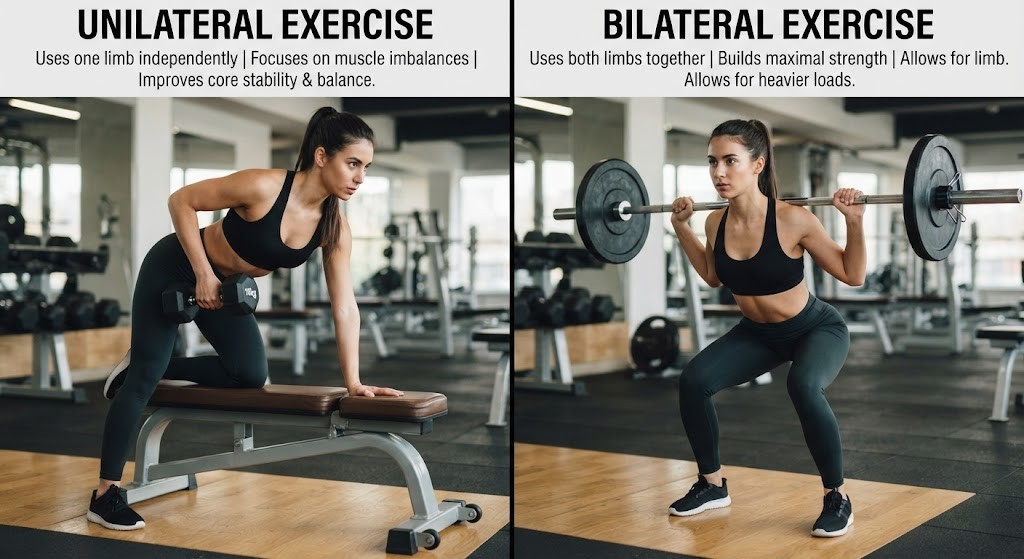
Unilateral exercises use one primary limb at a time, while bilateral exercises use both sides simultaneously. A dumbbell chest press performed with both arms is bilateral, whereas a one-arm cable chest press is unilateral.
| Training Type | Example | Primary Feature |
|---|---|---|
| Unilateral | Bulgarian split squat | One leg performs most of the work |
| Unilateral | Single-arm row | One arm pulls independently |
| Bilateral | Barbell squat | Both legs work together |
| Bilateral | Barbell bench press | Both arms press together |
| Mixed | Split-stance cable press | One side works with a staggered stance |
Neither training style is automatically superior. A 2025 systematic review and meta-analysis found no significant difference in muscle hypertrophy between unilateral and bilateral resistance training, while strength improvements were more specific to the movement used. — Source: Sports Medicine, 2025
Why Is Unilateral Training Important for Strength and Stability?
Unilateral training matters because it can expose side-to-side differences in strength, stability, coordination, and movement control. For example, if your right leg performs a step-up smoothly while your left leg wobbles, the movement can reveal a difference that may be less obvious during a bilateral squat.
Moreover, unilateral exercises can help expose side-to-side differences in strength, stability, coordination, and movement control. This does not mean every strength difference represents a problem, but comparing performance between sides can help make your training more precise.
A 2026 systematic review and multilevel meta-analysis of 24 randomized controlled trials found that unilateral training produced greater improvements in unilateral strength, while bilateral training produced a small advantage for bilateral strength. No significant difference was found for muscle hypertrophy. — Source: BMC Sports Science, Medicine and Rehabilitation, 2026
How Unilateral Training Supports Balance and Coordination
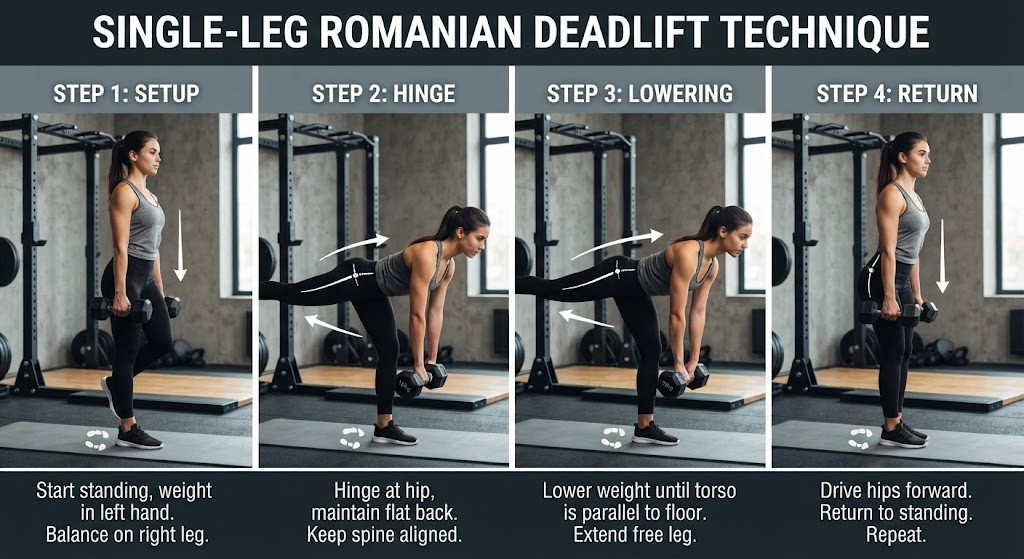
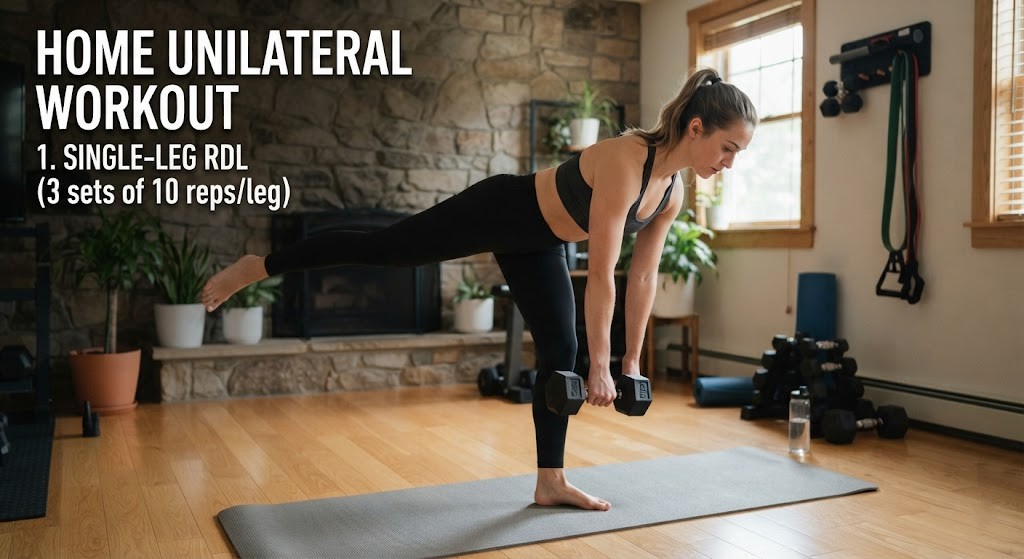
Unilateral exercises challenge your body to control movement while one side carries most of the load. For example, a single-leg Romanian deadlift requires your working leg, hip, trunk, and foot to coordinate while you maintain balance.
This makes unilateral movements particularly useful for recreational athletes and people who want more single-sided control and functional strength. A meta-analysis of athletic populations found unilateral training produced meaningful improvements in several unilateral performance measures, although results depended on the specific performance task. — Source: Frontiers in Physiology, 2023
How Unilateral Training Can Address Strength Imbalances
Unilateral exercises can help you identify and manage differences by giving each side its own workload. For example, if you can complete 12 controlled reps with your left arm but only 9 with your right, you have measurable information about your current performance.
However, unilateral training should not be treated as a guaranteed solution for every imbalance. Instead, use consistent technique, equal work, and progressive loading while considering the underlying reason for the difference.
What Are the Best Unilateral Exercises for Beginners?
The best unilateral exercises for beginners are movements that provide stability, simple loading, and a controlled range of motion. Supported split squats, for example, are generally easier to learn than highly unstable single-leg exercises performed with heavy weights.
Start with movements that allow you to focus on position, control, and repeatability before adding challenging resistance.
Which Unilateral Exercises Train the Legs?
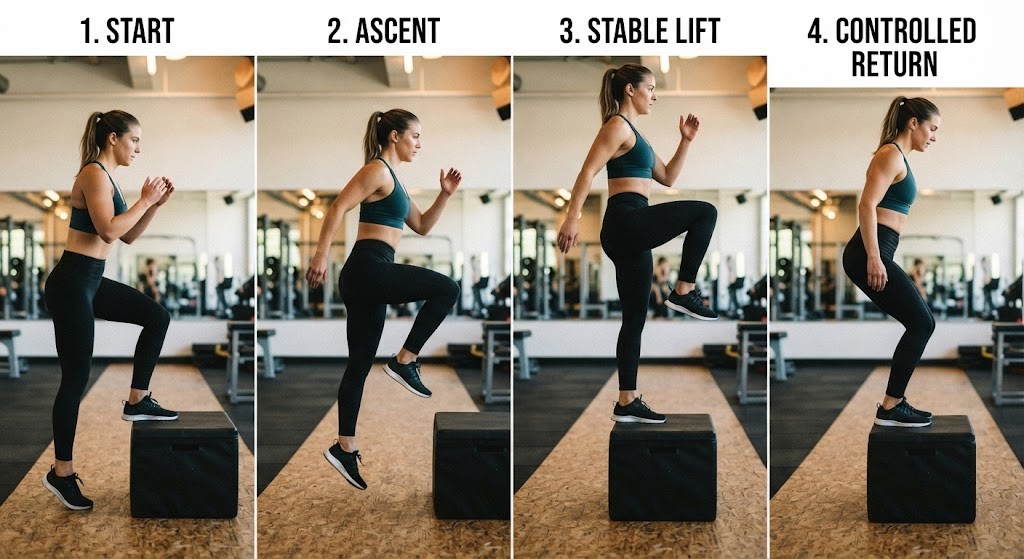
Some of the best unilateral leg exercises include Bulgarian split squats, reverse lunges, step-ups, and single-leg Romanian deadlifts. A step-up, for example, lets you train one leg while using a stable platform and controlled movement pattern.
Try these beginner-friendly options:
- Reverse lunge — Step backward and lower under control.
- Step-up — Drive through one foot to stand on a stable platform.
- Bulgarian split squat — Elevate the rear foot while loading the front leg.
- Single-leg Romanian deadlift — Hinge at the hip while balancing on one leg.
- Single-leg calf raise — Raise and lower through one ankle.
For more lower-body variety, combine this section with best leg workout exercises.
The [single-leg Romanian deadlift → Single-Leg Romanian Deadlift Guide] is especially useful when you want to combine hip-hinge strength with balance and trunk control.
Which Unilateral Exercises Train the Upper Body?
The best unilateral upper-body exercises include single-arm dumbbell rows, single-arm shoulder presses, single-arm chest presses, and single-arm cable movements. A single-arm row, for example, lets you focus on one side of your back while your torso remains supported or braced.
Useful options include:
- Single-arm dumbbell row
- Single-arm shoulder press
- Single-arm chest press
- Single-arm cable row
- Single-arm lat pulldown
- Single-arm biceps curl
- Single-arm triceps extension
For additional programming ideas, combine these movements with an shoulder workout or back workout.
Which Unilateral Exercises Train the Core?
Unilateral core exercises challenge your trunk to resist unwanted rotation, leaning, or movement. A suitcase carry, for example, requires you to walk while holding weight on only one side.
Effective unilateral core movements include:
- Suitcase carries
- Single-arm farmer carries
- One-arm cable presses
- Single-arm cable rows
- Contralateral dead bugs
- Single-arm overhead carries
These movements can complement your core workout exercises by adding anti-rotation and stability demands.
How Do You Perform Unilateral Exercises Correctly?
Proper unilateral exercise technique starts with stable positioning, controlled movement, appropriate resistance, and equal attention to both sides. A single-leg Romanian deadlift, for example, should be performed with a controlled hip hinge rather than rushing through the movement simply to maintain balance.
Follow these basic technique principles:
- Establish your starting position. Before lifting, make sure your feet, hips, shoulders, and working limb are positioned correctly.
- Brace your trunk. Keep your rib cage, pelvis, and spine controlled before initiating the movement.
- Use a controllable range of motion. A shorter controlled range is more useful than forcing a deeper movement while your technique breaks down.
- Control the movement. Avoid bouncing, rushing, or using momentum to complete repetitions.
- Breathe consistently. Exhale during the challenging portion of the movement and inhale during the easier phase when appropriate.
- Match your work between sides. If one side reaches technical failure earlier, do not automatically add extra repetitions to the stronger side.
How Many Sets and Reps Should You Do for Unilateral Exercises?
Unilateral exercises generally work well with 2–4 sets of 6–15 controlled repetitions per side, depending on the movement, training goal, and experience level. A beginner, for example, might perform three sets of 8 reverse lunges per leg before progressing to heavier resistance.
A practical starting range is:
| Goal | Sets | Reps per Side | Rest |
| Beginner technique | 2–3 | 8–12 | 60–90 sec |
| Strength | 3–4 | 5–8 | 90–150 sec |
| Muscle development | 3–4 | 8–15 | 60–120 sec |
| Stability/control | 2–3 | 8–12 | 60–90 sec |
| Loaded carries | 2–4 | 20–40 sec | 60–120 sec |
The right number of sets also depends on your total weekly training volume rather than one exercise alone. Adults are generally advised to perform muscle-strengthening activities involving the major muscle groups on at least two days per week. — Source: U.S. Department of Health and Human Services, 2018
Should You Do Unilateral Exercises Before or After Bilateral Exercises?
Unilateral exercises should usually come before bilateral exercises when the unilateral movement is a major training priority, but they can also work well after bilateral compound lifts when used as accessory work.
For example, an athlete prioritizing single-leg strength might perform Bulgarian split squats early in the session, while a general lifter might place them after squats.
When to Perform Unilateral Exercises First
Choose unilateral exercises early when balance, coordination, or single-sided strength is your main goal. This allows you to perform technically demanding movements before fatigue becomes excessive.
For example, a session focused on single-leg strength could begin with Bulgarian split squats before moving to bilateral exercises.
When to Perform Unilateral Exercises Later
Place unilateral accessories later when your primary goal is heavy bilateral strength. You could perform squats first, followed by Bulgarian split squats and single-leg curls.
As a result, unilateral and bilateral exercises can complement one another rather than competing for a single “best” position.
What Is the Difference Between Unilateral and Bilateral Training?
Unilateral training uses one primary limb independently, while bilateral training uses both sides simultaneously. A single-arm dumbbell press is unilateral, whereas a barbell bench press is bilateral.
The practical difference is mainly how force is produced and controlled, not whether one method is universally better.
| Factor | Unilateral Training | Bilateral Training |
| Main workload | One side at a time | Both sides together |
| Stability demand | Often higher | Often lower |
| Side-to-side assessment | Easier | Less direct |
| Maximum total load | Often lower | Often higher |
| Training efficiency | Can take longer | Usually faster |
| Best use | Single-side control and strength | Overall bilateral strength |
Furthermore, recent evidence supports a goal-specific approach. A 2026 meta-analysis found unilateral training was more effective for unilateral strength, whereas bilateral training showed an advantage for bilateral strength. — Source: BMC Sports Science, Medicine and Rehabilitation, 2026
How Does Unilateral Training Help With Muscle Imbalances?
Unilateral training can help address muscle imbalances by making each side perform its own workload instead of allowing the stronger side to contribute more easily. A single-arm dumbbell row, for example, prevents your stronger arm from doing most of the pulling work for the weaker arm.
Moreover, the simplest way to monitor an imbalance is to compare performance under the same conditions. Track repetitions, resistance, range of motion, stability, and perceived effort for each side.
Avoid automatically adding extra work to the weaker side. If the difference is large, persistent, painful, or associated with movement problems, professional assessment may be more appropriate than simply increasing training volume.
What Is Cross-Education?
Unilateral training can also produce a phenomenon called cross-education, in which training one limb can improve strength in the opposite limb. A 2026 systematic review of 31 studies involving 1,214 participants found small but significant contralateral strength improvements, although the certainty of evidence ranged from low to very low. — Source: Sports Medicine, 2026
This finding adds another reason unilateral training can be useful, particularly when training one side independently is an important part of a broader strength program.
How Do You Create a Unilateral Workout Routine?
A unilateral workout routine combines one-sided strength exercises with appropriate sets, repetitions, rest, and progression. A beginner routine, for example, can use four movements covering the legs, upper body, core, and a loaded carry.
The key is to select exercises that match your experience level and training goals rather than simply adding as many unilateral movements as possible.
Beginner Unilateral Workout
Start with two or three sessions per week depending on your overall training schedule.
- Reverse lunge — 3 × 8–10 per leg
- Single-arm dumbbell row — 3 × 8–12 per arm
- Single-arm shoulder press — 2 × 8–10 per arm
- Suitcase carry — 3 × 20–30 seconds per side
Rest approximately 60–90 seconds between most exercises.
Focus on smooth repetitions, stable positioning, and equal work on both sides before increasing resistance.
Intermediate Unilateral Workout
An intermediate routine can increase resistance and movement complexity.
- Bulgarian split squat — 3 × 8–10 per leg
- Single-leg Romanian deadlift — 3 × 8–10 per leg
- Single-arm dumbbell row — 3 × 8–12 per arm
- Single-arm chest press — 3 × 8–12 per arm
- Suitcase carry — 3 × 30–40 seconds per side
Use controlled repetitions and stop a set when technique begins to deteriorate.
Advanced Unilateral Workout
Advanced lifters can use heavier resistance, more complex loading, or greater stability demands.
- Loaded Bulgarian split squat — 4 × 6–8 per leg
- Single-leg Romanian deadlift — 3 × 6–8 per leg
- Single-arm cable row — 4 × 8–10 per arm
- Single-arm overhead press — 3 × 6–10 per arm
- Heavy suitcase carry — 4 × 30–45 seconds per side
By gradually increasing resistance or repetitions, you can apply progressive overload without sacrificing movement quality.
What Tools and Equipment Can You Use for Unilateral Training?
Unilateral training can use almost any resistance method, including dumbbells, kettlebells, cables, resistance bands, machines, benches, and bodyweight.
A home trainee, for example, can perform reverse lunges and single-arm band rows without needing a full gym. Meanwhile, gym-based athletes can use cables and machines to provide more controlled resistance.
Dumbbells and Kettlebells
Dumbbells are especially convenient because each hand can hold a separate load. You can perform a single-arm row, single-arm press, or suitcase carry with one dumbbell.
Kettlebells can also be useful for unilateral exercises and loaded carries, particularly when you want to challenge grip, trunk control, and single-sided loading.
For more ideas, explore a dumbbell workout.
Cables and Machines
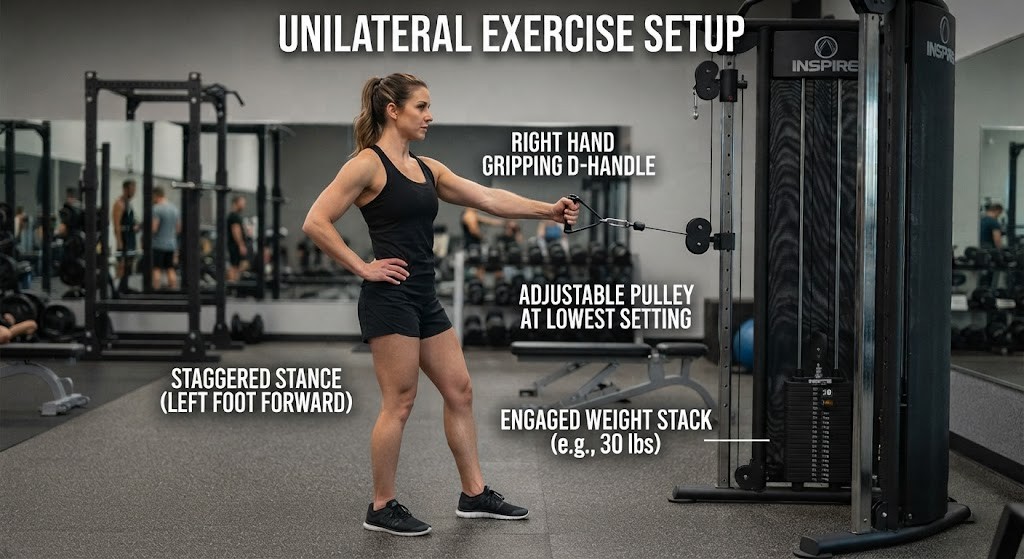
Cables provide adjustable resistance and allow movements such as one-arm rows, presses, pulldowns, and anti-rotation exercises. Machines can also provide additional stability when you want to focus on loading one limb without balancing a free weight.
Home Equipment and Bodyweight
Bodyweight movements can provide an excellent starting point. Reverse lunges, step-ups, split squats, single-leg glute bridges, and assisted single-leg exercises require minimal equipment.
A bench, sturdy step, resistance band, or pair of adjustable dumbbells can significantly expand your home exercise options.
What Are the Most Common Unilateral Training Mistakes?
The most common unilateral training mistakes include using excessive weight, sacrificing balance for repetitions, training sides unequally, and progressing too quickly. For example, using a heavy dumbbell during a single-leg Romanian deadlift may cause you to rotate or lose your hip position.
1. Using Too Much Weight
Avoid loading beyond your technical ability. Stability-focused exercises often require less weight than comparable bilateral movements.
If adding resistance causes your posture, balance, or range of motion to deteriorate, reduce the load and rebuild control.
2. Rushing Repetitions
Do not rush repetitions simply to complete a target number. Controlled lowering phases and stable positions make it easier to identify movement errors and maintain consistent technique.
3. Training the Sides Unequally
Avoid giving the stronger side additional repetitions simply because it can perform more. Instead, establish a consistent workload and monitor progress over time.
4. Progressing Too Quickly
Unilateral exercises can feel deceptively challenging because balance and coordination contribute to the difficulty. Progress resistance, repetitions, range of motion, or exercise complexity gradually.
Finally, remember that unilateral exercises are not automatically injury-prevention exercises. Good programming, recovery, technique, appropriate progression, and broader movement preparation matter too. For additional training guidance, explore injury prevention exercises.
Can You Do a Unilateral Workout at Home?
You can do an effective unilateral workout at home using bodyweight, a resistance band, or a pair of dumbbells. Reverse lunges, split squats, single-leg glute bridges, single-arm rows, and suitcase carries can cover many major movement patterns.
Try this simple home routine:
- Reverse lunges — 3 × 10 per leg
- Bulgarian split squats — 3 × 8 per leg
- Single-arm band rows — 3 × 12 per arm
- Single-arm shoulder presses — 2 × 10 per arm
- Single-leg glute bridges — 3 × 12 per leg
- Suitcase carry or static hold — 3 × 30 seconds per side
You can make home training progressively harder by increasing resistance, repetitions, range of motion, tempo, or exercise difficulty rather than simply adding more exercises.
How Can You Progress a Unilateral Workout?
Progression is an important part of making a unilateral workout effective over time. Once you can perform an exercise with consistent technique, you can gradually increase the training challenge.
Useful progression variables include:
- Resistance used
- Repetitions completed
- Range of motion
- Movement tempo
- Balance and stability
- Exercise difficulty
- Overall training volume
For example, you might begin with bodyweight reverse lunges, progress to dumbbell reverse lunges, and eventually increase the resistance while maintaining the same controlled movement pattern.
The goal is not to make every exercise increasingly unstable or complicated. Instead, choose a progression that increases the training demand without compromising technique.
What Should You Do Next With Unilateral Training?
Your next step with unilateral training is to choose a manageable routine, establish baseline performance on both sides, and progressively increase training difficulty. For example, record how many controlled repetitions you can complete on each side during your first session.
Start with one or two unilateral exercises if you are new to this style of training. Add more movements after you become comfortable controlling each side.
Then track:
- Resistance used
- Repetitions completed
- Range of motion
- Balance and stability
- Technique quality
- Left-right performance differences
Moreover, combine unilateral exercises with bilateral movements when appropriate. A complete strength program can include squats, deadlifts, presses, and rows alongside split squats, single-leg hinges, and single-arm movements.
As such, your goal should not be to make every exercise unilateral. The better strategy is to select the movement style that matches your training objective.
Conclusion
A unilateral workout uses one limb or side at a time to develop strength, stability, coordination, and movement control. Common choices include Bulgarian split squats, reverse lunges, step-ups, single-leg Romanian deadlifts, single-arm rows, single-arm presses, and suitcase carries.
Effective unilateral training uses controlled technique, appropriate resistance, balanced work between sides, and progressive overload over time. Current research suggests unilateral and bilateral training each have useful roles, with strength adaptations often being specific to the type of movement trained.
Start with simple movements, establish your baseline on both sides, and progress gradually. By combining unilateral and bilateral exercises intelligently, you can build a more balanced, versatile, and goal-focused strength-training program.
FAQs
What is a unilateral workout?
A unilateral workout trains one side of the body at a time.
What happens if you only train one side of your body?
It may create strength and muscle imbalances between sides.
What are examples of unilateral training exercises?
Examples include lunges, split squats, step-ups, and single-arm rows.
Can unilateral exercises fix muscle imbalance?
They can help improve strength differences between both sides.
What are the benefits of unilateral training?
It can improve strength, balance, stability, and coordination.
Are unilateral exercises good for beginners?
Yes, beginners can start with simple, controlled unilateral exercises.
How many reps should you do for unilateral exercises?
Aim for about 6–15 controlled reps per side.
Can you do unilateral workouts at home?
Yes, many unilateral exercises need little or no equipment.