
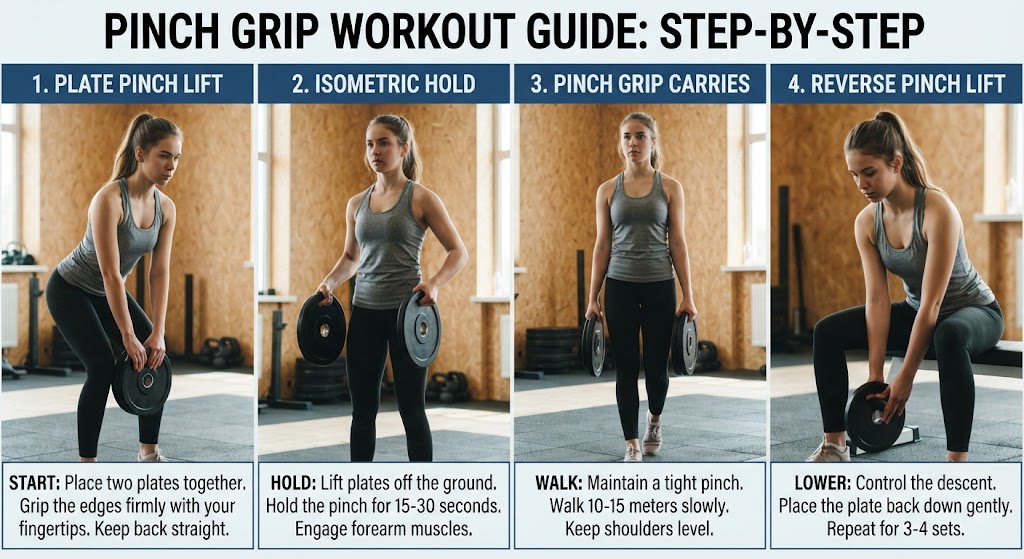
If you’ve already been training your forearms or general grip, you may have developed plenty of crushing strength without specifically challenging the muscles responsible for pinch grip strength. That missing piece can limit overall hand and grip development because pinching relies heavily on the thumb working against the fingers.
A well-designed pinch grip workout can help strengthen your thumb, fingers, hands, and forearms while improving your ability to hold and control objects without wrapping your fingers around a handle.
In this guide, you’ll learn what pinch grip training is, why pinch strength matters, which exercises are best for beginners, how to train your pinch grip at home, how long to hold each exercise, how often to train, what equipment to use, and how to progressively build stronger hands and forearms.
What Is a Pinch Grip Workout?
Pinch grip training is a form of grip-strength exercise that uses the thumb and fingers to hold an object between opposing surfaces. Unlike a traditional closed-hand grip, pinch grip strength depends heavily on the thumb pressing against the fingers to keep an object secure.
For example, a plate pinch involves holding the smooth edges of weight plates between your thumb and fingertips without wrapping your fingers around a handle. This makes pinch training particularly useful when you want to target parts of your hand that conventional grip exercises may not emphasize.
A pinch grip workout can therefore complement a broader Good Forearm Workouts because it trains a specific type of hand force rather than replacing every other grip pattern.
Why Is Pinch Grip Strength Important?
Pinch grip strength helps you generate controlled force between your thumb and fingers during lifting, climbing, sports, manual tasks, and everyday activities. Strong pinch strength can complement general grip strength by improving thumb control, finger force, hand endurance, and forearm involvement.
Many everyday movements require some combination of thumb and finger force. Opening a tight container, carrying a thin object, gripping a climbing hold, or controlling an object during lifting can all involve pinch-related strength.
Pinch Grip Strength Research
A 2024 Indian study measured grip and three types of pinch strength in 1,019 adults aged 18 to 60 years. Researchers reported mean key pinch strength of 8.52 kg in men and 5.97 kg in women, although individual strength varies according to factors such as age, height, sex, and testing method.
Source: Indian Journal of Plastic Surgery, 2024.
In addition, hand-focused strength training has been studied in 22 randomized controlled trials involving 1,017 adults. The review found improvements in grip strength and manual dexterity, while evidence for improvements in pinch strength was positive but less certain.
Source: Journal of Clinical Medicine, 2025.
These findings reinforce an important point: pinch strength is one component of overall hand function, and it should be trained as part of a balanced approach to grip development.
What Muscles Does Pinch Grip Training Work?
Pinch grip training primarily challenges the thumb and finger muscles while also involving the hand and forearm muscles that help maintain a secure grip. The exact muscular demand changes according to the pinch style, object thickness, resistance, and duration.
Thumb and Finger Strength
The thumb provides the primary opposing force during most pinch exercises. Your fingertips then press against the opposite surface to prevent the object from slipping.
For example, holding two weight plates together requires continuous thumb pressure while the fingers maintain contact along the opposite edge.
Forearm and Hand Strength
The muscles of your hand and forearm also help maintain finger and thumb positioning during a sustained pinch. This makes pinch exercises useful alongside broader forearm strengthening exercises
A 2025 systematic review found that hand-focused strength and proprioceptive training produced a small-to-moderate improvement in overall grip strength across the included studies.
Source: Journal of Clinical Medicine, 2025.
What Are the Best Pinch Grip Exercises for Beginners?
The best pinch grip exercises for beginners are plate pinches, book pinches, block pinches, and controlled object holds. These exercises allow you to learn proper thumb positioning and gradually develop strength without requiring complicated equipment.
The goal at the beginning isn’t to lift the heaviest object possible. Instead, focus on maintaining consistent thumb pressure, controlled finger positioning, and a stable wrist.
Plate Pinch Exercise
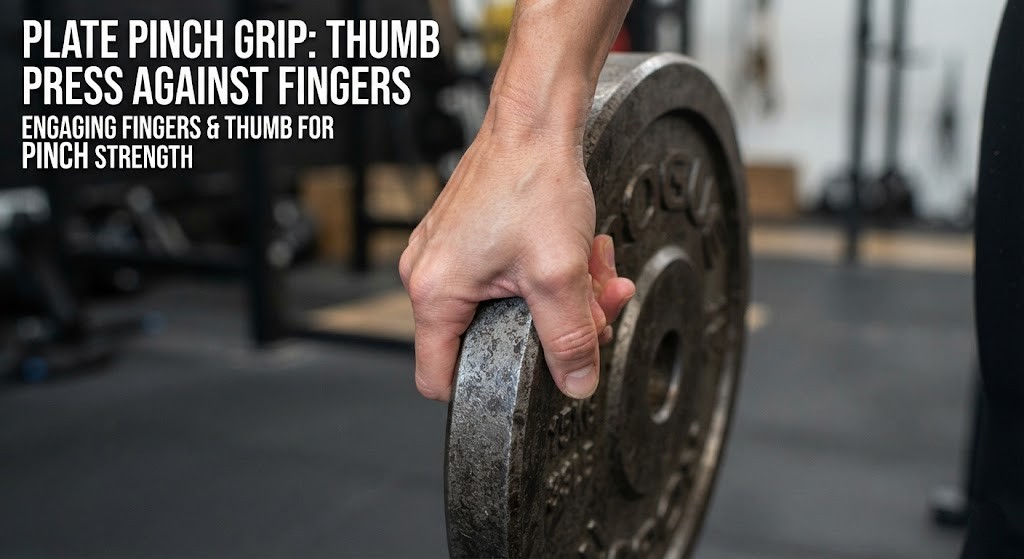
The plate pinch exercise involves gripping the edges of one or more weight plates between your thumb and fingers and holding them for a controlled period.
How to Perform a Plate Pinch
- Stand upright with your shoulders relaxed.
- Place a weight plate vertically beside your body.
- Press your thumb against one side and your fingers against the other.
- Lift the plate without curling your fingers around it.
- Hold for 10–30 seconds.
- Lower the plate slowly and switch hands.
Start with a single light plate and perform 2–3 controlled holds per hand. Increase resistance only when you can complete every hold without losing your position.
Book or Object Pinches
Book pinches are an easy pinch grip workout for beginners because you can adjust the difficulty by changing the object’s weight and thickness.
Hold a hardcover book between your thumb and fingers, lift it from a stable surface, and maintain the pinch for 15–30 seconds. You can also use a small block, thick card stack, or another secure household object.
These exercises can also be combined with other hand grip strength exercises to create a more balanced hand-training routine.
Finger-Thumb Pinches
Finger-thumb pinches provide another simple way to practice controlled thumb-to-finger force. Instead of holding a large object, focus on repeatedly bringing the thumb against individual fingers while maintaining controlled pressure.
This can be useful as a lighter movement during a warm-up or as accessory work after heavier pinch exercises.
How Can You Improve Pinch Grip Strength at Home?
You can improve pinch grip strength at home by using household objects that provide a secure edge and allow gradual increases in resistance.
The key is controlled progression rather than simply squeezing harder every session.
Simple Home Pinch Grip Routine
Then perform the following routine:
| Exercise | Sets | Hold/Reps | Rest |
|---|---|---|---|
| Book pinch | 2 | 20–30 sec | 60 sec |
| Plate pinch | 3 | 15–25 sec | 60–90 sec |
| Object pinch | 2 | 20 sec | 60 sec |
| Finger-thumb pinch | 2 | 8–12 reps | 45–60 sec |
Keep the resistance light enough that your thumb and fingers maintain contact throughout every repetition.
A successful pinch hold should feel challenging without forcing you to compensate with your wrist, shoulder, or body.
What Is the Best Pinch Grip Workout for Beginners?
A beginner pinch grip workout should prioritize controlled holds, manageable resistance, proper technique, and sufficient recovery before progressing to heavier loads.
Beginner Pinch Grip Workout
Complete a short hand and wrist warm-up before loading your fingers and thumbs.
- Light plate pinch: 2 × 20 seconds per hand
- Book or block pinch: 2 × 20–30 seconds per hand
- Plate pinch: 3 × 10–20 seconds per hand
- Thumb-to-finger pinches: 2 × 10 repetitions per hand
- Optional dead hang: 2 × 15–30 seconds
This routine gives beginners a combination of pinch strength, holding capacity, and general grip work.
How Long Should You Hold a Pinch Grip Exercise?
A pinch grip exercise can generally be held for about 10–30 seconds when training basic strength and endurance, although the ideal duration depends on the exercise and training goal.
Beginners should prioritize high-quality holds rather than chasing maximum time. If your thumb begins to lose contact or your wrist position changes substantially, the hold has probably become too difficult.
For example, if you can easily hold an object for 30 seconds with perfect technique, slightly increase the resistance and return to a shorter hold.
Longer holds are not automatically better. A 15-second heavy controlled hold can create a different training challenge than a 60-second light hold.
How Often Should You Train Your Pinch Grip?
You should generally train pinch grip about two times per week when starting, with enough recovery between challenging sessions.
Your hands and forearms already receive repeated stress during regular lifting, climbing, sports, and daily activities. Therefore, additional grip work should be programmed carefully instead of being performed hard every day.
For example, Monday and Thursday provide several days between focused pinch sessions.
At the same time, the 2026 American College of Sports Medicine resistance-training update emphasized that consistency matters more than unnecessarily complicated programming. Its evidence review included 137 systematic reviews representing more than 30,000 participants.
Source: American College of Sports Medicine, 2026.
This supports a simple approach: establish a routine you can perform consistently, then progress gradually.
What Equipment Is Best for Pinch Grip Training?
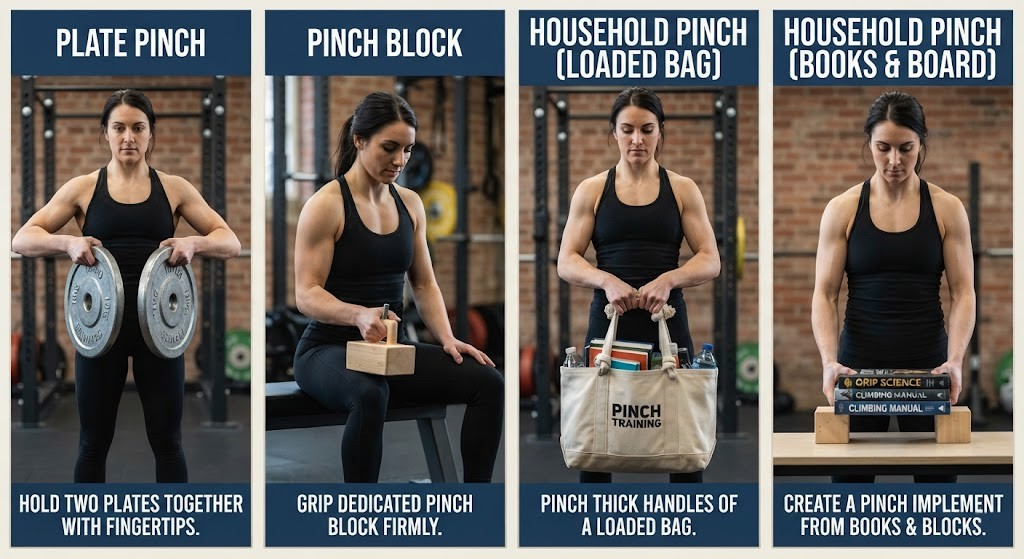
Pinch grip equipment can include weight plates, pinch blocks, climbing blocks, grip tools, and secure household objects that can be held between the thumb and fingers.
Plate Pinches
Weight plates are one of the simplest options because most gyms already have them. Start with plates that have manageable edges and a surface you can safely grip.
As your strength improves, you can increase the resistance while keeping the basic movement familiar.
Pinch Blocks
Pinch blocks provide a purpose-built surface for progressive pinch block training. Many blocks allow you to attach additional weight, making progression easier to measure and track.
They can be particularly useful for people who want a dedicated pinch grip workout and more precise control over resistance.
Household Alternatives
Books, wooden blocks, thick cardboard, and other stable objects can work well for beginners.
However, avoid fragile, sharp, slippery, or breakable objects. Choose something that remains secure when lifted and can be controlled throughout the entire movement.
What Are Advanced Pinch Grip Exercises?
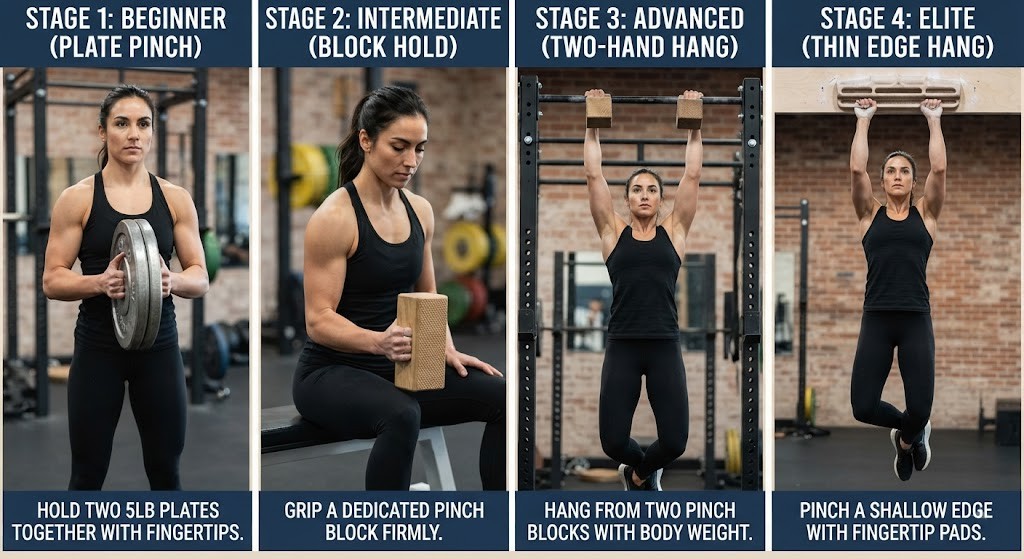
Advanced pinch grip exercises increase the demand by using heavier resistance, longer holds, thicker objects, or more challenging pinch positions.
These variations should be introduced only after basic holds become consistent and controlled.
Heavy Plate Pinches
Heavy plate pinches are one of the simplest progressions because they allow you to increase resistance while keeping the movement familiar.
For example, move from one manageable plate to a heavier plate or a carefully selected combination only after you can complete your prescribed holds without dropping the load.
The goal is controlled progression rather than testing your maximum every session.
Timed Pinch Holds
Timed holds challenge grip endurance by requiring continuous force production.
For example, perform three 20-second holds. Once that duration becomes manageable, gradually work toward 25 or 30 seconds before increasing the load.
Thick-Object Pinches
Thicker objects can change leverage and make it more difficult to maintain thumb pressure.
Changing object thickness can therefore provide progression without simply adding weight.
This is especially useful when you have limited access to heavier equipment but still want to make your pinch grip training more challenging.
How Do You Progress Pinch Grip Training?
Progressive pinch grip training involves gradually increasing resistance, hold duration, or exercise difficulty as your grip strength improves.
The safest approach is to change one training variable at a time rather than making every part of the workout harder simultaneously.
A Simple Pinch Grip Progression
Use the following progression:
- Improve technique with a light object.
- Increase hold duration slightly.
- Increase resistance.
- Return to a shorter hold with the new resistance.
- Repeat the process gradually.
For example, you might begin with a 15-second hold, progress toward 20–30 seconds, and then increase the resistance. Once the load increases, return to a shorter hold and build up again.
Moreover, track the weight, hold time, sets, and hand used during every workout.
A 2025 international review of handgrip norms analyzed data from 2,405,863 adults across 69 countries and regions, demonstrating how widely hand strength varies across populations.
Source: Journal of Sport and Health Science, 2025.
As a result, avoid comparing your pinch strength directly with someone else’s number without considering differences in body size, age, sex, equipment, technique, and testing method.
What Are the Most Common Pinch Grip Training Mistakes?
The most common pinch grip training mistakes include using excessive weight, losing thumb position, training too frequently, jerking the object, and ignoring persistent pain.
Avoiding these mistakes can make your training more consistent and help you focus the workload on the intended muscles and tissues.
Using Too Much Weight
Excessive resistance can cause you to compensate with your wrist, fingers, or body instead of maintaining a true pinch.
Reduce the load if you repeatedly lose contact, cannot control the object, or struggle to complete the lowering phase.
Training Too Often
Daily hard pinch sessions can create unnecessary fatigue because your hands already work during lifting, climbing, and other activities.
Recovery is part of progressive grip training.
Allow enough time between challenging sessions so your hands and forearms can recover before the next workout.
Losing Proper Thumb Position
The thumb is central to pinch grip training. If your thumb position changes significantly during a hold, the exercise may no longer provide the intended challenge.
Focus on keeping the thumb actively opposed to the fingers throughout each repetition.
Using Jerky Movements
Pinch exercises should be controlled rather than explosive. Jerking an object into position can reduce control and make the exercise unnecessarily difficult.
Lift smoothly, hold steadily, and lower the object under control.
Ignoring Pain
Normal muscular fatigue is different from sharp, persistent, or worsening pain.
Stop the exercise if pain appears and consider professional assessment if symptoms continue.
You can also incorporate injury prevention exercises when building a broader strength program.
How Can You Build Stronger Pinch Grip Strength?
The next step is to choose two or three pinch exercises, train them consistently twice per week, and record your performance after every session.
Progressive overload works best when your training increases gradually while technique remains stable.
For example, start with 15–20-second plate holds, build toward 25–30 seconds, and then increase the resistance before repeating the cycle.
Pinch Grip Progression Checklist
Use these principles to keep your training organized:
- Choose a manageable starting resistance.
- Keep your thumb and fingers properly positioned.
- Use controlled lifting and lowering movements.
- Track your sets, resistance, and hold duration.
- Increase only one major training variable at a time.
- Give your hands adequate recovery.
- Stop or modify an exercise if pain develops.
- Combine pinch training with other grip patterns.
In addition, remember that pinch training should complement rather than replace your overall strength program. Pair it with reverse wrist curl, carries, pulling exercises, and other forearm work for more complete grip development.
Pinch Grip Workout vs. General Grip Training
Pinch grip training and general grip training overlap, but they are not identical.
A traditional grip exercise may involve wrapping the entire hand around a bar, handle, or implement. Pinch grip exercises instead require the thumb and fingers to work against one another to secure an object.
| Training Type | Primary Emphasis | Example |
| Pinch grip | Thumb and finger opposition | Plate pinch |
| Crushing grip | Closing the hand around an object | Grip trainer |
| Support grip | Holding a load for time | Farmer carry |
| Hanging grip | Maintaining a hold while suspended | Dead hang |
Because each pattern creates a different challenge, combining them can provide more complete grip development than relying on one type alone.
How Can You Make Pinch Grip Training More Effective?
The effectiveness of a pinch grip workout depends less on using complicated equipment and more on applying consistent technique and progression.
Focus on these principles:
- Start light: Learn the movement before increasing resistance.
- Control every repetition: Avoid jerking or dropping the load.
- Train consistently: Two focused sessions per week can provide a practical starting structure.
- Progress gradually: Increase resistance or duration as your current level becomes manageable.
- Track performance: Record your hold time and resistance.
- Recover adequately: Avoid turning every workout into a maximum-effort test.
- Use different pinch variations: Plates, blocks, and thicker objects can provide different challenges.
This approach makes pinch grip training easier to manage while allowing you to build strength over time.
Conclusion
A pinch grip workout is a practical way to strengthen the thumb, fingers, hands, and forearms through controlled pinching movements. Plate pinches, pinch blocks, timed holds, and household-object pinches provide several ways to train without complicated equipment.
More importantly, consistent pinch grip training beats random maximum-effort attempts. Start with manageable resistance, maintain proper thumb and wrist positioning, track your holds, and gradually increase resistance or duration as your hands adapt.
Pinch grip strength can complement lifting, climbing, sports, manual activities, and everyday hand control. Start with the beginner routine, focus on quality repetitions, and build stronger hands one controlled hold at a time.
FAQs
What is pinch grip training?
Pinch grip training strengthens the thumb and fingers by holding objects between them.
What does pinch grip help with?
It improves thumb strength, finger strength, grip control, and hand endurance.
What is a pinch grip?
A pinch grip holds an object between the thumb and fingers without wrapping the hand around it.
What is the best pinch grip exercise?
Plate pinches are a simple and effective pinch grip exercise.
How long should you hold a pinch grip?
Hold for about 10–30 seconds, depending on your strength and goal.
How often should I train pinch grip?
Train pinch grip about twice per week with adequate recovery.
Can I do a pinch grip workout at home?
Yes, you can use safe objects such as books, blocks, or weight plates.
Does pinch grip training strengthen the forearms?
Yes, pinch exercises also engage the hand and forearm muscles.
Are plate pinches good for beginners?
Yes, beginners can start with a light plate and focus on proper technique.
How do I increase pinch grip strength?
Gradually increase the resistance, hold time, or exercise difficulty.
Can pinch grip training help climbing?
Yes, it can strengthen the thumb and fingers used on pinch-style holds.
Is pinch grip the same as crushing grip?
No, pinch grip uses thumb-and-finger pressure, while crushing grip closes the hand around an object.
What equipment is best for pinch grip training?
Weight plates and pinch blocks are practical options for training pinch strength.
Should I train pinch grip every day?
No, allow enough recovery between challenging pinch grip workouts.
1 thought on “Pinch Grip Workout: Build Stronger Hands, Fingers & Forearms”