
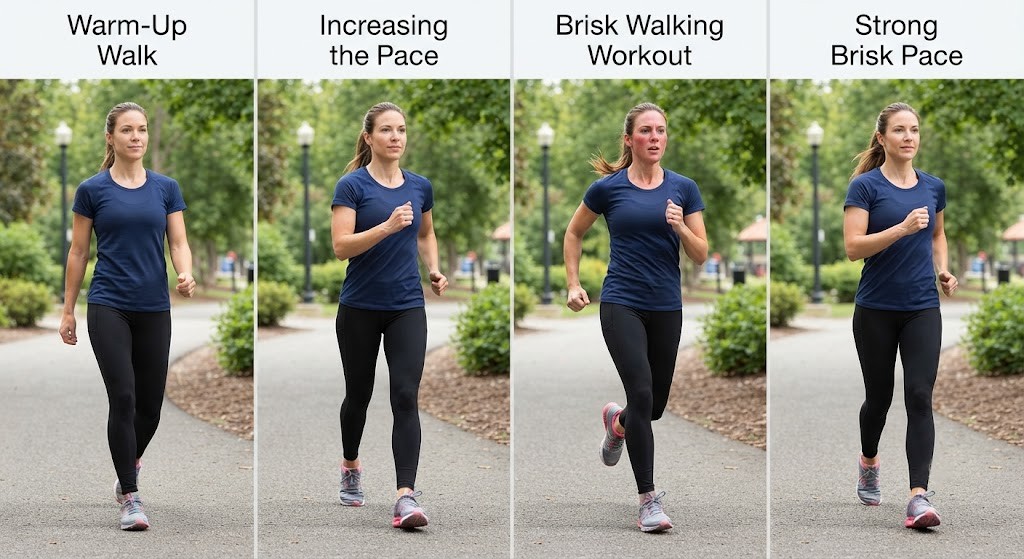
If you already walk regularly, you are already adding valuable movement to your day—but a casual stroll and a brisk walking workout are not quite the same. The biggest differences come down to intensity, structure, and consistency.
Brisk walking increases your breathing and heart rate while remaining sustainable for many people. It can be performed outdoors, indoors, or on a treadmill, and it requires very little equipment.
In this guide, you will learn what brisk walking is, how fast and how long to walk, how to tell whether your pace is truly brisk, which workout formats to try, and how to gradually build a routine that fits your fitness level.
What Is a Brisk Walking Workout?
A brisk walking workout is a moderate-intensity walking activity performed at a pace that noticeably increases your breathing and heart rate while remaining sustainable for an extended period. Unlike a casual stroll, brisk walking involves purposeful movement and a faster pace that makes your body work harder.
The CDC currently lists walking briskly at about 2.5 mph or faster as a moderate-intensity activity. However, the appropriate pace varies from person to person. — Source: [CDC, 2025]
Your fitness level, age, terrain, stride, and physical condition can all affect how difficult a particular walking speed feels.
For example, 3 mph might feel brisk to someone returning to exercise but relatively easy to a well-conditioned walker. Your effort matters more than reaching one universal speed.
Brisk Walking vs. Regular Walking
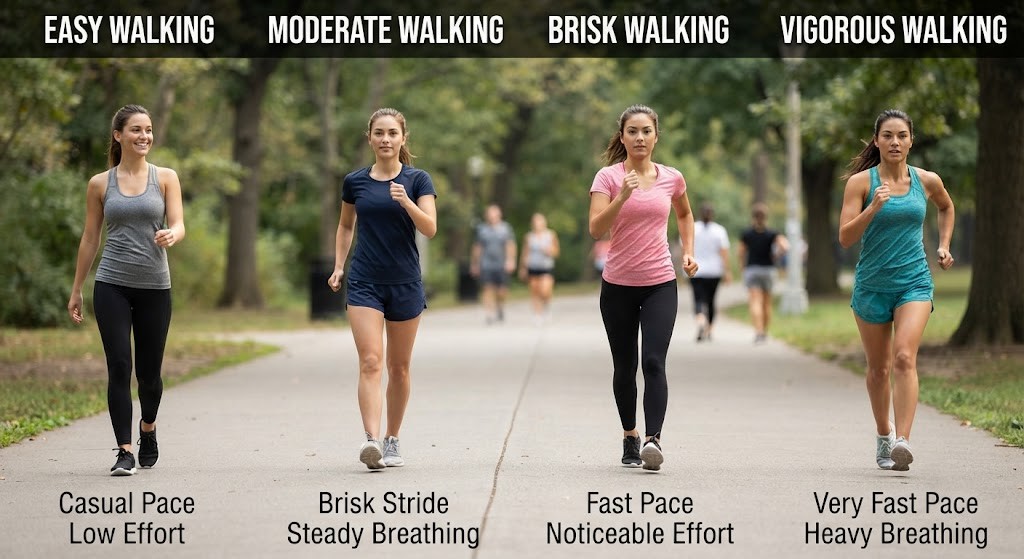
Brisk walking and regular walking differ primarily in intensity, breathing, and perceived effort. A relaxed walk may allow effortless conversation, whereas a brisk walk should make you breathe noticeably faster.
For example, you might stroll through a shopping area at an easy pace and then increase your speed during a 20-minute neighborhood workout. That deliberate increase in intensity turns ordinary walking into a more structured walking cardio workout.
| Walking intensity | Typical feeling | Conversation | Example use |
|---|---|---|---|
| Easy | Comfortable and relaxed | Easy conversation | Warm-up or recovery |
| Moderate/brisk | Breathing faster | Talk, but not comfortably sing | Main workout |
| Vigorous | Challenging breathing | Only a few words | Short harder intervals |
Why Does Brisk Walking Matter?
Brisk walking matters because it provides a practical way to accumulate moderate-intensity aerobic activity without requiring running or complicated equipment. Regular physical activity can support cardiovascular health, physical fitness, mental well-being, and everyday function.
Adults are advised to accumulate at least 150 minutes of moderate-intensity aerobic activity each week, which can include brisk walking. — Source: [CDC, 2025]
Brisk walking can also contribute to stamina and overall daily activity when practiced consistently. It may increase energy expenditure, which can be relevant to Dance Walking Workout, although changes in body weight depend on overall calorie intake, activity, consistency, and individual factors.
For example, instead of trying to find one uninterrupted 30-minute period, someone with a busy schedule could complete three 10-minute brisk walks throughout the workday.
What Does Research Say About Walking Pace?
Research has also found associations between faster self-reported walking pace and lower mortality risk. However, these observational findings do not prove that walking speed itself directly causes those outcomes.
A large UK Biobank analysis included 391,652 participants and followed them for a median of 12.6 years. — Source: [PubMed, 2023]
For more accessible exercise ideas, brisk walking can also be paired with other low-impact workouts that reduce repetitive impact while keeping you active.
How Fast Should You Walk During a Brisk Walking Workout?
A brisk walking pace is generally fast enough to raise your breathing and heart rate while still allowing you to speak in short sentences.
The CDC gives 2.5 mph or faster as one general example of brisk walking, but individual intensity can differ substantially. — Source: [CDC, 2025]
Instead of forcing yourself to reach a specific speed, increase your pace until you feel warmer, your breathing becomes faster, and talking requires more effort.
How Do You Know If You Are Walking at a Brisk Pace?
The talk test is one of the simplest ways to judge brisk-walking intensity. During moderate-intensity walking, you should generally be able to talk but not comfortably sing. — Source: [CDC, 2025]
Perceived exertion provides another practical guide. On a simple 1-to-10 effort scale, many people can use roughly 5–6 out of 10 as a practical moderate-effort target, adjusting according to experience and circumstances.
Consider these examples:
- If you can comfortably sing a full song while walking, your pace may be too easy for a moderate-intensity workout.
- If you can have a conversation but singing comfortably is difficult, you are likely closer to moderate intensity.
- If you cannot say a complete sentence without stopping for breath, you may be working closer to vigorous intensity.
For people building their first routine, a Retro Walking Workout can start below this intensity and gradually introduce longer brisk periods.
How Do You Do a Brisk Walking Workout for Beginners?
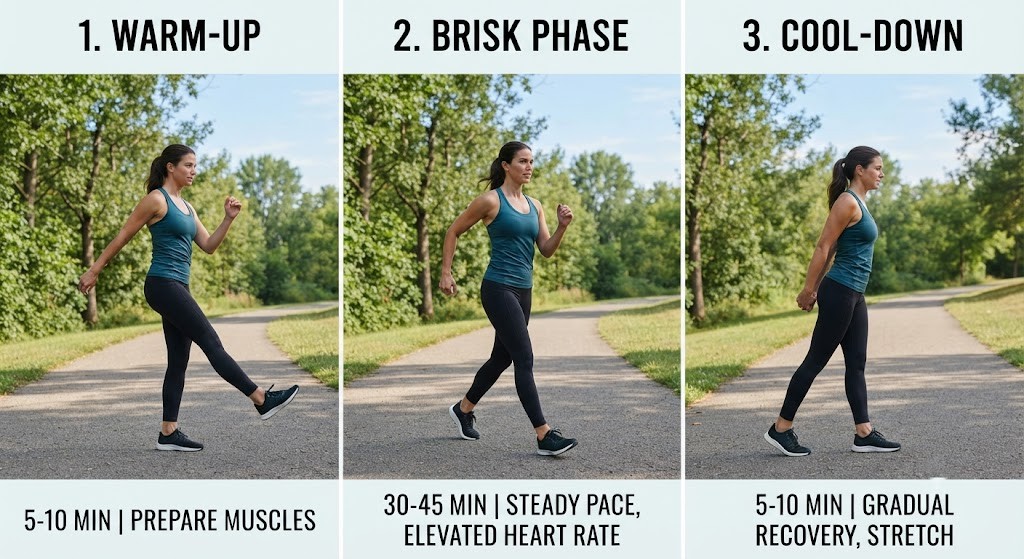
A beginner brisk walking workout should combine an easy warm-up, a manageable brisk phase, and a gradual cool-down. This structure lets you transition into exercise without immediately demanding your fastest pace.
Try this simple 25-minute beginner routine:
- 5 minutes: Walk comfortably to warm up.
- 15 minutes: Walk briskly at a sustainable pace.
- 5 minutes: Slow down gradually for your cool-down.
This straightforward format is enough to create a useful walking session without complicated programming.
Brisk Walking Form for Beginners
Good walking form does not require exaggerated movements. Instead, focus on staying comfortable and purposeful throughout the workout.
Keep these points in mind:
- Maintain a tall posture without stiffening your body.
- Keep your shoulders relaxed.
- Let your arms swing naturally.
- Use a comfortable stride.
- Avoid reaching excessively with each step.
- Increase your cadence gradually when you want to walk faster.
Imagine that you are walking toward a destination that is slightly farther away than usual. This can encourage purposeful movement without making you take unnaturally long steps.
What Are the Best Brisk Walking Workout Variations?
One advantage of brisk walking is its flexibility. You can use steady-state walking, intervals, hills, treadmill sessions, or longer endurance walks depending on your fitness level, goals, environment, and available time.
Steady-State Brisk Walking
Steady-state walking involves maintaining a relatively consistent brisk effort for most of the workout. It is one of the simplest ways to build aerobic endurance.
For example:
- Walk easily for 5 minutes.
- Maintain a brisk pace for 20–30 minutes.
- Slow down for your cool-down.
This format works particularly well when you want a predictable, straightforward walking routine.
Brisk Walking Intervals
Brisk walking intervals alternate faster walking with easier recovery periods. This approach allows beginners and intermediate walkers to experiment with higher effort without having to maintain a challenging pace continuously.
For example, try:
2 minutes brisk + 1 minute easy × 6 rounds
Begin with an easy warm-up before starting the intervals and finish with a cool-down.
Hill Walking
Hill walking increases the challenge because you must work against gravity. As a result, an otherwise moderate walking session can feel substantially harder.
A simple hill workout could include:
- 5 minutes of brisk walking on level ground
- 1 minute of uphill walking
- 2 minutes of easier walking
- Repeat the hill sections as appropriate
The goal is not to sprint uphill. Instead, maintain purposeful movement and adjust your pace to the terrain.
Treadmill Brisk Walking
A treadmill brisk walking workout provides a controlled indoor environment where you can adjust speed and incline. It can be especially useful when weather, safety, or location makes outdoor walking inconvenient.
Start with a comfortable speed and gradually increase it until you reach your brisk effort rather than copying someone else’s treadmill setting.
For a more structured indoor session, see the treadmill walking workout guide.
Power Walking
Power walking is a faster, more purposeful style of walking that emphasizes stronger arm movement and an efficient stride. It can provide an additional challenge for experienced walkers without requiring a transition to running.
Maintain an upright posture, drive your arms naturally, and increase cadence without taking excessively long steps.
How Long Should You Do a Brisk Walking Workout?
A brisk walking workout can last anywhere from about 10 minutes to an hour or more depending on fitness, schedule, intensity, and experience. Beginners can start with manageable sessions and gradually build duration.
A simple progression could look like this:
| Experience | Example session | Weekly approach |
|---|---|---|
| Beginner | 15–20 minutes | 3 days |
| Developing | 20–30 minutes | 3–5 days |
| Intermediate | 30–45 minutes | 4–5 days |
| Experienced | 45–60+ minutes | 4–6 days |
These are practical examples rather than requirements. Your appropriate workout duration depends on your current fitness and how well the routine fits your schedule.
The CDC recommends at least 150 minutes of moderate-intensity activity per week for adults, with activities spread across the week in whatever pattern is practical. — Source: [CDC, 2025]
For example, 30 minutes of brisk walking on five days can reach 150 minutes. Shorter sessions can also be accumulated across the day.
How Many Days a Week Should You Do Brisk Walking?
Adults can work toward at least 150 minutes of moderate-intensity activity each week, and brisk walking is one way to reach that target.
The CDC also recommends muscle-strengthening activity on at least two days each week. — Source: [CDC, 2025]
For example, you could walk briskly on Monday, Wednesday, Friday, Saturday, and Sunday while adding strength training on two of those days.
Daily step goals can also be useful as an activity-tracking measure. However, step count does not replace intensity guidance when your specific goal is moderate-intensity cardio.
How Can You Make Brisk Walking More Challenging?
You can make brisk walking more challenging by increasing duration, frequency, incline, cadence, or the amount of brisk work rather than simply trying to walk as fast as possible.
For example, if 20 minutes feels comfortable for several weeks, progress to 25 minutes before adding short hills or brisk intervals.
Whenever possible, change one major variable at a time. Increasing both speed and duration dramatically in the same week can make the workout unnecessarily difficult.
Ways to Progress Your Walking Workout
Use one or more of these progression strategies:
- Add 5 minutes to selected sessions.
- Add one walking day to your weekly schedule.
- Introduce short hills.
- Add brisk intervals after your warm-up.
- Increase treadmill incline gradually.
- Extend one weekly walk for endurance.
You can also complement your walking routine with leg workouts for beginners and core workouts for beginners on separate days for a more balanced approach to fitness.
What Tools and Equipment Do You Need?
One of the biggest advantages of a brisk walking workout is that it requires very little equipment. A comfortable pair of walking shoes, suitable clothing, and a simple timer are generally enough to get started.
For example, you can complete a 20-minute neighborhood workout using only your phone’s timer and a route that allows uninterrupted walking.
Useful tools include:
- Comfortable walking shoes
- Breathable clothing
- A phone or basic timer
- A step or activity tracker
- A treadmill when indoor walking is preferable
- Water for longer or hotter sessions
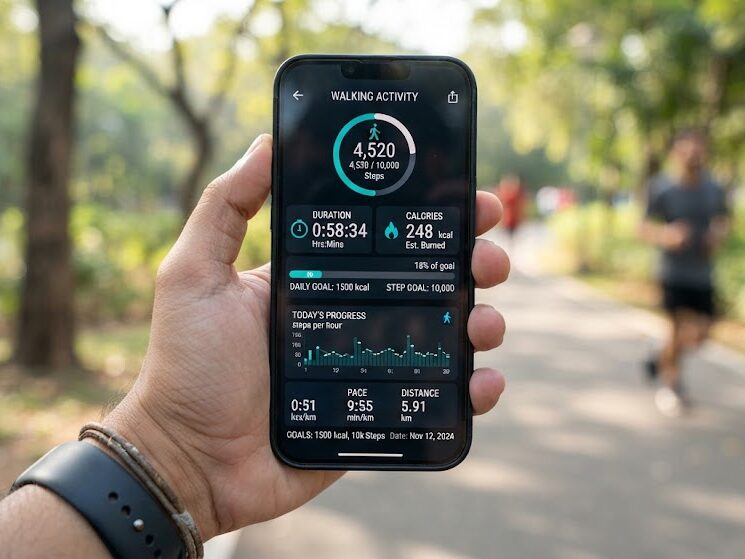
Activity trackers can help you monitor duration, distance, pace, and heart rate, but they are optional. A simple walking workout plan written on paper can be just as useful for building consistency.
If you want to compare activity data or estimate energy expenditure, explore fitness calculators and calories burned walking resources. Keep in mind that calorie estimates are approximations.
How Can You Build a Consistent Brisk Walking Routine?
The most effective way to build a sustainable brisk walking workout habit is to progress gradually rather than trying to maximize speed immediately.
For example, you might begin with three 20-minute sessions during your first week. Once that routine feels manageable, you can gradually add time or another walking session.
Focus on Consistency Before Intensity
Consistency should be the main goal before intensity becomes the focus. A repeatable 25-minute walk performed several times each week is often more practical than an exhausting workout that you rarely complete.
A sustainable routine can also make it easier to adapt your workouts around work, family responsibilities, weather, and other daily commitments.
A Simple Four-Step Walking Progression
Use this four-step approach to build your routine:
- Start manageable: Choose a duration you can repeat comfortably.
- Build consistency: Establish several walking days each week.
- Increase gradually: Add minutes or one additional session.
- Add challenge: Introduce hills or intervals once regular brisk walking feels easier.
This progression allows your routine to develop without making every session a maximum-effort workout.
When Should You Adjust Your Walking Routine?
Your walking plan should remain flexible. Fatigue, discomfort, weather, and changes in your schedule can all affect how much activity is practical on a particular day.
At the same time, listen to your body and adjust your routine when necessary. People with chronic health conditions or other concerns should discuss appropriate activity levels with a healthcare professional. — Source: [CDC, 2025]
A Simple Brisk Walking Workout Plan
If you want a straightforward place to start, use the following structure:
| Workout stage | Duration | Intensity |
|---|---|---|
| Warm-up | 5 minutes | Easy |
| Main walk | 15 minutes | Brisk/moderate |
| Cool-down | 5 minutes | Easy |
Once this becomes comfortable, you can gradually extend the main brisk section or introduce intervals and hills.
For example, you could progress from 5 minutes easy + 15 minutes brisk + 5 minutes easy to a longer session with additional brisk walking. The goal is steady improvement rather than maximum speed.
Brisk Walking Workout Tips for Better Results
A few simple habits can make your walking routine easier to maintain.
Choose a Pace You Can Sustain
Brisk walking should feel purposeful but manageable. You should notice an increase in breathing and heart rate without turning every session into an all-out effort.
Use the Talk Test
If you can talk but cannot comfortably sing, you are using a practical indicator of moderate intensity. — Source: [CDC, 2025]
Increase Difficulty Gradually
Add time, walking days, hills, incline, cadence, or intervals progressively. There is no need to increase every variable simultaneously.
Make Walking Convenient
Choose routes and workout times that fit naturally into your schedule. A convenient 20-minute walk may be easier to maintain than a longer routine that requires extensive preparation.
Track Progress If It Helps
A phone, tracker, or written walking log can help you monitor your sessions. However, tracking is optional; the primary objective is to develop a consistent routine that works for you.
Conclusion: Make Brisk Walking a Sustainable Workout Habit
A brisk walking workout is a practical form of moderate-intensity cardio that can fit into busy schedules, outdoor routines, and indoor treadmill sessions. The most useful routine is not necessarily the fastest or longest one—it is the one that matches your current fitness level and can be repeated consistently.
You do not need to chase a perfect speed or follow a complicated program. Start with an easy warm-up, settle into a sustainable brisk pace, and finish with a gradual cool-down.
For example, your first workout could simply be 5 minutes easy + 15 minutes brisk + 5 minutes easy. Once that feels comfortable, gradually increase your walking time or introduce short intervals and hills.
Ultimately, brisk walking is a long-term habit rather than a one-day challenge. Choose a realistic routine, track your progress if helpful, and let consistency build your fitness over time.
FAQs
What is a brisk walking workout?
A brisk walking workout is a moderate-intensity walk that raises your heart rate and breathing while remaining sustainable.
How fast should you walk for a brisk walking workout?
A brisk walking pace is generally about 2.5 mph or faster, although the ideal pace varies by person.
How many minutes should you brisk walk?
Aim for at least 150 minutes of moderate-intensity activity per week, such as 30 minutes on five days.
What do 20 minutes of brisk walking do?
Twenty minutes of brisk walking adds moderate-intensity activity to your day and supports your weekly exercise routine.
Is a 30 minute brisk walk a day enough?
Yes, a 30-minute brisk walk five days a week can meet the general 150-minute weekly activity target.
Which exercise is brisk walking?
Brisk walking is a moderate-intensity aerobic exercise that increases your heart rate and breathing.
How do you know if walking is brisk?
You should be able to talk but not comfortably sing while walking at a brisk pace.
Is brisk walking good for beginners?
Yes, beginners can start with shorter walks and gradually increase their walking time and intensity.
Can you do a brisk walking workout on a treadmill?
Yes, treadmill walking allows you to control your speed and incline for an indoor workout.
Can brisk walking help with weight loss?
Brisk walking can increase energy expenditure and may support weight loss when combined with a suitable diet and regular activity.
How can you make brisk walking more challenging?
You can gradually add hills, incline, faster intervals, longer walks, or increase your walking cadence.
Is brisk walking considered cardio?
Yes, brisk walking is a moderate-intensity aerobic exercise that provides cardiovascular activity.
1 thought on “Brisk Walking Workout: Boost Cardio, Endurance & Overall Fitness”