
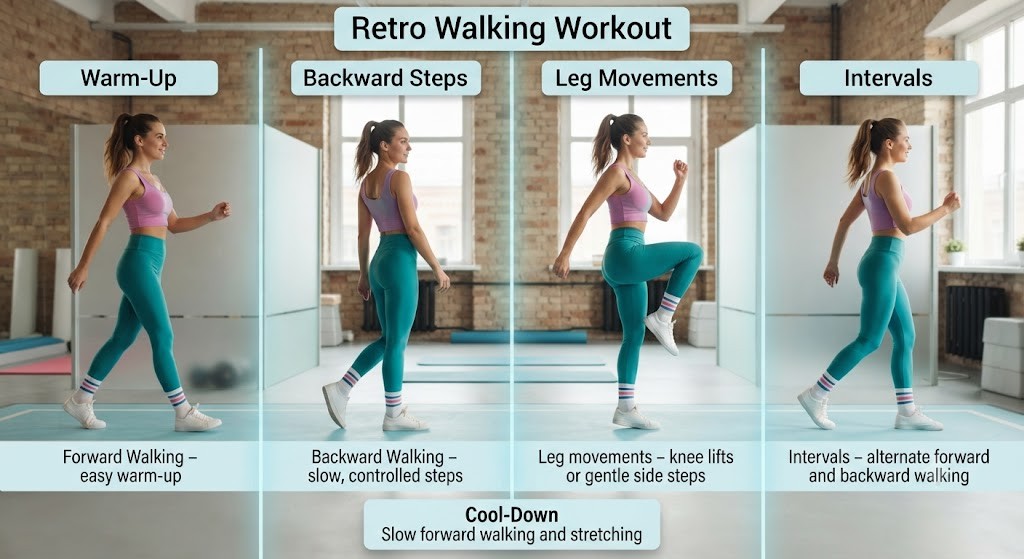
You already know that walking is one of the simplest ways to add more movement to your day. But walking does not always have to mean moving forward at the same pace. A retro walking workout adds rhythmic patterns, directional movements, and playful, old-school fitness-inspired exercises to make a familiar activity more engaging.
Whether you’re new to exercise or simply looking for a more enjoyable way to stay active, retro walking can be adapted to your fitness level. In this guide, you’ll learn what a retro walking workout is, how it differs from regular walking, which exercises to include, how to build a beginner routine, ways to increase intensity, and how to exercise safely.
What Is a Retro Walking Workout?
A retro walking workout is a walking-based exercise routine that combines rhythmic walking patterns, directional movements, and retro-inspired fitness exercises into a structured cardio session. Instead of simply walking forward, you move through patterns such as step-touches, side steps, knee lifts, heel digs, arm swings, and controlled changes of direction.
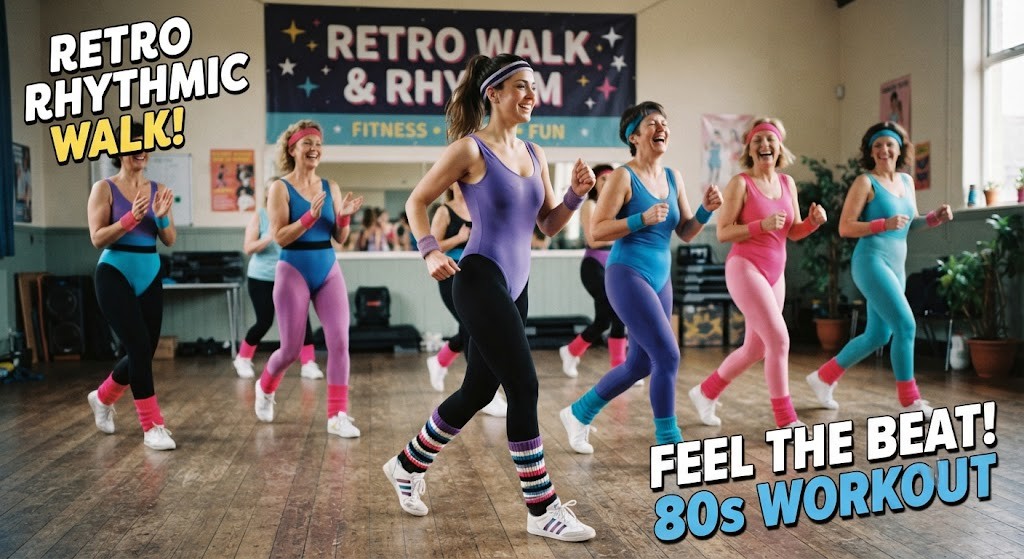
The term “retro” refers primarily to the style and movement feel rather than a single standardized exercise program. A routine might borrow the rhythmic step patterns and upbeat movement style associated with classic aerobic workouts while keeping the exercises low impact.
Retro walking can also be performed indoors or outdoors, depending on the movements selected. For example, an indoor session could alternate two minutes of marching with step-touch patterns and gentle knee lifts.
How Is Retro Walking Different From Regular Walking?
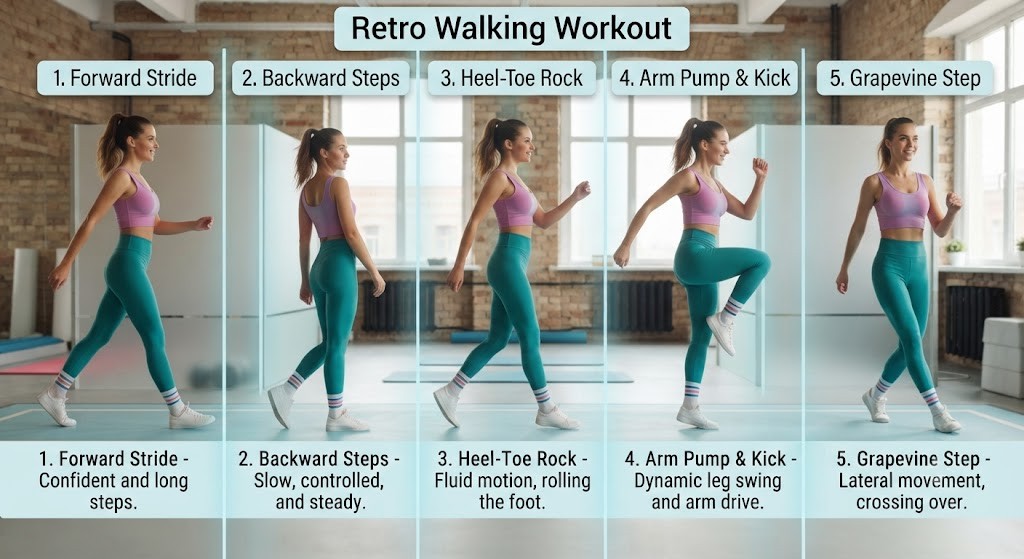
Retro walking builds on conventional walking by adding structured movement variety. Regular walking generally emphasizes forward locomotion, whereas a retro walking workout can incorporate lateral steps, rhythmic patterns, deliberate arm movements, and carefully controlled changes in direction.
However, regular walking remains the foundation. You might briskly walk for two minutes, then perform 30 seconds of step-touches and 30 seconds of knee lifts before returning to walking.
| Feature | Regular Walking | Retro Walking Workout |
|---|---|---|
| Main movement | Forward walking | Walking plus rhythmic patterns |
| Direction | Mostly forward | Forward, lateral, and optional backward |
| Arm movement | Natural swing | Deliberate arm patterns |
| Variety | Usually consistent | Frequently changes |
| Equipment | Usually none | Usually none |
| Intensity | Pace dependent | Pace and movement dependent |
For beginners, Walking Yoga for Beginners can provide a useful foundation before introducing more complex movement patterns.
Why Is a Retro Walking Workout Good for Fitness?
A retro walking workout can support fitness by combining sustained movement with changes in pace, direction, and movement range. How challenging the session feels depends on factors such as your pace, fitness level, movement range, and how continuously you exercise.
A gentle routine may feel relatively easy, while a brisk and continuous session can become moderate-intensity physical activity.
Walking-based exercise is valuable because some physical activity is better than none. The CDC recommends that adults get at least 150 minutes of moderate-intensity physical activity each week, along with muscle-strengthening activity on at least two days. — Source: [CDC, 2025]
The need for accessible forms of physical activity is also reflected in global activity levels. WHO reported that approximately 31% of adults worldwide, or about 1.8 billion people, did not meet recommended activity levels in 2022. — Source: [WHO, 2024]
Can Retro Walking Be a Low-Impact Cardio Workout?
Yes. A retro walking workout can function as low-impact cardio when movements keep at least one foot connected to the floor and avoid jumping.
Examples include:
- Brisk marching
- Side steps
- Step-touches
- Heel digs
- Controlled knee lifts
- Rhythmic arm swings
These movements can raise your heart rate without requiring running or jumping.
The CDC identifies brisk walking as an example of moderate-intensity physical activity. — Source: [CDC, 2023]
However, not every retro walking workout automatically reaches moderate intensity. Your pace, fitness level, movement range, and how continuously you move determine the actual demand of the workout.
For more related ideas, explore low-impact workouts.
Why Does Variety Make Walking More Engaging?
Movement variety can make a familiar walking session feel more interactive and purposeful. Instead of maintaining one repetitive pattern, you can change movements every minute or two, giving yourself a simple movement goal to follow.
For example, you might transition from forward marching to step-touches and then to knee lifts. A nostalgic music theme can add another recreational element to the workout.
Ultimately, the best routine is not necessarily the hardest one. A workout you enjoy and can perform consistently may be more practical than a highly intense routine you struggle to maintain.
What Exercises Are Included in a Retro Walking Workout?
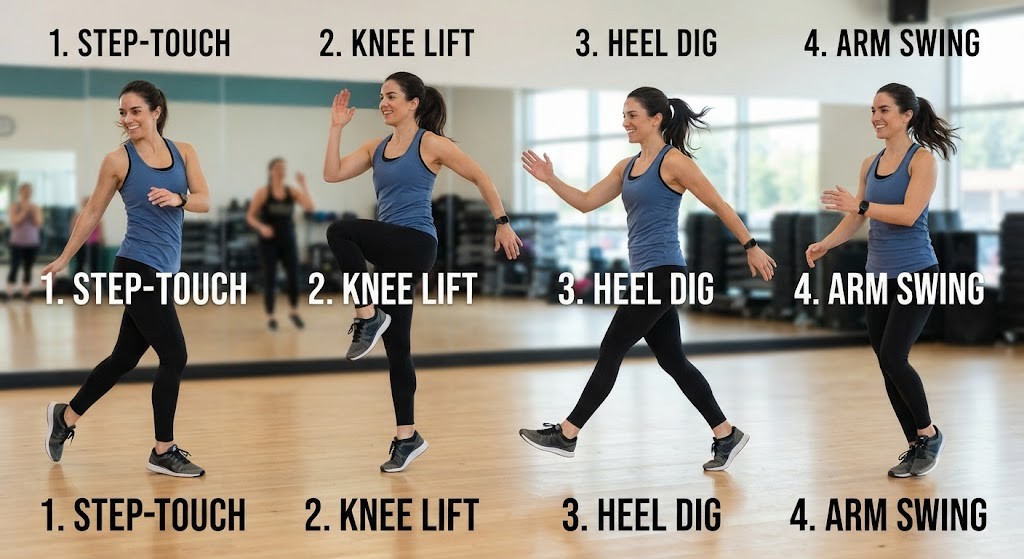
Common retro walking workout exercises include step-touches, side steps, knee lifts, heel digs, arm swings, and controlled changes of direction. These movements can be combined into short sequences that provide variety while remaining accessible to beginners.
Before combining multiple patterns, learn each movement individually. For example, practice four step-touches, four knee lifts, and four heel digs before linking them into one continuous sequence.
Step-Touch and Side-Step Walking
Step-touch and side-step movements add lateral variety without requiring jumping. Step to one side, bring the opposite foot toward it, and then repeat in the opposite direction while keeping your posture upright.
As your coordination improves, add relaxed arm swings. The combination increases movement variety while keeping the exercise relatively simple.
Knee Lifts and Heel Digs
Knee lifts involve raising one knee at a controlled pace while maintaining balance. Heel digs, meanwhile, involve placing one heel forward and then returning it to the starting position.
A simple sequence is to alternate right and left knee lifts for 30 seconds before switching to alternating heel digs.
These movements can complement a broader leg workouts routine because they repeatedly involve the lower body. Keep the movements controlled rather than trying to lift your knee as high as possible.
Arm Swings and Direction Changes
Arm swings add upper-body movement to walking, while direction changes introduce an additional coordination challenge.
For example:
- Walk forward for four counts.
- Perform step-touches for four counts.
- Return to your original position.
- Repeat the sequence at a comfortable pace.
Backward walking requires additional awareness because you cannot see the space behind you. A systematic review found that backward-walking training may improve balance measures, although the researchers described the evidence as preliminary. — Source: [PubMed, 2019]
How Do You Do a Retro Walking Workout at Home?
A beginner retro walking workout at home can be built around five basic elements: warm up, walk, introduce simple step patterns, gradually increase intensity, and cool down.
You do not need specialized equipment. A clear, stable space is usually enough to get started.
Beginner Retro Walking Workout Steps
- Warm up for 2–3 minutes. March gently in place and use relaxed arm swings.
- Walk for 2 minutes. Maintain an easy-to-moderate pace.
- Add step-touches for 1 minute. Alternate sides while maintaining control.
- Perform heel digs for 1 minute. Keep your chest lifted and movements smooth.
- Perform knee lifts for 1 minute. Use a lower knee height if your balance is limited.
- Repeat the walking and movement sequence. Increase your pace slightly if comfortable.
- Cool down for 2–3 minutes. Gradually slow your steps and return to easy movement.
Before starting, use warm-up exercises to prepare for a broader walking routine.
Is Retro Walking a Good Workout for Beginners?
A retro walking workout can be suitable for many beginners when it starts with simple, controlled movements and progresses gradually.
For example, beginners can begin with:
- Marching
- Step-touches
- Heel digs
- Easy forward walking
There is no need to begin with backward walking, rapid direction changes, or complicated choreography.
Most importantly, prioritize control over speed. If a movement causes you to lose balance or makes your technique uncomfortable, reduce the range of motion or return to basic walking.
How Long Should a Retro Walking Workout Last?
A retro walking workout can last 10, 20, or 30 minutes, depending on your fitness level, schedule, and goals.
A 10-minute session can work as a short movement break, while a 20-minute session gives you more time to repeat walking intervals and movement combinations.
CDC guidance emphasizes that adults can spread their weekly physical activity across the week rather than completing it all in one session. — Source: [CDC, 2025]
For a broader plan, combine walking sessions with a structured beginner workout routine.
What Is a Beginner Retro Walking Workout Routine?
A beginner retro walking workout routine uses short intervals of familiar movements so you can develop confidence before increasing intensity.
The following 10-minute retro walking workout focuses on low-impact patterns. Once you are comfortable with the sequence, you can repeat it once or twice.
| Time | Movement | Effort |
|---|---|---|
| 0–2 min | Easy march/walk | Easy |
| 2–3 min | Step-touch | Easy |
| 3–4 min | Brisk walking | Moderate |
| 4–5 min | Heel digs | Easy |
| 5–6 min | Knee lifts | Easy-moderate |
| 6–8 min | Brisk walk + arm swings | Moderate |
| 8–9 min | Step-touch + direction changes | Easy-moderate |
| 9–10 min | Slow walk/cooldown | Easy |
Perform the routine at a pace that allows you to maintain control. If knee lifts feel unstable, for example, replace them with gentle marching.
Try a 20-Minute Retro Walking Workout
A 20-minute retro walking workout provides more sustained movement while keeping each individual exercise manageable.
One simple approach is to complete the 10-minute beginner sequence twice. During the second round, you can slightly increase your walking pace if you feel comfortable.
You can also use simple musical counts to create a nostalgic aerobic feel. Try:
- Four counts of walking
- Four counts of step-touch
- Four counts of heel digs
- Return to regular walking
The goal is to create a smooth rhythm rather than complicated choreography.
How Do You Make a Retro Walking Workout More Challenging?
The safest way to progress a retro walking workout is to gradually increase duration, pace, movement range, or repetitions while maintaining control and balance.
You do not need to immediately introduce jumping or complicated choreography.
Ways to Progress Your Workout
Change just one variable at a time. For example, add five minutes to your workout before increasing the speed of your knee lifts.
Useful progression options include:
- Increasing walking pace
- Extending workout duration
- Adding another movement round
- Increasing arm movement range
- Gradually raising knee lifts
- Combining two or three movements
- Reducing unnecessary rest periods
- Adding gentle resistance after mastering bodyweight patterns
As movement combinations become more complex, posture and core control become increasingly important. Pairing your routine with core and abs workouts can support a more comprehensive fitness program.
What Equipment Do You Need for a Retro Walking Workout?
One advantage of a retro walking workout is that it generally requires no specialized equipment. You can perform it at home or outdoors with supportive footwear, comfortable clothing, adequate space, and a timer or music source.
Choose footwear that feels secure and comfortable for your walking surface. If exercising indoors, use a stable, uncluttered floor rather than a slippery rug.
A timer or playlist can also help structure intervals without requiring additional fitness equipment. If you enjoy exercising at home, explore or more equipment-free ideas.
Optional Retro Walking Workout Equipment
You may also use:
- A phone or interval timer
- A stable exercise mat for cooldown movements
- Light hand weights for experienced users
- A fitness tracker for duration and activity monitoring
Equipment should enhance the workout rather than make the basic movement unnecessarily complicated.
What Should You Know About Safety and Modifications?
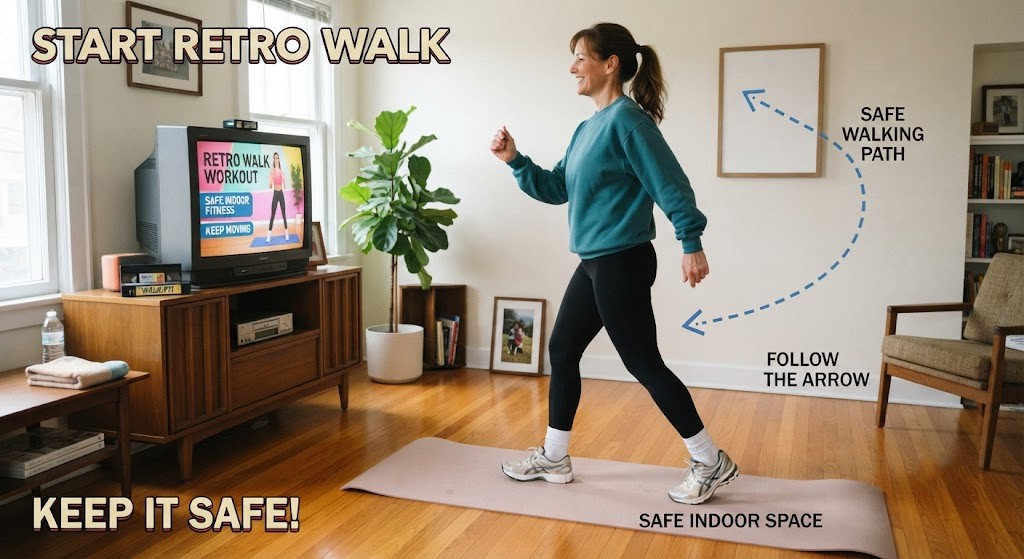
Retro walking safety depends on selecting an appropriate surface, maintaining balance, controlling movement, and progressing gradually. Directional movements require greater spatial awareness than ordinary forward walking, particularly during an indoor session.
Create a Safe Workout Space
Before starting, remove potential obstacles from your workout area.
Check for:
- Furniture in your movement path
- Loose electrical cords
- Slippery mats
- Clutter
- Uneven surfaces
- Objects positioned behind you
This becomes especially important if you plan to include backward movement.
Treat Backward Walking as Optional
Backward walking is not required for a retro walking workout. If you cannot safely see the space behind you, replace backward walking with stationary marching or side steps.
This modification allows you to retain movement variety without adding unnecessary balance or spatial-awareness challenges.
When Should You Reduce Intensity?
Reduce your intensity if you experience unusual pain, dizziness, significant shortness of breath, or loss of balance.
People with medical conditions, significant mobility limitations, or concerns about exercise should seek appropriate guidance from a qualified healthcare or exercise professional. The CDC specifically recommends consulting a healthcare professional or physical activity specialist when needed. — Source: [CDC, 2025]
How Often Should You Do a Retro Walking Workout?
A retro walking workout can be performed several times per week as part of a balanced activity routine when your body tolerates the workload. The appropriate frequency depends on your current activity level, workout intensity, recovery, and other forms of exercise you perform.
A Simple Beginner Schedule
Beginners can start with two or three short sessions per week and gradually add time as the routine becomes comfortable.
For example:
| Day | Suggested Activity |
|---|---|
| Monday | 10–20 minute retro walking workout |
| Wednesday | 10–20 minute retro walking workout |
| Saturday | 10–20 minute retro walking workout |
As your fitness and comfort improve, you can gradually increase the duration or movement variety.
The broader goal for adults is at least 150 minutes of moderate-intensity physical activity per week, alongside muscle-strengthening activities on two or more days. — Source: [WHO, 2024]
For additional movement ideas, explore cardio workouts.
How Can You Build a Retro Walking Workout Routine?
Building a sustainable retro walking workout routine starts with manageable sessions, consistent scheduling, and gradual progression.
Rather than trying to make every workout longer or harder, focus on creating a routine you can realistically repeat.
1. Choose Your Starting Duration
Begin with 10–20 minutes if you are new to structured exercise. The goal is to establish consistency before worrying about advanced movements.
2. Schedule Consistent Sessions
Choose two or three days that fit naturally into your existing routine.
A realistic schedule is easier to maintain than an ambitious plan that constantly conflicts with your daily responsibilities.
3. Track One Progression Metric
Choose one simple measurement, such as:
- Minutes completed
- Number of rounds
- Walking pace
- Perceived effort
Tracking one metric makes progress easier to recognize without making the workout feel overly complicated.
4. Add Complementary Exercise
Walking can be part of a broader fitness routine. Add strength, mobility, or recovery sessions during the week to create more variety.
At the same time, recovery matters when you increase activity. Use workout recovery for practical strategies that support a balanced routine.
5. Turn It Into a Personal Challenge
If you enjoy structured goals, a simple workout challenges approach can encourage consistency without requiring every workout to become more intense.
The objective is sustainable progress, not maximum difficulty.
Conclusion: Make Walking More Fun With a Retro-Inspired Routine
A retro walking workout combines familiar walking patterns with rhythmic steps, directional changes, arm movements, and nostalgic fitness-inspired exercises. This format can make an ordinary walking session feel more varied while remaining adaptable to different fitness levels.
For beginners, the best approach is to start with simple movements such as marching, step-touches, heel digs, and controlled knee lifts. From there, you can gradually increase your workout duration, pace, movement range, or number of rounds.
Most importantly, consistency matters more than complexity. A 10-minute session is a practical place to begin. As you become more comfortable, progress toward 20 or 30 minutes and complement your walking sessions with strength and mobility training.
Retro walking does not need to be complicated to make movement more enjoyable. Put on your favorite upbeat playlist, clear a safe space, and turn your next walking session into a fun, rhythmic workout.
FAQs
What is a retro walking workout?
A retro walking workout combines walking with rhythmic steps, side movements, knee lifts, heel digs, and arm movements.
Is retro walking good for beginners?
Yes, retro walking is beginner-friendly and can be adjusted to different fitness levels.
Can retro walking be a low-impact workout?
Yes, it can be low impact when you avoid jumping and keep at least one foot on the floor.
How long should a retro walking workout be?
A retro walking workout can last 10, 20, or 30 minutes depending on your fitness level.
Can I do retro walking at home?
Yes, you can do retro walking at home with comfortable footwear and a clear workout space.
What exercises are included in retro walking?
Common exercises include marching, step-touches, side steps, knee lifts, heel digs, and arm swings.
Does retro walking count as cardio?
Yes, retro walking can provide cardio activity when performed continuously at a brisk pace.
Is backward walking necessary for retro walking?
No, backward walking is optional and can be replaced with marching or side steps.
How often should I do a retro walking workout?
Beginners can start with two or three sessions per week and gradually increase activity.
Can retro walking make exercise more enjoyable?
Yes, rhythmic movements and upbeat music can make walking more fun and engaging.
What is the 3-3-3 rule for walking?
The 3-3-3 rule is not a universal walking guideline and may vary depending on the program.
How long does it take to retro walk?
A retro walking workout can take 10, 20, or 30 minutes depending on the routine.
What is the 6-6-6 rule for walking?
The 6-6-6 rule is not a universally standardized walking guideline and may vary by program.
Does retro walking burn more calories?
Retro walking may burn more calories when you increase your pace, movement range, or workout intensity.
1 thought on “Retro Walking Workout: A Fun Low-Impact Cardio Routine for All Levels”