
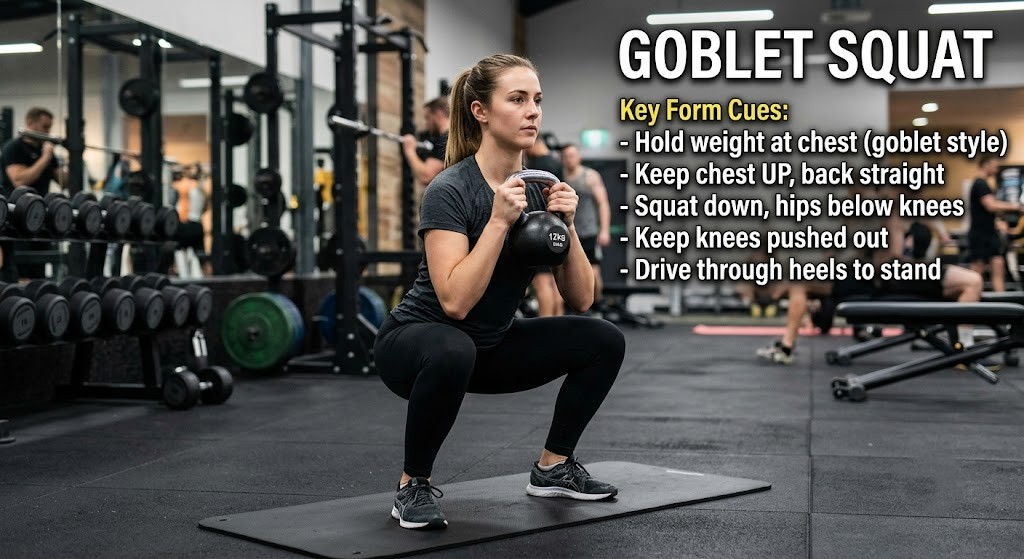
You’ve probably tried squats to strengthen your legs and glutes, but adding a dumbbell can make this classic exercise more challenging. The goblet squat exercise is a beginner-friendly strength-training movement that helps develop your quadriceps, glutes, and core while allowing you to practice controlled squat mechanics.
However, using too much weight or performing the movement with poor technique can make goblet squats harder to execute correctly. Learning proper form, choosing an appropriate dumbbell weight, and understanding how to progress can help you get more out of every repetition.
In this guide, you’ll learn how to perform the goblet squat exercise step by step, which muscles it works, its main benefits, the best sets and repetitions for beginners, common mistakes to avoid, and variations to include in your lower-body workout.
What Is the Goblet Squat Exercise and How Does It Work?
The goblet squat is a lower-body strength exercise in which you hold a dumbbell or kettlebell close to your chest while lowering your body into a squat and returning to standing. It primarily targets the quadriceps and glutes while engaging the core and other stabilizing muscles.
Unlike a bodyweight squat, the goblet squat uses external resistance to increase the exercise’s difficulty. Holding the weight in front of your chest also provides a useful reference point for practicing balance and maintaining a controlled torso position.
For example, beginners can hold a light dumbbell vertically against their chest while learning to squat with their feet firmly planted on the floor. As their technique and strength improve, they can gradually increase the resistance.
Why Are Goblet Squats Important?
Goblet squats help develop lower-body strength, reinforce squat technique, and provide a convenient way to train with external resistance. They are suitable for beginners learning fundamental movement patterns and intermediate exercisers looking for an additional leg exercise.
Holding a weight in front of your body encourages you to coordinate your hips, knees, and torso throughout the movement. It also challenges your ability to maintain balance and control while working against resistance.
Goblet squats can be useful for:
- Learning proper squat mechanics before progressing to more demanding variations.
- Strengthening the quadriceps and gluteal muscles.
- Practicing controlled movement through a comfortable range of motion.
- Developing trunk stability during lower-body exercises.
- Adding resistance to home workouts without requiring a barbell or squat rack.
What Are the Main Goblet Squat Benefits?
The main goblet squat benefits include improved lower-body strength, quadriceps and glute training, core engagement, and convenient exercise progression.
1. Builds lower-body strength
Goblet squats challenge the muscles responsible for bending and extending your hips and knees. With consistent training and gradually increasing resistance, they can contribute to stronger legs.
2. Strengthens the quadriceps
The quadriceps are the muscles at the front of your thighs. They work to extend your knees as you rise from the bottom of the squat.
3. Trains the glutes
Your gluteal muscles contribute to hip extension and help you return to a standing position. Goblet squats can support glute development when performed with sufficient resistance and appropriate training volume.
4. Engages the core
Your abdominal and other trunk muscles work to stabilize your torso while you hold the weight and move through the squat. This makes core control an important part of proper technique.
5. Helps you practice squat mechanics
Holding the weight close to your chest can help you focus on balance, foot placement, and controlled movement. This makes the goblet squat a practical exercise for learning and refining the squat pattern.
6. Makes home strength training convenient
You need only a suitable dumbbell or kettlebell and enough clear space to perform the movement. You can also practice the squat pattern without external resistance before introducing a weight.
Goblet squats can complement the best dumbbell leg exercises in a balanced lower-body program. However, no single exercise guarantees injury prevention or improved mobility. Your results depend on technique, training consistency, recovery, and individual needs.
What Muscles Do Goblet Squats Work?
Goblet squats primarily work the quadriceps and gluteus maximus while engaging the adductors, hamstrings, core muscles, and spinal stabilizers. These muscle groups work together to control your descent, maintain balance, and return your body to standing.
| Muscle group | Main role during the goblet squat |
|---|---|
| Quadriceps | Extend the knees as you stand up |
| Gluteus maximus | Helps extend the hips and supports the standing phase |
| Adductors | Assist hip movement and stabilization |
| Hamstrings | Contribute to hip control and stabilization |
| Core muscles | Help stabilize the trunk |
| Spinal stabilizers | Help maintain a controlled torso position |
Are Goblet Squats Effective for Building Glutes and Quads?
Yes, goblet squats can help build stronger quadriceps and glutes when performed consistently with resistance that challenges your muscles. The results depend on factors such as training volume, progressive overload, nutrition, recovery, and your starting fitness level.
For example, a beginner might perform three sets of ten repetitions with a light dumbbell. Once those repetitions become manageable without compromising technique, the beginner can gradually increase the resistance.
For more comprehensive lower-body development, combine goblet squats with the Best Glute Workout for Muscle Growth
Although goblet squats are useful for strengthening your legs, they do not replace every exercise required for a balanced lower-body program. Combining different movement patterns allows you to train additional muscles and work toward broader fitness goals.
How Do You Perform a Goblet Squat With Proper Form?
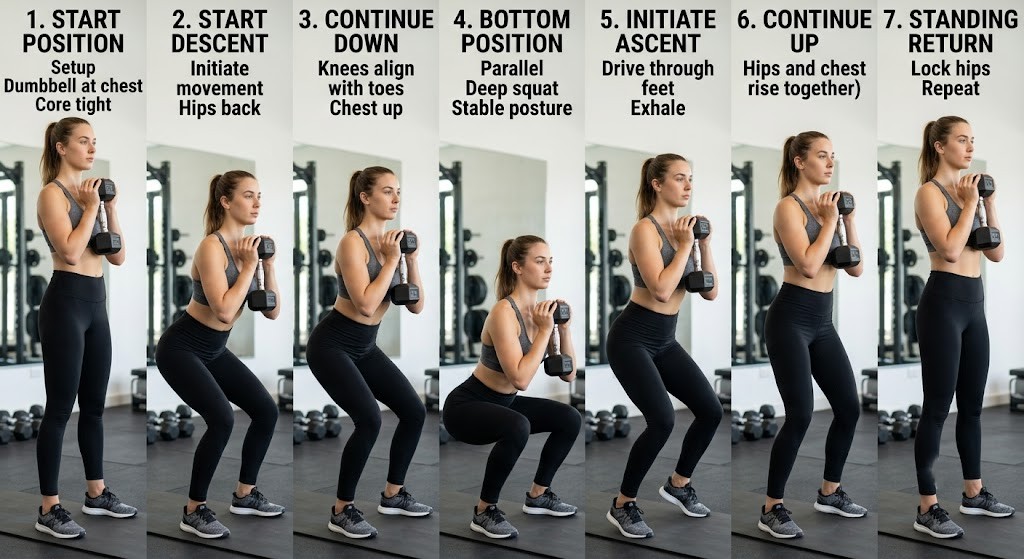
Proper goblet squat form involves holding the weight securely against your chest, keeping your feet stable, allowing your knees to track in the direction of your toes, and controlling both the descent and ascent.
Follow these steps to learn the movement.
Step-by-Step Goblet Squat Instructions
Step 1: Choose a manageable weight
Start with a light dumbbell or kettlebell that you can hold securely throughout the exercise. If you’re unfamiliar with squats, practice the movement using only your body weight first.
Step 2: Hold the weight close to your chest
Hold a dumbbell vertically with both hands around one end, or grip a kettlebell securely by its handles. Keep the weight close to your chest rather than allowing it to drift forward.
Step 3: Set your stance
Stand with your feet approximately shoulder-width apart. Turn your toes outward slightly if that feels comfortable for your hips and ankles.
Step 4: Brace your core
Gently tighten your abdominal muscles and maintain a natural spinal position. Keep your chest comfortably lifted without exaggerating the arch in your lower back.
Step 5: Lower into the squat
Bend your hips and knees to lower your body. Keep your feet firmly planted and guide your knees in the direction of your toes.
Step 6: Control your squat depth
Descend only as far as you can maintain balance, a comfortable range of motion, and consistent technique. Avoid forcing yourself into a deeper position if doing so causes your heels to lift or your posture to deteriorate.
Step 7: Return to standing
Push through your feet and extend your hips and knees to stand up. Keep the weight close to your chest and avoid forcefully locking your knees at the top.
What Should Proper Goblet Squat Form Feel Like?
During a well-controlled goblet squat, you should feel your thighs and glutes working as you lower and rise. Your trunk should remain stable, and your feet should maintain contact with the floor.
Imagine lowering yourself between your feet while keeping the dumbbell close to your chest. This cue can help you avoid excessive forward leaning or allowing the weight to drift away from your body.
Your knees do not have to remain directly above your ankles throughout the movement. Instead, allow them to move naturally in the direction of your toes while maintaining control and a comfortable position.
If you cannot complete the movement without losing balance, reduce the weight or squat to a shallower depth until you can maintain consistent technique.
How Deep Should You Go During a Goblet Squat?
The ideal goblet squat depth is the deepest position you can reach while maintaining balance, control, and a comfortable range of motion. Your appropriate depth depends on your anatomy, ankle mobility, hip structure, and training experience.
For example, you might initially lower your body until your thighs approach parallel with the floor. As your movement control improves, you can gradually explore a deeper squat if it remains comfortable.
You do not need to force your hips below your knees to make every repetition effective. The priority is maintaining stable feet, controlled movement, and a consistent torso position.
If limited mobility affects your squat, try strength-training
What Is the Best Goblet Squat Weight for Beginners?
The best goblet squat weight for beginners is a resistance level that allows you to complete controlled repetitions without compromising your technique. There is no single ideal dumbbell weight because individual strength, coordination, and training experience vary.
Start by practicing the squat without a weight. Once you can lower and rise comfortably, introduce a light dumbbell or kettlebell and assess whether you can maintain balance and posture throughout the set.
Use these guidelines to evaluate your starting weight:
- Too light: You can complete the repetitions easily, with little muscular challenge.
- Appropriate: The final repetitions feel challenging, but your posture and movement remain controlled.
- Too heavy: You struggle to hold the weight, lose balance, or cannot maintain consistent technique.
For example, if a dumbbell makes you rush through repetitions, round your back, or lift your heels, choose a lighter weight.
Increase the resistance gradually when your current load feels manageable. Your goal is to challenge your muscles while keeping every repetition controlled, not to lift the heaviest dumbbell available.
How Many Sets and Reps of Goblet Squats Should You Do?
Beginners can start with 2–3 sets of 8–12 goblet squat repetitions, adjusting the resistance and training volume to their fitness level and goals. This range provides an accessible starting point for practicing the movement while developing lower-body strength.
Your ideal sets and repetitions depend on whether you’re learning the technique, building general fitness, or progressing toward more demanding strength work.
| Training goal | Suggested starting approach |
|---|---|
| Learning the technique | 1–2 sets of 8–10 repetitions with body weight or a light load |
| General strength and fitness | 2–3 sets of 8–12 repetitions |
| Building muscular strength | Gradually increase resistance while maintaining controlled repetitions |
| Improving movement control | Use lighter resistance and slower repetitions |
Rest for approximately 60–120 seconds between sets, extending the interval if you need additional recovery.
For example, a beginner performing three sets of ten repetitions can rest for 90 seconds between sets. If breathing, grip, or movement quality has not recovered sufficiently, take more time before starting the next set.
What Is Progressive Overload in Goblet Squat Training?
Progressive overload means gradually increasing the challenge placed on your muscles as your ability improves. With goblet squats, you can do this by increasing resistance, adding repetitions, increasing sets when appropriate, or improving movement control.
For example, if you currently perform three sets of eight repetitions with good technique, you might gradually work toward three sets of twelve. Once that workload becomes manageable, you can consider increasing the dumbbell weight and returning to a lower repetition count.
Learn more about progressive overload.
How Often Should You Do Goblet Squats?
Most beginners can practice goblet squats approximately 1–3 times per week, depending on their total workout volume, experience, and recovery.
For example, you might perform goblet squats twice weekly, leaving at least a day between demanding lower-body sessions. Adjust your schedule if your legs remain unusually sore or your movement technique deteriorates.
Consistency is important, but performing more sessions is not automatically better. Allow sufficient recovery so you can maintain good technique and gradually progress.
What Are the Most Common Goblet Squat Mistakes?
The most common goblet squat mistakes include lifting the heels, allowing the knees to collapse inward, rounding the back, holding the weight too far forward, and using excessive resistance. Recognizing these issues can help you improve movement control and perform the exercise more consistently.
| Common mistake | Why it matters | How to fix it |
|---|---|---|
| Heels lifting off the floor | Reduces stable foot contact | Reduce squat depth and work within a comfortable range |
| Knees collapsing inward | Makes knee tracking less controlled | Guide the knees in the direction of the toes |
| Rounding the back | Indicates a loss of the intended torso position | Reduce the load and brace your core |
| Weight held too far forward | Can increase forward leaning | Keep the dumbbell close to your chest |
| Excessive resistance | Can compromise movement quality | Choose a lighter weight |
| Rushing repetitions | Reduces control and consistency | Lower slowly and stand up smoothly |
| Forcing excessive depth | May cause balance or posture problems | Stop at a comfortable depth you can control |
How Can You Correct Poor Goblet Squat Technique?
Start by identifying the specific problem rather than changing everything at once.
If your heels rise, reduce your squat depth and focus on maintaining contact between your feet and the floor. If your knees move inward, use a lighter load and practice guiding them in the direction of your toes.
If your back rounds or you struggle to hold the dumbbell close to your body, reduce the resistance and concentrate on bracing your trunk. You can also record a front-view or side-view video to review your positioning.
Most importantly, avoid forcing deeper squats or heavier loads when your current technique is inconsistent. If you experience sharp pain, stop the exercise rather than attempting to correct the movement by pushing through it.
What Are the Best Goblet Squat Variations for Beginners?
Goblet squat variations change the exercise’s difficulty, equipment requirements, or movement demands to suit different fitness levels and training goals. Start with a version you can perform confidently, then progress when your technique remains consistent.
1. Bodyweight Squat
The bodyweight squat uses no external resistance and helps you learn the basic movement pattern.
Practice controlling your descent, keeping your feet stable, and returning to standing smoothly. Once the movement feels comfortable, you can introduce a light dumbbell.
2. Box or Bench Goblet Squat
The box or bench goblet squat uses a stable surface as a reference for squat depth.
Lower yourself until you lightly touch the surface, then stand without dropping your body onto it. Choose a suitable height that allows you to maintain balance and control.
This variation can help beginners practice consistent depth without guessing how far to descend.
3. Kettlebell Goblet Squat
The kettlebell goblet squat follows the same basic movement as the dumbbell version but uses a kettlebell.
Hold the kettlebell securely by its handles and keep it close to your chest. Choose a weight that allows you to complete the planned repetitions without losing posture or balance.
4. Tempo Goblet Squat
The tempo goblet squat uses a slower descent to emphasize movement control.
For example, lower your body over three seconds before standing smoothly. Avoid bouncing at the bottom or using a load that makes the slower movement difficult to control.
5. Pause Goblet Squat
The pause goblet squat includes a brief, controlled pause at the bottom of the movement.
Lower yourself to a comfortable depth, pause briefly, and return to standing. Start with a light weight and maintain trunk tension throughout the pause.
6. Heavier Goblet Squat
The heavier goblet squat increases resistance to challenge lower-body strength.
Progress to a heavier dumbbell or kettlebell only when your current weight feels manageable and you can maintain a secure grip, stable posture, and consistent squat depth.
If the heavier load causes you to rush, lose balance, or compromise your technique, return to a more manageable resistance.
Can You Do Goblet Squats at Home With a Dumbbell?
Yes, you can perform goblet squats at home using a dumbbell, a suitable kettlebell, or body weight while learning the movement. You do not need a full gym to begin developing lower-body strength.
Choose a clear, nonslip surface and check that your equipment is secure. A stable bench or box is optional if you want a consistent depth reference.
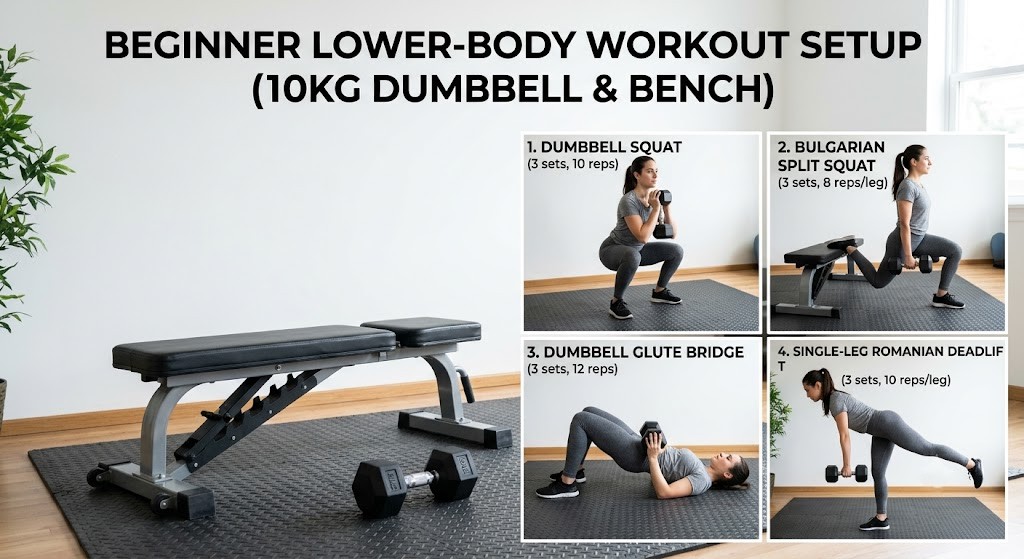
For a balanced home workout, combine goblet squats with exercises such as glute bridges, reverse lunges, and calf raises. These movements train different aspects of lower-body strength.
If you’re new to dumbbell training, start with Full Body Dumbbell Exercises.
Sample Beginner Lower-Body Workout
The following routine combines goblet squats with three additional exercises. You can perform it two or three times per week if your overall program and recovery allow it.
| Exercise | Sets | Repetitions |
|---|---|---|
| Goblet squat | 2–3 | 8–12 |
| Glute bridge | 2–3 | 10–15 |
| Reverse lunge | 2 | 8–10 per leg |
| Standing calf raise | 2–3 | 12–15 |
Before the workout: Warm up for 5–10 minutes with easy walking, comfortable bodyweight squats, and gentle leg movements.
During the workout: Begin with goblet squats because they require coordination and controlled technique. Rest approximately 60–120 seconds between sets, adjusting the interval to your needs.
After the workout: Complete the remaining exercises with controlled repetitions and suitable resistance. You can review the calf workout to learn the other movements.
How Can You Make Goblet Squats More Challenging?
You can make goblet squats more challenging by increasing resistance, adding repetitions, slowing the descent, or introducing controlled pauses. Choose a progression that increases the training challenge without sacrificing movement quality.
Try these methods as your strength improves:
- Increase repetitions: Gradually add repetitions within your chosen range while maintaining proper form.
- Increase resistance: Move to the next available dumbbell weight when the current load becomes manageable.
- Slow the descent: Take more time to lower your body while maintaining balance and control.
- Add a pause: Briefly pause at the bottom of the squat without relaxing your trunk.
- Add a set: Increase your total training volume when your current workload and recovery allow it.
For example, if you can complete three sets of twelve repetitions with stable posture and the final repetitions remain manageable, consider increasing the weight slightly.
You may need to return to a lower repetition count after increasing resistance. Build your repetitions back up gradually rather than trying to increase weight and volume too quickly.
Should You Do Goblet Squats Before or After Other Leg Exercises?
Goblet squats generally belong near the beginning of a workout when improving squat technique or lower-body strength is a priority. Performing them while relatively fresh can make it easier to maintain consistent movement quality.
For example, you could organize your workout in this order:
- Goblet squats
- Reverse lunges
- Glute bridges
- Standing calf raises
This sequence places the squat first, followed by other lower-body exercises.
However, the best order depends on your goals. If goblet squats are being used as a light warm-up rather than your main strength exercise, their placement can be more flexible.
Whichever order you choose, begin with an appropriate warm-up and avoid using a heavy load before you are ready to perform the movement with control.
What Is the Difference Between a Goblet Squat and a Regular Squat?
A goblet squat involves holding a weight in front of your chest, while a traditional bodyweight squat uses no external resistance. Both exercises train the lower body, but they differ in loading method and how you adjust their difficulty.
| Feature | Goblet squat | Bodyweight squat |
|---|---|---|
| Equipment | Dumbbell or kettlebell | None |
| External resistance | Yes | No |
| Difficulty adjustment | Change the weight or repetitions | Change repetitions, tempo, or variation |
| Beginner suitability | Suitable with a manageable load | Useful for learning basic technique |
| Main muscles | Quadriceps, glutes, and stabilizers | Quadriceps, glutes, and stabilizers |
| Common use | Loaded lower-body training | Movement practice and bodyweight training |
A beginner may learn the squat pattern using body weight before progressing to a goblet squat. Someone who already squats confidently may use goblet squats as an accessory exercise alongside other lower-body movements.
The two exercises can also complement each other. Bodyweight squats provide a way to practice the movement without equipment, while goblet squats allow you to introduce external resistance.
How Can You Improve Your Goblet Squat?
Improving your goblet squat requires consistent practice, gradual progression, and attention to technique. Focus on making each repetition controlled before increasing resistance or attempting a more challenging variation.
Follow these steps to build a solid foundation:
- Practice bodyweight squats to establish a comfortable movement pattern.
- Select a light dumbbell or kettlebell and hold it close to your chest.
- Perform two or three sets of controlled repetitions.
- Record a front-view or side-view video to review your technique.
- Increase resistance gradually when your current load feels manageable.
- Allow enough recovery between demanding lower-body sessions.
- Stop if you experience sharp pain and seek qualified professional guidance for persistent pain or significant movement limitations.
Also, use a comfortable range of motion instead of forcing yourself into a deeper squat. Consistent, well-controlled repetitions provide a better foundation for progression than lifting excessive weight with poor technique.
Conclusion: Build Stronger Legs With the Goblet Squat Exercise
The goblet squat exercise is a practical way to strengthen your quadriceps, glutes, and supporting muscles while practicing controlled squat mechanics. Its simple equipment requirements make it suitable for home workouts, beginner strength programs, and gym-based lower-body training.
To get started, choose a manageable dumbbell or kettlebell, keep your feet stable, guide your knees in the direction of your toes, and lower your body only as far as you can control comfortably. Begin with 2–3 sets of 8–12 repetitions and adjust your training according to your ability and recovery.
As your strength improves, gradually increase resistance, repetitions, or movement control. You can also combine goblet squats with lunges, glute bridges, and calf raises to create a more balanced lower-body routine.
Remember, proper form and consistent training matter more than lifting the heaviest dumbbell available. Start at your current ability level, practice patiently, and build stronger legs one controlled repetition at a time.
FAQs
What is the goblet squat exercise?
A goblet squat is a lower-body exercise performed while holding a dumbbell or kettlebell close to your chest.
What muscles do goblet squats work?
They primarily target the quadriceps and glutes while engaging the core and stabilizing muscles.
Are goblet squats good for beginners?
Yes, they help beginners learn proper squat technique while building lower-body strength.
How many goblet squats should a beginner do?
Start with 2–3 sets of 8–12 repetitions using a manageable weight.
What is the best weight for goblet squats?
Choose a weight that challenges your muscles without compromising your form.
Are goblet squats effective for building glutes?
Yes, they can strengthen and develop the glutes when combined with consistent training and progressive overload.
Are goblet squats better than bodyweight squats?
Goblet squats add resistance, while bodyweight squats help beginners practice without equipment.
How deep should you go in a goblet squat?
Squat as deeply as you comfortably can while maintaining balance and proper form.
How often should you do goblet squats?
Beginners can perform them 1–3 times per week, depending on their training schedule and recovery.
Can you do goblet squats every day?
You can, but regular recovery between challenging lower-body sessions is important.
What are the most common goblet squat mistakes?
Common mistakes include lifting the heels, letting the knees collapse inward, and using excessive weight.
Can you do goblet squats at home?
Yes, you need only a dumbbell or kettlebell and enough space to exercise.
Do goblet squats work your abs?
Yes, they engage your core muscles to help stabilize your torso during the movement.
How can you make goblet squats harder?
Increase the weight, add repetitions, slow the descent, or include a controlled pause.
Should you do goblet squats before or after lunges?
Do goblet squats first if improving squat strength and technique is your priority.
What are goblet squats good for?
They help strengthen your legs and glutes, engage your core, and improve squat technique.
What is the queen of all exercises?
There is no official queen of exercises. Squats are often called the king of exercises because they engage multiple muscle groups.
How heavy should I goblet squat?
Start with a light weight that allows controlled repetitions, then gradually increase resistance as your strength improves.
Why is it called a goblet squat?
The name comes from holding the dumbbell or kettlebell in front of your chest like a drinking goblet.