
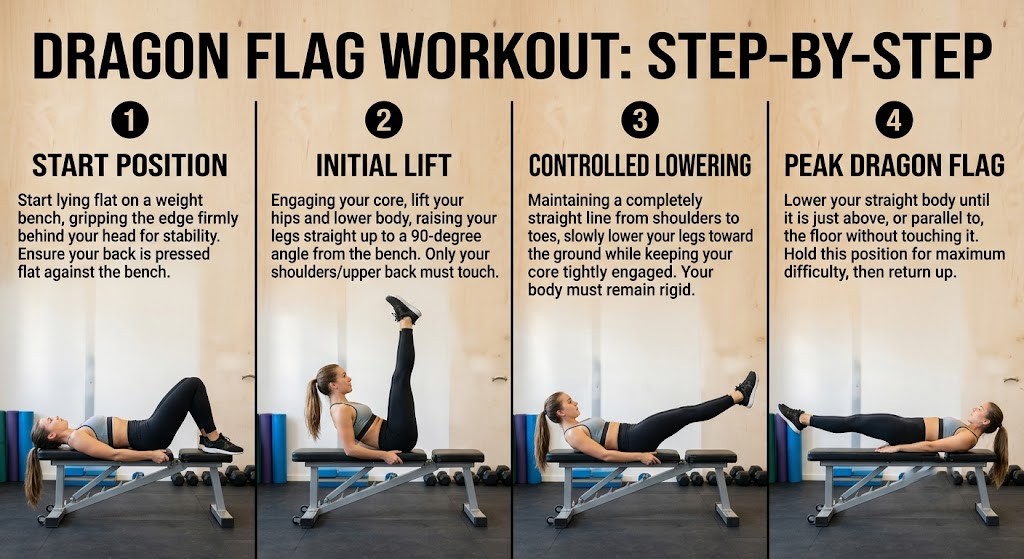
You’ve probably tried crunches, planks, and leg raises to strengthen your abs. But if you’re ready for a more demanding challenge, the dragon flag workout takes core training to another level by requiring you to control almost your entire body against gravity.
Popular in advanced calisthenics and associated with martial artist Bruce Lee, the dragon flag is an impressive bodyweight exercise that challenges abdominal strength, trunk stability, and full-body control. However, performing it correctly requires more than simply lifting your legs.
In this guide, you’ll learn how to perform the dragon flag with proper form, which muscles it works, how beginners can progress toward their first full repetition, common mistakes to avoid, and how to include the exercise in a practical core workout.
What Is the Dragon Flag Workout?
The dragon flag is an advanced bodyweight core exercise in which your torso and legs move together while your upper back provides the main support point. Your body remains relatively straight as you lift and lower yourself under control.
The exercise is widely associated with Bruce Lee and is popular among calisthenics athletes and people who train for advanced abdominal strength.
Unlike traditional crunches, which involve curling your torso, dragon flags require you to maintain a rigid body position while resisting the pull of gravity. This places substantial demands on your abdominal muscles and your ability to control your pelvis and spine.
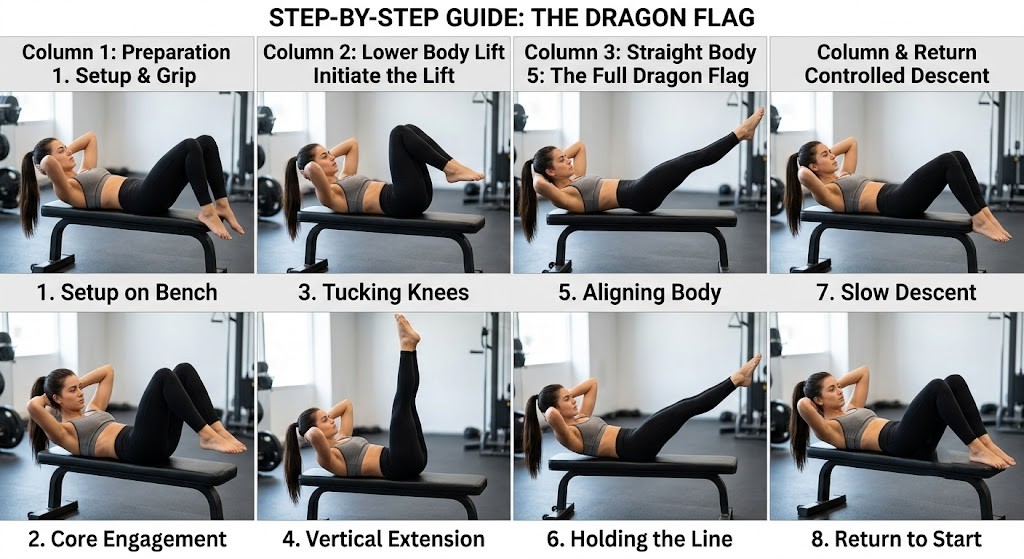
A successful dragon flag depends on three essential elements:
- Core bracing: Keep your abdominal muscles engaged throughout the movement.
- Body alignment: Maintain a relatively straight line from your shoulders toward your feet.
- Controlled movement: Avoid swinging your legs or allowing your lower back to arch excessively.
Because the exercise is demanding, beginners should develop foundational core strength before attempting the full version.
Why Does the Dragon Flag Exercise Matter?
The dragon flag exercise develops abdominal strength, trunk stability, and whole-body control through a challenging bodyweight movement. It can also help experienced trainees improve their ability to maintain a rigid torso during advanced calisthenics exercises.
For example, if you already perform planks, hollow-body holds, and leg raises with good technique, dragon flag progressions can introduce a greater challenge to your core training.
The exercise may be particularly useful for people who want to:
- Develop stronger abdominal muscles.
- Improve control over their torso and pelvis.
- Progress toward advanced calisthenics movements.
- Build confidence with challenging bodyweight exercises.
- Add variety to an established abdominal workout.
For additional preparation, explore our best core exercises for stronger abs.
However, dragon flags are not essential for building strong abs. Consistent core training, appropriate resistance, nutrition, and recovery remain important for developing abdominal strength. Visible abdominal definition also depends on overall body composition and genetics.
What Muscles Do Dragon Flags Work?
Dragon flags primarily challenge the rectus abdominis, the muscle group responsible for much of the visible six-pack appearance. The obliques, transverse abdominis, hip flexors, and supporting muscles also contribute to controlling the movement.
Rather than isolating a single muscle, the dragon flag requires multiple muscle groups to coordinate throughout each repetition.
| Muscle group | Main role during dragon flags |
|---|---|
| Rectus abdominis | Helps control the torso and resist spinal extension |
| Obliques | Support trunk stability and resist unwanted rotation |
| Transverse abdominis | Contributes to abdominal bracing |
| Hip flexors | Assist with controlling the legs and hip position |
| Latissimus dorsi | Helps stabilize the upper body through the support point |
| Glutes | Help maintain body alignment |
Additionally, your shoulders, upper back, and arms help stabilize your position by gripping the bench. Your abdominal muscles perform much of the demanding trunk-control work, while the supporting muscles help you maintain the correct position.
Do Dragon Flags Work the Lower Abs?
Dragon flags challenge the abdominal muscles as a coordinated unit rather than isolating the lower abs. Controlling your pelvis and resisting excessive spinal extension places significant demands on your core.
Although you may feel the exercise more strongly in certain areas, this does not mean that it exclusively targets those muscles. Your technique, body position, and current strength influence how the exercise feels.
For related training, see best lower ab exercises and Copenhagen Plank.
How Do You Do a Dragon Flag With Proper Form?
A proper dragon flag involves lifting your body into a controlled position and lowering it slowly without excessive lower-back arching. Because this is an advanced movement, practice an easier variation first if you cannot maintain your body alignment.
Step 1: Set Up on a Stable Bench
Lie on a sturdy, padded bench with your head near one end. Grip the bench securely behind your head so that your upper body has a stable support point.
Before starting, check that the bench cannot tip, slide, or move during the exercise. Your grip should remain secure throughout the movement.
Step 2: Brace Your Core
Tighten your abdominal muscles before lifting your body. Gently tuck your pelvis to help reduce excessive arching in your lower back.
Keep your shoulders and upper back supported while preparing to lift. Avoid holding your breath for the entire repetition; maintain controlled breathing while keeping your torso stable.
Step 3: Lift Your Body
Lift your hips and legs while maintaining a relatively straight line from your shoulders toward your feet. Keep your core engaged and avoid swinging your legs to generate momentum.
Your body should move as a controlled unit rather than folding sharply at the hips. If you cannot lift into position without losing alignment, switch to a more manageable progression.
Step 4: Lower Yourself Slowly
Lower your body under control while keeping your abdominal muscles braced. Resist the urge to let gravity pull your legs down quickly.
Stop the descent when you can no longer maintain your alignment. Return to the starting position safely rather than forcing additional range of motion.
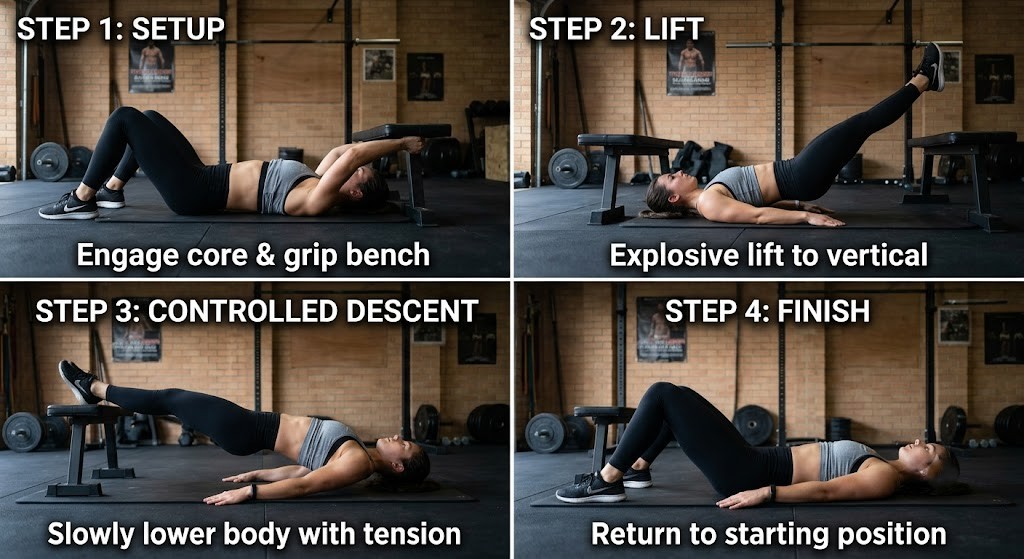
Technique tip: Prioritize control over range of motion. Dragon flag negatives can help you practice the lowering phase, but only use them when you can maintain alignment without pain or uncontrolled movement.
How Can Beginners Progress to a Full Dragon Flag?
A dragon flag progression takes you from foundational core exercises to tucked positions, controlled negative repetitions, partial repetitions, and eventually the full exercise.
The time required depends on your starting strength, technique, consistency, and recovery. Instead of following a fixed timeline, move to a harder variation when you can perform your current one with consistent control.
| Progression | How to perform it | Main purpose |
|---|---|---|
| Reverse crunch | Curl your pelvis toward your chest | Develop basic abdominal control |
| Lying leg raise | Lift and lower your legs while controlling your pelvis | Build abdominal strength and pelvic control |
| Tuck dragon flag hold | Keep your knees bent and maintain a compact body position | Learn bracing and body control |
| Bent-knee dragon flag | Perform a controlled movement with bent knees | Reduce the leverage challenge |
| Negative dragon flag | Lower from the elevated position slowly | Build eccentric strength |
| Partial-range dragon flag | Work through a manageable range | Develop control gradually |
| Full dragon flag | Lower and raise your aligned body under control | Apply advanced core strength |
Which Exercises Help You Prepare for Dragon Flags?
Several core exercises can help you develop the strength and control required for a dragon flag workout.
1. Reverse crunches
Reverse crunches teach you to control your pelvis while curling your hips toward your chest. Begin with slow repetitions instead of using momentum to lift your legs.
Practice the reverse crunch exercise to build a foundation for more advanced abdominal movements.
2. Hollow-body holds
Hollow-body holds teach you to maintain abdominal tension while keeping your torso stable. Focus on controlling your lower back rather than simply holding the position for as long as possible.
Follow the Vacuum Exercise for Core to learn the movement.
3. Planks
Planks help develop trunk stability and the ability to maintain a braced position. They are useful for beginners who need to improve core endurance before attempting more demanding exercises.
Explore plank exercises for core stability for additional options.
4. Lying leg raises
Lying leg raises help you practice controlling your legs and pelvis while maintaining abdominal tension. Start with a manageable range and avoid allowing your lower back to arch excessively.
5. Hanging leg raises
Once you have access to a suitable bar and sufficient control, hanging leg raises can add another challenge to your abdominal training.
6. Beginner bodyweight exercises
A balanced bodyweight routine can help you build general strength and movement control before progressing to advanced calisthenics.
Remember, the safest progression is the hardest variation you can perform with consistent control, not the most advanced exercise you can attempt.
What Are the Most Common Dragon Flag Mistakes?
Dragon flag mistakes often occur when people attempt the full movement before developing enough strength or control. Excessive lower-back arching, momentum, and uncontrolled lowering can compromise technique.
Avoid these common errors during your dragon flag workout.
1. Arching Your Lower Back
Allowing your lower back to arch excessively can indicate that the chosen variation or range of motion is too difficult.
How to correct it: Reduce your range of motion, brace your abdominal muscles, and maintain a controlled pelvic position. Switch to a tucked variation if necessary.
2. Using Momentum
Swinging your legs can make the movement appear easier, but it reduces your ability to control the exercise deliberately.
How to correct it: Move slowly and avoid kicking your legs to lift your body. Choose a progression that allows you to perform the movement without swinging.
3. Bending at the Hips
Folding sharply at the hips can make it difficult to maintain the intended body position.
How to correct it: Keep your torso and legs aligned as much as your current strength allows. If you cannot maintain this position, bend your knees deliberately as part of an easier progression.
4. Dropping Too Quickly
Lowering your body without control removes much of the challenge and may place unnecessary stress on your body.
How to correct it: Slow down the descent and stop when your technique begins to deteriorate.
5. Progressing Too Soon
Attempting full dragon flags before mastering easier variations can lead to poor technique and unnecessary discomfort.
How to correct it: Build your strength through reverse crunches, hollow-body holds, tucked variations, and controlled negatives before progressing.
6. Using Unstable Equipment
A bench that slides, tips, or cannot support your body weight creates an avoidable safety risk.
How to correct it: Choose a stable, suitable bench or support with a secure grip. Do not use furniture that can move or collapse.
Most importantly, stop the set whenever your form breaks down. One controlled repetition is more useful than several repetitions performed with poor technique.
How Many Dragon Flags Should You Do in a Workout?
A dragon flag workout should prioritize controlled repetitions rather than high repetition counts. Because the exercise is demanding, performing more repetitions is not helpful if your body alignment deteriorates.
Your training volume should depend on your current strength and the variation you can perform safely. Beginners may benefit more from short holds or controlled negatives than from attempting repeated full repetitions.
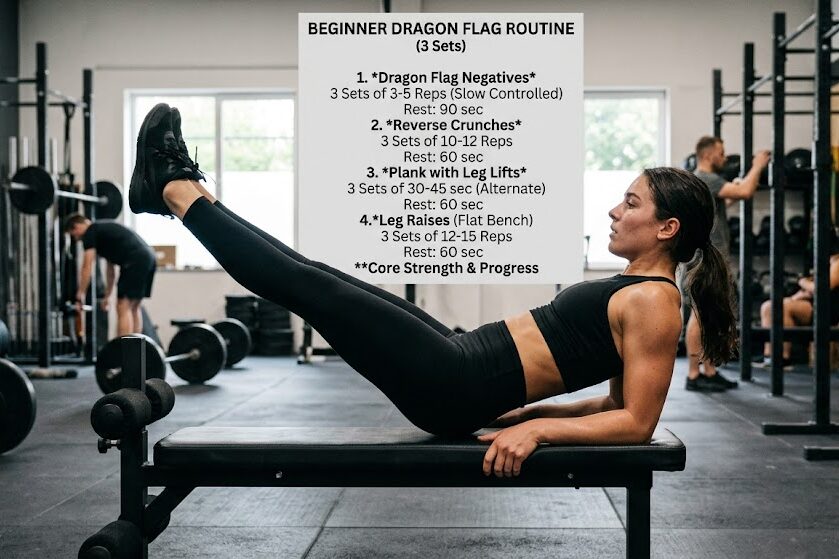
Sample Beginner Core Workout
Use the following routine to develop the foundational strength needed for dragon flags.
| Exercise | Sets | Repetitions or duration | Rest |
|---|---|---|---|
| Reverse crunch | 2–3 | 8–12 reps | 45–60 seconds |
| Hollow-body hold | 2–3 | 10–20 seconds | 45–60 seconds |
| Tuck dragon flag hold or controlled negative | 2–3 | 2–4 controlled reps or short holds | 90–120 seconds |
| Plank | 2 | 20–40 seconds | 45–60 seconds |
These are starting guidelines, not mandatory targets. Choose a variation that allows you to maintain good form, and reduce the difficulty if your back arches or you cannot control the descent.
How Often Should You Train Dragon Flags?
The appropriate frequency depends on the difficulty of your variation, your overall training schedule, and how well you recover. Because dragon flags place substantial demands on the core, avoid repeatedly training them to the point of exhaustion.
Consider these practical guidelines:
- Warm up before each session.
- Begin with a manageable number of sets.
- Rest sufficiently between demanding sets.
- Allow adequate recovery between challenging core sessions.
- Increase difficulty gradually instead of adding repetitions at the expense of technique.
If your abdominal muscles remain sore or fatigued, give them additional recovery time before another demanding session.
Are Dragon Flags Bad for Your Lower Back?
Dragon flags are not automatically harmful to the lower back, but their difficulty makes proper technique and gradual progression essential. Excessive spinal extension, poor movement control, and attempting an unsuitable variation can increase discomfort or injury risk.
To make your dragon flag workout more manageable, follow these precautions.
Warm up first. Begin with gentle movement and easier core exercises before attempting challenging variations.
Choose an appropriate progression. Select an exercise that allows you to brace your abdomen without forcing your lower back into an exaggerated arch.
Control your range of motion. Do not lower your body farther than you can manage with good technique.
Avoid training through pain. Stop immediately if you experience sharp pain, particularly in your back or neck. Seek advice from a qualified fitness professional or healthcare professional if you are unsure whether the exercise is suitable for you.
Allow sufficient recovery. Avoid demanding core sessions when your muscles are still significantly sore or fatigued.
For more guidance, explore fitness recovery and rest days.
What Are the Best Next Steps for Learning Dragon Flags?
The best next step is to build a consistent core-training routine and progress only when your current exercise feels controlled. You do not need to rush into full dragon flags to improve abdominal strength.
Start with one or two suitable progressions and practice them with good technique. Track your control, range of motion, and ability to maintain a stable torso over time.
As your strength improves, gradually introduce more challenging variations. Avoid increasing the difficulty simply because you can complete a repetition; make sure you can control the movement throughout its range.
How Can You Combine Dragon Flags With an Abs Workout?
Dragon flag training works best as part of a balanced core routine rather than as your only abdominal exercise.
Consider combining:
- Abdominal control exercises: Reverse crunches and hollow-body holds.
- Core stability exercises: Planks and other controlled trunk exercises.
- Progressive abdominal movements: Leg raises and suitable dragon flag variations.
- Recovery practices: Adequate rest between demanding training sessions.
Consistency, good technique, and gradual progression will help you develop the foundation needed to work toward a full dragon flag.
Conclusion
The dragon flag workout is a demanding bodyweight exercise that develops abdominal strength, trunk stability, and advanced movement control. Its difficulty makes it an excellent challenge for experienced calisthenics enthusiasts, but beginners can also work toward it through appropriate progressions.
Start with foundational exercises such as reverse crunches, hollow-body holds, and planks before introducing tucked dragon flags and controlled negatives. Maintain proper technique, avoid excessive lower-back arching, and allow adequate recovery between challenging sessions.
Remember that progress is not measured by how quickly you achieve a full dragon flag. Focus on the quality of your movement, increase the difficulty gradually, and remain consistent with your training. With patience and controlled practice, you can build the strength needed to work toward your first full repetition.
FAQs
What is the dragon flag workout?
The dragon flag is an advanced bodyweight exercise that builds core strength and control.
Is dragon flag a good exercise?
Yes, it strengthens your abs, improves core stability, and develops body control.
How to train your dragon flag?
Start with planks, reverse crunches, hollow-body holds, and tucked dragon flags.
How to work up to a dragon flag?
Progress from basic core exercises to tucked holds, negatives, and full repetitions.
Are dragon flags harder than planks?
Yes, dragon flags generally require more strength and control than standard planks.
Will dragon flags give you abs?
They strengthen your abs, but visible definition also depends on body fat, nutrition, and genetics.
What is the queen of all exercises?
There is no official answer. The squat is commonly called the king of exercises.
Are dragon flags suitable for beginners?
Full dragon flags are advanced, but beginners can build strength with easier variations.
How long does it take to learn a dragon flag?
It depends on your strength, consistency, technique, and recovery.
Is the dragon flag better than leg raises?
Neither is universally better. Dragon flags are more advanced, while leg raises are easier to scale.
Can you do dragon flags at home?
Yes, if you have a stable bench or suitable support that cannot slip or tip.
How many dragon flags should you do?
Start with a few controlled repetitions or short holds using a suitable variation.
What muscles do dragon flags work?
They primarily target the rectus abdominis, with support from the obliques, hip flexors, and other stabilizing muscles.
Are dragon flag negatives effective?
Yes, they help develop eccentric strength and control during the lowering phase.
Can dragon flags reduce belly fat?
No exercise specifically targets belly fat. Fat loss depends on overall energy balance and lifestyle.