
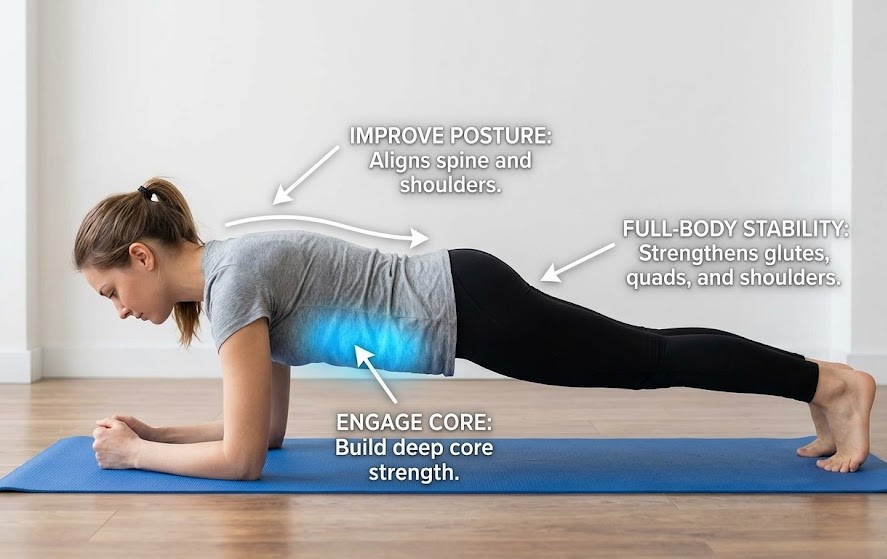
You probably already know that planks are one of the most popular core exercises. But many people perform planks every day without understanding how this simple movement improves posture, stability, endurance, and total-body strength.
The truth is that plank exercise benefits go far beyond building visible abs.
When performed correctly, planks strengthen:
- Core muscles
- Shoulders
- Back
- Glutes
- Legs
They also improve balance, posture, and movement efficiency without requiring gym equipment.
In this guide, you’ll learn the real plank exercise benefits, proper form, beginner-friendly variations, common mistakes, and how to use planks effectively for long-term results.
What Is a Plank Exercise?
A Plank exercise benefits is an isometric bodyweight movement that strengthens the core by forcing the muscles to maintain tension while holding a stable position.
Unlike crunches, planks do not involve repetitive spinal bending. Instead, they train the body to resist movement and maintain spinal stability.
y=0
This is one reason why plank exercise benefits are strongly connected to posture and spinal support.
A properly performed plank activates:
- Rectus abdominis
- Obliques
- Transverse abdominis
- Lower back
- Glutes
- Shoulders
- Chest
- Legs
For example, a forearm plank forces your body to resist gravity while maintaining full-body tension. Over time, this improves endurance and stability.
According to the American Council on Exercise (2025), core stability exercises improve posture, movement efficiency, and injury prevention.
Types of Plank Exercises
Different plank variations target the core in different ways.
Popular variations include:
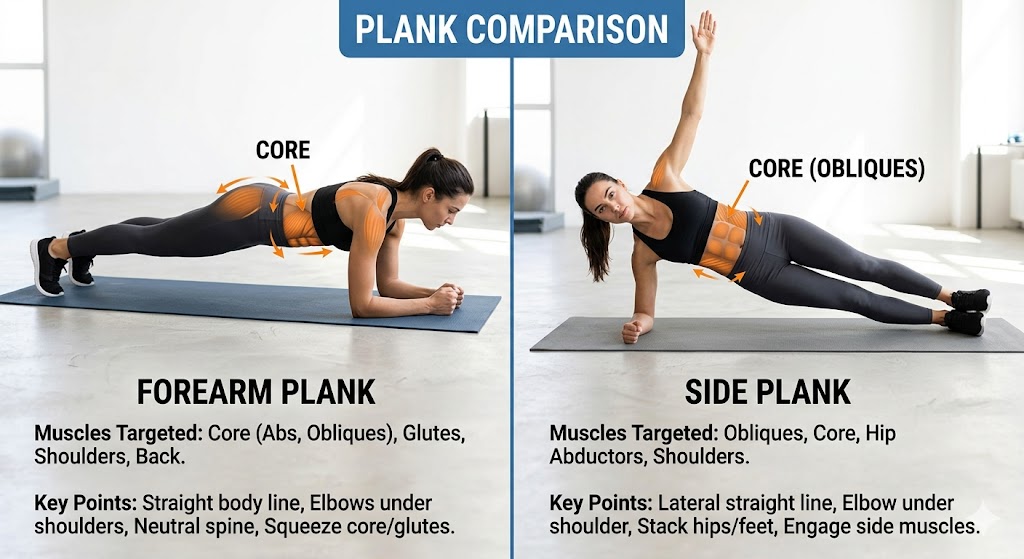
- Forearm plank
- High plank
- Side plank
- Reverse plank
- Plank shoulder taps
- Dynamic planks
Each variation increases stability demands and muscular engagement differently.
best core strengthening exercises
Are Planks Better Than Crunches?
Plank exercise benefits Many fitness experts consider planks better than crunches for total core stability because they activate multiple muscle groups simultaneously.
| Exercise | Primary Focus | Muscle Activation | Spine Stress |
|---|---|---|---|
| Plank | Full core stability | High | Low |
| Crunch | Front abs | Moderate | Higher |
| Side Plank | Obliques & balance | High | Low |
| Dynamic Plank | Core endurance | Very High | Moderate |
Crunches mainly target the front abdominal muscles, while planks strengthen the entire core system.
For example, people with poor posture or lower back discomfort often benefit more from planks than repetitive crunches.
Why Planks Are One of the Best Core Exercises
One of the biggest plank exercise benefits is full-body core stability.
Your core muscles support almost every movement you perform daily, including:
- Walking
- Running
- Lifting
- Bending
- Climbing stairs
- Sports movements
Weak core muscles can contribute to:
- Poor posture
- Lower back tension
- Balance problems
- Reduced athletic performance
Core stability exercises strengthen the muscles responsible for spinal alignment and movement control.
Research published in the Journal of Physical Therapy Science (2024) found core stabilization exercises improved posture and reduced lower back discomfort.
Plank Exercise Benefits for Daily Life
Strong core muscles improve functional movement during everyday activities.
For example:
- Carrying groceries requires core stability
- Sitting at a desk requires postural endurance
- Lifting objects safely depends on spinal support
- Sports require rotational control and balance
Plank exercise benefits also include better body awareness and movement efficiency.
Can Planks Help Lower Back Pain?
Plank exercise benefits may help support lower back health by strengthening the muscles that stabilize the spine.
However, proper form is essential.
Poor alignment during planks can increase spinal strain instead of reducing it.
For example, sagging hips during a plank place excessive stress on the lower back.
Research published in Sports Health (2024) found that core stabilization training improved lower back function in adults with chronic discomfort.
Main Plank Exercise Benefits
Improves Core Strength
Planks strengthen the abdominal muscles through continuous tension instead of fast repetitions.
This improves:
- Core endurance
- Stability
- Muscle activation
- Movement control
Athletes often use planks to improve force transfer during lifting, sprinting, and jumping.
Enhances Posture
Plank exercise benefits include improved posture and spinal alignment.
Weak core muscles often contribute to:
- Rounded shoulders
- Lower back arching
- Poor sitting posture
Regular plank practice teaches the body to maintain better alignment naturally.
According to Harvard Health (2025), core training helps maintain posture and balance as people age.
Improves Balance and Stability
Plank exercise benefits challenge stabilizing muscles throughout the body.
This improves:
- Balance
- Coordination
- Body control
- Athletic movement
Side planks especially help improve lateral stability and oblique strength.
Activates Multiple Muscle Groups
One major plank exercise benefit is total-body activation.
Proper plank form engages:
- Abs
- Shoulders
- Chest
- Back
- Glutes
- Legs
This makes Plank exercise benefits an effective compound bodyweight exercise.
bodyweight exercises for strength
Can Planks Burn Belly Fat?
Planks alone do not directly burn belly fat.
Spot reduction is mostly a myth.
However, plank exercise benefits can support fat-loss goals by:
- Increasing muscular engagement
- Improving workout efficiency
- Supporting strength training
The best results come from combining:
- Planks
- Cardio
- Strength training
- Proper nutrition
- Recovery
According to the CDC (2025), combining strength training and aerobic exercise is highly effective for long-term fat loss.
aerobic exercise to lose weight
Correct Plank Form
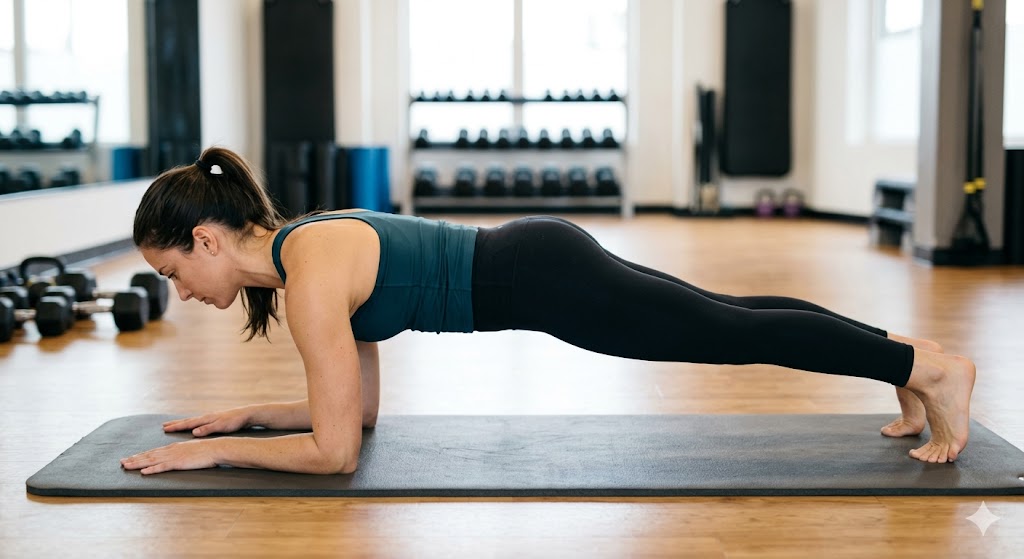
Proper plank form is essential for maximizing plank exercise benefits.
How to Perform a Perfect Plank
- Place forearms on the floor
- Keep elbows below shoulders
- Extend legs backward
- Tighten your abs
- Squeeze glutes and legs
- Maintain a straight body line
- Keep neck neutral
- Breathe steadily
For example, imagine balancing a glass of water on your back. Your hips should stay level throughout the exercise.
Proper Breathing During Planks
Many beginners accidentally hold their breath during planks.
This increases tension and reduces endurance.
Instead:
- Inhale slowly through the nose
- Exhale through the mouth
- Maintain controlled breathing
Steady breathing improves endurance and muscle control.
Beginner Plank Variations
Plank exercise benefits Beginner-friendly plank variations help build core strength safely.
Popular beginner options include:
- Knee planks
- Elevated planks
- Wall planks
- Short-duration holds
For example, a properly aligned 20-second plank is more effective than a poorly performed 60-second hold.
home workout routine for beginners
Common Plank Mistakes
Sagging Hips
Sagging hips increase lower back strain and reduce core activation.
Fix this by:
- Tightening glutes
- Shortening hold time
- Resetting posture
Raised Hips
Raised hips shift tension away from the core.
Keep your body in a straight line from shoulders to ankles.
Neck Strain
Looking upward or tucking the chin excessively creates neck tension.
Keep your neck neutral by looking slightly ahead.
Holding Your Breath
Breath-holding reduces endurance and stability.
Maintain steady breathing throughout the hold.
Overtraining
Too much plank training can reduce recovery quality and increase fatigue.
Recovery still matters for progress.
Best Plank Variations for Beginners
Forearm Plank
Forearm Plank exercise benefits reduce wrist strain while improving core endurance.
This variation is ideal for beginners learning alignment.
High Plank
High planks increase shoulder and upper-body activation.
They also improve stability and posture control.
Side Plank
Side planks target:
- Obliques
- Balance
- Lateral stability
This variation also helps improve rotational control.
Dynamic Planks
Dynamic Plank exercise benefits increase movement complexity and calorie burn.
Examples include:
- Plank shoulder taps
- Walking planks
- Up-down planks
- Plank jacks
How Long Should Beginners Hold a Plank?
Beginners should usually hold planks for:
- 15–30 seconds
Quality matters more than duration.
Beginner Structure
- 3 sets
- 15–30 second holds
- 30–60 second rest
Intermediate Progression
- 45–60 second holds
- Side plank integration
- Shoulder tap planks
According to NASM (2025), movement quality matters more than maximum-duration plank holds.
How Often Should You Do Planks?
Most people can safely include planks:
- 3–5 times weekly
Beginners often benefit from shorter, more frequent sessions.
Beginner Plank Routine
| Exercise | Duration | Sets |
|---|---|---|
| Forearm Plank | 20 sec | 3 |
| Side Plank | 15 sec/side | 2 |
| High Plank | 20 sec | 2 |
| Shoulder Tap Plank | 10 reps | 2 |
This routine can fit into a simple 10-minute home workout.
Combining Planks With Other Exercises
Plank exercise benefits work best when combined with:
- Strength training
- Walking
- Mobility work
- Cardio
- Full-body workouts
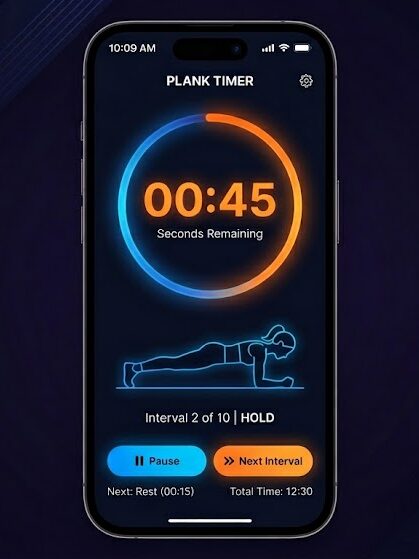
Tools That Improve Plank Training
Useful tools include:
- Interval timer apps
- Smartwatches
- Workout journals
- Fitness apps
These tools help improve workout consistency and progression.
What’s Next After Mastering Basic Planks?
After mastering standard Plank exercise benefits, progressive overload becomes important.
Advanced plank variations include:
- Weighted planks
- Stability ball planks
- Single-arm planks
- TRX planks
These variations increase:
- Core resistance
- Stability demands
- Muscular endurance
Conclusion
Plank exercise benefits extend far beyond building visible abs. Planks strengthen the core, improve posture, enhance stability, support balance, and improve overall functional fitness.
Moreover, planks are beginner-friendly, require no equipment, and can easily fit into home workout routines.
The key is focusing on:
- Proper form
- Consistency
- Progressive overload
- Recovery
Start with simple variations, progress gradually, and remember that quality always matters more than hold duration.
Even a few well-executed planks weekly can significantly improve your strength, posture, and overall fitness over time.
FAQs
Q: What muscles do planks work?
Planks work the abs, obliques, transverse abdominis, shoulders, chest, glutes, back, and legs.
Q: Are planks better than crunches?
Planks are generally better for full core stability, while crunches isolate the front abdominal muscles more directly.
Q: How long should beginners hold a plank?
Beginners should usually hold planks for 15–30 seconds with proper form.
Q: Can planks reduce belly fat?
Planks strengthen the core, but overall fat loss requires proper nutrition and cardio alongside exercise.
Q: How often should I do planks?
Most people can safely perform planks 3–5 times weekly depending on recovery and workout intensity.
Q: Are planks safe for beginners?
Yes, beginner plank variations like knee planks and wall planks are safe when performed correctly.
Q: Do planks help posture?
Yes, plank exercise benefits include improved posture and spinal stability through stronger core muscles.
Q: Can planks help lower back pain?
Proper plank training may help support lower back health by strengthening stabilizing muscles.
Q: Which plank variation is best for beginners?
Forearm planks are one of the best beginner-friendly variations because they reduce wrist strain and improve core stability.
Q: Do I need equipment for planks?
No, planks are bodyweight exercises that can be performed anywhere without gym equipment.
2 thoughts on “Plank Exercise Benefits: Core Strength & Full-Body Stability”