
Running Pace Zone Calculator
Calculate your running pace and discover estimated training pace zones for easy runs, long runs, tempo workouts, threshold runs, intervals, and repetitions.
Your Training Pace Zones
These are estimated training paces, not measured physiological thresholds. Adjust them according to your fitness, recovery, terrain, and weather.
Estimated Race Time Equivalents
Race-time equivalents use a mathematical distance-adjustment model. Training zones use practical pace offsets and may not match your individual lactate threshold or VO₂ max. Use a recent, hard effort for the best estimate.
Running faster isn’t just about pushing yourself harder during every workout. Running too quickly on easy days can increase fatigue, while running too slowly during speed sessions may limit your progress.
A Running Pace Zone Calculator helps you estimate suitable running paces based on your recent performance. In this guide, you’ll learn how running pace zones work, how to calculate your pace, and how to use different intensities to improve endurance, speed, and recovery.
What Is a Running Pace Zone Calculator?
A Running Pace Zone Calculator is an online tool that estimates training pace ranges using your recent race time or running performance. It helps you identify suitable paces for recovery runs, easy runs, steady runs, tempo workouts, threshold sessions, and intervals.
Running pace measures the time required to cover a distance, usually in minutes per kilometer or minutes per mile.
For example, completing 5 kilometers in 30 minutes gives you an average pace of 6:00 min/km, equivalent to 10 km/h.
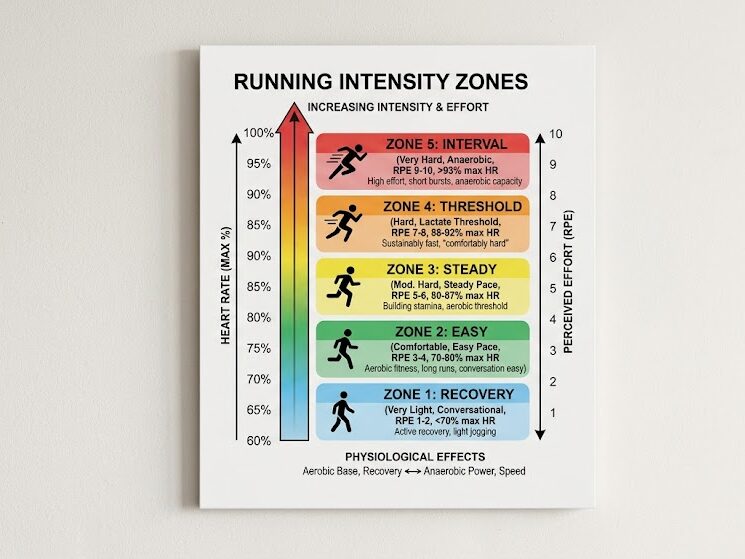
What Are the Five Running Pace Zones?
| Zone | Intensity | Main purpose |
|---|---|---|
| Zone 1: Recovery | Very easy | Support recovery |
| Zone 2: Easy aerobic | Comfortable | Build endurance |
| Zone 3: Steady | Moderate | Improve sustained running |
| Zone 4: Threshold | Comfortably hard | Improve sustainable speed |
| Zone 5: Intervals | Hard to very hard | Develop speed and high-intensity capacity |
Zone boundaries vary between training systems, so calculator results should be treated as estimates.
Why Are Running Pace Zones Important?
Running pace zones help you match workout intensity to your training goals while managing fatigue.
Benefits include:
- Aerobic endurance: Easy runs help develop aerobic fitness.
- Sustainable speed: Tempo and threshold workouts improve your ability to maintain challenging paces.
- Speed development: Interval sessions introduce faster running with planned recovery.
- Recovery management: Easy sessions prevent every run from becoming a hard workout.
- Training consistency: Pace targets make structured training easier to follow.
Remember that consistent training, sleep, nutrition, and recovery also influence running performance.
How Do You Use a Running Pace Zone Calculator?
Follow these steps to estimate your running pace zones:
- Enter a recent race distance and finishing time.
- Select minutes per kilometer or minutes per mile.
- Calculate your estimated pace zones.
- Review the recommended ranges for different workouts.
- Match each range to your training goals.
- Adjust your pace for hills, heat, fatigue, and recovery needs.
Can Beginners Calculate Pace Zones Without a Race Result?
Yes. Beginners can use perceived effort and the talk test to establish a comfortable starting intensity. Start with easy jogging, alternate jogging and walking when necessary, and build consistency before introducing demanding intervals.
For additional guidance, see Running Tempo Workout.
What Are the Different Running Pace Zones?
Zone 1: Recovery Pace
Recovery pace is a very easy intensity intended for recovery-focused sessions. You should feel comfortable jogging slowly or alternating jogging with walking.
If your legs feel unusually tired, slowing down or taking a rest day may be more appropriate.
Zone 2: Easy Running Pace
Easy running should feel comfortable enough for conversation. It supports aerobic endurance and allows you to build training volume without repeatedly placing high demands on your body.
Avoid copying another runner’s pace. Your easy pace should reflect your fitness and current effort.
Zone 3: Steady Running Pace
Steady running is more demanding than easy running but remains controlled and sustainable. You might include a steady segment during a longer run to practice maintaining a consistent rhythm.
Avoid turning every steady run into an all-out effort.
Zone 4: Tempo and Threshold Pace
Tempo pace generally describes sustained, comfortably hard running, while threshold pace refers to an individualized intensity near the runner’s lactate threshold.
Use a recent race result and a calculator with a clearly explained method to estimate these targets. Adjust them according to your fitness and workout duration.
Zone 5: Interval Pace
Interval pace involves faster running repeated over several efforts, with recovery between repetitions. The appropriate pace depends on repetition length, recovery time, fitness, and workout purpose.
Short sprints and longer intervals should not automatically use the same target pace.
How Do You Calculate Running Pace?
The basic running pace formula is:
Running pace = Finishing time ÷ Distance covered
For example, if you complete a 5K in 30 minutes:
- Distance: 5 km
- Time: 30 minutes
- Calculation: 30 ÷ 5 = 6 minutes per kilometer
- Average pace: 6:00 min/km
This calculates your average race pace, not every training zone. A pace-zone calculator uses its own performance model to estimate the different intensity ranges.
How Do You Convert Min/km to Min/mile?
Use these formulas:
- Minutes per mile = Minutes per kilometer × 1.60934
- Minutes per kilometer = Minutes per mile ÷ 1.60934
For example, 6:00 min/km equals approximately 9:39 min/mile.
Running Pace Zones vs. Heart Rate Zones
Pace zones use running speed to guide intensity, while heart rate zones use heartbeats per minute.
| Feature | Pace zones | Heart rate zones |
|---|---|---|
| Measurement | Time per distance | Heartbeats per minute |
| Units | min/km or min/mile | bpm |
| Best for | Setting running-speed targets | Monitoring cardiovascular response |
| Limitation | Pace is affected by terrain and weather | Heart rate changes with heat, stress, and fatigue |
Both methods can be useful, alongside perceived effort and the talk test.
For more information, see BMI Calculator, Calorie Deficit Calculator, and Ideal Body Weight Calculator.
How Often Should You Recalculate Your Running Pace Zones?
Update your zones when your fitness changes significantly or your existing targets no longer reflect your ability.
Consider recalculating when:
- You achieve a new personal best.
- Your easy pace becomes consistently more comfortable.
- Your current targets feel unusually difficult.
- You return after an extended break.
- Your training goals change.
Avoid changing your zones after every run. A representative race result and consistent training trends provide a more reliable basis for adjustment.
Best Running Pace Tools and Calculators
Different calculators help you plan training and interpret running performance.
| Calculator | Main purpose |
|---|---|
| Running Pace Calculator | Calculate pace from distance and time |
| Running Pace Zone Calculator | Estimate training intensities |
| Race Time Predictor | Estimate potential finishing times |
| Running Speed Calculator | Convert pace into speed |
| Heart Rate Zone Calculator | Estimate heart rate training ranges |
| Marathon Pace Calculator | Plan marathon pace |
| Half Marathon Pace Calculator | Plan half-marathon pace |
| 5K and 10K Pace Calculators | Establish shorter race targets |
How Should You Use Pace Zones in a Weekly Training Plan?
A weekly running plan should balance comfortable aerobic running with appropriately scheduled harder sessions.
Follow these practical recommendations:
- Keep easy runs conversational.
- Allow recovery between demanding workouts.
- Warm up before tempo and interval sessions.
- Slow down when heat, hills, or fatigue affect performance.
- Record your pace and perceived effort.
- Update targets when your fitness changes.
Use warm-up exercises before faster sessions.
If an easy run feels unusually difficult, reduce the intensity rather than forcing yourself to maintain a predetermined pace.
Conclusion
A Running Pace Zone Calculator helps you estimate appropriate paces for recovery, easy running, steady efforts, tempo workouts, threshold sessions, and intervals. Understanding these zones allows you to organize training more effectively and avoid making every run unnecessarily demanding.
Use recent performance data, adjust your targets to your current fitness, and consider weather, terrain, and recovery. Combined with consistent training and realistic goals, pace zones can help you become a stronger and more efficient runner.
FAQs
What is a Running Pace Zone Calculator?
A Running Pace Zone Calculator estimates training paces for different intensities using recent race times or other running performance data.
How do I calculate my running pace?
Divide your finishing time by the distance covered. A 30-minute 5K gives an average pace of 6:00 min/km.
What are the five running pace zones?
They are recovery, easy aerobic, steady, threshold, and intervals. Exact boundaries vary between training systems.
What is a good running pace for beginners?
A good beginner pace allows comfortable conversation without excessive breathlessness. Prioritize consistency over speed.
Are running pace zones the same as heart rate zones?
No. Pace zones use time per distance, while heart rate zones use heartbeats per minute to guide exercise intensity.
How often should I update my running pace zones?
Recalculate after meaningful fitness changes, new race results, extended breaks, or changes in training goals.
Can I calculate running pace zones without a race result?
Yes. Beginners can use perceived effort and the talk test until they have a recent race or time-trial result.
Should I always follow my calculator’s pace targets?
No. Calculator results are estimates. Adjust your pace for weather, terrain, fatigue, and recovery needs.
1 thought on “Running Pace Zone Calculator: Find Your Ideal Training Paces”