
BMR Calculator
Calculate your Basal Metabolic Rate (BMR) and estimate your daily calorie requirements based on your activity level.
Daily Calories by Activity Level
BMR is estimated using the Mifflin–St Jeor equation. TDEE and calorie targets are estimates and may differ from your actual energy needs.
Your body burns calories even when you're resting, sleeping, or sitting still. But how many calories does your body need to maintain essential functions? A BMR Calculator helps you estimate your resting calorie requirements using your age, sex, height, and weight.
Whether your goal is weight loss, muscle building, or weight maintenance, understanding your Basal Metabolic Rate (BMR) can help you make better nutrition and fitness decisions.
What Is Basal Metabolic Rate (BMR)?
Basal Metabolic Rate (BMR) is the estimated amount of energy your body needs at rest to maintain essential functions, including breathing, blood circulation, brain activity, and temperature regulation.
For example, someone with a BMR of 1,600 calories per day needs approximately that amount of energy to support basic bodily functions under resting conditions.
However, BMR does not include all the calories you burn through walking, exercising, working, and digesting food.
What Does a BMR Calculator Measure?
A BMR Calculator estimates your resting calorie requirements using four main inputs:
- Age
- Sex
- Height
- Weight
How to Use a BMR Calculator
Follow these simple steps to calculate your BMR:
- Select your sex.
- Enter your age in years.
- Enter your height in centimeters or feet and inches.
- Enter your weight in kilograms or pounds.
- Click calculate to view your estimated BMR in kcal/day.
For example, a result of 1,550 kcal/day means your estimated resting energy requirement is approximately 1,550 calories daily. Your total daily calorie needs will generally be higher because of physical activity and digestion.
What Is the BMR Formula?
The Mifflin-St Jeor equation is a commonly used method for estimating BMR in adults.
BMR Formula for Men
BMR = (10 × weight in kg) + (6.25 × height in cm) − (5 × age) + 5
Example: A 25-year-old man weighing 70 kg with a height of 175 cm has an estimated BMR of approximately 1,674 kcal/day.
BMR Formula for Women
BMR = (10 × weight in kg) + (6.25 × height in cm) − (5 × age) − 161
Example: A 25-year-old woman weighing 60 kg with a height of 165 cm has an estimated BMR of approximately 1,345 kcal/day.
These results are estimates, not exact measurements of metabolism.
Source: Mifflin MD et al., 1990, A New Predictive Equation for Resting Energy Expenditure in Healthy Individuals.
What Is the Difference Between BMR and TDEE?
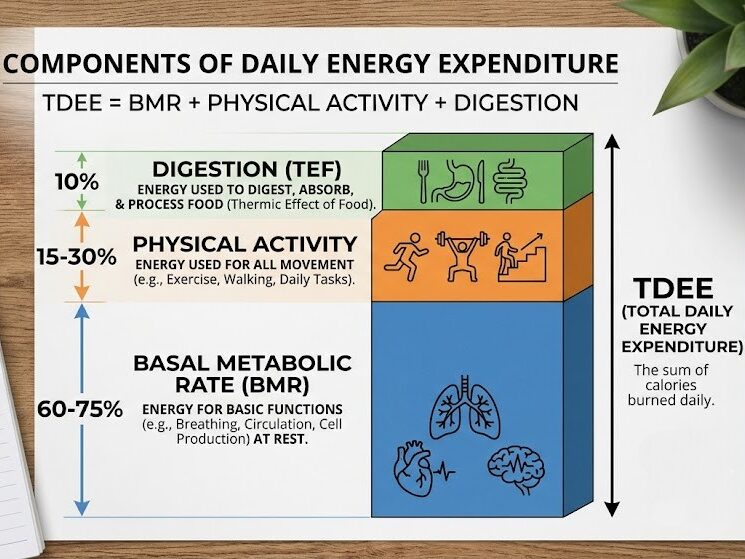
BMR estimates the calories your body needs at rest, while Total Daily Energy Expenditure (TDEE) estimates the total calories you burn throughout the day.
| Feature | BMR | TDEE |
|---|---|---|
| Measures | Resting energy needs | Total daily energy expenditure |
| Physical activity | Not included | Included |
| Digestion | Not included separately | Included |
| Main use | Estimate baseline needs | Plan daily calorie intake |
How Many Calories Should You Eat Based on Your BMR?
Your daily calorie target should generally be based on your TDEE, goals, and nutritional needs rather than BMR alone.
For Weight Loss
Weight loss generally requires a sustained calorie deficit, meaning you consume fewer calories than your body uses over time.
Use a Calorie Deficit Calculator to estimate a starting target.
Avoid extreme calorie restriction, as it can make meeting your nutritional needs more difficult.
For Muscle Building
Muscle growth requires resistance training, sufficient protein, adequate recovery, and enough energy to support your training.
Use a maintenance intake and a Protein Intake Calculator to estimate your daily protein needs.
What Factors Affect BMR?
Several factors influence your estimated resting energy requirements:
- Age: Energy requirements can change as body composition changes.
- Body size: Height and weight influence resting energy expenditure.
- Body composition: Muscle and other lean tissues contribute to resting energy use.
- Physiological differences: Sex-related characteristics influence common BMR equations.
- Genetics and health: Genetic variation, illness, thyroid function, and certain medications may affect energy expenditure.
Explore a FFMI Calculator to understand your body composition in more detail.
How Can You Support Healthy Metabolism?
Healthy habits support overall well-being and help you maintain a sustainable fitness routine.
- Eat balanced meals containing protein, fruits, vegetables, whole grains, and healthy fats.
- Perform resistance training to build or preserve muscle.
- Stay physically active throughout the day.
- Get sufficient sleep to support recovery.
- Avoid extreme dieting and prioritize adequate nutrition.
For more guidance, explore Strength Training and our High-Protein Diet for Weight Loss guide.
How Accurate Is a BMR Calculator?
A BMR Calculator provides an estimate rather than an exact measurement. Your actual resting energy expenditure may differ because of body composition, genetics, health conditions, and other individual factors.
Indirect calorimetry can provide a more direct assessment by measuring oxygen consumption and carbon dioxide production under controlled conditions.
For everyday fitness planning, a calculator is a useful starting point. If you have a medical condition or unexplained changes in weight or energy, consult a qualified healthcare professional.
How to Use Your BMR Result for Nutrition Planning
Follow these steps to make your BMR result more useful:
- Calculate your BMR using your current measurements.
- Estimate your TDEE using your activity level.
- Set a realistic weight loss, muscle-building, or maintenance goal.
- Plan balanced meals with adequate protein and nutrients.
- Monitor your progress and adjust your intake when necessary.
A Healthy Weight Loss Tips guide can help you develop sustainable habits, while an Ideal Body Weight Calculator offers another reference point for understanding body size.

Conclusion
A BMR Calculator helps you estimate how many calories your body needs at rest. By understanding your BMR and calculating your TDEE, you can make more informed decisions about daily calorie intake.
Remember that BMR is not your daily calorie target. Combine your estimate with balanced nutrition, regular exercise, adequate recovery, and progress tracking to support your weight management and fitness goals.
FAQs
What is a BMR Calculator?
A BMR Calculator estimates the calories your body needs at rest using your age, sex, height, and weight.
What is a normal BMR for adults?
There is no single normal BMR for everyone. Your estimate depends on body size, age, body composition, and other individual factors.
Is BMR the same as TDEE?
No. BMR estimates resting energy needs, while TDEE includes resting metabolism, physical activity, and digestion.
Should I eat below my BMR to lose weight?
Not necessarily. Weight loss generally requires an appropriate calorie deficit relative to TDEE, rather than automatically eating below BMR.
Does BMR change with age?
Yes. BMR can change as body composition and other physiological characteristics change over time.
How accurate is a BMR Calculator?
It provides an estimate, not an exact measurement. Actual resting energy expenditure can differ from the calculated result.
Can a BMR Calculator help with muscle building?
Yes. It provides a baseline estimate that you can combine with TDEE, protein intake, resistance training, and recovery to plan your nutrition.
Can I calculate BMR using pounds and feet?
Yes, if your calculator supports imperial units. Otherwise, convert your weight to kilograms and height to centimeters before using the formula.
1 thought on “BMR Calculator: Calculate Your Basal Metabolic Rate & Daily Calories”