
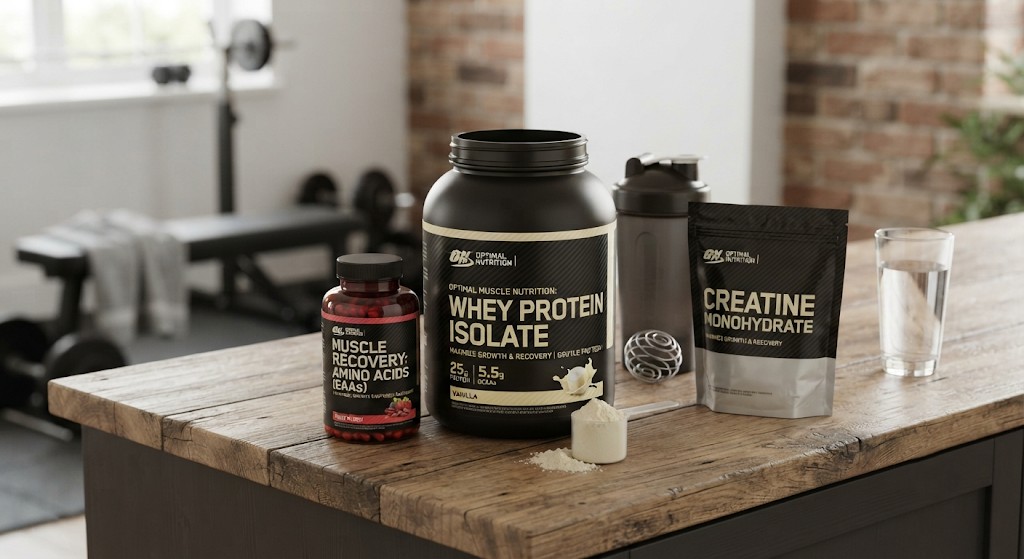
Plenty of products promise to “switch on” muscle growth, but only a few have solid research behind them. Your body builds muscle through a process called muscle protein synthesis, and the right supplement can support it when training and diet are already in place. This guide breaks down which supplements are worth considering, how much the research supports, and where the limits are.
daily protein intake calculator
What Are Muscle Protein Synthesis Supplements?
Muscle protein synthesis supplements are products that supply amino acids or related compounds your body uses to build and repair muscle tissue. Muscle protein synthesis (MPS) is the process of making new muscle proteins, and muscle grows over time when MPS outpaces muscle protein breakdown.
The most common options include:
- Protein powders such as whey and casein
- Leucine and essential amino acid (EAA) blends
- Creatine monohydrate
- HMB, a metabolite of leucine
Not every item on that list works the same way. Protein and amino acids feed MPS directly, while creatine supports the training that drives it.
High Protein Plant-Based Foods
Why Do Muscle Protein Synthesis Supplements Matter?
They matter because muscle gain depends on getting enough protein quality and quantity, and supplements make that easier to hit. Resistance exercise and protein intake each stimulate MPS, and they work together when protein is eaten before or after training (Source: ISSN, 2017).
Here is where supplements fit in:
- They give a convenient, low-calorie way to reach daily protein targets
- They help people with busy schedules or small appetites
- They add precision, since a scoop has a known amount of protein
- They sit on top of a good diet and cannot replace it
The International Society of Sports Nutrition notes that active people can meet protein needs through whole foods. Supplements are a practical option when food alone falls short (Source: ISSN, 2017).
How Does Muscle Protein Synthesis Work?
MPS is triggered mainly by two things: mechanical tension from resistance training and amino acids from protein. Leucine, a branched-chain amino acid, appears to play a signaling role by activating the mTOR pathway, which switches on protein-building machinery in muscle cells (Source: Nutrition Reviews, 2011).
A few practical points follow from the research:
- The boost from a workout lasts at least 24 hours, though it fades as time passes
- Protein before or after training both work, so timing is flexible
- Spreading protein across the day, roughly every 3 to 4 hours, is the pattern most often recommended
(Source: ISSN, 2017)
Which Supplements Support Muscle Protein Synthesis?
Protein powder has the strongest evidence, followed by creatine for training performance, while leucine, EAAs, and HMB have more limited or mixed results. The sections below cover each one.
Protein powder (whey, casein, and plant blends)
Protein supplements are the best-studied option. A meta-analysis of 49 trials with 1,863 participants found that protein supplementation significantly increased strength and fat-free mass during resistance training of at least 6 weeks (Source: Morton et al., 2018).
Other findings from that analysis:
- Gains in fat-free mass were smaller with increasing age
- Resistance-trained people saw larger benefits
- Gains stopped growing once total daily protein passed about 1.6 g per kg of body weight
Casein before bed is a separate case. A 30 to 40 g dose has been shown to increase overnight MPS (Source: ISSN, 2017).
Leucine and essential amino acids
Leucine is a potent trigger for MPS in lab and short-term studies, but much of the evidence comes from cell, animal, and acute human experiments (Source: Nutrition Reviews, 2011). If your meals already contain enough high-quality protein, extra leucine may add little. Food sources such as meat, fish, dairy, and soy already supply it.
Creatine monohydrate
Creatine does not stimulate MPS the way protein does. It raises muscle creatine stores, which can improve high-intensity performance and training adaptations (Source: ISSN creatine position stand, 2017). Better training quality may support muscle growth over time.
What the ISSN position stand reports:
- Creatine monohydrate is the most commonly studied form
- After muscle stores are full, 3 to 5 g per day typically maintains them
- Supplementation of up to 30 g per day for 5 years was safe and well tolerated in healthy people
HMB
HMB is a leucine metabolite that has been used for years by athletes. Reviews describe effects on increasing protein synthesis and reducing protein breakdown, but results vary across studies and populations (Source: Journal of Human Kinetics, 2019). It is a reasonable topic to discuss with a sports dietitian, though it is not a starting point.
How the Supplements Compare
| Supplement | How it relates to MPS | Evidence snapshot |
|---|---|---|
| Protein powder | Supplies amino acids that stimulate MPS directly | Strong: meta-analysis of 49 trials shows gains in strength and fat-free mass |
| Pre-sleep casein | Raises overnight MPS | Supported by the ISSN position stand at 30 to 40 g |
| Leucine or EAAs | Signals MPS through mTOR | Mostly mechanistic and short-term data |
| Creatine monohydrate | Supports training performance and adaptations | Strong for performance and safety in healthy adults |
| HMB | May increase synthesis and reduce breakdown | Mixed results across studies |
(Sources: ISSN, 2017; Morton et al., 2018; Nutrition Reviews, 2011; Journal of Human Kinetics, 2019)
How Much and When to Take Muscle Protein Synthesis Supplements
Most active adults do well with 1.4 to 2.0 g of protein per kg of body weight per day, spread across meals (Source: ISSN, 2017). A single serving of about 0.25 g per kg, or 20 to 40 g, is the usual range for stimulating MPS.
Here is a simple way to apply it:
- Estimate your daily protein target in grams per kg of body weight.
- Count what you already get from food.
- Use a supplement to cover the gap, not to double your intake.
- Aim for 3 to 5 protein feedings across the day.
- Add 3 to 5 g of creatine daily if you want to try it.
- Keep training consistent, since supplements cannot replace the workout stimulus.
Higher intakes of 2.3 to 3.1 g per kg may be useful in some situations, such as dieting while keeping muscle, but they go beyond what most people need (Source: ISSN, 2017).
sleep and recovery tips for muscle growth
Who May Benefit Most?
These supplements tend to help people who struggle to meet protein needs through food alone:
- Lifters following a structured resistance program
- Vegetarians and vegans with lower protein or creatine intake
- Busy people who skip meals
- Older adults, who may need more attention to protein, although the benefit of supplementation on fat-free mass shrinks with age in trials (Source: Morton et al., 2018)
Risks, Limits, and Precautions
Supplements are not a shortcut, and quality varies between brands. The NIH Office of Dietary Supplements points out that many products contain several ingredients, while most research tests single ingredients. It also notes that sellers rarely fund journal-quality studies of their own formulas (Source: NIH Office of Dietary Supplements).
Keep these cautions in mind:
- Check labels for added stimulants or proprietary blends with hidden amounts
- Do not use a supplement to replace a balanced diet
- Talk to a doctor first if you have kidney disease, take medication, or are pregnant
- Be cautious with products making dramatic muscle-gain promises
- Remember that most studies involve young, trained adults, so results may differ for others (Source: NIH Office of Dietary Supplements)
Conclusion
Muscle protein synthesis supplements work best as support for solid training and a protein-rich diet. Protein powder and creatine have the clearest evidence, while leucine, EAAs, and HMB are more situational.
Start by finding your daily protein target, fill gaps with food first, and add one supplement at a time so you can judge what helps.
FAQs
What are muscle protein synthesis supplements?
They are supplements such as protein powder, leucine, EAAs, creatine, and HMB that support the way your body builds muscle protein. Protein and amino acids act directly, while creatine helps your training performance.
Which supplement is best for muscle protein synthesis?
Protein powder has the strongest evidence. A large meta-analysis found it improves strength and fat-free mass when combined with resistance training (Source: Morton et al., 2018).
How much protein should I take per serving?
Research supports about 0.25 g per kg of body weight, or 20 to 40 g, per serving (Source: ISSN, 2017).
Does creatine increase muscle protein synthesis?
Creatine does not trigger MPS directly. It raises muscle creatine stores, which can improve high-intensity training performance (Source: ISSN creatine position stand, 2017).
Do I need leucine if I already take protein powder?
Probably not. Quality protein sources already provide leucine, and the strongest data for isolated leucine come from short-term and mechanistic studies.
When is the best time to take protein?
Before or after training both work, and the exercise effect lasts at least 24 hours (Source: ISSN, 2017). Total daily intake and consistency matter more than the exact minute.
Are these supplements safe?
Protein and creatine are generally well tolerated in healthy adults, but individual risks vary. Check with a healthcare professional if you have a medical condition or take medication.
Sources
- Jäger, R., et al. (2017). International Society of Sports Nutrition Position Stand: protein and exercise. Journal of the International Society of Sports Nutrition.
- Morton, R. W., et al. (2018). A systematic review, meta-analysis and meta-regression of the effect of protein supplementation on resistance training-induced gains in muscle mass and strength in healthy adults. British Journal of Sports Medicine.
- Kreider, R. B., et al. (2017). International Society of Sports Nutrition position stand: safety and efficacy of creatine supplementation in exercise, sport, and medicine. Journal of the International Society of Sports Nutrition.
- National Institutes of Health, Office of Dietary Supplements. Dietary Supplements for Exercise and Athletic Performance: Fact Sheet for Health Professionals.
- Nutrition Reviews. (2011). Supplemental dietary leucine and the skeletal muscle anabolic response to essential amino acids.
- Journal of Human Kinetics. (2019). Mechanism of Action and the Effect of Beta-Hydroxy-Beta-Methylbutyrate (HMB) Supplementation on Different Types of Physical Performance: A Systematic Review.
Disclaimer: This article is for informational and educational purposes only and is not a substitute for personalized medical advice. Consult a qualified healthcare professional before making significant changes to your diet, exercise routine, or supplement use.