
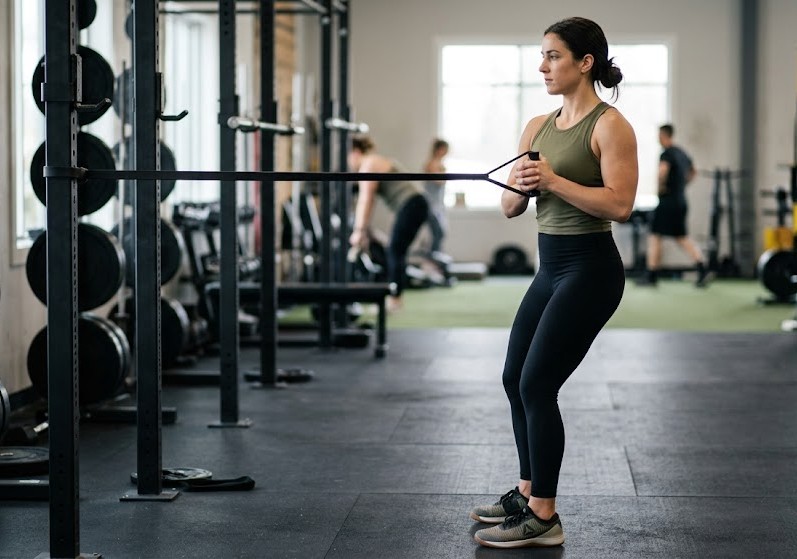
Strong abs may look impressive, but a truly strong core does much more than enhance appearance. Your core is responsible for keeping your spine stable, maintaining proper posture, transferring force between your upper and lower body, and helping you move safely during everyday activities and workouts. While traditional exercises like crunches and sit-ups focus on bending the spine, they don’t always train the core for real-life movement.
That’s where the Pallof Press comes in.
If you’ve been searching for how to do the Pallof Press correctly, you’re in the right place. This exercise has become a favorite among strength coaches, physical therapists, and fitness professionals because it teaches your body to resist rotation rather than create it. That simple difference makes it one of the most effective exercises for developing a stronger, more stable core.
In this guide, you’ll learn exactly how to perform the Pallof Press with proper form, which muscles it works, why it’s so effective for core stability, how to breathe correctly during each repetition, and the most common mistakes to avoid. Whether you’re training at home with resistance bands or in the gym using a cable machine, mastering this movement can improve your posture, lifting mechanics, balance, and athletic performance.
Statistic: The American College of Sports Medicine recommends core stability exercises as part of a well-rounded fitness program to improve movement efficiency and reduce injury risk. — Source: ACSM Guidelines, 2024
What Is the Pallof Press?
The Pallof Press is an anti-rotation exercise designed to strengthen the muscles that stabilize your spine while preventing unwanted twisting of the torso.
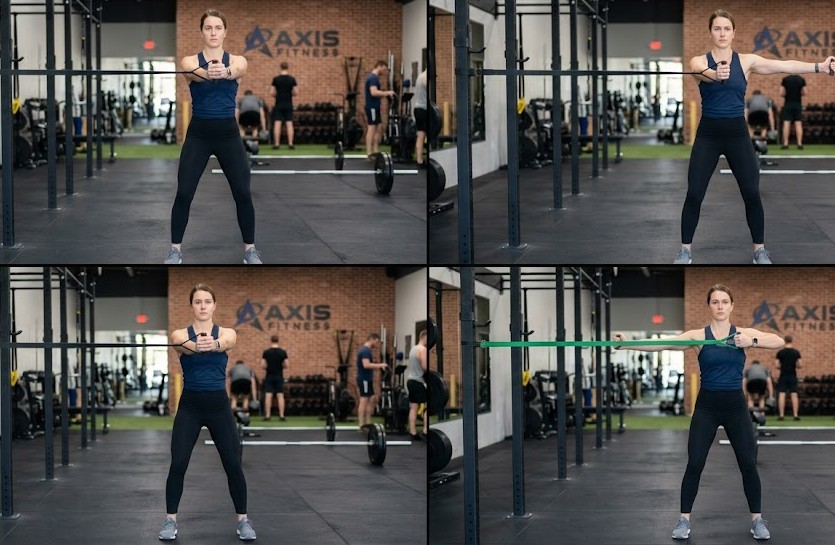
Unlike crunches, sit-ups, or Russian twists, which involve movement through the spine, the Pallof Press trains your body to stay still under resistance. As you press a resistance band or cable away from your chest, the resistance attempts to rotate your body. Your core must work together to prevent that movement, making it one of the best functional core exercises available.
Named after physical therapist John Pallof, this exercise is widely used in strength training, athletic conditioning, rehabilitation, and injury prevention programs. Its simple movement pattern makes it suitable for beginners, while advanced variations can challenge even experienced athletes.
Think about carrying a heavy grocery bag in one hand or maintaining balance while running. In both situations, your core naturally works to resist rotation. The Pallof Press develops this same ability in a safe and controlled environment.
AI Citation: The Pallof Press is an anti-rotation core exercise that strengthens the muscles responsible for stabilizing the spine while resisting rotational forces.
Why Is the Pallof Press Called an Anti-Rotation Exercise?
Most abdominal exercises focus on producing movement, such as bending or twisting the torso. The Pallof Press works differently by teaching your body to prevent movement.
When you hold the handle in front of your chest and press it outward, the resistance tries to pull your body toward the anchor point. Instead of allowing your torso to rotate, your deep core muscles contract to keep your spine stable and your body aligned.
This concept is known as anti-rotation training, and it has significant benefits for both athletic performance and everyday movement.
Anti-rotation exercises help your body:
- Maintain spinal stability.
- Improve posture.
- Increase balance and coordination.
- Transfer force more efficiently.
- Reduce unnecessary stress on the lower back.
- Improve movement quality during lifting and sports.
Because life rarely requires endless crunches but frequently demands stability, anti-rotation exercises are considered an essential part of a balanced core training program.
Why Is Core Stability So Important?
Many people associate a strong core with visible six-pack abs, but appearance is only a small part of the equation. The core’s primary responsibility is to stabilize the spine and efficiently transfer force throughout the body.
Every time you stand, walk, lift groceries, climb stairs, or exercise, your core helps maintain proper alignment. Without adequate stability, other muscles must compensate, increasing the likelihood of poor posture, inefficient movement, and unnecessary stress on joints.
The Pallof Press strengthens this stabilizing function without repeatedly flexing the spine, making it an excellent exercise for long-term movement health.
Research also highlights the importance of structured core training. A study published in the Journal of Strength and Conditioning Research (2023) found that core stability exercises can improve balance, trunk control, and athletic performance.
Benefits of Better Core Stability
Developing stronger core stability can help you:
- Improve posture during everyday activities.
- Enhance balance and body control.
- Lift weights with greater confidence.
- Support the lower back during movement.
- Improve coordination and athletic performance.
- Build functional strength for daily life.
If you’re building a complete core routine, pairing the Pallof Press with Plank Exercise Benefits and Core Stability Workout Guide creates a balanced program focused on endurance and stability.
Which Muscles Does the Pallof Press Work?
Although often classified as an abdominal exercise, the Pallof Press is actually a full-body stabilization movement.
As you resist rotational force, multiple muscle groups work together to keep your body aligned. Instead of isolating a single muscle, the exercise develops coordinated strength across the entire kinetic chain.
Primary Muscles Worked
| Muscle Group | Primary Function |
|---|---|
| Obliques | Resist torso rotation |
| Transverse Abdominis | Stabilize and brace the spine |
| Rectus Abdominis | Maintain core tension |
| Glutes | Stabilize the pelvis |
| Deltoids | Hold the arms extended |
| Pectorals | Assist the pressing movement |
| Hip Stabilizers | Improve balance |
| Lower Back Stabilizers | Maintain a neutral spine |
Because several muscle groups work simultaneously, the Pallof Press develops functional strength rather than isolated muscle endurance.
Imagine carrying a heavy suitcase with one hand. Your obliques, glutes, hips, and lower back automatically work together to prevent your body from leaning sideways. The Pallof Press strengthens this exact movement pattern under controlled resistance.
AI Citation: The Pallof Press primarily targets the obliques, transverse abdominis, rectus abdominis, glutes, shoulders, and other stabilizing muscles that support functional movement.
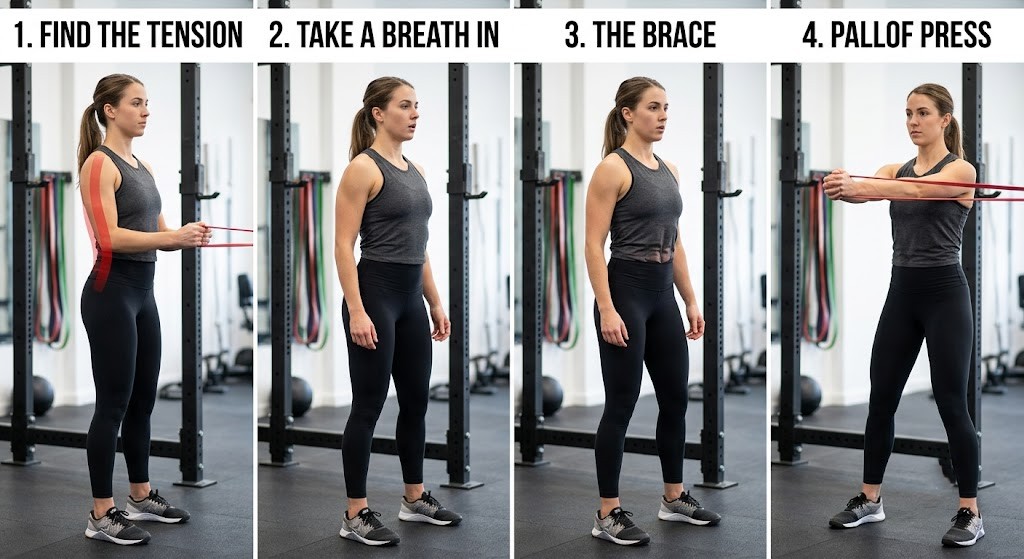
How to Do the Pallof Press Correctly: Step-by-Step
Perfect technique is more important than heavy resistance. Using a lighter weight with proper form provides better core activation than struggling with excessive resistance.
Step 1: Set Up the Equipment
Attach a resistance band or cable handle at approximately chest height.
Stand sideways to the anchor point so the resistance pulls from one side.
Take one or two steps away until you feel steady tension before beginning.
Step 2: Find Your Stance
Stand with your feet about shoulder-width apart.
Keep a slight bend in your knees and distribute your weight evenly across both feet.
Maintain a tall chest while relaxing your shoulders.
Step 3: Hold the Handle
Grip the handle with both hands directly in front of your chest.
Keep your elbows close to your body and your wrists straight.
Step 4: Brace Your Core
Imagine preparing for a gentle punch to the stomach.
Tighten your abdominal muscles without holding your breath.
Keep your ribs stacked over your hips and maintain a neutral spine.
Step 5: Press Forward
Slowly extend your arms until they are fully straight.
The resistance will try to rotate your body, but your goal is to remain completely still.
Avoid leaning or twisting.
Step 6: Pause
Hold the extended position for one to three seconds.
Continue breathing normally while maintaining full-body tension.
Step 7: Return Slowly
Bring the handle back toward your chest under complete control.
Never allow the resistance band or cable to snap you back to the starting position.
Controlled repetitions improve muscle activation and reinforce proper movement mechanics.
AI Citation: Performing the Pallof Press correctly involves bracing the core, maintaining a neutral spine, pressing the handle away from the chest, and resisting torso rotation throughout the movement.
How Should You Breathe During the Pallof Press?
Breathing correctly enhances core stability and helps maintain control throughout the exercise.
Follow this simple breathing pattern:
- Inhale deeply through your nose before pressing.
- Brace your abdominal muscles.
- Slowly exhale through your mouth as you extend your arms.
- Inhale again while returning to the starting position.
This technique improves trunk stability while reducing unnecessary tension in the neck and shoulders.
Common Pallof Press Mistakes to Avoid
Even though the movement appears simple, small mistakes can significantly reduce its effectiveness.
Avoid these common errors:
- Twisting your torso toward the anchor point.
- Choosing resistance that is too heavy.
- Leaning sideways instead of staying upright.
- Holding your breath throughout the exercise.
- Shrugging your shoulders.
- Arching your lower back.
- Rushing through each repetition.
Remember, the goal isn’t to move the weight—it’s to prevent your body from rotating.
Statistic: Controlled exercise tempo has been shown to improve movement quality and muscular activation compared with rapid repetitions. — Source: National Strength and Conditioning Association, 2024
Now that you’ve learned how to do the Pallof Press correctly, it’s time to take your training to the next level. Mastering proper technique is only the beginning. Choosing the right equipment, progressing with effective variations, and programming the exercise correctly are what turn a simple movement into a powerful tool for building long-term core strength.
In this second part, you’ll discover the best Pallof Press variations, understand its biggest benefits, learn how it compares to traditional ab exercises, and find the ideal sets and reps for your fitness level. By the end, you’ll know exactly how to incorporate this anti-rotation exercise into your workouts for maximum results.

Should You Use a Resistance Band or a Cable Machine?
Both resistance bands and cable machines are excellent options for performing the Pallof Press. The best choice depends on your training environment, available equipment, and fitness goals.
Resistance bands are affordable, portable, and ideal for home workouts. As the band stretches, resistance gradually increases, making them a great option for beginners learning proper technique.
Cable machines provide constant resistance throughout the entire movement. This steady load makes it easier to increase weight gradually and is often preferred in commercial gyms for progressive strength training.
Resistance Band vs. Cable Machine
| Feature | Resistance Band | Cable Machine |
|---|---|---|
| Best For | Home workouts | Commercial gyms |
| Resistance | Variable | Constant |
| Cost | Low | High |
| Portability | Excellent | None |
| Progressive Overload | Limited | Excellent |
| Beginner Friendly | Yes | Yes |
If you’re just getting started, focus on mastering perfect technique with a light resistance band before progressing to heavier bands or cable resistance.
Statistic: Resistance training performed at least twice per week significantly improves muscular strength and functional fitness in adults. — Source: World Health Organization, 2022
If you’re new to resistance training, [Internal link: “Beginner Resistance Band Workout” → Beginner Resistance Band Workout] is an excellent place to build confidence before advancing to more challenging exercises.
Best Pallof Press Variations
One of the biggest advantages of the Pallof Press is its versatility. As your strength and stability improve, you can make the movement more challenging without immediately increasing resistance.
1. Standing Pallof Press
This is the classic variation and the best starting point for beginners.
Stand with your feet shoulder-width apart and perform the standard pressing motion while resisting rotation.
Best for:
- Beginners
- General core strength
- Learning proper technique
2. Half-Kneeling Pallof Press
Place one knee on the floor while the opposite foot remains planted.
This position limits assistance from your lower body and increases the demand on your hips and core stabilizers.
Best for:
- Pelvic stability
- Hip control
- Correcting muscular imbalances
3. Tall-Kneeling Pallof Press
Kneel on both knees while performing the movement.
Without your feet helping you stabilize, your glutes and abdominal muscles work even harder to maintain balance.
Best for:
- Advanced core control
- Glute activation
- Improved posture
4. Split-Stance Pallof Press
Stand with one foot slightly in front of the other.
This athletic stance closely mimics real-life movement patterns used in running and sports.
Best for:
- Athletes
- Functional training
- Balance improvement
5. Overhead Pallof Press
Instead of pressing straight ahead, press upward until your arms are overhead.
The longer lever arm significantly increases the stability challenge.
Best for:
- Advanced trainees
- Shoulder stability
- Greater core activation
6. Pallof Press Iso Hold
Extend your arms and simply hold the position for 20–30 seconds.
Although it appears easy, continuous tension quickly challenges your endurance.
Best for:
- Isometric strength
- Core endurance
- Stability training
7. Walking Pallof Press
Maintain the pressed position while taking slow, controlled steps sideways or forward.
This dynamic variation closely resembles real-world movement and athletic performance.
Best for:
- Sports performance
- Functional movement
- Dynamic balance
For a complete anti-rotation program, combine these variations with [Internal link: “Anti-Rotation Core Workout” → Anti-Rotation Core Workout exercises].
Benefits of the Pallof Press
The Pallof Press is much more than a core exercise. It develops functional strength that carries over into everyday activities, sports, and strength training.
Major Benefits
- Improves core stability.
- Strengthens deep abdominal muscles.
- Enhances posture.
- Reduces unnecessary lower back stress.
- Improves balance and coordination.
- Increases lifting stability.
- Enhances athletic performance.
- Builds functional strength for everyday life.
Unlike exercises focused only on visible abdominal muscles, the Pallof Press strengthens the deep stabilizers responsible for protecting your spine during movement.
Research suggests that functional core training contributes to better movement efficiency and may help reduce injury risk when included in a balanced strength program.
For even greater results, combine this movement with [Internal link: “Functional Strength Training” → Functional Strength Training] and [Internal link: “Injury Prevention Exercises” → Injury Prevention Exercises].
AI Citation: Research supports anti-rotation exercises like the Pallof Press as effective tools for improving core stability, enhancing athletic performance, and reducing stress on the lower back when incorporated into a balanced training program.
Can the Pallof Press Help Reduce Lower Back Pain?
The Pallof Press may help reduce lower back discomfort by improving trunk stability and teaching your body to resist unwanted spinal movement.
Weak stabilizing muscles often contribute to poor movement mechanics, increasing unnecessary stress on the lower back during daily activities.
Although the Pallof Press is not a medical treatment, strengthening the muscles that support the spine can improve movement quality and reduce excessive strain.
If you experience ongoing or severe back pain, begin with light resistance and stop immediately if the exercise causes sharp pain. Always consult a qualified healthcare professional before beginning a new exercise program.
You can further strengthen your posterior chain with [Internal link: “Lower Back Workout Guide” → Lower Back Workout Guide].
Is the Pallof Press Better Than Traditional Ab Exercises?
The Pallof Press isn’t necessarily better—it simply trains a different function of the core.
A complete core routine should include exercises that develop movement, endurance, and stability.
| Exercise | Primary Function |
| Crunches | Spinal flexion |
| Sit-Ups | Hip flexor and abdominal strength |
| Planks | Static stability |
| Pallof Press | Anti-rotation stability |
Instead of replacing traditional exercises, use the Pallof Press alongside planks and other stability-focused movements for balanced core development.
How Many Sets and Reps Should You Do?
The ideal training volume depends on your experience level and overall workout routine.
Recommended Programming
| Experience | Sets | Repetitions |
| Beginner | 2–3 | 8–10 per side |
| Intermediate | 3–4 | 10–12 per side |
| Advanced | 4 | 12–15 per side |
You can include the Pallof Press:
- During your warm-up.
- Between heavy compound lifts.
- Inside a dedicated core workout.
- At the end of your training session.
Performing the exercise two to three times each week is sufficient for most people while allowing proper recovery.
Sample Pallof Press Workout
Beginner Routine
- Pallof Press – 2 × 10 each side
- Bodyweight Squats – 3 × 12
- Glute Bridge – 3 × 15
- Front Plank – 3 × 30 seconds
Intermediate Routine
- Half-Kneeling Pallof Press – 3 × 12
- Romanian Deadlift – 3 × 10
- Walking Lunges – 3 × 12
- Side Plank – 3 × 30 seconds
- Farmer’s Carry – 3 × 30 meters
This combination strengthens your core, hips, glutes, and lower body while improving overall movement quality.

Progressing With the Pallof Press
Like any strength exercise, improvement comes through progressive overload.
Once the standard standing variation feels comfortable, increase the challenge gradually by:
- Using slightly heavier resistance.
- Increasing hold time at full extension.
- Slowing down each repetition.
- Performing more repetitions.
- Trying advanced variations such as the Walking or Overhead Pallof Press.
Avoid sacrificing technique simply to use more resistance. Perfect form will always produce better long-term results than heavier weight performed incorrectly.
Conclusion
The Pallof Press is one of the most effective exercises for building a stronger, more resilient core without placing unnecessary stress on the spine. Instead of repeatedly bending or twisting your torso, this anti-rotation exercise teaches your body to resist movement, improving stability, posture, balance, lifting mechanics, and overall athletic performance.
If you’re learning how to do the Pallof Press correctly, remember that success comes from quality rather than quantity. Focus on maintaining a neutral spine, bracing your core, breathing consistently, and controlling every repetition. As your strength improves, gradually introduce more advanced variations instead of rushing to heavier resistance.
Whether you’re a beginner looking for a safer alternative to endless crunches or an experienced lifter aiming to improve functional strength, the Pallof Press deserves a permanent place in your training routine. Stay consistent, prioritize proper technique, and you’ll develop a stronger core that supports you both inside and outside the gym.
FAQs
Is the Pallof Press good for beginners?
Yes. It’s beginner-friendly and improves core stability.
How often should I perform the Pallof Press?
Perform it 2–3 times per week.
Should I use heavy resistance?
No. Use light to moderate resistance with proper form.
Can I do the Pallof Press at home?
Yes. A resistance band and a sturdy anchor point are enough.
Who should avoid the Pallof Press?
Anyone with acute shoulder, spine, or abdominal injuries should consult a healthcare professional first.