
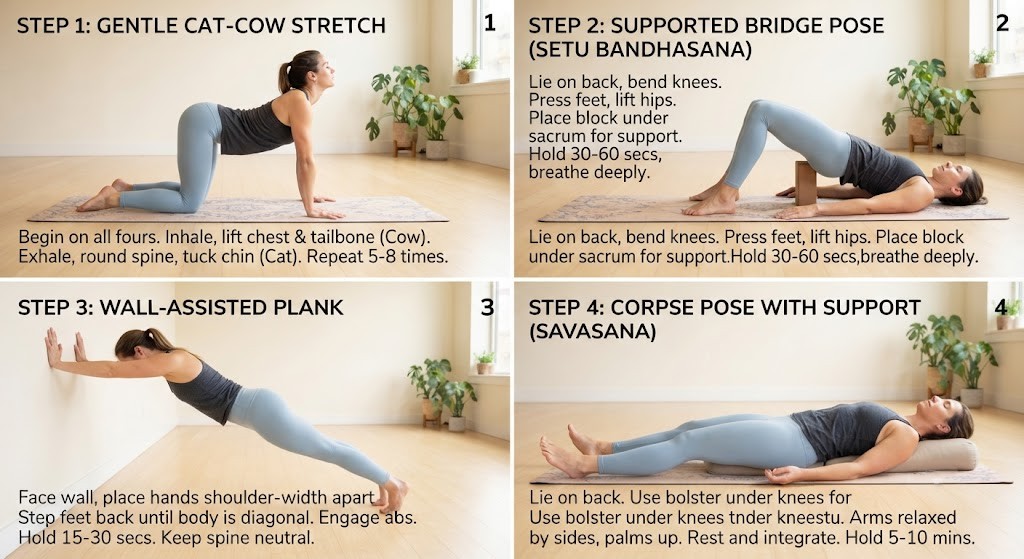
If you have osteoporosis, staying active can support strength, balance, posture, mobility, and overall physical function. But when bones are more fragile, not every yoga pose is appropriate—and some familiar movements may need to be modified to reduce unnecessary stress on the spine and lower the risk of falls.
That is why yoga for osteoporosis should focus on controlled movement rather than extreme flexibility. In this guide, you’ll learn how yoga may fit into a bone-health exercise plan, which poses can be adapted for greater stability, which movements may need to be avoided, how to use yoga props, and how to create a beginner-friendly routine.
What Is Yoga for Osteoporosis?
Yoga for osteoporosis is a modified approach to yoga that emphasizes controlled movement, balance, posture, mobility, and strength while minimizing movements that could increase fracture risk.
Osteoporosis weakens bones and can make certain falls or high-stress movements more concerning, particularly around the spine. As a result, osteoporosis-friendly yoga generally prioritizes stable alignment, controlled transitions, and comfortable ranges of motion rather than achieving deeper or more advanced poses.
For example, a supported standing pose performed beside a wall can help you practice posture and balance without requiring an advanced range of motion.
It is also important to remember that osteoporosis affects people differently. Bone loss, previous fractures, mobility, fitness level, and movement limitations can all influence which exercises are appropriate.
Why Does Yoga Matter for People With Osteoporosis?
Yoga can support balance, posture, mobility, body awareness, and muscular control, but it should generally be considered one part of a broader osteoporosis exercise program.
A 2025 systematic review of 18 randomized controlled trials involving 1,408 participants found that yoga improved balance, although its effect on bone mineral density remained uncertain. Source: [PubMed, 2025].
Balance is particularly important because falls are a major pathway to osteoporotic fractures. Practicing controlled, supported balance movements can help develop stability and body awareness while allowing you to keep a wall or chair nearby.
Yoga may also complement posture exercises, particularly when the objective is controlled movement rather than maximizing flexibility.
Can Yoga Help People With Osteoporosis?
Yoga may help people with osteoporosis improve balance, posture, strength, and movement confidence when the practice is appropriately modified. However, evidence that yoga directly increases bone mineral density remains inconsistent.
For example, one older study followed 30 postmenopausal women with osteoporosis through six months of supervised yoga and reported an improvement in lumbar-spine T-score. Source: [PubMed, 2016].
Although this finding is notable, it does not establish yoga as a replacement for medically recommended osteoporosis treatment or resistance exercise.
Instead, yoga can be viewed as a complementary movement practice that may help address several factors important to safe physical activity.
Can Yoga Increase Bone Density?
Yoga may influence aspects of bone health, but current evidence does not support claiming that yoga reliably increases bone density in people with osteoporosis.
The 2025 systematic review found that only three included trials examined bone mineral density or bone-turnover markers, and pooled results did not demonstrate a significant BMD effect. Source: [PubMed, 2025].
Therefore, yoga is best viewed primarily as a balance, posture, mobility, and strength-supporting activity, while following professional recommendations for bone-loading and resistance exercise.
What Are the Best Yoga Poses for Osteoporosis?
The best yoga poses for osteoporosis are generally controlled and stable movements that emphasize upright posture, balance, gentle strength, and comfortable spinal positioning.
However, there is no universal list of poses that is appropriate for everyone with osteoporosis. Your individual fracture risk, previous injuries, mobility, and professional recommendations should guide the selection.
Mountain Pose
Mountain Pose is a simple standing position that encourages upright posture and body awareness.
Stand with your feet comfortably apart, keep your chest lifted, and allow your shoulders to remain relaxed rather than forcing them backward.
Practicing near a wall can provide additional security while you concentrate on alignment and body position.
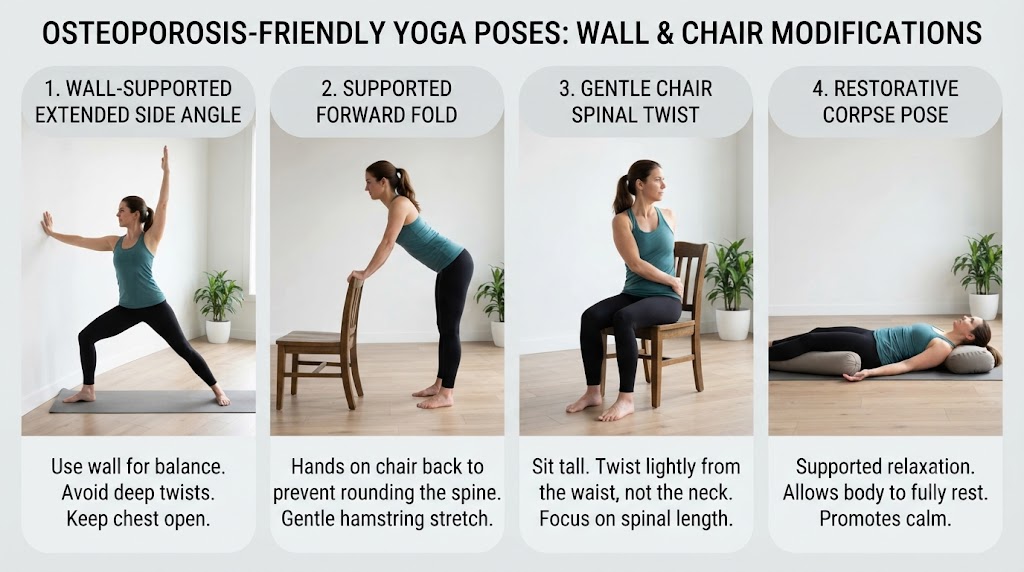
Supported Warrior Pose
A supported Warrior variation can help develop leg strength, hip stability, and balance without requiring extreme flexibility.
Use a wall or chair when necessary and move slowly into a comfortable stance. The goal is not to make the position as deep as possible.
Instead, prioritize control, stability, and comfortable alignment. Reducing the depth of the pose can make it easier to maintain good technique.
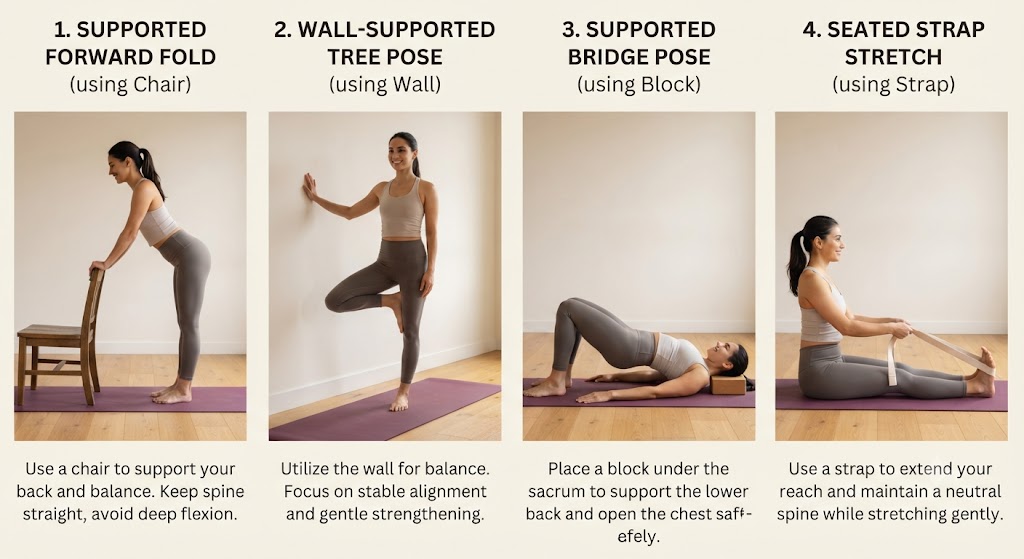
Supported Tree Pose
Tree Pose can provide a simple way to practice balance when performed with appropriate support.
Stand beside a wall or sturdy chair and place only as much weight on one leg as feels stable. If your balance is limited, keep the lifted foot lower instead of placing it high against the opposite thigh.
This modification reduces the balance challenge while allowing you to practice controlled weight shifting.
Supported Bridge
A gentle, supported bridge variation may strengthen the hips and posterior-chain muscles while encouraging comfortable spinal positioning.
Avoid forcing the spine into a large range of motion. If you have a history of vertebral fractures, a qualified healthcare or exercise professional should determine whether this movement is appropriate for you.
| Yoga movement | Potential focus | Helpful modification |
|---|---|---|
| Mountain Pose | Posture and alignment | Practice near a wall |
| Supported Warrior | Leg strength and stability | Reduce depth |
| Supported Tree | Balance | Hold a chair or wall |
| Gentle Bridge | Hip and posterior strength | Use controlled range |
| Supported standing work | Balance and mobility | Keep both hands supported |
Which Yoga Poses Should You Avoid With Osteoporosis?
People with osteoporosis may need to modify or avoid deep spinal flexion, forceful twisting, and extreme ranges of motion depending on their individual fracture risk and medical guidance.
The spine deserves particular attention because repeated or forceful rounding can place additional stress on vulnerable vertebrae.
For example, avoid automatically copying yoga movements that require deep forward bending from the waist. A traditional toe-touch position rounds the spine and is specifically discouraged by the Bone Health & Osteoporosis Foundation for people with osteoporosis. Source: [Bone Health & Osteoporosis Foundation, 2026].
Similarly, forceful or end-range twisting may require modification. The foundation recommends avoiding full trunk rotations and movements that combine twisting with spinal stress. Source: [Bone Health & Osteoporosis Foundation, 2025].
Potentially risky movements may include:
- Deep seated forward folds
- Forceful spinal twists
- Rapid twisting transitions
- Aggressive abdominal crunches
- Extreme end-range movements
- Uncontrolled movements that increase fall risk
However, this does not mean that every yoga movement involving the spine is automatically dangerous.
Technique, intensity, fracture history, movement control, and individual risk all matter. A pose that can be modified safely for one person may not be appropriate for another.
How Should Yoga Poses Be Modified for Osteoporosis?
Yoga modifications for osteoporosis should aim to reduce unnecessary spinal stress while improving stability and movement control.
Useful modifications can include:
- Chairs
- Walls
- Yoga blocks
- Straps
- Bolsters
- Reduced movement ranges
- Slower transitions
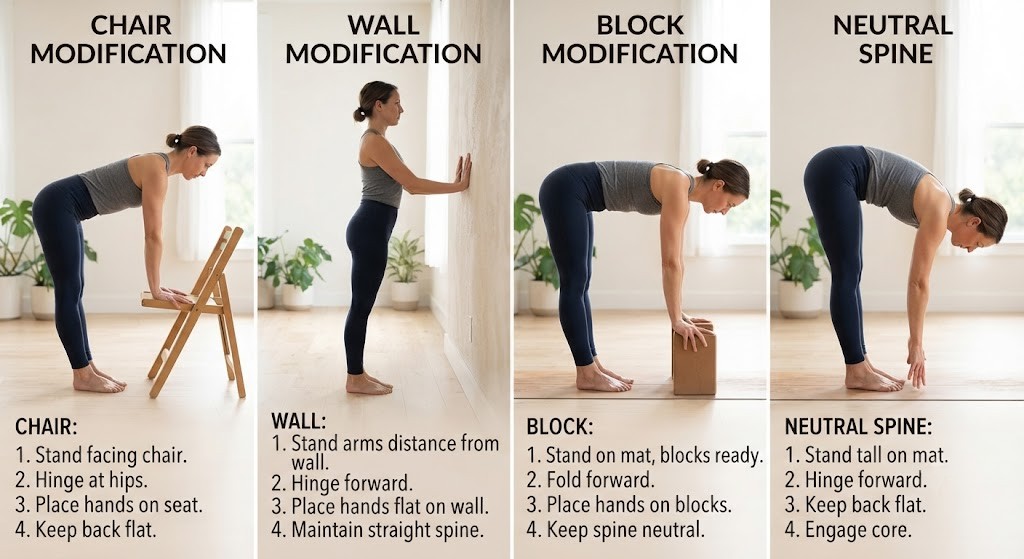
A neutral-spine approach is particularly useful when appropriate. For example, instead of reaching toward the floor with a rounded back, hinge gently from the hips while maintaining a comfortable spinal position.
Props should also be used to improve stability rather than to encourage deeper stretching. A chair can provide balance support during Tree Pose, while blocks can bring the floor closer during standing movements.
In addition, consider working with a physical therapist or instructor trained in osteoporosis-specific exercise. The Bone Health & Osteoporosis Foundation recommends professional guidance for people at high fracture risk. Source: [Bone Health & Osteoporosis Foundation, 2026].
Is Yoga Safe After an Osteoporotic Fracture?
Yoga after an osteoporotic fracture should be individualized and medically guided, particularly when the fracture involves the spine.
People with vertebral fractures may need to avoid forward bending, rapid twisting, heavy loading, and movements that increase fall risk.
For example, the Bone Health & Osteoporosis Foundation advises people with previous osteoporotic spinal fractures to be especially careful with bending forward and rapid twisting. Source: [Bone Health & Osteoporosis Foundation, 2026].
Therefore, do not immediately restart a regular yoga routine after a fracture simply because the movements feel gentle.
A physical therapist or other qualified professional can help determine which positions, ranges of motion, and activities are appropriate for your stage of recovery.
What Is a Beginner Yoga Routine for Osteoporosis?
A beginner yoga routine for osteoporosis should use slow, supported movements that develop posture, balance, mobility, and gentle strength without forcing spinal flexion.
Start gradually and stay within a comfortable, pain-free range.
1. Breathing and Posture — 2 Minutes
Sit or stand comfortably and focus on maintaining an upright, relaxed posture.
Avoid forcing your shoulders backward or creating unnecessary tension. Instead, concentrate on controlled breathing and comfortable alignment.
2. Gentle Warm-Up — 3 Minutes
Move the shoulders, ankles, and hips through comfortable ranges.
Keep the movements slow and controlled rather than using momentum.
3. Mountain Pose — 1 Minute
Practice upright alignment near a wall for additional support.
Keep your feet stable and focus on maintaining comfortable posture.
4. Supported Warrior — 2 Minutes
Practice on each side using a chair or wall if needed.
Keep the stance comfortable and avoid forcing the depth of the position.
5. Supported Tree Pose — 1 Minute
Hold a wall while practicing balance on each side.
If necessary, keep the lifted foot low rather than placing it against the upper thigh.
6. Gentle Standing Strength Work — 3 Minutes
Perform controlled heel raises or other chair-supported movements.
Focus on stability and deliberate movement instead of speed.
7. Relaxation — 2 Minutes
Finish with comfortable breathing while maintaining good posture.
Allow the body to settle without moving into deep forward folds or aggressive stretches.
At first, prioritize consistency over intensity.
International Osteoporosis Foundation guidance notes that many people benefit from approximately 30–40 minutes of exercise three to four times weekly, including weight-bearing and resistance work tailored to individual ability. Source: [International Osteoporosis Foundation, 2024].
What Tools and Practical Support Can Make Yoga Safer?
Yoga props can make osteoporosis-friendly yoga more manageable by improving balance, stability, and positioning.
The purpose of a prop is to help you control the movement—not to push your body farther into a stretch.
Chair
A sturdy chair can provide balance support during standing poses and transitions.
Wall
A wall can provide an easily accessible source of support during balance exercises and standing alignment work.
Yoga Blocks
Blocks can reduce the need to reach toward the floor and can make certain standing positions easier to control.
Strap
A strap can provide positioning assistance without requiring you to force your range of motion.
Supportive Mat
A supportive mat can improve traction and standing stability, particularly during balance-focused movements.
Moreover, an osteoporosis-informed yoga instructor or physical therapist can demonstrate safer alternatives for movements that normally involve spinal flexion or twisting.
What Exercises Are Best for Bone Health Besides Yoga?
Bone-health exercise is broader than yoga and commonly includes weight-bearing, resistance, posture, and balance activities.
The Bone Health & Osteoporosis Foundation identifies weight-bearing and muscle-strengthening exercises as important components for maintaining bone strength. Source: [Bone Health & Osteoporosis Foundation, 2026].
For example, brisk walking can provide low-impact weight-bearing activity, while resistance bands or appropriately prescribed strength exercises can challenge muscles against resistance.
This is why yoga should generally complement, rather than replace, other components of a bone-health exercise plan.
Depending on individual ability and professional recommendations, a broader routine may include:
- resistance training exercises
- Walking or other appropriate weight-bearing activities
- Balance-focused exercises
- Professionally recommended therapeutic exercises
The right combination depends on individual fracture risk, fitness level, medical history, and exercise tolerance.
What Should You Do Before Starting Yoga With Osteoporosis?
Before starting yoga with osteoporosis, consider your fracture risk, previous injuries, symptoms, mobility, and exercise experience with an appropriate healthcare professional.
This is particularly important if you have experienced a fracture or have significant back pain.
1. Understand Your Movement Restrictions
Ask whether you need specific movement restrictions.
For example, someone with a previous vertebral fracture may require substantially different modifications from someone with osteopenia and no fracture history.
2. Begin Gradually
Do not assume that doing more or stretching farther will provide greater benefits.
Start with manageable movements and gradually build your practice as your control and confidence improve.
3. Stay Within a Pain-Free Range
Avoid exercising through pain.
The Bone Health & Osteoporosis Foundation recommends beginning gradually and performing exercises within a pain-free range of motion. Source: [Bone Health & Osteoporosis Foundation, 2026].
4. Prioritize Stability
Keep a chair or wall nearby during balance exercises if needed.
Reducing the risk of a fall is more important than performing an unsupported or advanced variation.
What’s Next: How to Build a Safe Long-Term Yoga Practice
A long-term osteoporosis-friendly yoga practice should prioritize consistency, controlled progression, balance, posture, and strength rather than increasingly difficult flexibility poses.
Your routine should evolve according to your abilities and professional guidance.
For example, you might begin with two or three short sessions each week and gradually increase duration as your technique and confidence improve.
At the same time, continue your broader bone-health plan. Yoga can complement core strengthening exercises, and other professionally recommended activities, but it should not replace prescribed osteoporosis treatment.
The guiding principle is simple:
Osteoporosis-friendly yoga prioritizes quality of movement over depth of movement.
Conclusion
Yoga for osteoporosis can be a useful part of a broader exercise routine when movements are appropriately modified for bone health, balance, posture, strength, and individual fracture risk.
Supported standing poses, controlled balance work, and neutral-spine movements can provide practical movement benefits without making deep flexibility the primary goal.
Most importantly, safety should come before complexity. Avoid forceful spinal flexion, aggressive twisting, uncontrolled transitions, and exercises that increase fall risk. If you have osteoporosis, a history of fragility fractures, or significant pain, seek individualized guidance before beginning or changing your yoga routine.
With gradual progression and appropriate modifications, yoga can become a supportive part of a long-term approach to movement, confidence, balance, and healthy aging.
FAQs
Which yoga is best for osteoporosis?
Gentle, modified yoga with supported poses, balance work, and a neutral spine is generally the best choice.
Which yoga poses should you avoid with osteoporosis?
Avoid deep forward bends, forceful twists, rapid twisting, and extreme movements that may stress the spine.
What do Japanese do for osteoporosis?
They generally focus on exercise, balanced nutrition, fall prevention, medical care, and prescribed treatment when needed.
What are the top 5 exercises for osteoporosis?
Walking, resistance training, balance exercises, posture exercises, and appropriate weight-bearing activities are commonly recommended.
Is yoga good for osteoporosis?
Yes, modified yoga can support balance, posture, mobility, and strength.
Can yoga increase bone density with osteoporosis?
Current evidence is insufficient to show that yoga reliably increases bone mineral density.
Can you do yoga after an osteoporotic fracture?
Yes, but appropriate modifications and professional guidance are important, especially after a spinal fracture.
Is yoga safe for osteoporosis of the spine?
Modified yoga may be suitable, but deep bending and forceful twisting should generally be avoided.
Can I do Tree Pose if I have osteoporosis?
Yes, a supported Tree Pose can help practice balance using a wall or sturdy chair.
Should people with osteoporosis avoid forward bends in yoga?
Deep forward bends may need to be avoided, particularly after vertebral fractures.
How often should you do yoga for osteoporosis?
Frequency depends on your abilities, health status, and overall exercise program.
What equipment is useful for osteoporosis-friendly yoga?
A chair, wall, yoga blocks, strap, and supportive mat can improve stability and control.