
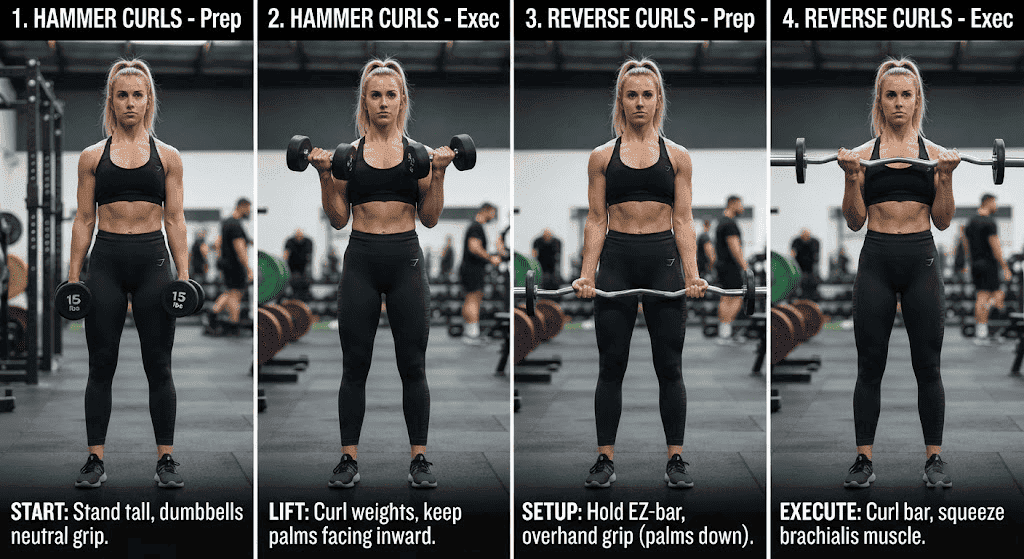
If you already train curls regularly but your arms still lack the thickness you want, your biceps may not be the only muscle worth focusing on. The brachialis sits beneath the biceps and plays an important role in elbow flexion, making it a valuable muscle to train when your goal is fuller-looking upper arms.
A well-designed brachialis workout for bigger arms combines effective curl variations, controlled technique, appropriate training volume, progressive overload, and sufficient recovery. In this guide, you’ll learn where the brachialis is located, why it matters for arm size, which exercises target it, how many sets and reps to perform, how often to train it, and how to build it into a complete arm routine.
What Is the Brachialis Muscle and Where Is It Located?
The brachialis is a primary elbow-flexor muscle located beneath the biceps that contributes to upper-arm thickness. It sits on the front of the upper arm and attaches from the humerus to the ulna, helping bend the elbow regardless of whether your palm faces up, down, or inward.
Moreover, the brachialis is considered a “pure” elbow flexor because it does not perform forearm supination or pronation. For example, when you bend your elbow during a hammer curl, the brachialis contributes strongly to the movement.
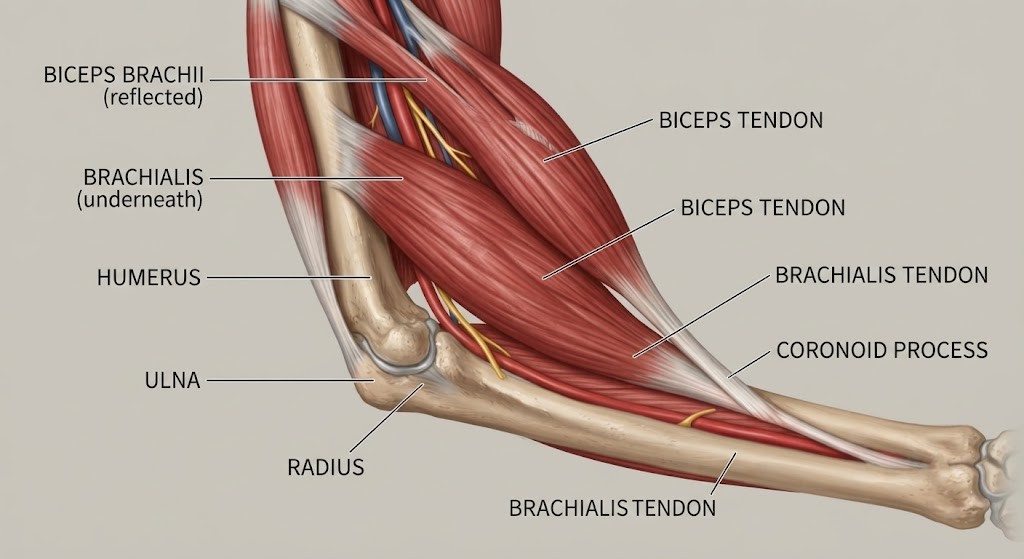
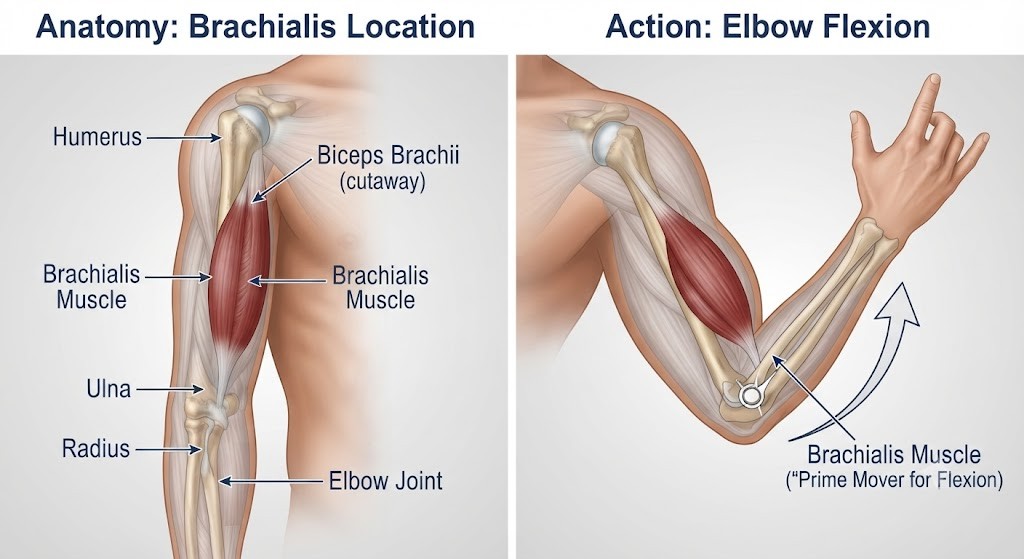
Understanding the brachialis is useful because it explains why simply adding more traditional supinated curls is not necessarily the best way to maximize overall arm development. Different curl grips can change the contribution of the muscles involved in elbow flexion.
Why Is the Brachialis Important for Bigger Arms?
The brachialis is important for bigger arms because developing this underlying elbow flexor can add thickness beneath and around the biceps. A well-developed brachialis can make the upper arm appear fuller, especially when viewed from the side.
Because the brachialis lies underneath the biceps, building it can contribute to the overall appearance of a more substantial upper arm. However, its development should be viewed as one part of a complete arm-building strategy.
At the same time, brachialis training does not replace biceps or triceps training. Building bigger arms requires developing the brachialis alongside the biceps and triceps rather than relying on a single muscle or exercise.
What Are the Best Brachialis Exercises for Muscle Growth?
The best brachialis exercises are controlled elbow-flexion movements that allow you to progressively increase training difficulty without sacrificing technique. Hammer curls, cross-body hammer curls, reverse curls, preacher hammer curls, and cable hammer curls are practical options.
Here is a simple comparison of useful movements:
| Exercise | Grip | Sets | Reps | Main Focus |
|---|---|---|---|---|
| Hammer Curl | Neutral | 3 | 8–12 | Brachialis + biceps |
| Cross-Body Hammer Curl | Neutral | 3 | 10–15 | Brachialis + brachioradialis |
| Reverse Curl | Pronated | 2–3 | 10–15 | Brachialis + forearms |
| Preacher Hammer Curl | Neutral | 2–3 | 8–12 | Controlled elbow flexion |
| Cable Hammer Curl | Neutral | 2–3 | 10–15 | Constant resistance |
Do Hammer Curls Build the Brachialis?
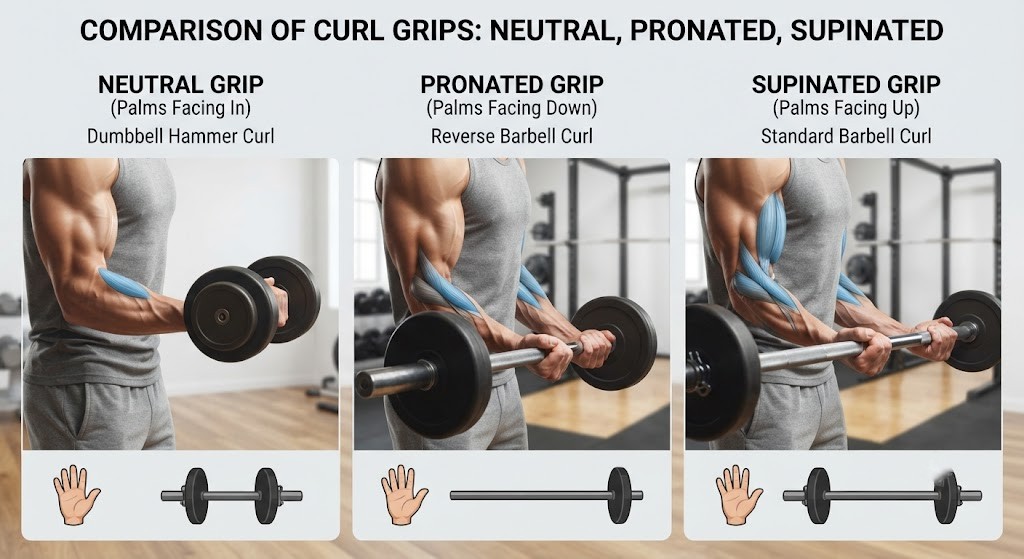
Yes, hammer curls are a practical exercise for training the brachialis. They use a neutral hand position while repeatedly loading elbow flexion, allowing the brachialis to contribute alongside the biceps and brachioradialis.
Hammer curls use a neutral grip that can effectively train the brachialis while also involving the biceps and brachioradialis.
To perform them, hold dumbbells with your palms facing each other and curl without rotating your wrists. Research on elbow-flexor activity confirms that the brachialis remains active during resisted elbow flexion across different forearm positions.
Are Cross-Body Hammer Curls Good for the Brachialis?
Cross-body hammer curls are another practical option when you want to add variety to a brachialis-focused routine. The neutral grip maintains the characteristic hammer-curl position while the arm travels toward the opposite side of the body.
They can also involve the brachioradialis, making them useful when you want to develop the muscles that contribute to overall upper- and lower-arm thickness.
Are Reverse Curls Good for the Brachialis?
Reverse curls are useful for brachialis-focused training because their pronated grip reduces the mechanical advantage of the biceps during elbow flexion. For example, gripping an EZ-bar with your palms facing downward can shift more emphasis toward the brachialis and brachioradialis.
However, reverse curls also train the forearms, so they should complement rather than completely replace neutral-grip curls. You can pair them with forearm workout exercises when grip and lower-arm development are also priorities.
Are Preacher Hammer Curls Effective?
Preacher hammer curls provide a supported setup that can make it easier to keep the upper arm relatively stable while performing elbow flexion. This can be particularly useful when you want to focus on controlled repetitions rather than using momentum.
Because the movement is more constrained, use a load that allows you to maintain consistent technique throughout the set.
Can Cable Hammer Curls Train the Brachialis?
Cable hammer curls are another option for adding direct elbow-flexion work to a brachialis workout. The cable setup provides resistance throughout the movement and can make it easier to maintain a consistent loading pattern.
They are especially useful when you want to vary your equipment while continuing to train with a neutral grip.
How Should You Perform Brachialis Exercises With Proper Form?
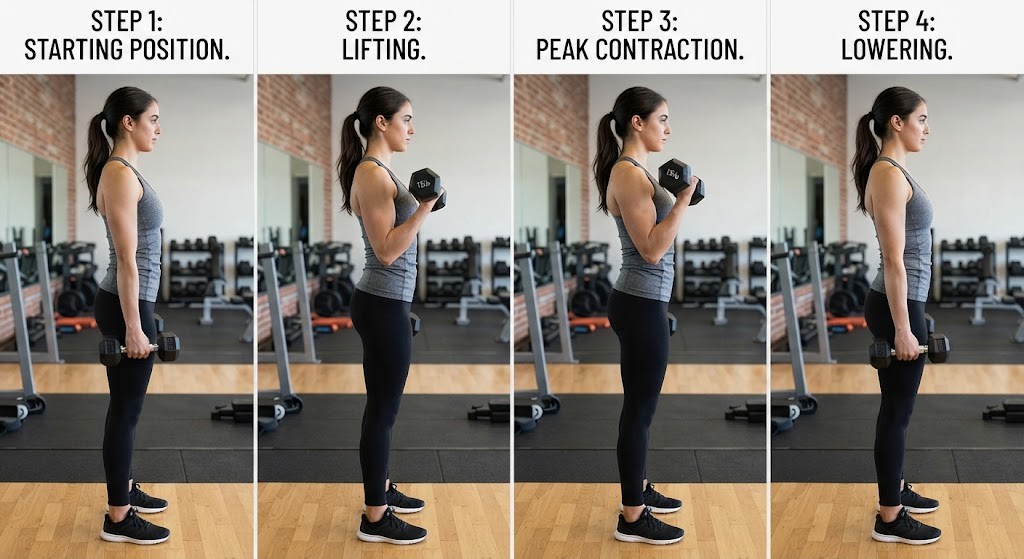
Proper brachialis exercise form means keeping the upper arm relatively stable, controlling the weight, and moving through a comfortable elbow range of motion. Brachialis training involves progressively challenging elbow-flexion exercises while maintaining controlled technique and an appropriate range of motion.
Rather than chasing maximum weight, focus on making each repetition consistent. Your elbows should remain reasonably controlled, your torso should stay stable, and the lowering portion should not be rushed.
How to Perform a Hammer Curl
First, stand or sit upright with a dumbbell in each hand and keep your palms facing inward. Next, brace your core and keep your elbows close to your torso.
Then, curl the dumbbells by bending your elbows without swinging your shoulders forward. Finally, lower the weights slowly until your elbows reach a comfortable extended position.
Avoid these common mistakes:
- Swinging the torso to lift heavier weights
- Moving the elbows excessively
- Shortening the lowering phase
- Using more weight than you can control
- Turning the movement into a shoulder raise
Why Does Grip Matter During Brachialis Training?
Grip can influence how the muscles involved in elbow flexion contribute to a movement. Neutral-grip and pronated-grip curls are commonly included in brachialis-focused programs because they reduce the emphasis on forearm supination compared with a traditional supinated curl.
However, no curl completely isolates the brachialis. The biceps, brachialis, and brachioradialis can all contribute to elbow flexion, so it is more accurate to think in terms of emphasis rather than complete isolation.
How Many Sets and Reps Should You Do for the Brachialis?
A practical starting point for brachialis hypertrophy is 2–4 sets per exercise for roughly 8–15 controlled repetitions, adjusted according to your experience, exercise selection, and total arm-training volume.
In 2026, the American College of Sports Medicine summarized evidence from 137 systematic reviews involving more than 30,000 participants and recommended approximately 10 weekly sets per muscle group as a useful hypertrophy-oriented target, while emphasizing that individual programming should be adjusted to the person. — Source: American College of Sports Medicine, 2026
Therefore, you do not need to perform dozens of brachialis sets. Start with a manageable amount of direct work while counting the indirect elbow-flexion volume you already receive from other exercises.
For example, two weekly sessions containing 3 direct brachialis-focused sets each can provide 6 direct sets per week, with additional stimulation coming from other pulling and curling movements.
For a broader plan, consider a hypertrophy workout plan.
How Often Should You Train the Brachialis for Bigger Arms?
Training the brachialis two times per week is a practical starting point for many lifters because it distributes training volume rather than concentrating everything into one session.
At the same time, your ideal frequency depends on total arm volume and recovery. If your elbows remain sore or your performance declines between sessions, reduce volume or increase recovery time.
The 2026 ACSM position stand emphasizes that consistency matters more than unnecessarily complicated programming. — Source: American College of Sports Medicine, 2026
You can also use a muscle recovery after workouts to improve how you manage training fatigue.
How Do You Add Brachialis Exercises to a Biceps Workout?
Brachialis exercises fit best after your primary biceps movement or as a secondary exercise that complements your existing curl selection. The goal is to add useful stimulus without repeating several movements that train the same elbow-flexion pattern.
If your current workout already contains several curling movements, you may not need a large amount of additional direct brachialis work. Instead, replace one redundant curl variation with a neutral- or pronated-grip movement.
Beginner Brachialis Workout
For beginners, try this simple routine:
- Dumbbell Hammer Curl: 3 × 10–12
- Alternating Supinated Curl: 3 × 8–12
- Reverse Curl: 2 × 12–15
Rest approximately 60–120 seconds between sets and prioritize consistent technique over heavier weights.
Intermediate Brachialis Workout
For intermediate lifters, try:
- Hammer Curl: 3 × 8–12
- Preacher Hammer Curl: 3 × 10–12
- Reverse EZ-Bar Curl: 2 × 12–15
- Cable Hammer Curl: 2 × 12–15
This routine provides 10 direct working sets, so account for your other biceps, back, and pulling exercises when planning weekly volume.
How Should Advanced Lifters Approach Brachialis Training?
Advanced lifters generally benefit from treating brachialis work as part of their total elbow-flexor volume rather than automatically adding more exercises.
For example, if heavy pulling movements and several biceps exercises already provide substantial elbow-flexion work, adding multiple extra brachialis movements may create unnecessary fatigue. Instead, select one or two exercises that complement the rest of your program and progress them consistently.
What Are the Most Common Brachialis Training Mistakes?
The most common brachialis training mistakes are using excessive weight, swinging the body, shortening the range of motion, and performing too much direct volume. Better technique usually creates a more repeatable training stimulus than simply adding heavier dumbbells.
For example, if you must lean backward to complete a 10-kilogram hammer curl, reducing the load may allow you to perform the same repetitions with greater control.
Additionally, avoid assuming that a particular grip completely isolates the brachialis. Elbow-flexion exercises involve multiple muscles, and research shows coordinated activity among the biceps, brachialis, and brachioradialis.
Common Mistake: Using Too Much Weight
Heavy weights are not automatically better for muscle growth if they force you to change the movement. If your torso swings or your shoulders take over, the exercise becomes less consistent.
Choose a load that allows you to complete your target repetitions with controlled movement.
Common Mistake: Training Only the Brachialis
The brachialis can contribute to upper-arm thickness, but it is not the only muscle responsible for bigger arms. Your program should also include appropriate biceps and triceps training.
A complete arm routine should therefore distribute attention across all major contributors to arm size.
Common Mistake: Ignoring Recovery
More sets are not always better. If your performance continually declines, your elbows remain sore, or you cannot maintain good technique, your current workload may be more than you can recover from effectively.
Adjust your training volume and frequency according to how you respond.
Can Training the Brachialis Make Your Arms Look Thicker?
Training the brachialis can contribute to thicker-looking arms because the muscle occupies a substantial portion of the deep anterior upper arm. However, visible arm growth depends on total muscle development, training consistency, nutrition, and genetics rather than brachialis training alone.
For example, someone with well-developed biceps but underdeveloped triceps may still have less overall arm circumference than someone who trains all three major arm contributors effectively.
This is why the best brachialis workout for bigger arms should be part of a broader hypertrophy program rather than treated as a standalone solution.
What Tools Can You Use for a Brachialis Workout?
Dumbbells, cables, EZ-bars, benches, and resistance bands can all provide effective equipment options for brachialis training. The equipment matters less than whether you can perform the movement safely and progressively increase its training demand.
Moreover, the 2026 ACSM review found that traditional gym equipment is not mandatory for producing meaningful resistance-training benefits, with bands and home-based training also capable of improving strength and hypertrophy. — Source: American College of Sports Medicine, 2026
Can You Train the Brachialis at Home?
Yes. Dumbbells and resistance bands can provide enough resistance to perform practical elbow-flexion exercises at home.
A home-based routine can include:
- Dumbbell hammer curls
- Cross-body hammer curls
- Resistance-band hammer curls
- Resistance-band reverse curls
The key is to maintain controlled technique and progressively increase the training challenge as your strength improves.
How Can You Progress a Brachialis Workout for Better Results?
Progressive overload means gradually increasing the training demand placed on your muscles while maintaining effective technique. Progressive overload, adequate recovery, and consistent resistance training are key factors for supporting brachialis hypertrophy.
Start by tracking your sets, repetitions, and weights. When you can complete the upper end of your target range with clean form, increase the load slightly and rebuild your repetitions.
For example, if you perform hammer curls for 3 × 10–12 and reach 12, 12, and 12 with strong technique, increase the weight modestly during your next session.
Use a progressive overload for muscle growth to structure this progression.
A Simple Brachialis Progression Method
Use this approach to make progression easier to track:
- Choose a brachialis-focused exercise.
- Select a repetition range, such as 8–12.
- Keep the same exercise for several weeks.
- Record every working set.
- Gradually increase repetitions while maintaining technique.
- Once you consistently reach the upper end, increase the load modestly.
- Repeat the process.
This approach helps you measure progress without constantly changing exercises.
How Important Is Protein for Building Bigger Arms?
Training provides the stimulus for muscle growth, while nutrition provides the resources needed to support adaptation. Protein is therefore an important part of a muscle-building strategy.
A meta-analysis of 49 studies involving 1,863 participants found that protein supplementation improved gains in fat-free mass and strength during resistance training, with benefits generally plateauing around 1.6 g/kg/day of total protein intake. — Source: Morton et al., 2018
A high protein diet for muscle growth can help you build an appropriate nutrition strategy alongside your training.
However, protein is only one component of the bigger picture. Sufficient overall food intake, consistent resistance training, recovery, and long-term adherence all matter when the goal is to increase muscle size.
How Long Does It Take to Build Bigger Arms?
Arm development is a gradual process rather than an overnight change. Your results depend on factors such as training consistency, progression, nutrition, recovery, previous training experience, and genetics.
Instead of judging progress from one workout or one week, track your performance over time. Improvements in repetitions, resistance, technique, and eventually measurements can provide a more useful picture of progress.
What’s Next: How Should You Build Bigger Arms?
Your next step is to choose one or two brachialis exercises, add them to your existing arm routine, and track performance for several weeks. A simple, consistent program is usually more useful than constantly changing exercises.
Try this progression:
- Choose hammer curls as your primary brachialis movement.
- Perform 2–3 working sets twice per week.
- Stay mostly within the 8–15 repetition range.
- Record every working set.
- Increase repetitions before adding small amounts of weight.
- Keep technique consistent as loads increase.
- Measure your arm circumference periodically under the same conditions.
Conclusion
A brachialis workout for bigger arms can help develop an important elbow-flexor muscle that sits beneath the biceps and contributes to upper-arm thickness. Hammer curls, cross-body hammer curls, reverse curls, preacher hammer curls, and cable variations provide practical ways to train it.
However, bigger arms require more than isolated brachialis exercises. Consistent resistance training, progressive overload, sufficient protein and calories, quality recovery, and patience all contribute to long-term muscle growth.
Start with a manageable amount of direct brachialis work, master your technique, and gradually increase the training demand. Your goal is not simply to perform more curls—it is to create a consistent stimulus that your muscles can adapt to over time.
FAQs
What is a brachialis workout for bigger arms?
Exercises that target the brachialis, such as hammer curls and reverse curls, to add upper-arm thickness.
What is the best exercise for the brachialis?
Hammer curls are a practical exercise for effectively training the brachialis.
Do hammer curls build the brachialis?
Yes, hammer curls train the brachialis along with the biceps and brachioradialis.
Are reverse curls good for the brachialis?
Yes, reverse curls train the brachialis while also working the forearms.
How many sets should I do for the brachialis?
Start with 2–4 sets per exercise for controlled muscle-building work.
How often should I train the brachialis?
Training the brachialis twice per week is a practical starting point.
Does brachialis make arms bigger?
Yes, developing the brachialis can add thickness and fullness to the upper arms.
How to increase brachialis size?
Use hammer curls, reverse curls, progressive overload, and consistent resistance training.
What muscle takes up 70% of your arm?
The 70% triceps claim is an oversimplification because multiple muscles contribute to arm size.
How do I get 20 inch arms?
Build the biceps, triceps, and brachialis with progressive training, proper nutrition, and recovery.
Can I train the brachialis at home?
Yes, dumbbells and resistance bands can effectively train the brachialis.
What rep range is best for brachialis growth?
A practical range is 8–15 controlled repetitions per set.
Do I need special equipment for a brachialis workout?
No, dumbbells, cables, EZ-bars, and resistance bands can all work.
How do I progress my brachialis workout?
Gradually increase repetitions or resistance while maintaining proper form.
1 thought on “Brachialis Workout for Bigger Arms: Build Thickness & Strength”