
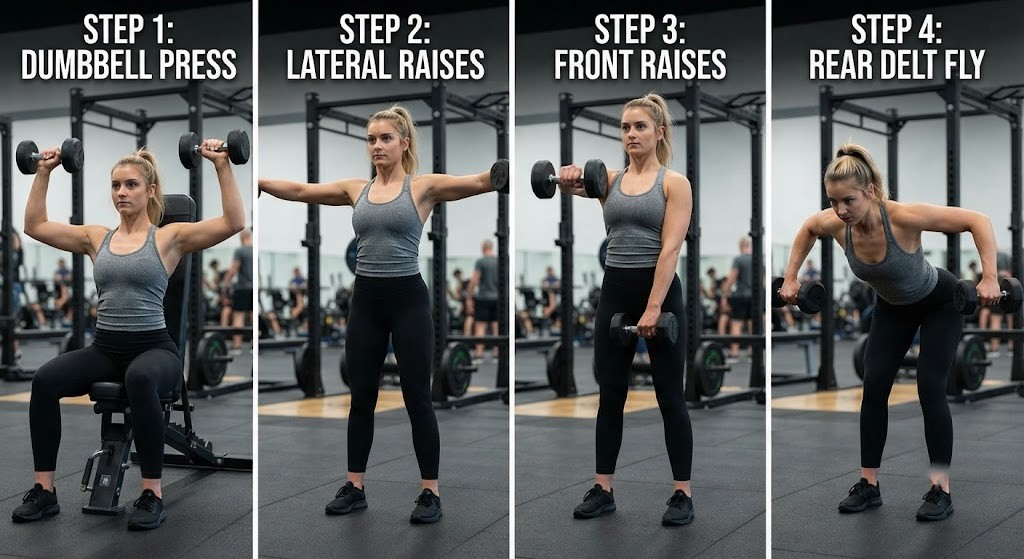
If you already perform shoulder presses and lateral raises, you’re covering some of the fundamentals of shoulder training. However, developing shoulders that look wide, round, and muscular from every angle requires more than simply lifting heavy weights overhead.
A well-designed 3D shoulder workout trains all three heads of the deltoid—the anterior, lateral, and posterior deltoids—while balancing compound pressing with targeted isolation exercises. This approach can help create better shoulder proportions, improve upper-body symmetry, and build the rounded shoulder appearance many lifters want.
In this guide, you’ll learn what a 3D shoulder workout is, how to train each deltoid head, which exercises are most useful, how many sets and reps to perform, how often to train your shoulders, and how to progressively overload your workouts without sacrificing technique.
What Is a 3D Shoulder Workout?
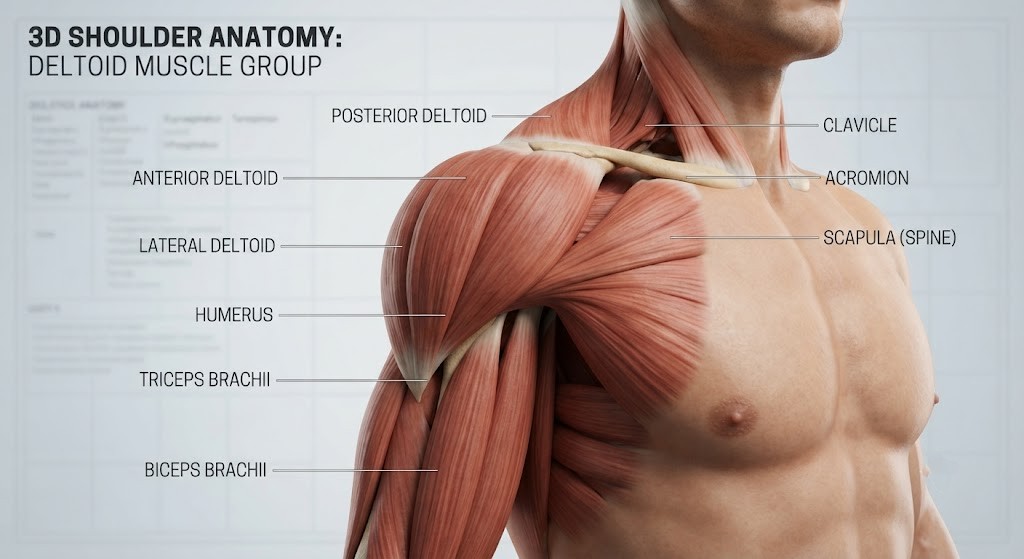
A 3D shoulder workout is a training approach that develops the anterior, lateral, and posterior deltoids to create a broader, fuller, and more rounded shoulder appearance. The term “3D shoulders” does not refer to a separate muscle. Instead, it describes the visual result of balanced development across the three major heads of the deltoid.
The three deltoid heads perform different functions and respond to different movement patterns.
Anterior Deltoid
The anterior deltoid, commonly called the front delt, is located at the front of the shoulder. It contributes to shoulder flexion and plays an important role during pressing movements.
For example, an overhead press strongly involves the front delts while also training other muscles involved in the movement.
Lateral Deltoid
The lateral deltoid, or side delt, sits on the outer portion of the shoulder. Developing this region is particularly important for creating the appearance of greater shoulder width.
A controlled dumbbell or cable lateral raise moves the arm away from the body and provides targeted resistance for the lateral delts.
Posterior Deltoid
The posterior deltoid, also known as the rear delt, sits at the back of the shoulder. It contributes to horizontal arm movement and shoulder extension.
Exercises such as reverse flyes can emphasize the rear delts without requiring the heavy loads typically used for pressing exercises.
Therefore, a complete 3D shoulder workout should include movements that collectively address all three regions rather than relying on a single exercise.
For more width-focused programming, see our shoulder workout.
Why Does 3D Shoulder Training Matter?
3D shoulder training matters because balanced deltoid development can improve shoulder width, upper-body proportions, symmetry, and overall physique aesthetics. Well-developed shoulders can make the upper body appear broader even when overall body size remains unchanged.
This is one reason shoulder training is often an important part of physique-focused resistance training. Developing the side and rear delts alongside the front delts can create a more complete appearance than focusing primarily on overhead pressing.
Resistance training also produces measurable improvements in muscle size, although individual results vary. A 2020 meta-analysis of 111 studies involving 1,927 participants found that resistance training significantly increased muscle mass, with an average increase of about 1.53 kg across the included studies.
Source: Systematic Review and Meta-Analysis, 2020.
However, training is only one factor that determines shoulder shape. Genetics, clavicle width, muscle insertions, body-fat levels, posture, and the development of the chest and back can all influence how your shoulders ultimately look.
For example, two people can follow the same round shoulder workout and develop noticeably different shoulder shapes because their skeletal structures and muscle proportions differ.
That means the goal of 3D shoulder training should not be to copy another person’s exact appearance. Instead, focus on maximizing your own shoulder development through effective exercise selection, progressive overload, and consistency.
How Do You Train All Three Deltoid Heads?
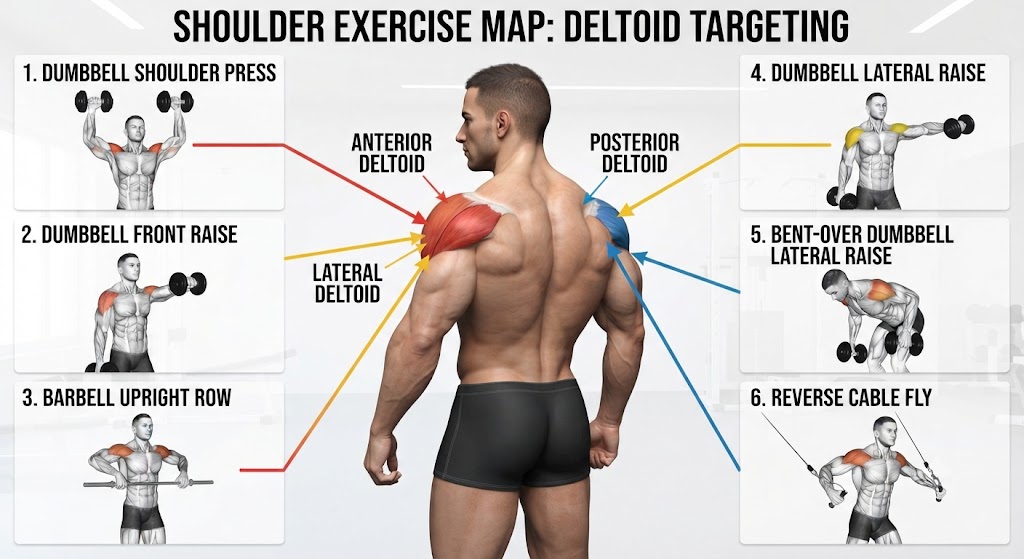
You train all three deltoid heads by combining pressing movements, lateral raises, and rear-delt exercises rather than relying on one movement. Each category provides a different training stimulus.
A balanced shoulder workout generally includes:
- A compound pressing movement for overall shoulder development.
- A lateral-delt movement for shoulder width.
- A rear-delt movement for posterior shoulder development.
- Appropriate training volume for continued progression.
- Sufficient recovery between demanding sessions.
Let’s look at each deltoid head more closely.
How Do You Train the Front Delts?
Front-delt training is best supported by overhead pressing and other shoulder-flexion movements. Exercises such as the barbell overhead press and dumbbell shoulder press allow you to use relatively challenging loads while training the anterior deltoids.
For example, perform a dumbbell shoulder press for 3 sets of 6–10 controlled repetitions, keeping your torso stable and avoiding excessive lower-back arching.
However, direct front-delt isolation may not always be necessary. The anterior deltoids already contribute significantly during chest pressing movements such as bench presses.
If your training program includes substantial chest pressing, you may already be providing your front delts with considerable indirect training volume.
How Do You Train the Lateral Delts?
Lateral raises primarily target the lateral deltoids, which contribute significantly to the visual appearance of shoulder width. This makes them a central exercise category in a shoulder workout for width.
For example, perform a cable lateral raise for 3 sets of 10–15 repetitions. Raise the arm smoothly while keeping the torso controlled instead of using excessive momentum to move the weight.
Because lateral raises are an isolation movement, the goal is not to move the heaviest possible dumbbell or cable load. Instead, focus on maintaining consistent technique and directing the training stimulus toward the side delts.
Moreover, you can explore more variations in our lateral delt exercises.
How Do You Train the Rear Delts?
Rear-delt exercises develop the posterior deltoids and help create balanced shoulder development when combined with pressing and lateral-raise movements.
Reverse pec-deck flyes and cable rear-delt flyes are practical choices because they allow you to use controlled resistance while focusing on the rear shoulder.
For example, perform a reverse pec deck for 3 sets of 12–15 repetitions while focusing on moving your upper arms rather than aggressively pulling with your hands.
Rear-delt training can be particularly valuable in programs dominated by pressing exercises because pressing tends to emphasize the front of the shoulder more than the rear.
For additional exercise options, see our rear delt exercises.
What Exercises Are Best for 3D Shoulder Development?
The best exercises for 3D shoulder development are movements that collectively train pressing strength, lateral-delt width, and rear-delt development. No single exercise completely develops every aspect of the shoulder.
| Exercise | Primary Focus | Suggested Reps |
|---|---|---|
| Overhead Press | Front delts + overall pressing | 6–10 |
| Dumbbell Shoulder Press | Front delts + overall development | 6–10 |
| Cable Lateral Raise | Lateral delts | 10–15 |
| Dumbbell Lateral Raise | Lateral delts | 10–20 |
| Machine Lateral Raise | Lateral delts | 10–15 |
| Reverse Pec Deck | Rear delts | 12–20 |
| Cable Rear-Delt Fly | Rear delts | 12–20 |
| Face Pull | Rear delts + upper back | 12–20 |
Each movement serves a different purpose within a complete shoulder program.
Compound Shoulder Presses
Compound presses provide efficient overall shoulder training and are useful when strength and muscle growth are priorities.
Overhead presses and dumbbell shoulder presses allow you to handle relatively challenging loads while training the front delts and other muscles involved in shoulder pressing.
Lateral-Raise Variations
Lateral-raise variations provide targeted work for the outer delts, making them particularly valuable for a shoulder cap workout.
Cable, dumbbell, and machine variations can all be used. The most important factor is your ability to perform the exercise with controlled movement and consistent technique.
Rear-Delt Movements
Rear-delt movements fill an important programming gap that can occur when a routine relies heavily on pressing.
Reverse pec decks, cable rear-delt flyes, and face pulls provide options for training the posterior portion of the shoulder while also supporting balanced upper-body development.
What Is the Best 3D Shoulder Workout for Muscle Growth?
An effective 3D shoulder workout combines one pressing movement with lateral- and rear-delt exercises while keeping total training volume recoverable.
A practical intermediate session can look like this:
- Dumbbell Shoulder Press — 3 × 6–10, rest 2–3 minutes
- Cable Lateral Raise — 3 × 10–15, rest 60–90 seconds
- Machine Lateral Raise — 2 × 12–20, rest 60–90 seconds
- Reverse Pec Deck — 3 × 12–20, rest 60–90 seconds
- Cable Rear-Delt Fly — 2 × 12–20, rest 60–90 seconds
This structure gives you a combination of heavier compound work and higher-repetition isolation training.
Why Start With the Shoulder Press?
Start with the compound press because it requires more coordination and usually benefits from greater energy availability.
Performing the shoulder press first also allows you to focus on technique and progressive overload before fatigue accumulates from isolation exercises.
Why Train the Lateral Delts in the Middle?
Next, perform lateral-delt work when you can concentrate on controlled movement and a consistent range of motion.
Because lateral raises are primarily intended to target the side delts, maintaining control is generally more important than using very heavy resistance.
Why Finish With Rear-Delta Exercises?
Finally, finish with rear-delt exercises because these movements generally work well with lighter loads and deliberate execution.
The order can be adjusted when necessary, particularly if rear-delt development is a major priority or if equipment availability affects your gym session.
The 2026 ACSM resistance-training position stand reviewed 137 systematic reviews representing more than 30,000 participants and suggests approximately 10 weekly sets per muscle group as a useful hypertrophy-oriented starting point, while emphasizing individualization.
Source: ACSM, 2026.
For more programming detail, see our hypertrophy workout.
Are Lateral Raises Good for Building Wider Shoulders?
Lateral raises are highly useful for building the appearance of wider shoulders because they directly train the lateral deltoids. Their value comes from targeted loading rather than the amount of weight you can move.
For example, a 10- to 15-repetition cable lateral raise performed with strict control can be more productive for the lateral delts than a much heavier movement performed with substantial momentum.
This is particularly relevant when your goal is a broader shoulder silhouette. The lateral delts sit toward the outside of the shoulder, so developing them can contribute to the visual appearance of shoulder width.
Moreover, you do not need extremely heavy weights to stimulate muscle growth. A systematic review and meta-analysis of 45 studies found similar hypertrophy from higher- and lower-load resistance training, although heavier loads produced greater improvements in maximal strength.
Source: Schoenfeld et al., 2021.
By controlling the eccentric phase and avoiding excessive swinging, you can keep the lateral delts involved throughout the movement.
If you find yourself using your legs, torso, or excessive momentum to complete repetitions, reduce the resistance and focus on performing cleaner repetitions.
How Do You Progress for Bigger and Rounder Shoulders?
Progressive overload means gradually increasing the training challenge while maintaining effective technique. Progress does not always mean dramatically increasing the weight.
You can progress by:
- Increasing repetitions within your target range.
- Slightly increasing resistance.
- Improving movement control.
- Maintaining a better range of motion.
- Adding recoverable training volume when appropriate.
- Improving consistency across workouts.
Use Double Progression
First, use a double-progression approach.
For example, if your target is 10–15 repetitions, work toward completing 15 repetitions with consistent form before increasing the weight. After increasing resistance, return toward the lower end of the repetition range and gradually build back up.
This approach works particularly well for isolation exercises such as lateral raises because it prevents you from constantly chasing heavier weights.
Track Your Training
Second, track your exercises, sets, repetitions, and loads.
A training log makes it easier to determine whether your performance is actually improving over time. Without tracking, it can be difficult to distinguish genuine progression from simply having a good workout.
Prioritize Technique Over Ego
Third, avoid turning every isolation movement into a strength test.
Good lateral raises usually require control more than impressive numbers on the dumbbell rack. If increasing the load causes excessive swinging or changes the movement pattern, the heavier weight may not provide a better stimulus.
Our progressive overload for muscle growth guide can help you build a more systematic progression strategy.
How Many Sets and Reps Should You Do for 3D Shoulders?
A practical 3D shoulder workout can use roughly 8–12 challenging weekly sets distributed across pressing, lateral-delt, and rear-delt movements, then adjust volume according to recovery and progress.
The ideal amount varies based on training experience, existing indirect shoulder work, and individual response.
For example, a lifter who already performs several chest presses may need fewer direct front-delt sets than someone whose program contains little pressing.
Likewise, someone who trains shoulders alongside a high-volume upper-body routine may need less direct work than someone whose weekly program has relatively little shoulder stimulation.
Recommended Repetition Ranges
Repetitions can vary considerably depending on the exercise.
| Exercise Type | Practical Rep Range |
| Overhead presses | 6–10 |
| Dumbbell shoulder press | 6–10 |
| Cable lateral raises | 10–15 |
| Dumbbell lateral raises | 10–20 |
| Machine lateral raises | 10–15 |
| Reverse pec deck | 12–20 |
| Cable rear-delt fly | 12–20 |
| Face pulls | 12–20 |
Compound presses commonly fit well around 6–10 repetitions, while lateral- and rear-delt isolation exercises often work comfortably around 10–20 repetitions.
ACSM’s 2026 guidance identifies approximately 10 weekly sets per muscle group as a useful hypertrophy-oriented target, while emphasizing that training should be personalized rather than rigid.
Source: ACSM, 2026.
How Often Should You Train Shoulders for Muscle Growth?
Most lifters can train shoulders one to two times per week, depending on how much indirect shoulder work their program already contains.
Frequency should support high-quality training and recovery rather than simply adding more sessions.
For example, you could perform a dedicated shoulder session on Monday and add a smaller lateral- and rear-delt session later in the week.
Another option is to distribute shoulder exercises across upper-body sessions. This can make it easier to manage fatigue while still accumulating productive weekly volume.
Moreover, research suggests that when weekly training volume is equated, training frequency itself does not appear to meaningfully determine hypertrophy outcomes, allowing frequency to be selected around preference and recovery.
Source: Schoenfeld et al., 2019.
What Are the Most Common Mistakes in 3D Shoulder Training?
The most common 3D shoulder training mistakes include neglecting rear delts, using excessive weight, relying only on presses, using momentum, and failing to recover.
Avoiding these mistakes can make your training more efficient without requiring a more complicated workout.
Relying Only on Shoulder Presses
First, do not rely exclusively on overhead presses.
Pressing is valuable for overall shoulder development and strength, but it does not replace direct lateral- and rear-delt work when balanced shoulder development is the goal.
Using Too Much Weight on Lateral Raises
Second, avoid swinging heavy dumbbells during lateral raises.
If your torso is doing most of the movement, reduce the load and regain control. A lighter weight that allows consistent execution can be more appropriate for an isolation exercise.
Neglecting the Rear Delts
Third, do not overlook the posterior deltoids.
A routine filled with presses and front-delt-dominant movements can leave the rear delts undertrained relative to the rest of the shoulder.
Training Shoulders Too Frequently
Finally, do not train shoulders hard every day.
Your deltoids also receive indirect work from chest and upper-body exercises. Combining a heavy shoulder session with frequent pressing and additional high-volume lateral raises can create unnecessary fatigue without guaranteeing faster growth.
Recovery is part of the program, not time wasted between workouts.
How Do You Add 3D Shoulder Training to Your Program?
The next step is to place 3D shoulder training into your weekly program based on your existing pressing volume, recovery, and progression goals.
Your shoulder workout should complement your overall training plan rather than compete with it.
Warm Up Before Training
First, warm up before heavy pressing with your warm-up exercises before lifting.
A suitable warm-up can help you transition into your working sets while allowing you to practice the movement pattern before using heavier resistance.
Track Your Progress
Second, track your shoulder exercises for at least several weeks before changing them.
Consistency makes progression easier to evaluate. If you constantly replace exercises, it becomes harder to determine whether a particular movement is actually working well for you.
Change Exercises for a Reason
Third, rotate exercises only when you have a practical reason, such as discomfort, equipment limitations, boredom, or a plateau.
You do not need to constantly search for new exercises to build impressive shoulders. A small selection of effective movements performed consistently can provide plenty of productive training.
Combine Shoulder Training With Other Muscle Groups
You can also combine shoulder training intelligently with other sessions using a chest and shoulder workout or back and shoulder workout,
The best split depends on your overall weekly training schedule and how much pressing and pulling volume you already perform.
Support Training With Nutrition and Recovery
Finally, support training with adequate food and recovery.
A structured high protein diet for muscle growth can complement resistance training, while sufficient rest supports your ability to train consistently.
Remember that muscle growth is not determined by a single workout. Your results are shaped by the combination of training, nutrition, recovery, and consistency over time.
Who Should Use a 3D Shoulder Workout?
A 3D shoulder workout can be useful for beginners, intermediate lifters, and advanced trainees, but the amount of training should match the individual’s experience and recovery capacity.
Beginners
Beginners generally do not need a large number of exercises.
A simple routine containing one pressing movement, one lateral-delt exercise, and one rear-delt exercise can provide a practical starting point.
The priority should be learning proper technique, building consistency, and gradually increasing training capacity.
Intermediate Lifters
Intermediate lifters can benefit from more targeted volume and exercise variation.
The five-exercise routine above provides a practical structure because it includes pressing, direct lateral-delt work, and direct rear-delt work.
Intermediate trainees can also use double progression and training logs to make their progression more systematic.
Advanced Lifters
Advanced trainees may require more individualized programming because their existing weekly volume is often higher.
Instead of automatically adding more exercises, advanced lifters should consider how much direct and indirect shoulder training they already perform, how well they recover, and whether additional volume is actually improving performance and development.
How Can You Make Your Shoulders Look More Three-Dimensional?
Creating a three-dimensional shoulder appearance requires balanced development rather than simply increasing shoulder-training volume.
The lateral delts are particularly important for visual width, while the front and rear delts contribute to overall shoulder fullness and depth.
A balanced approach therefore includes:
- Pressing movements for overall shoulder development.
- Lateral raises for the appearance of shoulder width.
- Rear-delt exercises for posterior shoulder development.
- Progressive overload to provide an ongoing training stimulus.
- Controlled technique to keep the intended muscles working effectively.
- Appropriate weekly volume.
- Adequate recovery.
However, remember that genetics, bone structure, muscle insertions, and body composition also influence the final appearance of your shoulders.
The goal is to build the best-developed shoulders possible for your individual structure rather than trying to reproduce someone else’s exact proportions.
Conclusion
Building 3D shoulders requires consistent training of the front, lateral, and rear deltoids with appropriate volume, progressive overload, controlled technique, and adequate recovery.
Pressing movements build overall shoulder strength and contribute to front-delt development, while lateral raises provide targeted work for the side delts that contribute to shoulder width. Rear-delt exercises complete the approach by developing the posterior portion of the shoulders.
At the same time, impressive shoulder proportions are influenced by genetics, skeletal structure, body composition, and the development of surrounding muscles. You cannot control every factor, but you can control your exercise selection, technique, progression, nutrition, and consistency.
Start with the routine above, track your performance, and adjust the workload as you learn how your shoulders respond. Train the shoulders from every angle, progress patiently, and let consistent training create the three-dimensional look.
FAQs
What is a 3D shoulder workout?
A 3D shoulder workout trains the front, side, and rear delts for wider, rounder shoulders.
How do I get 3D shoulders?
Train all three delt heads with presses, lateral raises, and rear-delt exercises consistently.
Which 3 shoulder exercises?
Dumbbell shoulder presses, lateral raises, and reverse pec-deck flyes are three effective choices.
Is 3 shoulder exercises enough?
Yes, three exercises can be enough when they effectively train all three deltoid heads.
Are lateral raises good for 3D shoulders?
Yes, lateral raises target the side delts and help create wider-looking shoulders.
How many sets should I do for 3D shoulders?
Around 8–12 challenging weekly sets can be a practical starting point.
How many reps should I do for shoulder growth?
Use 6–10 reps for presses and 10–20 reps for lateral and rear-delt exercises.
How often should I train shoulders?
Most lifters can train shoulders one to two times per week.
Do I need to train front delts separately?
Not always, because pressing exercises already train the front delts.
How do I build wider shoulders?
Prioritize lateral raises while training all three deltoid heads for balanced development.
Can I build 3D shoulders with dumbbells?
Yes, dumbbell presses and lateral raises can effectively build shoulder muscle.
What is the biggest mistake when training for 3D shoulders?
Relying only on presses and neglecting the lateral and rear delts is a common mistake.
How long does it take to build 3D shoulders?
Results vary depending on training, nutrition, recovery, genetics, and consistency.
Can genetics affect 3D shoulder development?
Yes, genetics, bone structure, muscle insertions, and body composition affect shoulder shape.
1 thought on “3D Shoulder Workout: Build Bigger, Stronger & More Defined Shoulders”