
If you’ve been doing standard planks, you’ve probably already experienced how challenging they can be for your core. However, a traditional plank does not emphasize side-to-side stability in quite the same way. That is where a side plank workout can add valuable lateral core training to your routine.
A side plank is more than an abdominal exercise. It challenges the obliques, hip stabilizers, glutes, shoulders, and deeper core muscles while teaching your body to resist unwanted sideways movement. Because it requires no equipment, it can easily fit into home workouts, gym sessions, functional training, and dedicated ab routines.
In this guide, you’ll learn what a side plank workout is, which muscles it works, how to perform a side plank correctly, how long to hold it, the best beginner and advanced variations, common mistakes, progression strategies, and practical ways to add side planks to your workouts.
What Is a Side Plank Workout?
A side plank workout is an isometric core exercise that strengthens the muscles responsible for lateral trunk stability while your body is supported on one arm and the side of one foot or knee. Unlike dynamic exercises, a basic side plank requires you to maintain a fixed position while resisting gravity and unwanted movement.
The side plank primarily targets the obliques and lateral core muscles, while also challenging the glutes, hip stabilizers, shoulders, and deeper abdominal muscles. Holding your hips elevated while keeping your body straight forces your trunk to resist bending toward the floor.
The side plank is also one of several useful plank exercises that can complement traditional front planks, dead bugs, bird dogs, and other core movements.
Side Plank vs. Traditional Plank
A traditional plank mainly challenges the core while you face the floor, whereas a side plank places greater emphasis on lateral trunk stability. ACE notes that side planks engage the muscles responsible for lateral core stability and shoulder stabilization. — Source: ACE Fitness, 2014
A standard forearm plank requires you to resist your hips dropping toward the floor, while a side plank requires you to prevent your torso from collapsing sideways. This difference makes side planks a useful complement to traditional plank training.
Why Is the Side Plank Important for Core Strength?
The side plank is important for core strength because it trains your body to resist sideways movement while maintaining a stable trunk. Lateral stability is an important part of functional core control because everyday and athletic movements rarely occur in only one direction.
Side planks can develop core stability, lateral strength, balance, and muscular endurance without weights or machines. For example, an athlete changing direction or someone carrying a bag on one side needs the trunk and hips to maintain control against uneven forces.
The U.S. Physical Activity Guidelines recommend that adults perform muscle-strengthening activities on at least 2 days per week. — Source: U.S. Department of Health and Human Services, 2018
Healthy People 2030 reports that only 25.2% of U.S. adults aged 18 and older met both aerobic and muscle-strengthening guidelines during leisure time in 2020. — Source: Healthy People 2030, 2026
Side Planks and Core Stability
Core stability exercises help your trunk remain controlled while your limbs move or external forces affect your body. A side plank specifically trains lateral core stability by forcing the torso to resist gravity and rotation.
Keeping your hips stacked during a side plank teaches you to maintain alignment instead of allowing your pelvis to roll backward or downward.
Side Planks for Functional Fitness
Side planks support functional fitness because they train muscles to stabilize the body during positions that resemble real-world movement demands. ACE describes core stability as an important component of balance and movement control. — Source: ACE Fitness, 2017
For example, side planks can complement a functional training workout that includes squats, lunges, carries, pushes, and pulling movements.
What Muscles Does the Side Plank Work?
A side plank primarily targets the obliques while also challenging the transverse abdominis, glutes, hip stabilizers, shoulders, and other core muscles. Several muscle groups work together because your body must maintain one stable line while being supported from the side.
| Muscle or Area | Role During Side Plank |
|---|---|
| External obliques | Resist lateral bending and help stabilize the trunk |
| Internal obliques | Support trunk stability and controlled positioning |
| Transverse abdominis | Helps brace and stabilize the abdominal region |
| Rectus abdominis | Contributes to overall trunk stabilization |
| Gluteus medius | Helps stabilize the pelvis |
| Gluteus maximus | Supports hip and trunk positioning |
| Hip abductors | Help maintain lateral hip stability |
| Shoulder stabilizers | Support the upper body against the floor |
| Quadratus lumborum | Contributes to lateral trunk stability |
ACE’s exercise library describes the side plank as an abdominal exercise and emphasizes keeping the stomach and glutes engaged while maintaining a straight line from head to heels. — Source: ACE Fitness, 2026
Side Plank for Obliques
The side plank is particularly useful for the obliques because these muscles help control lateral trunk movement. A properly performed side plank creates a sustained demand on the muscles along the side of your abdomen.
When your hips begin to drop during a hold, your obliques and other stabilizers must work harder to maintain or restore the body’s straight position.
Side Plank for Abs
The side plank can strengthen your abdominal muscles, but it should not be treated as a standalone solution for visible abs. Abdominal definition depends on overall muscle development, body composition, nutrition, and training consistency rather than one exercise.
You can combine side planks with crunch variations, leg raises, dead bugs, and other best core exercises for a more complete abdominal routine.
How Do You Do a Side Plank Correctly?
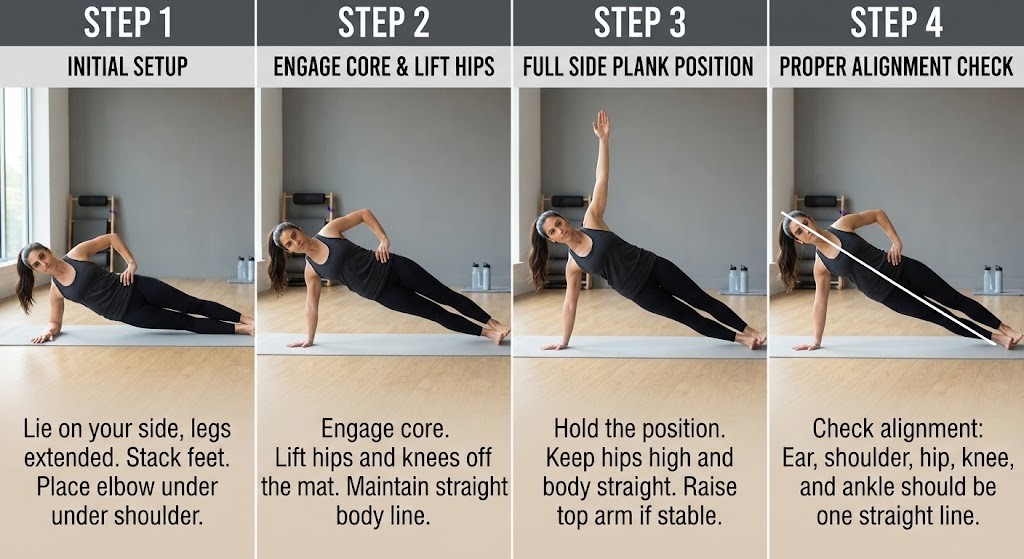
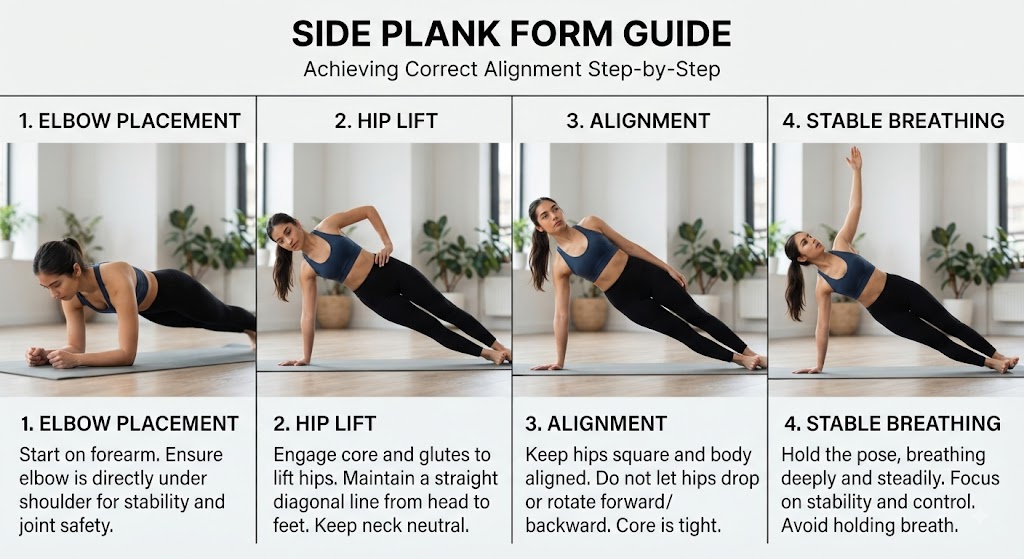
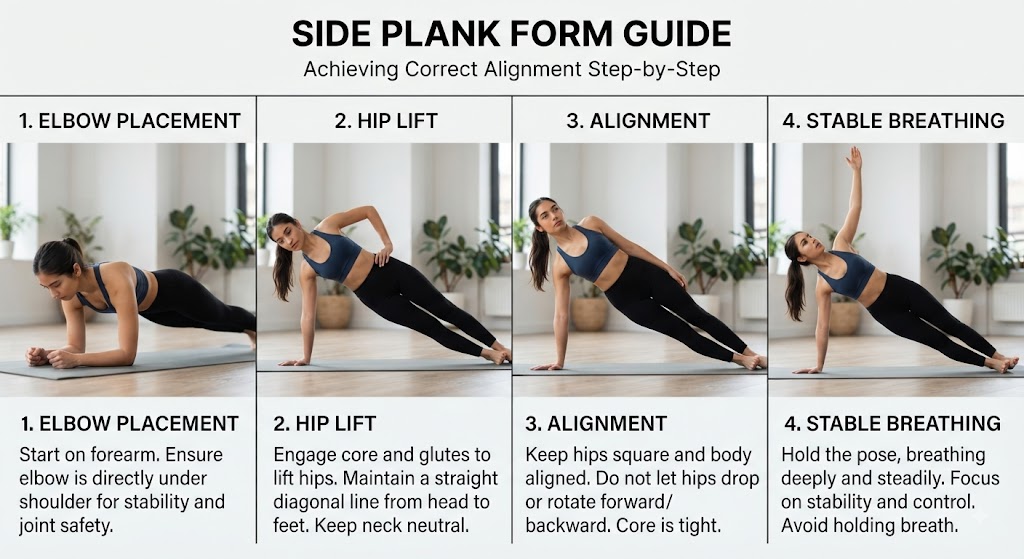
A proper side plank requires a straight body line, a braced core, stable shoulders, and controlled breathing. The goal is to create one controlled line from your head through your torso and hips to your feet.
Step-by-Step Side Plank Instructions
- Set up your position. Lie on your side with your legs extended and stacked. Place your elbow directly underneath your shoulder.
- Brace your core. Tighten your abdomen and squeeze your glutes before lifting your hips from the floor.
- Lift your hips. Push through your forearm and the side of your lower foot while raising your hips into the plank position.
- Maintain alignment. Keep your head, shoulders, hips, knees, and feet aligned instead of allowing your torso to twist.
- Control your breathing. Breathe slowly and continuously while maintaining abdominal tension throughout the hold.
- Finish with control. Lower your hips when your form begins to deteriorate, then repeat on the opposite side.
ACE’s recommended setup places the elbow directly below the shoulder and emphasizes a straight body line with the abdominal and glute muscles engaged. — Source: ACE Fitness, 2026
Side Plank Form Checklist
Use these cues to check your position:
- Elbow: Directly below the shoulder.
- Shoulders: Stacked rather than rotated forward.
- Hips: Lifted and aligned with the torso.
- Feet: Stacked or positioned for the chosen variation.
- Core: Braced without holding your breath.
- Neck: Neutral and relaxed.
- Breathing: Slow and controlled.
If your hips sag after 15 seconds, ending the set at 15 seconds is better than forcing another 20 seconds with poor technique.
How Long Should You Hold a Side Plank?
A side plank should generally be held only as long as you can maintain strong technique. Beginners can often start around 10–20 seconds per side and gradually increase the duration.
Quality of alignment matters more than reaching an arbitrary maximum hold time. Once your shoulders, hips, and breathing become difficult to control, the set has reached its useful limit.
ACE has used 20–45-second side plank holds in a core-focused warm-up example, while HSS has demonstrated 30-second side plank holds in a short workout format. — Source: ACE Fitness, 2014; HSS, 2021
| Training Level | Suggested Hold | Sets Per Side |
| Beginner | 10–20 seconds | 2 |
| Intermediate | 20–40 seconds | 2–3 |
| Advanced | 40–60+ seconds | 2–3 |
When Should You Increase Your Hold Time?
Increase your side plank hold when you can complete every repetition with stable hips, shoulders, and breathing. Progress because your current variation has become controlled and manageable, rather than simply trying to increase the number on the timer.
For example, if you can perform three 30-second holds without your hips moving, try 35–40 seconds or progress to a more difficult variation.
What Are the Best Side Plank Variations for Beginners?
The best beginner side plank variations reduce the amount of bodyweight and leverage you must control while allowing you to practice proper alignment. Bent-knee side planks are an effective starting point because the knees provide additional support.
1. Bent-Knee Side Plank
Lie on your side with your knees bent and stacked, then place your elbow below your shoulder. Lift your hips while keeping your knees on the floor and maintain a straight line from your head to your knees.
HSS demonstrates modified side planks with bent knees and also uses them as a foundation for more advanced variations. — Source: HSS, 2024
2. Knee-Supported Side Plank
The knee-supported side plank is a simple modification for people who cannot yet maintain a full side plank. It allows you to practice core bracing and shoulder positioning while reducing the lever length of the legs.
Hold the modified position for 15 seconds per side before progressing toward a full side plank.
beginner ab workout
3. Full Side Plank
The full side plank uses straight legs and supports the body through one forearm and the side of one foot. This version requires greater lateral core, hip, and shoulder stability than the knee-supported version.
HSS describes the standard side plank as lying on your side, supporting yourself on your forearm, and lifting the hips to form a straight line from head to heels. — Source: HSS, 2024
What Are the Best Advanced Side Plank Variations?
Advanced side plank variations increase the challenge by adding movement, reducing stability, changing leverage, or introducing resistance. The best progression is the one that increases difficulty without causing your alignment to break down.
Side Plank Hip Dips
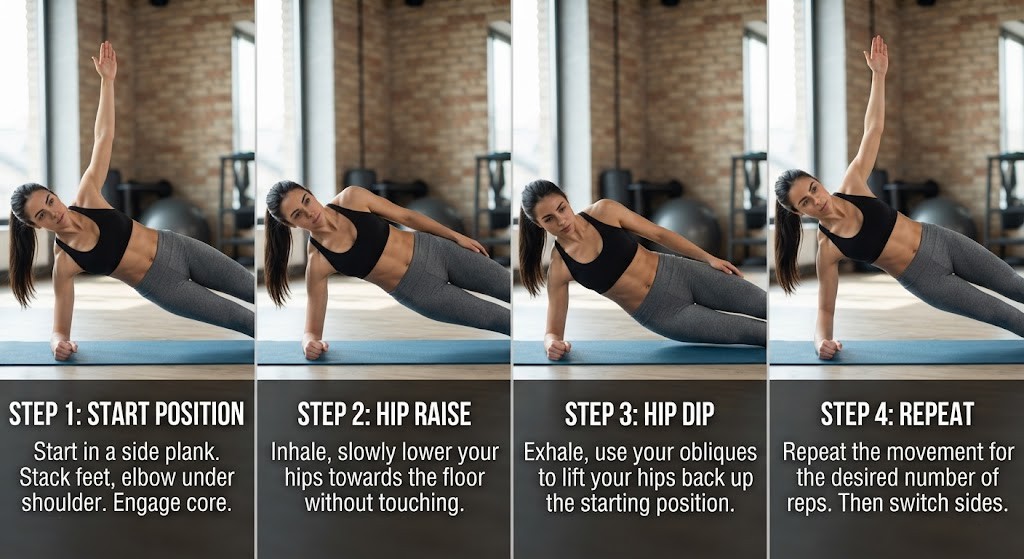
Side plank hip dips add controlled movement to the basic isometric position. The exercise challenges your lateral core repeatedly as you lower and raise your hips.
Start in a full side plank, lower your hip toward the floor without collapsing, then drive it back up to the starting position.
ACE demonstrates a side plank hip lift variation using slow, controlled hip movement while maintaining alignment. — Source: ACE Fitness, 2016
Side Plank Leg Raise
The side plank leg raise combines lateral core stability with hip abduction. The top leg must move without allowing the pelvis or torso to rotate.
Hold a stable side plank and slowly raise your upper leg several inches before lowering it with control.
Star Side Plank
The star side plank is a demanding variation that raises the top arm and top leg simultaneously. It increases the balance and stabilization demands of the standard side plank.
Begin with a strong full side plank before attempting this variation because poor control can quickly cause the hips to rotate.
Weighted Side Plank
A weighted side plank adds external resistance to an already challenging position. Weighted variations should be reserved for lifters who can maintain excellent body alignment without additional load.
For example, you can place a light dumbbell on the outside hip while maintaining a stable side plank. Stop if the weight causes your hips to sag or your position to deteriorate.
How Can You Make a Side Plank Harder?
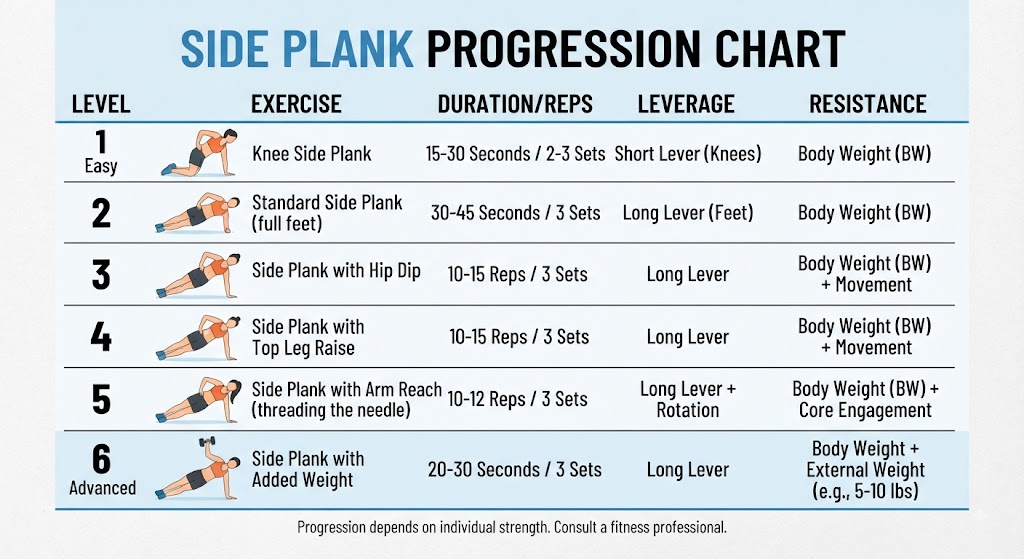
You can make a side plank harder by increasing hold duration, adding controlled repetitions, changing leverage, reducing points of contact, or introducing resistance. Progression can involve increasing hold duration, improving form, or advancing to more challenging variations such as hip dips, leg lifts, and star side planks.
A practical progression looks like this:
- Increase a clean 15-second hold to 20 seconds.
- Perform additional high-quality sets.
- Move from bent knees to straight legs.
- Add controlled hip dips.
- Add a leg raise.
- Progress to a star side plank.
- Introduce light external resistance.
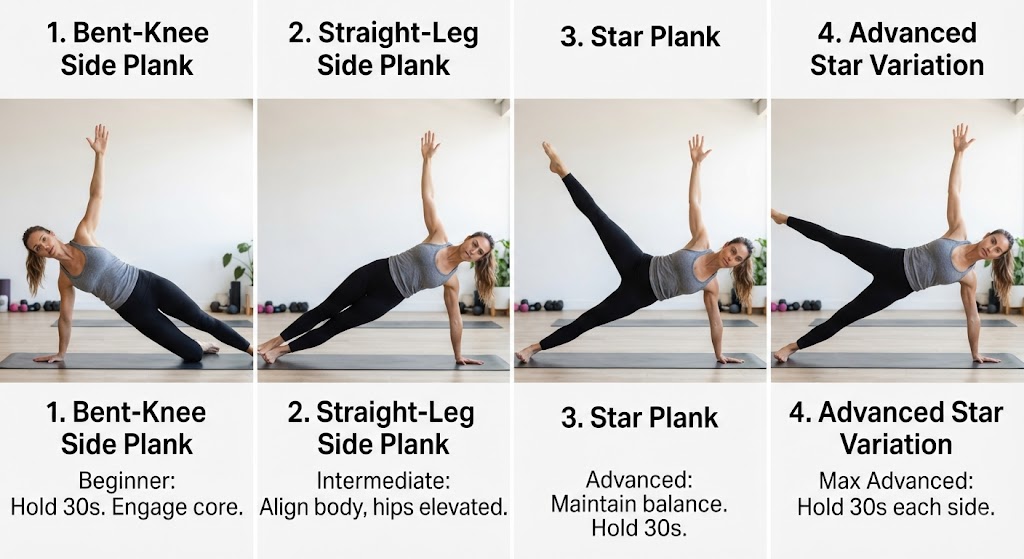
Progression should be gradual. If a harder variation makes your shoulder unstable or causes your hips to rotate, return to the previous level and build more control.
What Are the Most Common Side Plank Mistakes?
The most common side plank mistakes include sagging hips, rotated shoulders, incorrect elbow placement, breath-holding, and continuing after proper alignment has been lost.
Most technique problems reduce the effectiveness of the exercise because they shift the workload away from controlled lateral stabilization.
Sagging Hips
Sagging hips occur when the pelvis drops toward the floor during the hold. This usually indicates that your current hold duration or variation exceeds your ability to maintain the position.
For example, shorten a 40-second set to 20 seconds if your hips begin dropping halfway through.
Rotated Shoulders or Hips
Rotated shoulders and hips reduce the clean side-facing position required for a strong side plank. Keep your shoulders and hips stacked instead of allowing your top side to roll backward.
HSS specifically advises maintaining stacked hips during its side plank clamshell variation. — Source: HSS, 2020
Incorrect Elbow Placement
An elbow positioned too far away from the shoulder can make the position uncomfortable and less stable. Place the supporting elbow underneath or very close to the shoulder joint.
Holding Your Breath
Holding your breath can make a sustained isometric exercise feel unnecessarily difficult. Use controlled breathing so you can maintain abdominal tension without creating excessive strain.
Training Through Pain
Muscle fatigue and mild exertion are expected, but sharp or persistent pain is not a useful training signal. HSS advises avoiding exercises that cause pain and gradually building endurance and strength. — Source: HSS, 2024
How Many Side Planks Should You Do in a Workout?
Most people can start with 2–3 sets per side, using a hold duration that allows them to maintain consistent technique. A smaller number of high-quality sets is more useful than repeatedly performing poorly controlled holds.
For example, a beginner might perform two 15-second holds per side, while an intermediate trainee could use three 30-second holds.
| Goal | Sets | Suggested Hold |
| Beginner core training | 2 | 10–20 sec/side |
| General core strength | 2–3 | 20–40 sec/side |
| Advanced endurance | 2–3 | 40–60+ sec/side |
| Hip-dip variation | 2–3 | 8–15 reps/side |
| Leg-raise variation | 2–3 | 6–12 reps/side |
The U.S. Department of Health and Human Services recommends muscle-strengthening activity on at least two days each week, making side planks easy to incorporate into a broader weekly strength routine. — Source: U.S. Department of Health and Human Services, 2018
Can Side Planks Help Strengthen Your Obliques?
Side planks can strengthen the obliques because they require these muscles to help stabilize the trunk against lateral forces. The side plank primarily targets the internal and external obliques while also involving other stabilizing muscles.
ACE specifically notes that side planks engage both the internal and external obliques. — Source: ACE Fitness, 2014
Maintaining a straight torso during a 20-second side plank requires sustained muscular effort from the muscles along the side of your trunk.
However, side planks do not selectively remove abdominal fat from the waist. Strengthening the obliques and reducing body fat are separate fitness goals that require different strategies.
How Should Beginners Progress With Side Planks?
Beginners should prioritize controlled technique and shorter, high-quality holds before increasing side plank duration or progressing to more difficult variations. Gradual progression allows you to develop strength and endurance without sacrificing body position.
Try this four-stage progression:
| Stage | Exercise | Target |
| 1 | Bent-knee side plank | 10–20 sec/side |
| 2 | Full side plank | 15–30 sec/side |
| 3 | Side plank hip dips | 8–12 reps/side |
| 4 | Side plank leg raise or star plank | 6–12 reps/side |
Beginner Side Plank Progression
First, master the bent-knee version with steady breathing.
Next, perform full side planks for short, controlled holds.
Then, increase duration only when your hips and shoulders remain stable.
Finally, introduce movement-based variations such as hip dips or leg raises.
How Can You Add Side Planks to a Core Workout?
Side planks can be added to a core workout as an isometric exercise between dynamic abdominal movements. A balanced core session can combine lateral stability, anti-extension, controlled flexion, and hip stability rather than relying on one exercise.
10-Minute Side Plank Core Workout
Perform the following circuit for 2–3 rounds:
- Side plank — 20 seconds per side
- Dead bug — 8–10 reps per side
- Side plank hip dips — 8 reps per side
- Glute bridge — 12–15 reps
- Rest — 45–60 seconds
This routine works well at home because it requires no specialized equipment.
Side Plank in a Full-Body Workout
Side planks can also complement a full body workout by adding lateral core work to exercises such as squats, push-ups, rows, and lunges.
For example, perform squats, push-ups, rows, and side planks as a simple four-exercise circuit.
How Can You Use Side Planks in Athletic Training?
Side planks can complement athletic training by developing lateral trunk and hip stability. Athletic movements frequently involve changes in direction, uneven forces, and single-sided loading, making lateral core control valuable.
An athlete can pair side planks with lateral lunges, single-leg exercises, and controlled rotational movements.
However, side planks should support athletic training rather than replace sport-specific strength, conditioning, mobility, or skill work.
What’s Next: How to Progress Your Side Plank Workout
The next step in a side plank workout is to improve technique first, then gradually increase duration, volume, resistance, or exercise complexity. Side plank progression works best when only one major difficulty variable changes at a time.
For example, do not increase your hold time, add a dumbbell, and switch to a star plank during the same progression step.
Use this simple progression rule:
- Improve form before adding difficulty.
- Increase hold time when your current duration feels controlled.
- Add repetitions for dynamic variations.
- Change leverage with leg raises or star positions.
- Add resistance only after mastering bodyweight variations.
- Reduce instability only when you can maintain alignment.
A useful benchmark is being able to complete your current variation on both sides with similar control. Balanced performance between sides is more useful than chasing an extremely long hold on only your stronger side.
Conclusion
The side plank workout is a simple but effective way to train lateral core strength, oblique endurance, hip stability, and shoulder stability without requiring gym equipment. Proper technique means keeping your body aligned, bracing your core, breathing steadily, and stopping the set when your form starts to break down.
Beginners do not need to hold a side plank for several minutes to benefit from it. Start with short, controlled holds, progress toward full side planks, and eventually introduce hip dips, leg raises, star planks, or carefully selected resistance.
Consistency matters more than impressive numbers. Build your side plank workout gradually, prioritize clean technique, and use it as one part of a balanced strength and core-training routine.
FAQs
What is a side plank workout?
A side plank workout trains core strength, stability, and endurance.
What muscles does a side plank work?
It mainly works the obliques, core, glutes, hips, and shoulders.
How long should a beginner hold a side plank?
Beginners can start with 10–20 seconds per side.
How many side planks should I do?
Start with 2–3 sets per side.
Are side planks good for the obliques?
Yes, they effectively strengthen the obliques.
What is the easiest side plank variation?
The bent-knee side plank is a beginner-friendly option.
How can I make a side plank harder?
Increase the hold time or try hip dips, leg raises, or star planks.
Do side planks help build abs?
Yes, they strengthen the core and abdominal muscles.
Can I do side planks every day?
You can, but recovery should still be part of your training plan.
Are side planks good for beginners?
Yes, especially when starting with a modified variation.
What are the most common side plank mistakes?
Common mistakes include sagging hips, poor alignment, and holding your breath.
Should I stop a side plank if it hurts?
Yes. Stop if you experience sharp or persistent pain.
What are side planks good for?
They are good for core stability, oblique strength, and balance.
Do side planks actually work?
Yes, they effectively challenge the obliques and lateral core.
What happens if you do a 1 minute plank everyday for 30 days?
It can improve core endurance and consistency, depending on your training and form.
Is a 1 minute side plank good?
Yes, if you can maintain proper form throughout the hold.
1 thought on “Side Plank Workout: Strengthen Your Core, Obliques & Hips”