
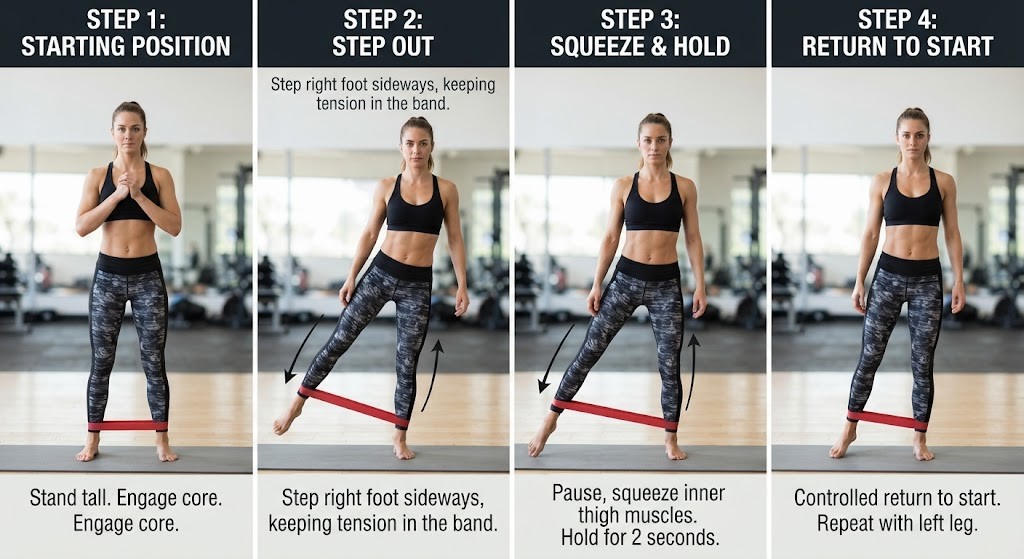
If you already train your legs with squats, lunges, leg presses, and other lower-body exercises, you may be covering most of the major muscle groups—but your inner thighs can still benefit from more direct attention. The adductor muscles play an important role in bringing your legs toward the body’s midline, stabilizing the hip, and controlling lower-body movement.
A well-designed adductor workout can help strengthen these often-overlooked muscles without requiring a complicated routine. In this guide, you’ll learn what the adductors are, why they matter, the best adductor exercises for home and gym workouts, recommended sets and reps, common mistakes, and how to progressively build stronger inner thighs.
What Is an Adductor Workout?
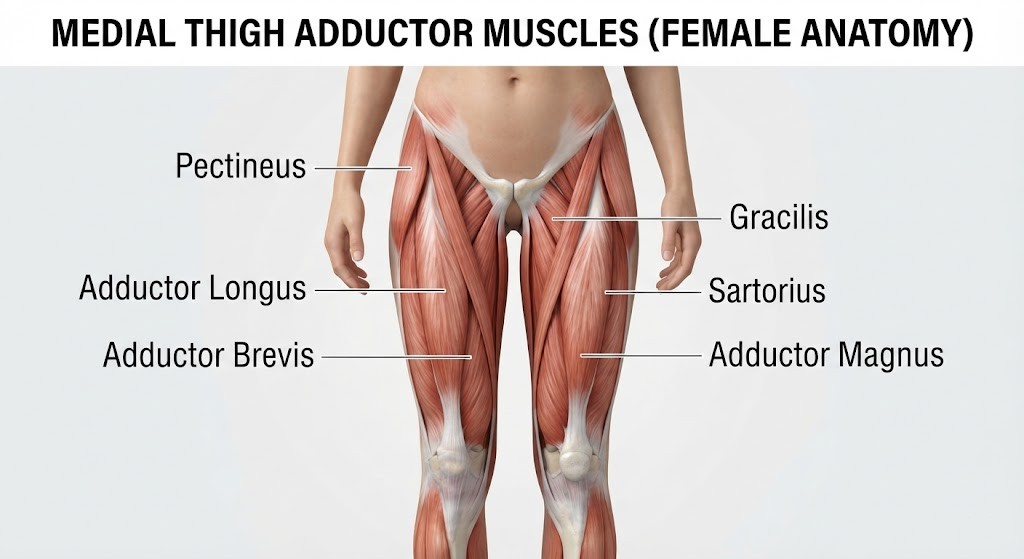
An adductor workout is a series of exercises designed to strengthen and develop the hip adductor muscles through controlled leg and hip movements. The adductors are muscles located primarily along the inner thigh that help bring the leg toward the body’s midline.
The major adductor group includes the adductor longus, adductor brevis, and adductor magnus. The gracilis and pectineus also contribute to hip adduction. Together, these muscles help control the position and movement of the legs and hips.
Source: NCBI Bookshelf, 2023.
In simple terms, adductor muscles are the inner-thigh muscles that pull the legs toward the body’s midline and contribute to hip stability. For example, when you step sideways and then bring your leg back toward your body, your adductors help control that movement.
Because many traditional leg exercises emphasize the quadriceps, glutes, and hamstrings, adding direct adductor exercises can help create a more balanced lower-body training program.
Why Are Adductor Muscles Important for Lower-Body Strength?
Adductor muscles are important because they contribute to hip stability, leg control, and lower-body movement. They help stabilize the pelvis and hip during everyday and athletic activities such as walking, running, squatting, changing direction, and jumping.
The adductor magnus is also a large muscle that contributes to hip movement and lower-body force production.
Source: NCBI Bookshelf, 2023.
Strong adductors do not replace your glutes, hamstrings, or quadriceps. Instead, they work alongside these muscles to support coordinated lower-body movement. Adding inner-thigh exercises to your leg training can therefore make your overall lower-body program more comprehensive.
Adductors and Athletic Performance
Adductor strength can be especially relevant for athletes who regularly accelerate, decelerate, kick, jump, or change direction.
One notable study involving 652 male football players found that a Copenhagen-based adductor strengthening program reduced reported groin problems by 41%.
Source: British Journal of Sports Medicine, 2019.
This does not mean every person needs an intensive Copenhagen plank program. However, it highlights why adductor strength and conditioning can be relevant to sports that place repeated demands on the groin and inner-thigh region.
What Are the Best Adductor Exercises for Building Inner-Thigh Strength?
The best adductor exercises combine controlled hip-adduction movements with compound exercises that challenge the inner thighs under resistance. Your ideal exercise selection depends on your training experience, equipment, goals, and overall leg routine.
You do not need to perform every adductor exercise in a single workout. Instead, choose a combination that provides direct inner-thigh work while complementing your primary lower-body movements.
| Exercise | Equipment | Main Focus | Suggested Sets |
|---|---|---|---|
| Seated Hip Adduction | Machine | Adductor isolation | 2–3 |
| Copenhagen Plank | None/bench | Strength and stability | 2–3 |
| Side-Lying Hip Adduction | None | Beginner isolation | 2–3 |
| Cable Hip Adduction | Cable | Controlled resistance | 2–3 |
| Sumo Squat | Dumbbell/barbell | Compound leg strength | 3 |
| Lateral Lunge | Bodyweight/dumbbell | Adductors + movement control | 2–3 |
These exercises cover several training styles, from simple bodyweight movements to machine and cable exercises. As your strength improves, you can gradually increase resistance or exercise difficulty.
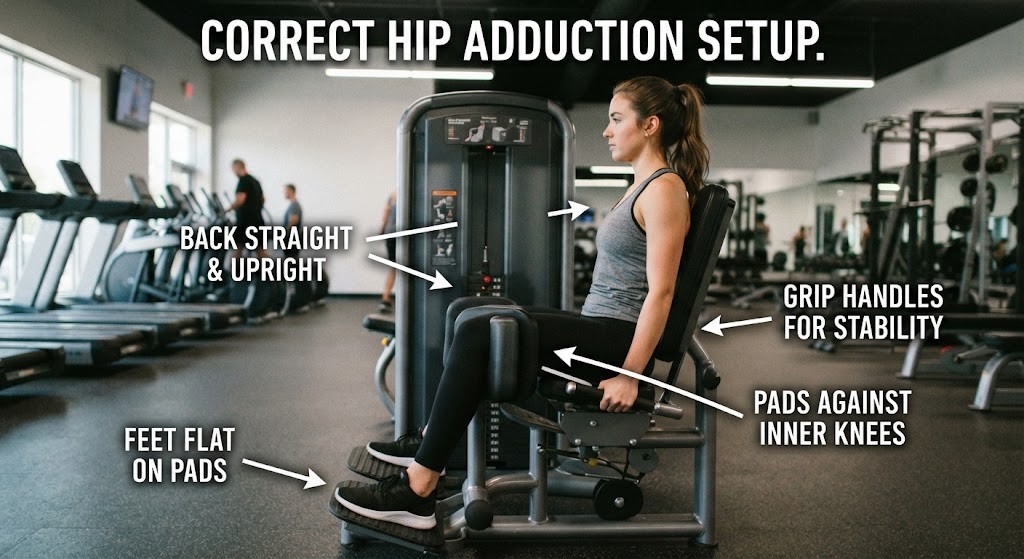
How Do You Perform a Seated Hip Adduction Correctly?
The seated hip adduction machine trains the inner-thigh muscles by moving the legs inward against resistance. It is one of the simplest ways to perform direct adductor training in a gym.
Step-by-Step Seated Hip Adduction
- Sit upright with your back supported against the machine.
- Position your legs comfortably against the machine pads.
- Brace your core and maintain a stable pelvis.
- Slowly bring your thighs together.
- Pause briefly when the legs are brought inward.
- Return to the starting position under control.
Keep your hips firmly against the seat throughout the exercise. Avoid bouncing or using momentum to move the weight.
A practical starting point is 2–3 sets of 10–15 controlled repetitions using a resistance that allows you to maintain consistent technique.
The goal is not to move the heaviest possible weight. Instead, focus on controlled movement and keeping tension on the target muscles.
How Do You Do a Copenhagen Plank for Stronger Adductors?
The Copenhagen plank is a bodyweight adductor exercise that challenges the inner thigh while your body remains in a side-plank position. It requires the adductors to support and stabilize the body while the hips remain elevated.
How to Perform a Copenhagen Plank
- Place your upper leg on a bench or elevated surface.
- Support your upper body with your forearm or hand.
- Lift your hips from the floor.
- Keep your body in a relatively straight line.
- Maintain a stable pelvis while holding the position.
- Lower yourself with control when the set is complete.
Beginners can start with a shorter lever or lower-support variation before progressing to longer holds or more challenging versions.
The Copenhagen exercise has been shown to improve hip-adduction strength and has been studied extensively in football populations.
Source: PubMed, 2021.
Because this movement can be demanding, prioritize quality and stability rather than simply trying to hold the position for as long as possible.
What Are the Best Adductor Exercises to Do at Home?
The best adductor workout at home uses bodyweight, bands, or dumbbells to create resistance without requiring a machine. This makes inner-thigh training accessible even if you do not have access to a commercial gym.
1. Side-Lying Hip Adduction
Side-lying hip adduction is a straightforward beginner exercise that directly targets the inner thigh.
Lie on your side and place your top leg forward for support. Keep the bottom leg extended and lift it toward the ceiling using the inner thigh. Lower it slowly and repeat before switching sides.
Focus on controlled repetitions rather than trying to lift the leg as high as possible.
2. Lateral Lunges
Lateral lunges combine movement control with lower-body strength.
Step sideways and bend the working leg while keeping the opposite leg relatively straight. Push through the working leg to return to the starting position.
This exercise challenges the adductors while also involving the glutes and quadriceps.
3. Sumo Squats
A sumo squat uses a wider stance with the feet angled outward. This creates a useful compound movement for lower-body training while involving the inner-thigh muscles.
Hold a dumbbell at your chest once bodyweight sumo squats become easy. Maintain control throughout the squat and avoid allowing the knees to collapse inward.
4. Resistance-Band Hip Adduction
Resistance-band hip adductions provide another practical home option.
Secure the band to a stable anchor, attach or position it safely around the working leg, and move the leg inward without rotating your pelvis. Return slowly to the starting position.
Always make sure the band and anchor are secure before performing the movement.
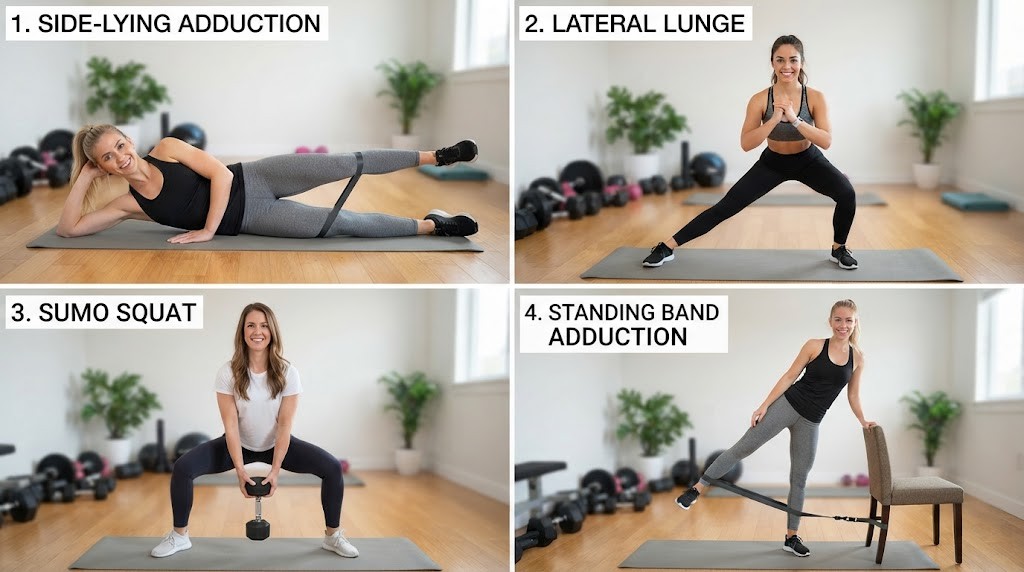
Together, these exercises can form a simple home-based adductor workout without requiring specialized equipment.
How Many Sets and Reps Should You Do for Adductor Training?
Adductor workout sets and reps should match your goal, training experience, and recovery capacity. Beginners can generally start with 2–3 sets of 8–15 repetitions for most resistance exercises while prioritizing controlled technique.
For muscle growth, moderate repetitions and sufficient weekly training volume can be useful. Current ACSM guidance emphasizes tailoring resistance-training load and volume to the individual’s goal, with approximately 10 weekly sets per muscle group serving as a useful hypertrophy reference for many adults.
The 2026 ACSM position stand reviewed 137 systematic reviews representing more than 30,000 participants.
Source: American College of Sports Medicine, 2026.
| Goal | Reps | Sets | Rest |
| General fitness | 10–15 | 2–3 | 60–90 sec |
| Muscle growth | 8–15 | 2–4 | 60–120 sec |
| Strength | 5–8 | 2–4 | 2–3 min |
| Copenhagen plank | 10–30 sec | 2–3 | 60–90 sec |
These numbers provide a practical starting framework rather than a requirement that every person must follow exactly.
Your total lower-body workload matters as well. If squats, lunges, deadlifts, and other exercises already place substantial demands on your hips and legs, you may not need a large amount of additional direct adductor volume.
How Often Should You Train Your Adductors?
Adults are generally advised to perform muscle-strengthening activity on at least 2 days per week, although your specific adductor frequency should account for your complete lower-body program.
Source: U.S. Department of Health and Human Services, 2026.
For direct adductor training, 1–3 sessions per week can be used depending on exercise intensity and total leg-day volume. Beginners can start with a small amount of direct work once or twice per week rather than training the muscles hard every day.
For example, you could perform machine hip adductions after one leg workout and Copenhagen planks during another session. Spreading the workload can make it easier to manage training volume and recovery.
What Are the Most Common Adductor Workout Mistakes?
The most common adductor training mistakes involve excessive resistance, poor hip positioning, uncontrolled movement, and ignoring pain. Because the inner-thigh muscles can be challenged through relatively small movements, adding more weight is not automatically better.
Common Adductor Training Mistakes
Avoid these errors during your adductor workout:
- Using too much weight
- Bouncing through repetitions
- Rotating the pelvis during cable exercises
- Rushing the eccentric phase
- Skipping a gradual warm-up
- Increasing volume too quickly
- Continuing through sharp or worsening groin pain
Why Form Matters
With isolation exercises, it can be tempting to focus only on completing the prescribed repetitions. However, swinging the legs or using momentum can reduce your ability to control the target movement.
Instead, use a resistance level that allows you to maintain stable hips, controlled repetitions, and a comfortable range of motion.
You also do not need to force an extreme stretch simply because the inner thigh feels tight. A controlled range of motion that you can consistently manage is preferable to chasing maximum movement.
If an exercise produces sharp or worsening groin pain, stop rather than attempting to push through it.
How Can You Build an Adductor Workout at Home or in the Gym?
A beginner adductor workout should prioritize controlled technique, manageable resistance, and gradual progression rather than maximum weight. You can create an effective routine using only a few carefully selected exercises.
A simple starting approach is to train the adductors twice per week, with at least one recovery day between demanding lower-body sessions.
Beginner Adductor Workout
- Side-lying hip adduction: 2 × 12–15 per side
- Bodyweight lateral lunge: 2 × 8–10 per side
- Sumo squat: 3 × 10–12
- Copenhagen plank: 2 × 10–20 seconds per side
This routine combines direct adductor work with compound movements and a stability-focused exercise.
Start with bodyweight resistance where appropriate. Once the exercises become comfortable and controlled, gradually increase difficulty.
Intermediate Adductor Workout
More experienced lifters can use additional resistance and more demanding variations.
- Seated hip adduction: 3 × 8–12
- Cable hip adduction: 3 × 10–15 per side
- Dumbbell sumo squat: 3 × 8–12
- Copenhagen plank: 3 × 15–30 seconds per side
The intermediate routine provides a combination of machine isolation, unilateral cable work, compound strength training, and adductor stability.
How Should You Use Adductor Exercises on Leg Day?
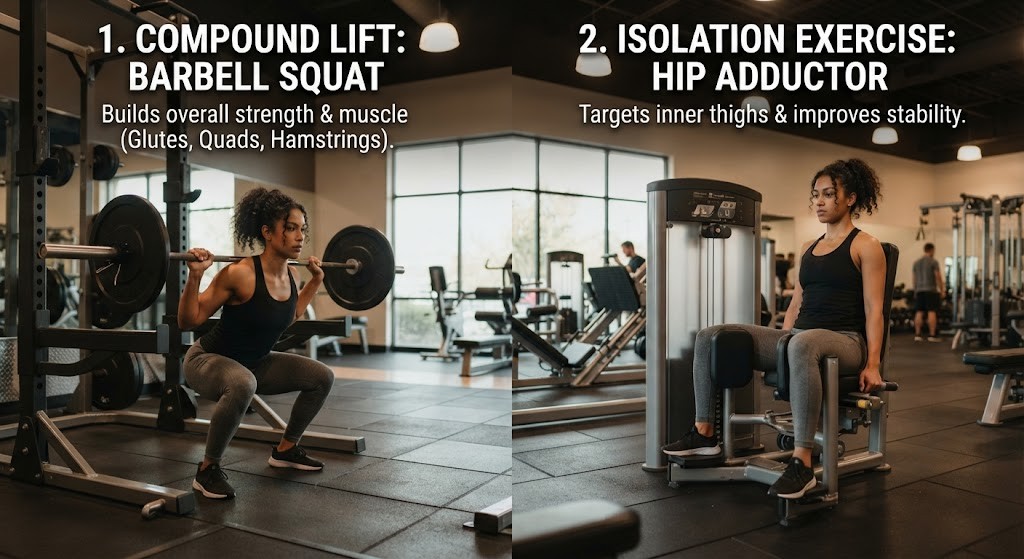
Adductor exercises work best on leg day when they complement rather than overwhelm your primary lower-body movements. Exercise order can help you maintain better performance on movements that require the most strength and coordination.
Start your workout with demanding compound exercises when you have the most energy. Depending on your overall program, this could include squats or another primary lower-body movement.
You can then add other major lower-body exercises before finishing with direct adductor isolation work.
For example, a leg session could be organized around:
- Squat or another primary compound movement
- Romanian deadlift or another posterior-chain exercise
- Quad-focused exercise
- Hamstring-focused exercise
- Seated hip adduction
- Optional mobility or controlled finishing work
This approach allows direct adductor exercises to complement the rest of your leg training instead of competing with your most demanding lifts.
What’s Next: How Should You Progress Your Adductor Workout?
Progressive adductor training involves gradually increasing resistance, repetitions, exercise difficulty, or training volume while maintaining proper form. You do not need to increase everything at once.
One simple method is to increase repetitions within your target range before adding substantial resistance.
For example, if you can comfortably perform 12 machine-adduction repetitions for three sets with consistent technique, you can increase the resistance slightly and return to around 8–10 quality repetitions.
Ways to Progress Adductor Exercises
Progression can come from several sources:
- Increasing resistance
- Performing more repetitions
- Adding an additional set
- Increasing hold duration
- Moving to a more challenging exercise variation
- Improving range of motion while maintaining control
- Using a more demanding training setup
For example, a beginner might progress from side-lying hip adduction to resistance-band work, then to cable or machine variations.
Similarly, Copenhagen planks can progress from an easier beginner variation to longer holds or more challenging lever positions.
The most important principle is to make progress while preserving good movement quality.
How Can You Make Your Adductor Workout More Effective?
A productive adductor workout does not need dozens of exercises. Instead, focus on selecting movements that match your current ability and progressively challenging the muscles over time.
Prioritize Controlled Repetitions
Move deliberately through each repetition. Avoid swinging, bouncing, or using momentum to complete the movement.
Train Through a Comfortable Range
Use a range of motion that you can control without forcing uncomfortable or painful positions. Quality movement is more important than trying to achieve an extreme stretch.
Balance Isolation and Compound Exercises
Isolation exercises such as seated hip adduction and cable hip adduction allow you to directly train the inner thighs. Compound movements such as sumo squats and lateral lunges add broader lower-body demands.
Using both approaches can create a more complete training stimulus.
Match Volume to Your Entire Leg Program
Remember that the adductors are not trained in isolation during every exercise. Your total lower-body workload includes all the exercises that challenge the hips and legs.
If your program already contains substantial leg volume, start conservatively with direct adductor work and adjust based on performance and recovery.
Can Adductor Workouts Be Used by Both Men and Women?
Yes. Adductor exercises can be incorporated into lower-body training for both men and women. The fundamental principles remain the same: select appropriate exercises, use manageable resistance, maintain good technique, and progressively increase training demands.
The specific exercise selection can vary according to experience, equipment, training goals, and the rest of the individual’s workout program.
Whether the goal is stronger inner thighs, balanced leg development, improved movement control, or athletic training, the adductors can be trained as part of a broader lower-body routine.
Conclusion
Consistent adductor training can strengthen the inner thighs while supporting balanced lower-body movement and hip stability. Although squats, lunges, and other traditional leg exercises are valuable, adding targeted adductor exercises can give these often-overlooked muscles more direct attention.
Start with manageable movements such as side-lying hip adductions, lateral lunges, sumo squats, or beginner Copenhagen planks. As your technique and strength improve, you can progress toward cable and machine exercises or more challenging variations.
Ultimately, an effective adductor workout comes down to controlled repetitions, sensible training volume, gradual progression, and adequate recovery. Whether you’re looking for an adductor workout for men, an adductor workout for women, stronger inner thighs, or better lower-body movement, consistency matters more than complicated programming.
FAQs
What is an adductor workout?
An adductor workout strengthens the inner-thigh muscles.
What exercise works the adductor?
Hip adductions, lateral lunges, and sumo squats work the adductors.
What does adductor exercise do?
Adductor exercises improve inner-thigh strength and hip stability.
Do adductors increase leg size?
Adductor training can increase inner-thigh muscle size.
Are adductors worth training?
Yes, they support balanced leg strength and stability.
Can I do an adductor workout at home?
Yes, many adductor exercises can be done at home.
How often should I train my adductors?
You can train adductors 1–3 times per week.
How many sets should I do for adductors?
Start with 2–3 sets per exercise.
Are adductor exercises good for inner thighs?
Yes, they directly strengthen the inner thighs.
Do sumo squats work the adductors?
Yes, sumo squats engage the adductors.
Is the Copenhagen plank good for adductors?
Yes, Copenhagen planks strongly challenge the adductors.
Can beginners do adductor exercises?
Yes, beginners can start with simple bodyweight exercises.
Should I train adductors before or after squats?
Train them after your main compound exercises.
How can I make my adductor workout harder?
Increase resistance, repetitions, or exercise difficulty.
What should I avoid during an adductor workout?
Avoid excessive weight, poor form, and painful movements.
1 thought on “Adductor Workout: Build Stronger Inner Thighs & Improve Hip Stability”