
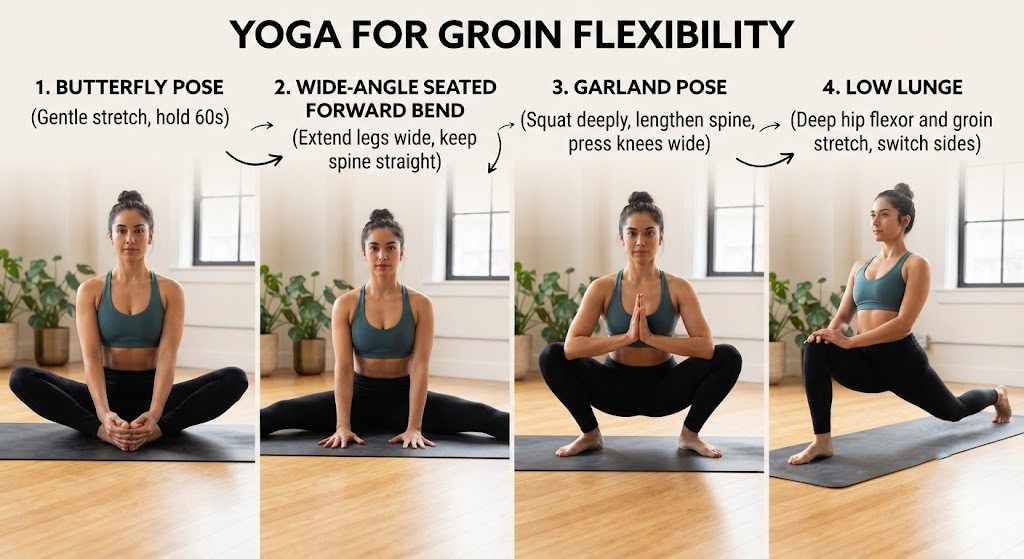
If your hips and inner thighs feel tight during yoga, squats, lunges, or everyday movement, basic stretching may not always be enough. The difference often comes down to choosing the right poses, positioning your body correctly, and progressing gradually rather than forcing a deeper stretch.
Yoga for groin flexibility can help you work on the inner thighs, adductors, hips, and surrounding muscles through controlled ranges of motion. In this guide, you’ll learn the best yoga poses for groin flexibility, how to perform them safely, how long to hold each stretch, which props can help, and how to build a simple 10–15 minute routine.
What Is Yoga for Groin Flexibility?
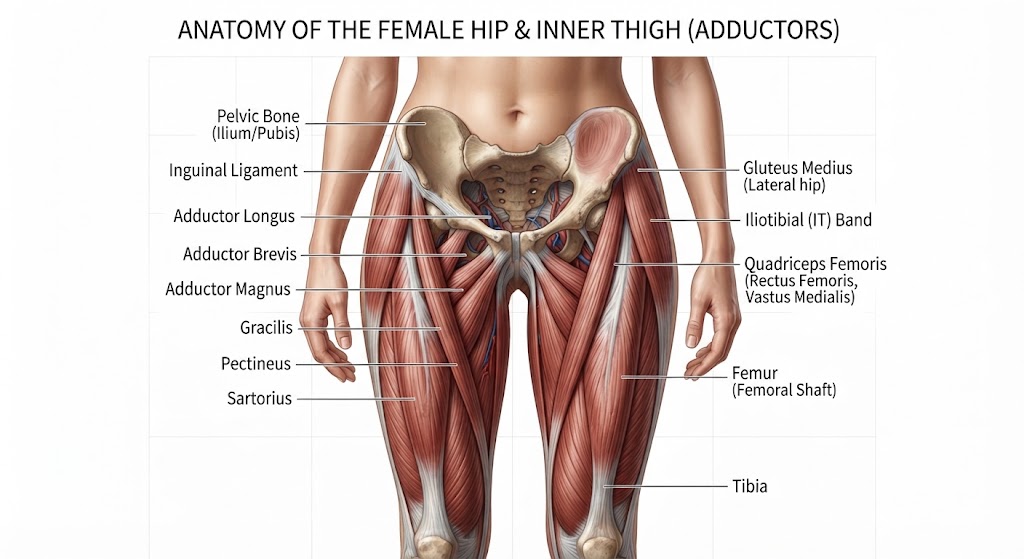
Yoga for groin flexibility involves controlled poses and stretches that gradually challenge the inner thighs, hips, and surrounding muscles through a comfortable range of motion. The groin area includes several adductor muscles that help bring the legs toward the body’s midline.
Groin flexibility is largely about comfortable hip and inner-thigh movement, rather than simply being able to perform an extreme split. For example, improved adductor mobility can make positions such as a wide squat or seated Butterfly Pose feel easier.
Yoga combines sustained positions, controlled breathing, and active positioning to gradually expose your body to a larger range of motion. A 2024 meta-analysis examining 77 studies and 186 effect sizes found that stretching produced a significant overall improvement in range of motion.
Source: Journal of Sport and Health Science, 2024.
For more targeted work, you can also combine yoga with Inner Thigh Workout and adductor exercises.
Why Is Groin Flexibility Important for Mobility and Movement?
Groin flexibility supports comfortable movement of the hips and inner thighs during activities such as walking, squatting, lunging, running, and yoga. Adequate mobility can help you move through these positions without unnecessarily restricting your range of motion.
The adductors contribute to hip stability and leg movement, while surrounding muscles such as the hip flexors and hamstrings can influence how comfortably the hips move. For example, limited mobility may make a deep squat feel restricted even when your leg strength is adequate.
However, flexibility should complement strength and control rather than replace them. For broader movement preparation, consider adding Hip Opening Yoga and Best Yoga Poses for Tight Hips.
Flexibility training also has measurable effects. A 2025 systematic review and meta-analysis included 189 studies involving 6,654 adults and found a large positive effect of chronic static stretching on flexibility.
Source: Sports Medicine, 2025.
What Are the Best Yoga Poses for Groin Flexibility?
The best yoga poses for groin flexibility are positions that gradually challenge the adductors and hips without forcing painful ranges of motion. Beginners can start with supported poses before progressing toward deeper positions.
| Yoga Pose | Difficulty | Main Focus | Beginner-Friendly? |
|---|---|---|---|
| Butterfly Pose | Easy | Inner thighs, adductors | Yes |
| Reclining Bound Angle | Easy | Inner thighs, hips | Yes |
| Low Lunge | Easy–Moderate | Hip flexors, hips | Yes |
| Half Split | Moderate | Hamstrings, hips | Yes, with support |
| Garland Pose | Moderate | Hips, adductors | With modification |
| Wide-Legged Forward Fold | Moderate | Adductors, hamstrings | With modification |
| Lizard Pose | Moderate–Advanced | Hips, groin | With support |
| Frog Pose | Advanced | Adductors, hips | Gradually |
Butterfly Pose
Butterfly Pose is one of the easiest starting points for inner-thigh flexibility. Beginners can sit on a folded blanket and allow the knees to move toward the floor naturally without pushing them down.
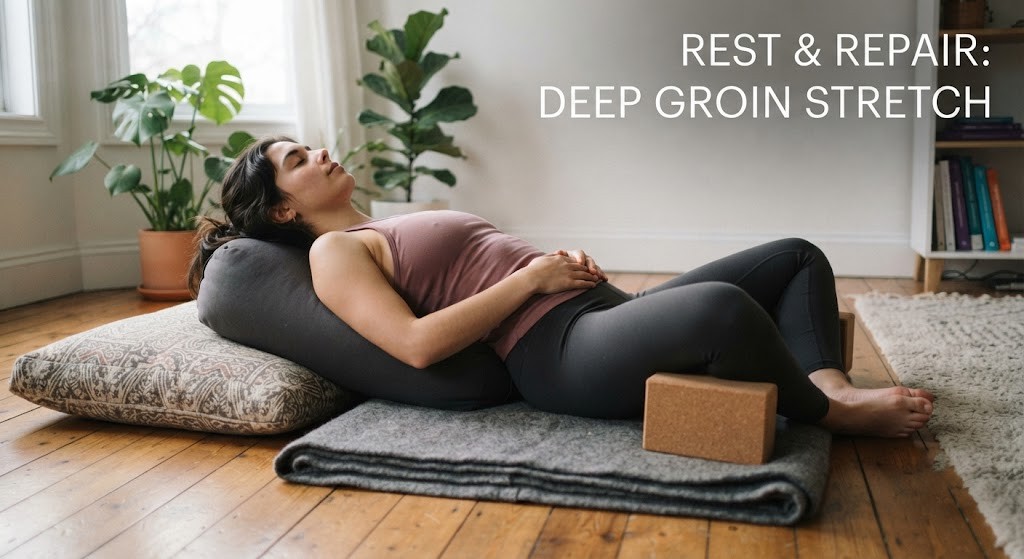
Reclining Bound Angle Pose
This supported position provides a gentler way to expose the inner thighs and hips to a stretch. It can be particularly useful when you’re beginning a yoga for groin flexibility routine.
Low Lunge
Low Lunge focuses more heavily on the hip flexors while also encouraging hip mobility. It works well as part of a sequence because it prepares the hips before more demanding positions.
Half Split
Half Split introduces greater flexibility demands through the hamstrings and hips. If hamstring tightness limits your movement, combine the practice with Yoga for Hamstrings.
Garland Pose
Garland Pose can challenge the hips, adductors, and ankle mobility. Beginners may need to modify the position or use support underneath the hips.
Wide-Legged Forward Fold
Wide-Legged Forward Fold places a stronger stretch on the adductors and hamstrings. Keep the movement controlled and avoid forcing yourself toward the floor.
Lizard Pose and Frog Pose
Lizard Pose and Frog Pose require more mobility and control. They should not be treated as tests of how flexible you are.
Instead, use them as gradual progressions after developing comfort with easier groin and hip stretches.
How Do You Perform Butterfly Pose for Groin Flexibility?
Butterfly Pose is a beginner-friendly yoga stretch that targets the inner thighs and can be used as part of a gradual groin-flexibility routine.
Follow these steps:
- Sit comfortably with your spine relatively tall.
- Bring the soles of your feet together.
- Hold your feet or ankles gently.
- Allow your knees to move outward naturally.
- Inhale slowly and lengthen through your spine.
- As you exhale, hinge forward slightly from your hips if comfortable.
- Maintain the position while breathing steadily.
Hold Butterfly Pose for 20–30 seconds, avoiding the temptation to force your knees toward the floor.
ACSM guidance commonly uses 10–30-second static stretches for flexibility work.
Source: American College of Sports Medicine, 2025.
For beginners, place a blanket beneath your hips or blocks beneath your knees for additional support. Avoid bouncing or aggressively pressing the knees downward.
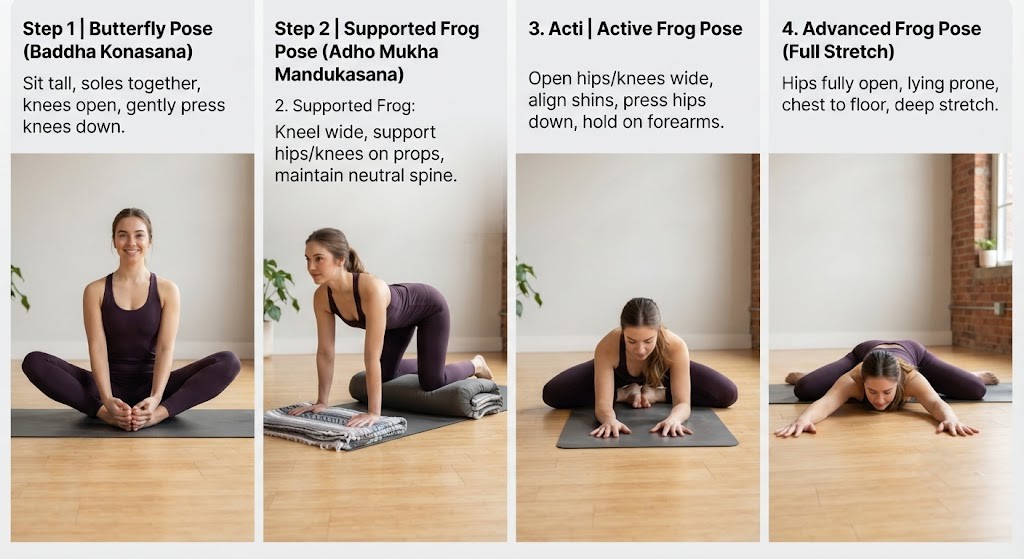
Is Frog Pose Good for Improving Groin Flexibility?
Frog Pose can challenge the adductors and inner thighs, but it is more demanding than beginner poses such as Butterfly Pose. It should therefore be introduced gradually and performed with controlled positioning.
To practice Frog Pose:
- Start on your hands and knees.
- Slowly move your knees wider apart.
- Keep your lower legs positioned comfortably.
- Support your upper body with your hands or forearms.
- Breathe slowly.
- Allow your hips to move backward only as far as comfortable.
A folded blanket beneath the knees can reduce pressure.
Stop if you experience sharp, pinching, sudden, or worsening groin pain. A stretching sensation can be expected, but pain is not a signal that you need to push harder.
For additional inner-thigh training, you can eventually combine flexibility work with Copenhagen plank, which emphasizes adductor strength and control rather than passive stretching.
What Are the Best Beginner Yoga Poses for a Tight Groin?
The best beginner yoga poses for a tight groin are supported positions that provide a mild-to-moderate stretch without forcing the hips into extreme ranges.
A beginner-friendly progression can include:
- Reclining Bound Angle — 60 seconds
- Butterfly Pose — 30 seconds
- Low Lunge — 30 seconds per side
- Half Split — 30 seconds per side
- Wide-Legged Forward Fold — 30 seconds
- Gentle Frog Pose — 20 seconds if comfortable
Start with the gentlest movements and gradually progress toward positions that require more mobility.
If your hips feel generally restricted, add yoga for tight hips rather than repeatedly forcing the groin stretch.
How Long Should You Hold a Groin Stretch During Yoga?
A practical beginner starting point is about 20–30 seconds per static groin stretch, using an intensity that feels like mild tension rather than pain. Longer holds are not automatically better.
Beginners can use shorter holds and repeat them once or twice. ACSM material describes static flexibility work using approximately 15–30 seconds per stretch, with multiple repetitions.
Source: American College of Sports Medicine, 2025.
Recent research also suggests that flexibility can improve across different stretching doses, meaning consistency is more important than chasing one perfect hold time. A 2025 meta-analysis found chronic static stretching produced a large positive effect on flexibility.
Source: Sports Medicine, 2025.
How Often Should You Do Yoga for Groin Flexibility?
Practicing groin-focused yoga around 2–3 times per week is a practical starting point for many beginners. You can also perform shorter, gentle mobility sessions more frequently if they remain comfortable.
Consistency gives your body repeated exposure to the movements without requiring aggressive stretching. For example, three 10-minute sessions can be easier to maintain than one very intense flexibility session.
ACSM recommendations commonly include flexibility exercise at least 2–3 times per week.
Source: American College of Sports Medicine, 2025.
For a broader plan, combine this routine with a daily stretching routine.
What Is a 10-Minute Yoga Routine for Tight Groin Muscles?
A 10-minute yoga routine for tight groin muscles should progress from gentle mobility toward moderate stretching instead of starting with the deepest pose.
Try this simple sequence:
- 1 minute: Gentle seated hip and leg movement
- 2 minutes: Reclining Bound Angle Pose
- 2 minutes: Butterfly Pose
- 2 minutes: Low Lunge, 1 minute per side
- 2 minutes: Wide-Legged Forward Fold
- 1 minute: Relaxed breathing in a comfortable seated position
Focus on slow breathing and controlled movement throughout the routine.
As your mobility improves, you can gradually introduce more challenging variations. However, you don’t need to make every session harder for the routine to be effective.
What Yoga Props Can Help With Groin Flexibility?
Yoga props can make groin-flexibility poses more accessible by supporting your body and reducing the need to force a position.
Useful options include:
- Blankets: Provide elevation and cushioning.
- Cushions: Add comfortable support during seated positions.
- Blocks: Help support the hands or other parts of the body.
- Bolsters: Provide support during restorative positions.
- Straps: Can assist with positioning when appropriate.
For example, use a blanket or cushion beneath the hips when sitting. This can make Butterfly Pose more comfortable by slightly changing your starting position.
You can also use blocks beneath your hands during Wide-Legged Forward Fold or in other supported positions. A bolster can provide additional support during Reclining Bound Angle Pose.
What Mistakes Should You Avoid When Stretching the Groin?
The biggest groin-stretching mistakes are forcing the range, bouncing, holding the breath, and ignoring painful sensations. Effective flexibility training should feel controlled rather than aggressive.
1. Bouncing During a Stretch
Avoid bouncing into the end range. Instead, use smooth and controlled movements.
2. Forcing the Knees Down
During Butterfly Pose, allow the knees to gradually move downward instead of manually pushing them toward the floor.
3. Holding Your Breath
Maintain slow, comfortable breathing throughout the movement. Controlled breathing can help you remain relaxed and focused.
4. Rounding Excessively
When appropriate, hinge from the hips rather than aggressively collapsing through the spine.
5. Ignoring Pain
Mild stretching tension and sharp pain are not the same. Stop when you experience sharp, sudden, pinching, or worsening pain.
6. Progressing Too Quickly
Deeper poses require appropriate mobility and control. Increase your range gradually instead of trying to achieve an advanced pose immediately.
7. Skipping Strength Training
Flexibility is only one part of movement quality. Pair mobility work with appropriate strengthening to develop control around the hips and inner thighs.
If discomfort persists, worsens, or follows an injury, consider getting an individualized assessment from an appropriately qualified healthcare professional.
What Yoga Props and Practical Tools Should You Use?
Blocks, blankets, bolsters, straps, and cushions are useful practical tools for supported groin-flexibility practice. They can help modify your range of motion and maintain better positioning.
You do not need expensive equipment to begin. A folded towel can substitute for a blanket, while sturdy books may temporarily provide elevation where appropriate.
The goal of a prop is not to push you deeper. Instead, it should make the position more comfortable, controlled, and sustainable.
How Can You Improve Groin Flexibility Over Time?
Improving groin flexibility is usually a gradual process, so consistent practice is more appropriate than forcing deeper stretches in a single session. Your goal should be a more comfortable range of motion rather than simply reaching a visually impressive pose.
Start by practicing your routine 2–3 times weekly. Track simple changes, such as how comfortably you squat, sit in Butterfly Pose, or widen your stance.
Next, progress one variable at a time. You might gradually increase hold duration, move through a slightly greater comfortable range, or introduce a more challenging variation.
Finally, reassess every few weeks rather than after every individual session. Comparing comfortable movement over time gives you a better indication of progress.
How to Build a Sustainable Yoga for Groin Flexibility Routine
A sustainable routine should be challenging enough to encourage adaptation but manageable enough that you can repeat it consistently.
A simple structure is:
Warm-up → gentle mobility → moderate stretching → deeper variation if appropriate → relaxed breathing
For example, you might begin with gentle hip movement, progress to Reclining Bound Angle and Butterfly Pose, then move into Low Lunge or Wide-Legged Forward Fold.
As your flexibility develops, you can gradually introduce Frog Pose or Lizard Pose. However, advanced poses are optional; you do not need them to work on groin mobility.
The most important factors are consistency, controlled movement, gradual progression, and respecting your body’s limits.
Conclusion
Yoga for groin flexibility can help improve comfortable inner-thigh and hip range of motion when practiced consistently and progressively. Beginner-friendly poses such as Butterfly Pose, Reclining Bound Angle, Low Lunge, and supported Half Split provide a useful starting point.
Deeper positions such as Frog Pose and Lizard Pose should come later, once you have developed better control and tolerance. Focus on steady breathing, proper alignment, gradual progression, and pain-free movement rather than forcing your body into deeper positions.
FAQs
What is the best yoga pose for groin flexibility?
Butterfly Pose is a simple choice for beginners.
Is yoga good for tight groin muscles?
Yes, yoga can help improve groin flexibility.
How often should I do yoga for groin flexibility?
Practice 2–3 times per week for steady progress.
How long should I hold a groin stretch?
Start by holding each stretch for 20–30 seconds.
Is Frog Pose good for groin flexibility?
Yes, Frog Pose provides a deeper inner-thigh stretch.
Can beginners do Frog Pose?
Yes, beginners can try it with proper support.
Should groin stretches hurt?
No, stretching should not cause sharp or severe pain.
Can yoga improve inner-thigh flexibility?
Yes, regular yoga can improve inner-thigh flexibility.
What props are useful for groin flexibility?
Blocks, blankets, and cushions can provide useful support.
Can I improve groin flexibility at home?
Yes, you can practice simple groin stretches at home.
Is flexibility or strength more important for the groin?
Both flexibility and strength are important for movement.
How long does it take to improve groin flexibility?
Progress varies, but consistent practice can help.
How to increase flexibility in groin area?
Practice gentle groin stretches regularly and gradually.
What are some good yoga poses for stretching the groin area?
Butterfly, Frog, and Wide-Legged Forward Fold are good options.
Why am I so tight in my groin area?
Limited mobility, sitting, and activity patterns can contribute.
How do I get rid of jiggly inner thighs?
Strength training and overall fat loss can improve their appearance.