
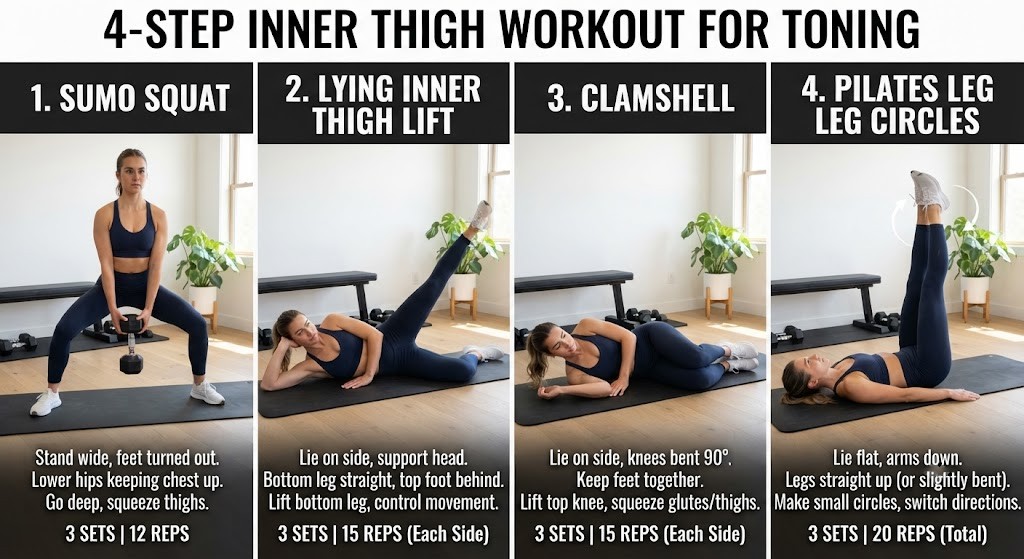
Most people know that squats and lunges can strengthen the legs, but the inner thighs often receive less direct attention. The key is choosing movements that effectively challenge the hip adductors while using proper form and realistic progression.
An inner thigh workout can help strengthen the muscles on the inside of your thighs while supporting hip stability, balance, and lower-body movement. In this guide, you’ll learn what the inner-thigh muscles do, the best exercises to target them, how to perform each movement, and how to build an effective inner thigh workout at home or in the gym.
What Is an Inner Thigh Workout?
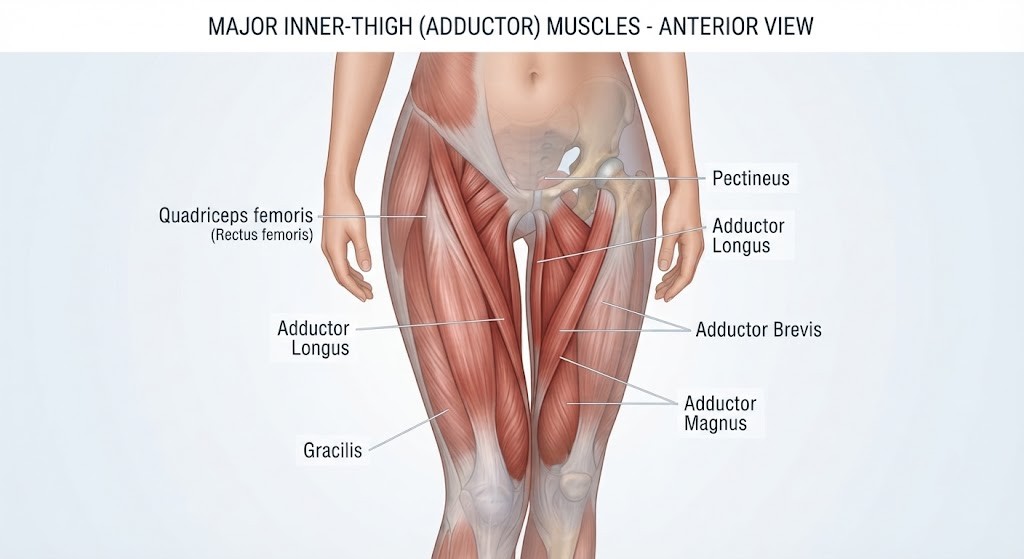
An inner thigh workout is a series of exercises designed to strengthen the hip adductor muscles located on the inside of the thigh. These muscles help pull the legs toward the body’s midline and contribute to controlled movement at the hip.
The primary muscles of the inner-thigh or medial-thigh group include the adductor longus, adductor brevis, adductor magnus, gracilis, and pectineus.
Targeted inner thigh exercises can use different types of movement. For example, squeezing a ball between your knees directly challenges the muscles responsible for bringing the thighs inward, while lateral lunges and squats train the adductors within larger lower-body movements.
An effective routine can include:
- Bodyweight squats
- Lateral lunges
- Side-lying adductor leg lifts
- Copenhagen planks
- Resistance-band exercises
- Slider exercises
- Gym-based hip adduction machines
Inner thigh exercises are useful for both men and women because the underlying muscle function is the same. Exercise selection should instead depend on factors such as training experience, mobility, available equipment, and individual goals.
Why Are Inner Thigh Exercises Important?
The hip adductors contribute to lower-body strength, hip stability, balance, and movement control. They help control the legs during movements such as squats, lunges, lateral movements, and changes of direction.
Adding direct adductor work can also complement a broader [leg workout for stronger lower body]. Rather than relying exclusively on forward-and-backward movements, targeted inner thigh exercises add more lateral and medial hip work to your training.
Inner Thigh Exercises and Athletic Performance
Adductor strength can be particularly relevant for athletes who regularly accelerate, decelerate, change direction, cut, or move sideways.
A randomized trial involving 35 semiprofessional football teams and 652 players found that an adductor-strengthening program was associated with a 41% lower risk of reported groin problems compared with the control group. Source: British Journal of Sports Medicine, 2019.
However, strengthening the inner thighs does not mean you can selectively burn fat from that area. Exercise can strengthen the underlying muscles, while changes in body fat generally depend on overall energy balance, activity, nutrition, genetics, and other individual factors.
What Are the Best Inner Thigh Exercises?
The best inner thigh exercises are movements that challenge hip adduction while allowing you to maintain controlled technique. A well-rounded routine can combine squatting, lateral movement, direct adduction, and isometric exercises.
| Exercise | Main Focus | Beginner Target | Equipment |
|---|---|---|---|
| Sumo squat | Adductors, glutes, quads | 8–12 reps | None/dumbbell |
| Side lunge | Adductors, glutes | 8–10/side | None |
| Lateral squat | Adductors, quads | 8–12/side | None |
| Adductor leg lift | Inner thigh | 10–15/side | None |
| Ball/pillow squeeze | Hip adductors | 12–15 reps | Pillow/ball |
| Copenhagen plank | Adductors, core | 10–20 sec/side | Bench/chair |
| Sliding lateral lunge | Adductors, glutes | 6–10/side | Slider/towel |
| Hip adduction machine | Hip adductors | 10–15 reps | Gym machine |
1. Sumo Squat
A sumo squat is a wide-stance squat that can place substantial emphasis on the adductors while also training the glutes and quadriceps.
How to perform a sumo squat:
- Stand with your feet wider than shoulder-width apart.
- Turn your toes slightly outward.
- Brace your core and keep your chest lifted.
- Bend your hips and knees as you lower.
- Lower only as far as you can maintain a comfortable, controlled position.
- Drive through your feet to return to standing.
- Squeeze your glutes at the top.
Start with 2–3 sets of 8–12 repetitions using body weight. Once the movement feels comfortable, you can add a dumbbell.
For example, a beginner can perform three sets of 10 controlled repetitions using a two-second lowering phase. A slower tempo can improve control without immediately requiring heavier resistance.
2. Side Lunge
A side lunge is a lateral movement that trains one leg while the opposite leg lengthens, creating a useful challenge for the inner thigh.
How to perform a side lunge:
- Stand tall with your feet together.
- Step out to one side.
- Bend the stepping leg while pushing your hips backward.
- Keep the opposite leg relatively straight.
- Keep your planted foot flat and your knee aligned with your toes.
- Push through the bent leg to return to the starting position.
Perform 8–10 repetitions per side for 2–3 sets. If you are new to lateral movements, begin with a smaller range of motion.
A shallow side lunge is often a practical starting point. As mobility and control improve, gradually increase the depth.
Pairing side lunges with [beginner lower-body workout] exercises can help create a more balanced lower-body session.
3. Adductor Leg Lift
The adductor leg lift directly challenges the inner-thigh muscles by lifting the lower leg toward the upper leg.
How to perform an adductor leg lift:
- Lie on your side with your torso supported.
- Position your upper leg comfortably in front of you.
- Straighten your lower leg.
- Slowly raise the lower leg toward the upper leg.
- Avoid swinging or using momentum.
- Lower the leg slowly and repeat.
Perform 10–15 repetitions per side for 2–3 sets. Stop before your technique becomes difficult to control.
This exercise is especially useful in an [inner thigh workout without equipment] because it requires only floor space. A folded mat can make the movement more comfortable.
4. Copenhagen Plank
The Copenhagen plank is an isometric exercise that challenges the adductors while also requiring core and hip stability.
How to perform a Copenhagen plank:
- Place one leg on a sturdy bench or elevated surface.
- Support your upper body with your forearm or hand.
- Lift your hips from the floor.
- Keep your body in a controlled line.
- Keep your shoulders stacked and avoid allowing your hips to sag.
- Hold the position for approximately 10–20 seconds per side.
Beginners can use a shorter lever or place more of the lower leg on the bench to reduce difficulty.
As your strength improves, you can gradually increase the hold duration or move toward a harder Copenhagen variation. The exercise also pairs naturally with [core strengthening exercises] for a more complete stability-focused workout.
5. Pillow or Ball Squeeze
A pillow or small ball squeeze is one of the simplest ways to introduce direct hip-adduction work.
Place a pillow or ball between your knees and squeeze inward in a controlled manner. Release gradually rather than letting the resistance disappear suddenly.
Aim for 12–15 repetitions and focus on controlled contractions.
This option can be particularly useful for beginners who want a low-impact movement before progressing to more demanding exercises.
6. Sliding Lateral Lunge
Sliding lateral lunges combine lateral movement with a controlled return to the starting position.
Place one foot on a slider or towel and gradually slide that leg outward while bending the opposite leg. Then use the working leg to control the return.
Start with 6–10 repetitions per side and focus on maintaining control throughout the movement.
7. Hip Adduction Machine
The hip adduction machine provides direct, adjustable resistance for the hip adductors.
Because the resistance can be adjusted in small increments, it can be useful for gym-goers who want a straightforward way to progressively overload the inner thighs.
A beginner target is 10–15 repetitions, using a resistance level that allows controlled technique throughout the set.
How Do You Do an Inner Thigh Workout at Home?
An inner thigh workout at home can be effective using bodyweight exercises, a pillow, resistance band, or household sliders. You do not need a gym machine to start strengthening the adductors.
Instead of repeating one exercise, choose movements that challenge the muscles in different ways. A simple home session can combine:
- Sumo squats
- Side lunges
- Adductor leg lifts
- Pillow squeezes
- Modified Copenhagen planks
Beginners can perform these exercises as a 10–15 minute session after a brief warm-up. Adults are generally advised to perform muscle-strengthening activity on at least 2 days per week as part of their overall activity routine. Source: CDC, 2025.
Beginner Inner Thigh Workout at Home
- Sumo squats: 10–12 reps
- Side lunges: 8 reps per side
- Adductor leg lifts: 12 reps per side
- Pillow squeezes: 15 reps
- Modified Copenhagen plank: 10–15 seconds per side
Rest for 30–60 seconds between exercises and repeat the circuit 2–3 times.
If you are new to training, begin with two rounds and increase the volume gradually.
What Is the Best Inner Thigh Exercise for Beginners?
The best inner thigh exercise for a beginner is one that can be performed safely with a controlled range of motion and manageable resistance. For many beginners, the sumo squat or pillow squeeze provides an accessible starting point.
Your choice should depend on your experience and limitations. A sumo squat introduces the adductors within a larger lower-body movement, while a pillow squeeze provides a simple, low-impact way to practice direct adduction.
Technique should come before difficulty. If an exercise causes sharp, pinching, or unusual pain, reduce the range of motion or stop and choose another movement.
For example, someone who finds side lunges uncomfortable can begin with supported lateral squats or pillow squeezes before progressing to more demanding variations.
How Many Reps and Sets Should You Do for Inner Thigh Exercises?
Most beginners can start with 2–3 sets of approximately 8–15 repetitions for dynamic inner thigh exercises. Isometric movements such as Copenhagen planks can instead use 10–20-second holds, depending on your ability.
Choose a resistance level that makes the final repetitions challenging without compromising your technique. If you can easily perform 15 repetitions while maintaining excellent control, a modest increase in resistance may be appropriate.
Your total training volume should also fit into your broader leg routine. Adults should strengthen all major muscle groups on at least 2 days per week, rather than focusing exclusively on one area. Source: CDC, 2023.
As a result, inner thigh exercises are generally best treated as one component of a complete lower-body program.
You can combine adductor work with:
[best glute exercises]
Squats Hamstring exercises Calf exercises Core exercises Lateral movements
This approach provides more balanced lower-body training than concentrating exclusively on the inner thighs.
How Often Should You Train Your Inner Thighs?
Most people can train their inner thighs approximately 2–3 times per week when sessions are appropriately spaced and recovery is adequate. Beginners can start with two sessions and assess how their muscles respond.
Avoid turning every workout into a high-volume adductor session. The hip adductors already contribute to several lower-body exercises, so direct inner-thigh work can complement rather than replace compound movements.
The CDC recommends at least 2 days of muscle-strengthening activity per week for adults, with exercises covering all major muscle groups. Source: CDC, 2025.
For example, you might perform direct inner-thigh exercises on Monday and Thursday while using other days for upper-body training, cardio, mobility, or recovery.
Can Inner Thigh Exercises Reduce Inner Thigh Fat?
Inner thigh exercises can strengthen the muscles but cannot reliably guarantee selective fat loss from the inner thighs. Fat loss generally occurs through changes in overall energy balance rather than simply exercising the muscle underneath a particular fat depot.
Overall physical activity can contribute to weight management when combined with appropriate nutrition. The CDC explains that physical activity increases energy expenditure and, alongside reduced calorie intake, can contribute to the calorie deficit associated with weight loss. Source: CDC, 2026.
Research on localized fat loss is mixed, so claims promising rapid inner-thigh fat removal from a particular exercise should be treated cautiously.
A 2023 randomized trial found evidence of localized trunk fat changes from targeted exercise, illustrating why the topic is more nuanced than a simple claim that spot reduction never occurs. Source: Physiological Reports, 2023.
Therefore, focus on strengthening your muscles, staying physically active, eating nutritiously, and following a sustainable training plan rather than expecting one exercise to remove fat from a specific body part.
What Equipment Can You Use for an Inner Thigh Workout?
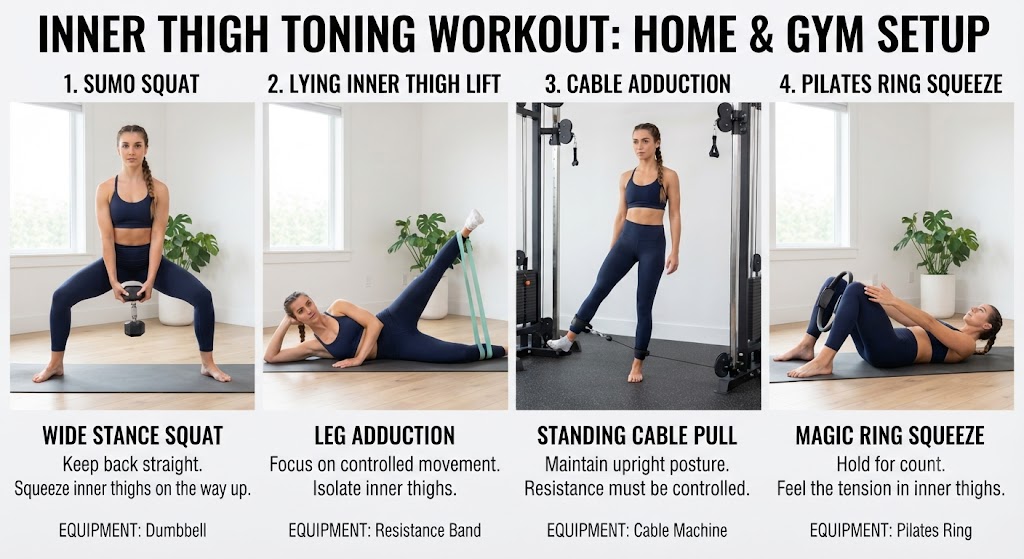
An inner thigh workout can require no equipment at all or use specialized gym equipment. The main difference is how much resistance, stability demand, and progression each option provides.
Useful Inner Thigh Workout Equipment
- Pillow or small ball: Knee squeezes
- Resistance band: Adduction and lateral movements
- Sliders or towels: Sliding lateral lunges
- Dumbbell or kettlebell: Loaded squats and lunges
- Bench or sturdy elevated surface: Copenhagen plank variations
- Hip adduction machine: Direct, adjustable resistance in a gym
For example, a resistance band can make a standing adduction movement more challenging without requiring heavy weights. In a gym, a hip adduction machine allows you to adjust the resistance in small increments.
What Is a Good 10-Minute Inner Thigh Workout?
A good 10-minute inner thigh workout combines several movements with controlled transitions rather than rushing through a long list of exercises.
The following routine works as a simple beginner-to-intermediate circuit.
2-Minute Warm-Up
Before the main workout, spend about 2 minutes warming up with easy bodyweight movements.
Try:
- Marching
- Gentle side steps
- Hip circles
- Controlled bodyweight squats
10-Minute Inner Thigh Workout Circuit
- Sumo squat — 12 reps
- Side lunge — 8 reps per side
- Adductor leg lift — 12 reps per side
- Pillow squeeze — 15 reps
- Modified Copenhagen plank — 10 seconds per side
Rest for approximately 30 seconds and repeat as time allows.
Keep every repetition controlled and use a range of motion that feels comfortable. The goal is to challenge the inner thighs without sacrificing technique.
Finally, finish with gentle movement rather than forcing an aggressive inner-thigh stretch. If you experience pain rather than normal muscular effort, stop or modify the exercise.
How Can You Make an Inner Thigh Workout More Challenging?
Progressive overload means gradually increasing the training challenge while maintaining good form. You can progress an inner thigh workout by increasing resistance, repetitions, hold duration, movement tempo, range of motion, or exercise difficulty.
When possible, change only one variable at a time. For example, increase a Copenhagen plank from 10 to 15 seconds before immediately moving to a significantly harder variation.
Inner Thigh Workout Progression
- Level 1: Bodyweight exercises and short holds
- Level 2: More repetitions or longer holds
- Level 3: Resistance bands or light weights
- Level 4: Slower tempo and greater range of motion
- Level 5: Advanced movements such as full Copenhagen planks or loaded lateral lunges
For example, someone who comfortably performs three sets of 12 bodyweight sumo squats could add a light dumbbell rather than immediately doubling the workout volume.
This creates a measurable challenge while avoiding unnecessary fatigue.
Recovery should also increase in importance as training becomes harder. The Physical Activity Guidelines encourage gradually increasing muscle-strengthening activity and varying activities to reduce the risks associated with doing too much of one type of exercise. Source: U.S. Department of Health and Human Services, 2018.
strength training for beginners
How Should You Progress Your Inner Thigh Workout?
The best next step is to choose a manageable routine and repeat it consistently before adding unnecessary complexity. A simple program performed well is more useful than an advanced routine performed inconsistently.
Track one or two measurable variables each week, such as:
- Number of repetitions
- Resistance used
- Hold duration
- Range of motion
- Perceived difficulty
You can also combine inner thigh training with a complete lower-body program. Use [bodyweight exercises] for equipment-free sessions, then gradually add resistance as your strength improves.
For example, after four weeks of consistent training, you might increase a side lunge from 8 to 12 repetitions per side or add a light dumbbell to your sumo squat. You do not need to change every exercise at once.
Finally, give your muscles adequate recovery and modify any movement that produces pain. Persistent or significant pain deserves professional evaluation rather than more repetitions.
Compression Boots Benefits for Recovery
Conclusion: Build Stronger, More Balanced Legs
An inner thigh workout can strengthen the hip adductors that support leg movement, hip stability, balance, and lower-body control. Effective choices include sumo squats, side lunges, adductor leg lifts, Copenhagen planks, pillow squeezes, sliders, resistance bands, and hip adduction machines.
Beginners should start with manageable exercises, controlled repetitions, and modest training volume. As strength improves, more experienced trainees can progressively increase resistance, repetitions, hold duration, tempo, range of motion, or exercise difficulty.
It is also important to remember that inner thigh exercises strengthen the muscles but cannot promise selective inner-thigh fat loss. Pair targeted adductor training with a balanced [leg workout for stronger lower body], consistent physical activity, good nutrition, and adequate recovery.
Start with the 10-minute routine, prioritize technique, and progress gradually. Stronger, more balanced legs are built through consistency—not by performing the largest possible number of exercises.
FAQs
What is an inner thigh workout?
An inner thigh workout uses exercises that strengthen the hip adductor muscles on the inside of the thighs.
What is the best inner thigh exercise?
The best inner thigh exercises include sumo squats, side lunges, adductor leg lifts, and Copenhagen planks.
How do I tone my inner thighs fast?
You can tone your inner thighs by consistently doing strength exercises and maintaining an active lifestyle.
How do you train inner thighs?
You train inner thighs with exercises such as sumo squats, side lunges, leg lifts, and pillow squeezes.
What causes inner thigh fat in females?
Inner thigh fat can be influenced by genetics, hormones, age, and overall body-fat distribution.
How to get rid of saggy inner thighs?
Strength training can improve inner-thigh muscle tone, while overall fat loss may improve their appearance.
Can inner thigh exercises reduce inner thigh fat?
Inner thigh exercises strengthen the muscles but cannot guarantee fat loss from one specific area.
How often should I do an inner thigh workout?
You can train your inner thighs about 2–3 times per week with adequate recovery.
Are inner thigh workouts effective at home?
Yes, bodyweight exercises, pillow squeezes, and resistance bands can effectively train the inner thighs.
How many sets should I do for inner thigh exercises?
Beginners can start with 2–3 sets of 8–15 repetitions per exercise.
What is the easiest inner thigh exercise for beginners?
Pillow squeezes and bodyweight sumo squats are simple inner thigh exercises for beginners.
Do squats work the inner thighs?
Yes, wide-stance squats such as sumo squats can engage the inner thigh muscles.
Can I do inner thigh exercises without equipment?
Yes, exercises such as sumo squats, side lunges, and adductor leg lifts require no equipment.
What equipment is best for an inner thigh workout?
Resistance bands, dumbbells, sliders, pillows, and hip adduction machines can be useful for inner thigh training.
2 thoughts on “Inner Thigh Workout: Strengthen, Tone & Sculpt Your Legs”