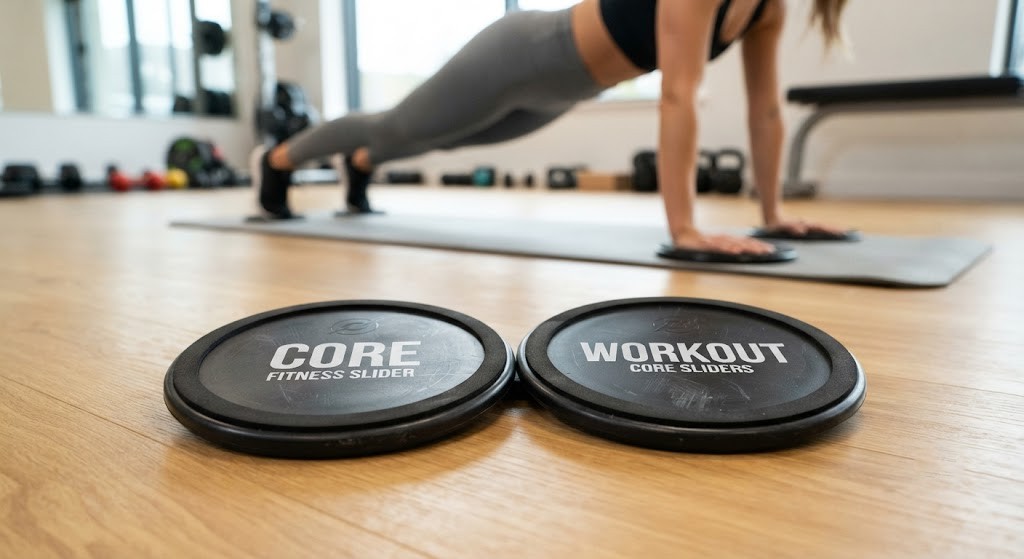
You may already use bodyweight exercises such as planks, lunges, and mountain climbers, but adding core slider discs can transform these familiar movements into more challenging, controlled exercises. These compact discs allow your hands or feet to glide across the floor while your muscles work to stabilize and control every movement.
In this guide, you’ll learn what core slider discs are, how they work, which muscles they target, the best beginner and advanced slider exercises, how to build a complete slider workout, how to progress safely, and what to consider when choosing the right discs.
What Are Core Slider Discs and How Do They Work?
Core slider discs are small exercise tools that allow your hands or feet to glide across a training surface during bodyweight movements. They are also commonly called core sliders, workout slider discs, exercise sliders, or sliding discs for exercise.
For example, placing one slider beneath each foot during a plank allows you to move your legs without lifting your feet from the floor. That sliding action introduces a new movement demand to an otherwise familiar bodyweight exercise.
Slider discs work by reducing friction between your hands or feet and the training surface. Your muscles must then control the sliding movement rather than relying on a stable contact point.
For more foundational training ideas, explore our guide to Abdominal Workout Exercises.
How Do Exercise Sliders Create Resistance?
Exercise sliders create resistance primarily through controlled body movement, friction, leverage, and stabilization, rather than by adding external weight. The lower the friction and the longer the lever position, the more control your body may need.
For instance, extending your legs farther during a slider body saw increases the distance your body needs to control. As a result, the same exercise can feel considerably more demanding without adding a dumbbell or weight plate.
Core slider exercises require you to maintain body tension while your hands or feet move across the floor, creating a combination of controlled movement and stabilization.
What Is the Difference Between Double-Sided and Single-Surface Sliders?
Double-sided exercise sliders have different materials on their two faces, allowing them to work across multiple floor types. Single-surface sliders are generally designed for a particular flooring material.
For example, a slider with a fabric side may glide more easily on hard flooring, while a plastic surface can be designed for use on carpet.
| Slider Type | Typical Use | Key Consideration |
|---|---|---|
| Double-sided | Multiple floor types | Versatility |
| Hard-floor slider | Hardwood, tile, laminate | Smooth movement |
| Carpet slider | Carpet and rugs | Reduced drag |
| Fabric slider | Hard surfaces | Surface protection |
| Plastic slider | Carpet or selected surfaces | Durability |
The appropriate slider disc depends on the floor surface, intended exercises, grip requirements, durability, and whether the disc is designed for hands, feet, or both.
Why Are Core Slider Discs Useful for Core Workouts?
Core slider discs are useful because they make you control movement while maintaining body alignment and trunk tension. Instead of simply holding a position, you often have to stabilize your body while another part of it moves.
For example, a slider knee tuck requires you to keep your upper body stable while drawing your knees toward your chest. This combination makes the exercise more dynamic than a traditional static plank.
Slider discs can also make bodyweight exercises more versatile without requiring large pieces of equipment. They are compact enough for home workouts and can be used for core, lower-body, upper-body, and full-body movements.
The World Health Organization reported that 31% of adults worldwide, approximately 1.8 billion people, did not meet recommended physical activity levels in 2022 — Source: World Health Organization, 2024.
That figure highlights the broader value of accessible exercise options, although slider discs themselves are not necessary to meet physical activity recommendations.
For more ideas, combine sliders with Full Body Functional Training Workout.
How Do Slider Discs Challenge Stability?
Slider discs challenge stability because your body must resist unwanted movement while your hands or feet glide. This requires coordination between the abdominal muscles, hips, shoulders, and other stabilizing muscles.
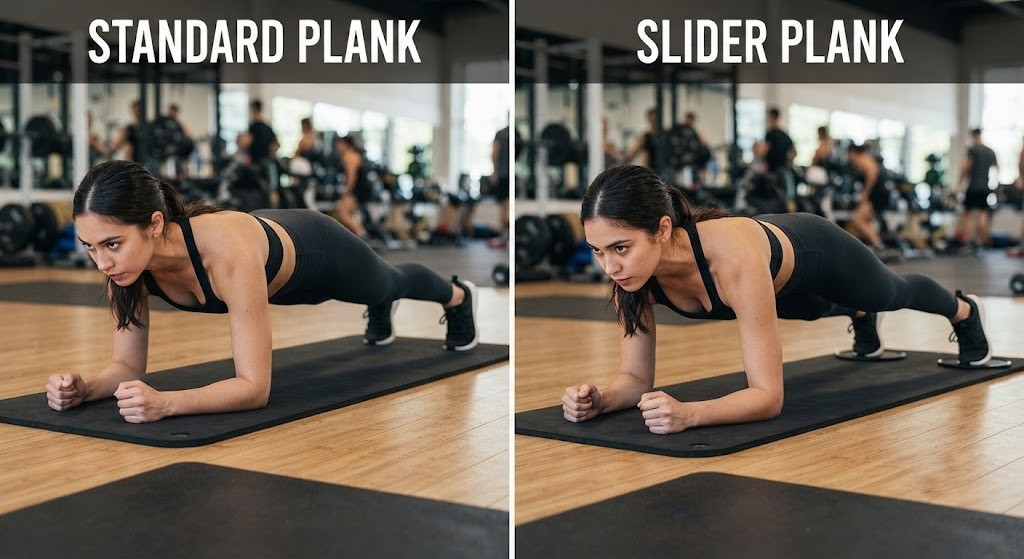
During a slider plank, for example, your shoulders and trunk must remain controlled while your feet move forward or sideways. If that control is lost, your hips may rotate or your lower back may arch.
Slider training turns many stable bodyweight exercises into controlled moving exercises.
What Muscles Do Core Slider Exercises Work?
Core slider exercises can work the abdominal muscles, obliques, hip flexors, glutes, hamstrings, shoulders, chest, and other stabilizing muscles depending on the movement. No single slider exercise targets every muscle equally.
For example, slider hamstring curls emphasize the posterior chain, while slider mountain climbers place greater demands on the abdominals, hip flexors, shoulders, and legs.
The core also functions as a stabilizing system rather than a single muscle during many slider exercises. The rectus abdominis, obliques, deeper abdominal muscles, spinal stabilizers, and hip muscles can all contribute to controlling movement.
For more targeted training, see our core strengthening exercises.
Which Muscles Do Slider Exercises Target?
Different slider movements emphasize different muscle groups:
- Abs: Knee tucks, body saws, and pikes.
- Obliques: Side plank variations and rotational movements.
- Hamstrings: Slider hamstring curls.
- Glutes: Slider reverse lunges and lateral movements.
- Shoulders: Slider plank movements and body saws.
- Chest: Sliding push-up variations.
- Hip flexors: Mountain climbers and knee tucks.
A small electromyography study comparing abdominal exercises found that abdominal muscle activation can vary between exercise variations, demonstrating why exercise selection matters — Source: Journal of Strength and Conditioning Research, 2011.
That finding does not mean slider exercises automatically outperform every other abdominal exercise. Instead, it supports using different movements according to your specific training goal.
What Are the Best Core Slider Exercises for Beginners?
The best core slider exercises for beginners are movements that allow you to control the slider without losing body alignment. Knee tucks, mountain climbers, reverse lunges, and basic plank slides are useful starting points.
If a full slider pike is too difficult, for example, begin with a short-range knee tuck and gradually increase the movement distance as your control improves.
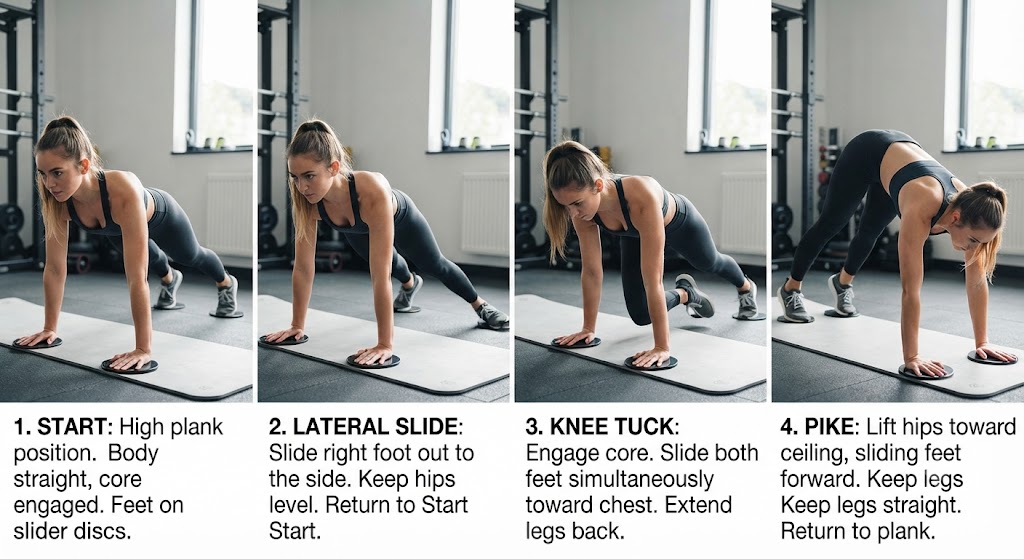
1. Slider Mountain Climbers
Slider mountain climbers are a dynamic core exercise in which each foot slides toward the chest while the upper body remains supported.
Start in a high plank with one slider under each foot. Brace your abdomen, slide one knee toward your chest, return it to the starting position, and then repeat with the opposite leg.
Keep your hips as level as possible throughout the movement. Avoid rapidly moving your legs if speed causes your lower back to arch or your hips to bounce.
2. Slider Knee Tucks
Slider knee tucks combine a plank position with a controlled knee-drawing movement.
Start in a high plank with both feet on sliders. Pull both knees toward your chest, pause briefly, and then extend your legs back without allowing your hips to collapse.
For an easier version, move only halfway toward your chest. To progress the exercise, gradually increase the range of motion while maintaining a stable torso.
3. Slider Body Saw
Slider body saws are a plank variation in which your body moves forward and backward while your feet remain on sliders.
Start on your forearms with your feet supported by sliders. Brace your core and slowly push your body backward, then pull yourself forward.
The movement should come from controlled shoulder and trunk movement rather than excessive lower-back motion.
4. Slider Reverse Lunges
Slider reverse lunges are a lower-body movement in which one foot slides backward while the opposite leg controls your body position.
Stand upright with one foot on a slider. Slide that foot backward, lower into a comfortable lunge, and then push through the front foot to return to the starting position.
For more lower-body variety, combine this movement with hamstring exercises.
5. Slider Hamstring Curls
Slider hamstring curls are a posterior-chain exercise that trains the hamstrings and glutes while also challenging hip control.
Lie on your back with your knees bent and your heels on sliders. Lift your hips, gradually extend your legs, and then pull your heels back toward your body.
Keep your hips elevated without forcing the range of motion. If your hips repeatedly drop, shorten the movement.
6. Slider Plank Variations
Slider plank variations add controlled movement to the traditional plank position.
You can slide one foot outward, alternate leg extensions, or move both feet backward and forward. Begin with small movements before progressing to larger ranges.
For additional plank ideas, see our Plank Exercise Benefits.
What Are the Best Core Slider Exercises for Stronger Abs?
Effective core slider exercises for stronger abs include controlled movements such as knee tucks, body saws, mountain climbers, and pike variations. These movements require the trunk to resist unwanted motion while the limbs change position.
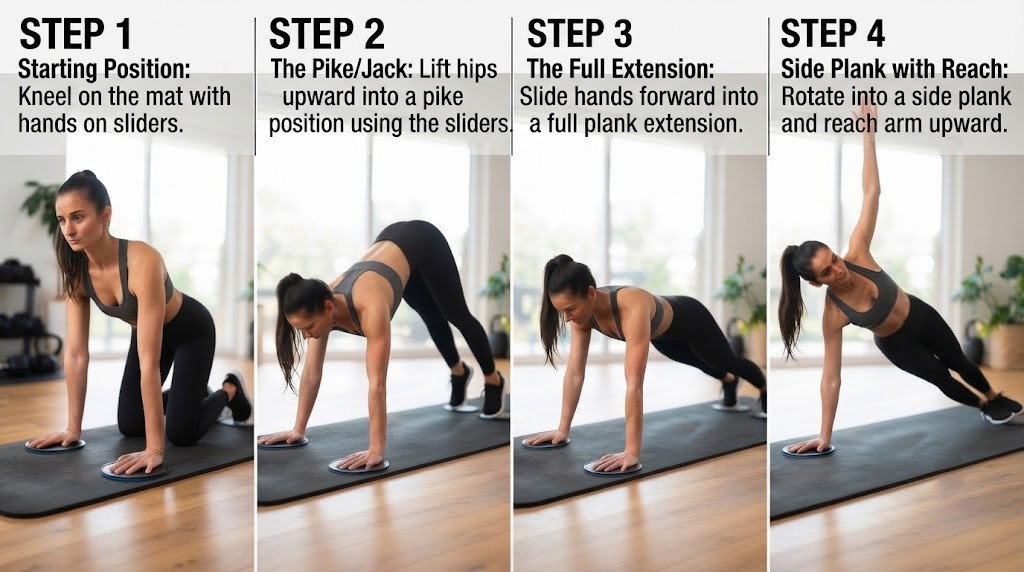
A slider pike, for example, starts from a plank position and uses a controlled hip lift to move the feet toward the hands. The exercise becomes more demanding when you increase the range of motion without losing control of your spine and trunk.
Slider discs can be used for exercises that target the core, including mountain climbers, knee tucks, body saws, plank variations, and pike movements.
For a short standalone routine, you can combine sliders with our Lower Abs Workouts.
How Do You Use Core Slider Discs Correctly?
You use core slider discs correctly by selecting a suitable surface, maintaining controlled movement, bracing your trunk, and progressing gradually. The goal is not to move as quickly as possible but to maintain control throughout each repetition.
During a knee tuck, for example, your shoulders should remain stable while your legs move smoothly beneath your body.
Start with a short warm-up that prepares your shoulders, hips, legs, and trunk. Then choose an easier slider variation and increase the difficulty only when your technique remains consistent.
Keep your spine in a controlled position and avoid excessive lower-back extension. Stop the set when you can no longer maintain proper alignment.
Can You Use Core Slider Discs on Carpet and Hardwood Floors?
Core slider discs can be used on carpet or hardwood floors when the slider design matches the surface. Using the wrong side can create excessive friction, poor movement, or unwanted surface damage.
For example, a carpet-specific slider may move poorly on hardwood, while a hard-floor slider may not glide effectively across thick carpet.
Always check the manufacturer’s surface recommendations before use. Test the slider with gentle movements before performing demanding exercises.
How Many Times a Week Should You Do Slider Exercises?
Most beginners can start with slider exercises two days per week, allowing recovery between challenging sessions. Your exact frequency should depend on training volume, intensity, experience, and the other workouts you perform.
For context, U.S. physical activity guidelines recommend adults perform muscle-strengthening activities on at least 2 days per week — Source: Centers for Disease Control and Prevention, 2023.
This guideline is broader than slider training and does not prescribe a specific slider frequency. Instead, use it as a general framework while adjusting your training to your individual needs.
Can Core Slider Discs Be Used for a Full-Body Workout?
Yes. Core slider discs can be incorporated into a full-body workout because they support movements for the core, legs, glutes, chest, shoulders, and posterior chain. Their primary advantage is versatility rather than isolation of a single muscle group.
A full-body circuit, for example, could combine slider mountain climbers, reverse lunges, hamstring curls, sliding push-ups, and body saws.
Beginner Slider Workout
Complete 2 rounds with controlled technique:
| Exercise | Reps/Time | Rest |
|---|---|---|
| Slider Knee Tucks | 8–10 reps | 30 sec |
| Reverse Lunges | 8 each side | 30 sec |
| Slider Hamstring Curls | 8–10 reps | 30 sec |
| Slider Mountain Climbers | 20 total | 30 sec |
| Body Saw | 8–10 reps | 60 sec |
For beginners, shorten the range of motion whenever necessary. The goal is consistent technique rather than completing the largest possible number of repetitions.
Intermediate Slider Workout
Complete 3 rounds:
- Slider mountain climbers — 30 seconds
- Slider knee tucks — 10–12 reps
- Reverse lunges — 10 each side
- Hamstring curls — 10–12 reps
- Body saws — 10–12 reps
- Slider pikes — 6–10 reps
Rest for 45–75 seconds between rounds.
You can also incorporate these movements into HIIT workout exercises when the exercises can be performed safely at the desired intensity.
The CDC recommends adults accumulate at least 150 minutes of moderate-intensity physical activity or 75 minutes of vigorous activity each week, alongside muscle-strengthening activity on at least 2 days — Source: Centers for Disease Control and Prevention, 2025.
How Do You Make Slider Disc Exercises Easier or Harder?
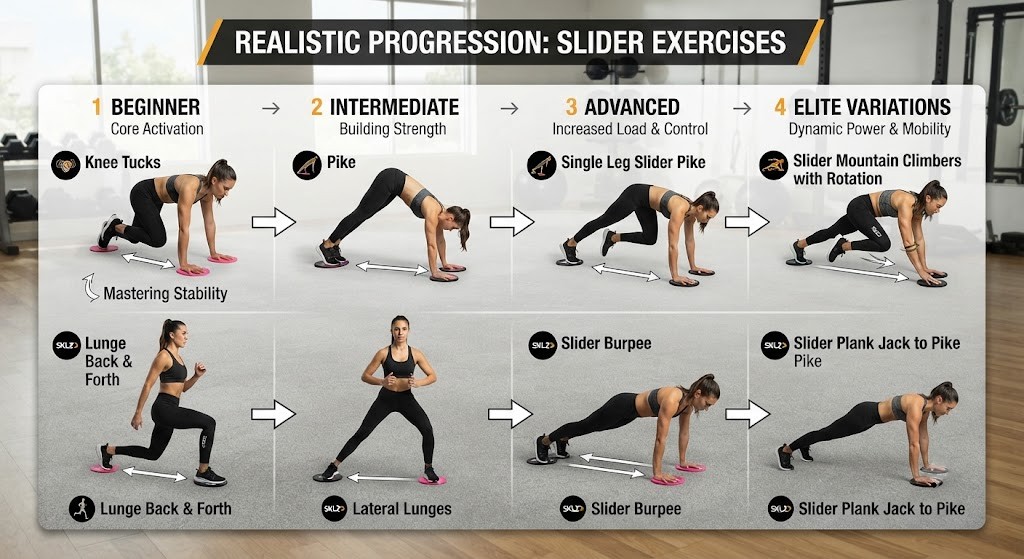
Slider exercises can become easier or harder by changing the range of motion, movement speed, repetitions, sets, leverage, or exercise variation. Change only one or two variables at a time so you can identify what increases the challenge.
A beginner can perform a partial knee tuck, for example, while an intermediate trainee can use a larger range of motion or progress toward a pike.
The difficulty of a slider exercise can be changed by modifying the range of motion, movement speed, repetitions, sets, or exercise variation.
Easy Slider Exercise Modifications
Use these regressions when learning a new movement:
- Reduce the range of motion.
- Perform fewer repetitions.
- Keep one foot stationary.
- Use a shorter work interval.
- Choose a more stable body position.
Advanced Slider Exercise Progressions
Increase difficulty by:
- Increasing range of motion.
- Adding repetitions or sets.
- Slowing the eccentric phase.
- Increasing time under tension.
- Moving to a harder variation.
- Combining two movements.
For controlled training ideas, see our time under tension workout.
What Are the Most Common Core Slider Exercise Mistakes?
The most common core slider exercise mistakes include moving too quickly, losing trunk alignment, using excessive range of motion, choosing an unsuitable floor, and progressing before mastering the basic variation.
Rushing through slider mountain climbers, for example, can cause the hips to bounce while reducing control of the abdominal position.
Moreover, poor technique can make a difficult exercise unnecessarily difficult. If your form starts to deteriorate, slow down, reduce the range of motion, and rebuild the movement pattern.
Common mistakes include:
- Letting the lower back sag during plank movements.
- Raising the hips excessively during knee tucks.
- Using momentum instead of muscle control.
- Selecting sliders that do not match the floor.
- Performing advanced exercises too early.
- Ignoring discomfort in the wrists, shoulders, knees, or lower back.
How Do You Choose the Right Core Slider Discs?
The right core slider discs should match your floor surface, preferred exercises, hand or foot use, grip requirements, durability needs, and portability.
A versatile double-sided design can be useful if you train on multiple surfaces. Someone who primarily trains on hardwood, for example, may prioritize smooth-gliding material and surface protection, while someone who trains on carpet may need a different slider construction.
Consider these factors before buying:
| Feature | What to Look For |
|---|---|
| Floor compatibility | Carpet, hardwood, tile, or multiple surfaces |
| Construction | Durable materials and secure edges |
| Size | Large enough for comfortable hand or foot placement |
| Grip | Secure contact without unnecessary slipping |
| Portability | Lightweight and easy to store |
| Surface design | Single-sided or double-sided |
| Exercise use | Hands, feet, or both |
What Should You Do Next With Core Slider Training?
The next step with core slider training is to master basic movements before increasing exercise complexity. Start with two or three controlled exercises, practice them consistently, and progress gradually.
A beginner might start with knee tucks, reverse lunges, and hamstring curls before adding pikes or more demanding plank variations.
A practical progression looks like this:
- Learn the movement.
- Improve your range of motion.
- Add repetitions.
- Increase sets.
- Increase time under tension.
- Move to a harder variation.
Progressive slider training should prioritize movement quality before exercise complexity.
If you want to build a broader routine, combine sliders with Calisthenics Workout Plan and a Full Body Workout for Beginners.
Conclusion
Core slider discs are compact training tools that allow your hands or feet to glide across the floor while your body controls the movement. They can make familiar exercises such as planks, mountain climbers, lunges, hamstring curls, and pikes more demanding without requiring heavy equipment.
Slider training is most effective when you focus on controlled movement, proper alignment, appropriate surface selection, and gradual progression. Start with beginner-friendly exercises, develop consistency, and increase the challenge only when you can maintain good technique.
Ultimately, slider discs are a training tool rather than a requirement for effective fitness. Used intelligently, they can add variety, movement control, and an additional challenge to a compact home workout routine.
FAQs
What are sliding core discs for?
They add controlled sliding resistance to exercises and challenge your core and stabilizing muscles.
What is the 3-3-3 rule gym?
It is a workout approach that can involve three exercises, sets, or repetitions depending on the program.
Are gliding discs worth it?
Yes, they can add variety and challenge to home workouts with minimal equipment.
Are AB sliders effective?
Yes, AB sliders can effectively challenge your core when used with proper technique.
Are core slider discs good for abs?
Yes, they can make exercises like knee tucks, body saws, and pikes more challenging.
What muscles do slider exercises work?
They can target the abs, obliques, glutes, hamstrings, shoulders, chest, and hip flexors.
Can beginners use core slider discs?
Yes, beginners can start with simple slider exercises and a limited range of motion.
Can you use slider discs on carpet?
Yes, if the slider discs are designed for carpet surfaces.
Can you use slider discs on hardwood floors?
Yes, use slider discs specifically designed for smooth, hard surfaces.
How often should you use slider exercises?
Beginners can start with slider workouts about two days per week.
How can you make slider exercises harder?
Increase the range of motion, repetitions, sets, or time under tension gradually.
How do you use core slider discs safely?
Use the correct surface, control each movement, and maintain proper body alignment.