
Most people think building muscle means lifting heavier weights or doing more repetitions. While both are effective, there’s another training variable that often gets overlooked—Time Under Tension (TUT). By simply controlling the speed of your repetitions, you can increase muscle activation, improve exercise technique, and stimulate muscle growth without constantly adding more weight to the bar.
A time under tension workout focuses on keeping your muscles working for longer during each set. Rather than rushing through repetitions, you deliberately slow each phase of the movement to maximise muscular effort. This training method is widely used by bodybuilders, strength athletes, and fitness enthusiasts to improve hypertrophy, movement quality, and the mind-muscle connection.
In this comprehensive guide, you’ll learn exactly what Time Under Tension is, how it builds muscle, the best rep tempos to use, ideal TUT ranges for different goals, beginner and intermediate workout plans, common mistakes to avoid, and how to incorporate this highly effective training method into your routine.
What Is a Time Under Tension Workout?
A time under tension workout is a resistance training method that increases the amount of time your muscles remain under load during every set.
Instead of performing fast repetitions, you intentionally slow certain phases of each exercise. This increases muscular effort without necessarily increasing the amount of weight you’re lifting.
Time Under Tension (TUT) is simply the total amount of time a muscle stays under load during one complete set.
For example:
- 10 fast repetitions may take 20 seconds
- 10 controlled repetitions may take 50 seconds
Although both sets use the same weight, the slower set places the muscles under significantly greater tension, creating a stronger training stimulus.
According to the American College of Sports Medicine (ACSM), manipulating training variables such as tempo is an effective way to improve muscular development when combined with progressive overload.
Source: ACSM Position Stand, 2024.
Time Under Tension training involves controlling the speed of each repetition to increase mechanical tension and metabolic stress for muscle growth.
Why Is Time Under Tension Important?
Time Under Tension improves the quality of every repetition by increasing muscular workload without relying solely on heavier weights.
Research suggests that muscle growth depends on more than simply lifting heavier loads. Factors like exercise tempo, movement quality, and muscular fatigue also play essential roles.
Improved Muscle Hypertrophy
Longer muscular tension forces muscle fibres to work harder.
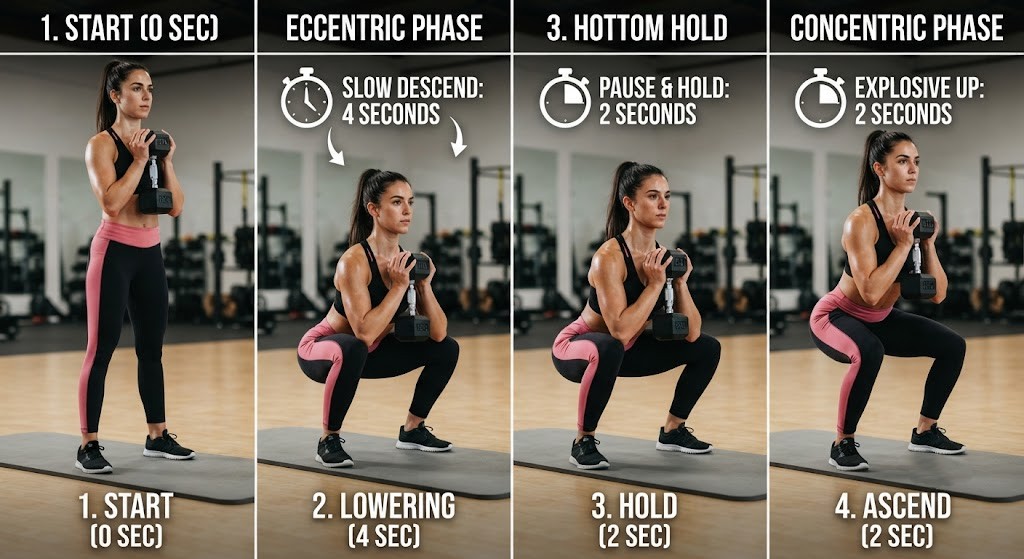
For example, lowering into a squat over four seconds requires significantly more muscular control than dropping quickly into the movement.
Better Mind-Muscle Connection
Slowing down your repetitions helps you focus on the target muscle throughout the movement.
This is especially useful for exercises like:
- Bicep curls
- Chest presses
- Shoulder raises
- Leg extensions
Better Exercise Technique
Controlled repetitions reduce momentum.
Instead of allowing the weight to move itself, your muscles remain responsible for producing and controlling the movement from beginning to end.
Increased Metabolic Stress
Longer sets often produce the familiar muscle-burning sensation caused by metabolite accumulation.
Research shows metabolic stress contributes to muscle hypertrophy alongside mechanical tension.
Source: Schoenfeld BJ, 2023.
How Does Time Under Tension Build Muscle?
Time Under Tension builds muscle by increasing several important physiological mechanisms responsible for hypertrophy.
These include:
- Mechanical tension
- Muscle damage
- Metabolic stress
- Muscle protein synthesis
Mechanical Tension
Mechanical tension refers to the force placed on muscle fibres during resistance training.
The longer muscles experience high-quality tension, the stronger the signal your body receives to repair and strengthen those fibres.
Muscle Damage
Controlled eccentric (lowering) repetitions create small amounts of muscle damage.
As your body repairs this damage, muscle fibres adapt by becoming larger and stronger.
Metabolic Stress
Longer sets create muscular fatigue and metabolite accumulation, producing the well-known “muscle pump.”
This metabolic stress contributes to muscle growth alongside mechanical tension.
Protein Synthesis
Resistance training stimulates muscle protein synthesis.
However, training alone isn’t enough. Proper nutrition, quality sleep, and adequate recovery determine whether those muscles actually grow.
Progressive overload, proper nutrition, sufficient recovery, and consistent Time Under Tension training work together to maximise long-term muscle development.
What Is the Best Time Under Tension for Muscle Growth?
For most people seeking muscle growth, the ideal Time Under Tension is between 30 and 70 seconds per set.
Different training goals require different TUT durations.
| Training Goal | Recommended Time Under Tension |
|---|---|
| Strength | 10–25 seconds |
| Hypertrophy | 30–70 seconds |
| Muscular Endurance | 70–120 seconds |
Most hypertrophy-focused training programmes aim for approximately 30 to 70 seconds of Time Under Tension per set, depending on the exercise and training goal.
Research published by the National Strength and Conditioning Association (NSCA) supports moderate tempos for maximising muscle hypertrophy.
Source: NSCA, 2024.
What Is the Best Rep Tempo for Time Under Tension Training?
Rep tempo refers to the speed at which you perform every phase of an exercise.
Tempo is commonly written using four numbers.
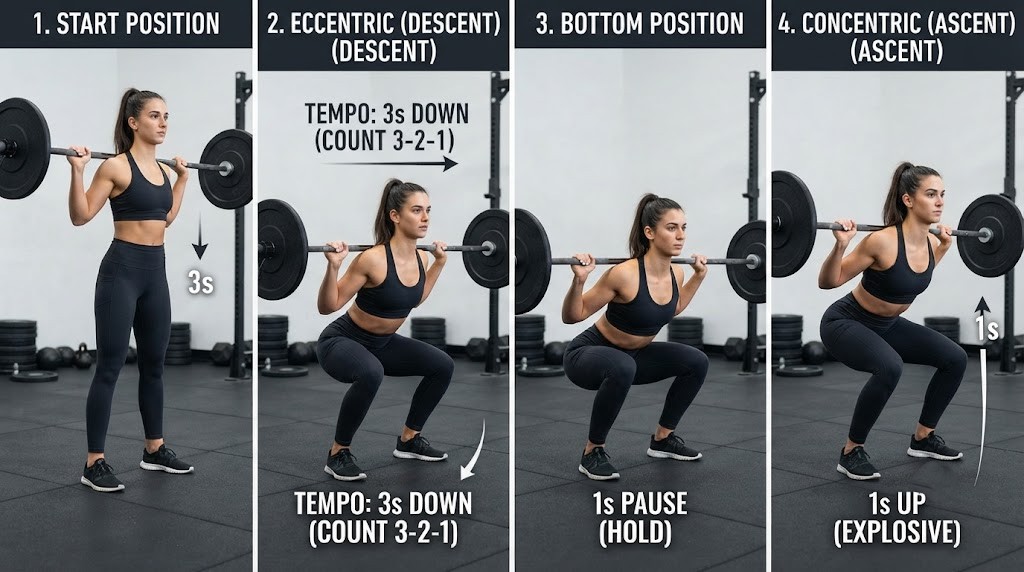
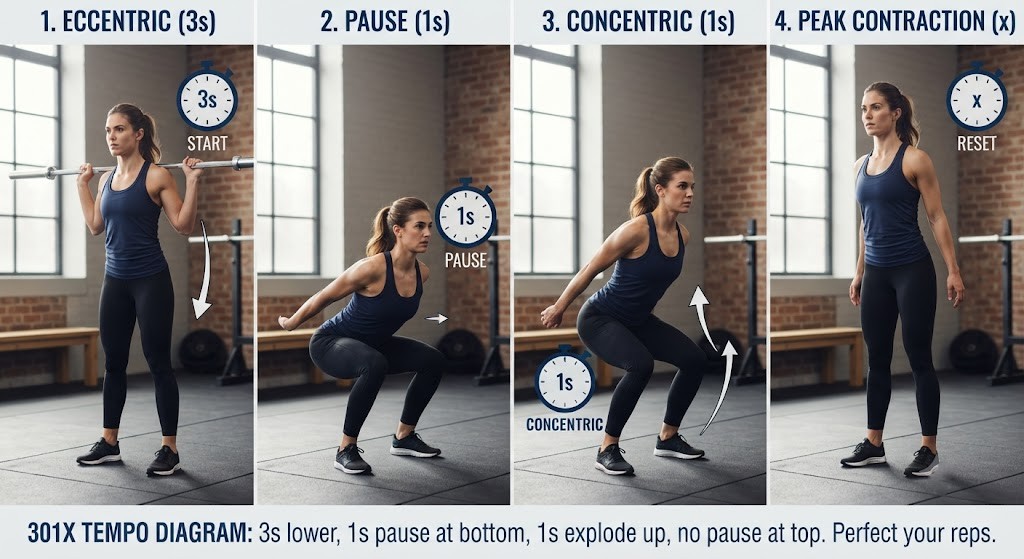
Example: 4-1-2-0
This means:
- 4 seconds lowering (eccentric)
- 1 second pause at the bottom
- 2 seconds lifting (concentric)
- 0 second pause at the top
Common Rep Tempos
| Tempo | Purpose |
|---|---|
| 2-0-2-0 | Standard lifting |
| 3-1-2-0 | Beginner hypertrophy |
| 4-1-2-1 | Advanced Time Under Tension |
| 5-0-1-0 | Eccentric emphasis |
The eccentric phase usually produces the greatest mechanical tension.
The eccentric phase of an exercise typically produces the greatest mechanical tension and plays a significant role in stimulating muscle hypertrophy.
How Do You Count Time Under Tension During a Workout?
Calculating Time Under Tension is straightforward.
Simply add the duration of every phase of one repetition, then multiply it by the total number of reps.
Example
One repetition:
- Lower = 4 seconds
- Pause = 1 second
- Lift = 2 seconds
Total = 7 seconds
For eight repetitions:
8 × 7 = 56 seconds Time Under Tension
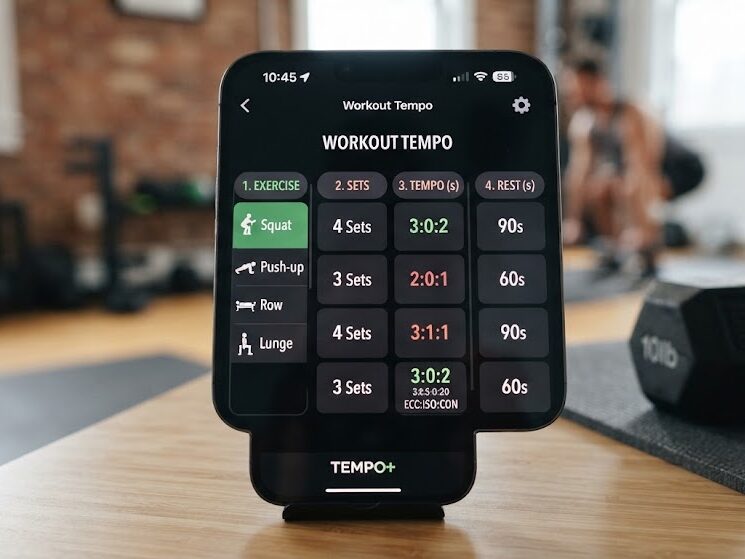
Many athletes track tempo using:
- Stopwatch
- Interval timer
- Tempo apps
- Smartwatches
Which Exercises Work Best With Time Under Tension?
Both compound and isolation exercises respond extremely well to Time Under Tension training.
Some of the best choices include:
Squats
Slow descents improve quadriceps and glute activation while reinforcing proper technique.
Bench Press
Controlled lowering increases chest muscle recruitment and improves stability.
Push-Ups
An excellent home exercise that becomes considerably more challenging when tempo is slowed.
Pull-Ups
Slow negatives dramatically increase muscular effort and improve pulling strength.
Lunges
Excellent for improving lower-body strength, stability, and balance.
Deadlifts
Use controlled lowering while maintaining a neutral spine throughout the movement.
Bicep Curls
Perfect for strengthening the mind-muscle connection.
Shoulder Press
Strict tempo builds shoulder stability and reduces momentum.
Can Beginners Benefit From Time Under Tension Workouts?
Absolutely.
Time Under Tension is especially valuable for beginners because it teaches proper movement mechanics before heavier lifting begins.
Rather than chasing bigger weights, beginners should prioritise high-quality repetitions with consistent tempo.
A simple beginner tempo might include:
- 3-second lowering phase
- Normal lifting speed
- Light-to-moderate weights
This approach improves movement control while reducing injury risk.
full body workout for beginners
Beginner Time Under Tension Workout
Perform this routine 2–3 times per week.
| Exercise | Sets | Reps | Tempo |
|---|---|---|---|
| Squats | 3 | 10 | 3-1-2 |
| Push-Ups | 3 | 10 | 3-0-2 |
| Dumbbell Rows | 3 | 12 | 3-1-2 |
| Shoulder Press | 3 | 10 | 3-0-2 |
| Plank | 3 | 30 sec | Hold |
Focus on mastering technique before increasing resistance.
Intermediate Hypertrophy Time Under Tension Workout
Once you’ve mastered basic tempo control, you can increase volume and introduce slower eccentric phases.
| Exercise | Sets × Reps | Tempo |
|---|---|---|
| Bench Press | 4 × 8 | 4-1-2 |
| Pull-Ups | 4 × 8 | 3-1-2 |
| Squats | 4 × 10 | 4-1-2 |
| Romanian Deadlift | 3 × 10 | 4-1-2 |
| Incline Curl | 3 × 12 | 3-1-2 |
| Lateral Raise | 3 × 15 | 2-1-2 |
Home Time Under Tension Workout
You don’t need a commercial gym to benefit from Time Under Tension.
Useful equipment includes:
- Resistance bands
- Adjustable dumbbells
- Bodyweight exercises
Sample Home Routine
- Push-Ups
- Bulgarian Split Squats
- Resistance Band Rows
- Pike Push-Ups
- Glute Bridges
- Plank Holds
Even bodyweight exercises become significantly more challenging when performed with slower tempos.
Does Time Under Tension Increase Strength or Only Muscle Size?
Time Under Tension improves both muscle size and strength, although its effects depend on how it is programmed.
Heavy loads remain the most effective method for maximising absolute strength.
However, TUT offers several additional benefits:
- Improved movement quality
- Better muscle control
- Increased hypertrophy
- Enhanced stability
Many powerlifters incorporate eccentric-focused training into their accessory exercises to improve overall lifting performance.
What Are the Most Common Time Under Tension Training Mistakes?
Avoiding common mistakes ensures you get the maximum benefit from every workout.
Going Too Slow
Extremely slow repetitions can reduce overall training volume and make workouts less effective.
Using Excessive Weight
Weights that are too heavy often force poor technique and eliminate proper tempo.
Losing Form
Movement quality should always take priority over maintaining a specific count.
Counting Incorrectly
Use a timer or maintain a steady internal rhythm for consistent repetition timing.
Using Time Under Tension on Every Exercise
Not every movement needs an intentionally slow tempo.
Instead, combine traditional lifting with strategic Time Under Tension work for the best overall results.
Best Equipment for Time Under Tension Training
While Time Under Tension can be performed with almost any resistance exercise, a few tools make tracking tempo much easier.
Recommended equipment includes:
- Interval timer apps
- Stopwatch
- Adjustable dumbbells
- Resistance bands
- Barbells
- Smith machine
- Weightlifting bench
Free Alternatives
If you don’t want specialised equipment, try:
- Google Timer
- Smartwatch countdown
- Phone stopwatch
How Often Should You Use Time Under Tension Workouts?
Most people benefit from performing Time Under Tension workouts one to three times per week for each muscle group.
A balanced weekly schedule might look like this:
| Day | Workout |
|---|---|
| Monday | Upper Body TUT |
| Tuesday | Recovery |
| Wednesday | Lower Body |
| Thursday | Traditional Strength |
| Friday | Full Body TUT |
| Saturday | Recovery |
| Sunday | Recovery |
Recovery remains just as important as training.
Prioritise:
- Quality sleep
- Adequate protein intake
- Proper hydration
- Rest days
protein rich muscle building diet
What’s Next After Learning Time Under Tension?
Learning the concept is only the beginning.
The next step is to integrate Time Under Tension gradually while continuing to follow progressive overload.
A simple progression strategy includes:
- Slow only the lowering phase of major exercises.
- Track your tempo, weight, and repetitions.
- Monitor recovery between workouts.
- Increase training complexity gradually.
- Introduce advanced tempos into accessory exercises.
- Follow a structured weekly training split.
Tracking your weekly progress helps ensure long-term improvements while avoiding unnecessary fatigue.
post workout stretching routine
Conclusion
A time under tension workout is one of the simplest yet most effective ways to make every repetition count. By slowing your movements and maintaining constant muscular control, you increase mechanical tension, improve exercise technique, and create a stronger stimulus for muscle growth without relying solely on heavier weights.
The key to long-term success is consistency. Focus on performing quality repetitions, combine Time Under Tension with progressive overload, eat enough protein, prioritise recovery, and gradually challenge yourself over time. Start by slowing the lowering phase of one or two exercises in each workout, master your tempo, and build from there. With patience and proper programming, Time Under Tension can become a powerful tool for building muscle, improving strength, and enhancing overall training performance.
FAQs
What is a time under tension workout?
A time under tension workout slows each rep to keep muscles under load longer, improving muscle growth, strength, and exercise technique.
How long should you do time under tension?
Aim for 30–70 seconds per set for muscle growth, depending on your training goal.
Does time under tension really work?
Yes. It increases muscle tension and can improve muscle growth when combined with proper training and recovery.
What is the 3-3-3 rule for working out?
The 3-3-3 rule commonly means performing 3 exercises for 3 sets, though its meaning varies by workout program.
What is the best Time Under Tension for muscle growth?
The ideal Time Under Tension for hypertrophy is 30–70 seconds per set.
Does Time Under Tension build muscle faster?
It can increase the muscle-building stimulus, but results also depend on nutrition, recovery, and progressive overload.
What is the best rep tempo for Time Under Tension?
A 3-1-2-0 or 4-1-2-0 tempo is commonly recommended for muscle growth.
Can beginners use Time Under Tension training?
Yes. It helps beginners improve form, control, and the mind-muscle connection.
Does Time Under Tension increase strength?
Yes. It improves strength, muscle control, and stability when included in a balanced program.
Which exercises work best for Time Under Tension?
Squats, bench presses, push-ups, pull-ups, deadlifts, rows, curls, and shoulder presses are excellent choices.
How often should I perform Time Under Tension workouts?
Train each muscle group with Time Under Tension 1–3 times per week, allowing enough recovery.
Is the eccentric phase the most important part of Time Under Tension?
Yes. The slow lowering phase creates the greatest mechanical tension for muscle growth.
Can I do Time Under Tension workouts at home?
Yes. Bodyweight exercises, resistance bands, and dumbbells work well for Time Under Tension training.