
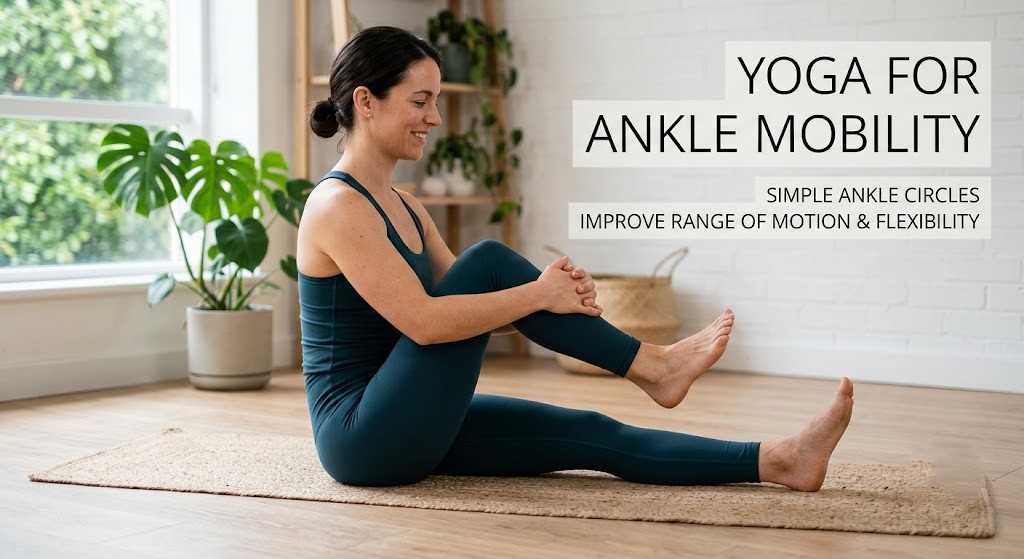
Have you tried stretching your calves or practicing yoga but still struggle with deep squats, lunges, and standing poses? Stiff ankles can limit comfortable movement, making certain yoga positions and everyday activities more challenging. The solution may be a targeted routine that combines flexibility, joint movement, balance, and control.
Yoga for ankle mobility uses gentle stretches, accessible yoga poses, and controlled exercises to help you explore your available ankle range of motion. In this guide, you’ll learn eight beginner-friendly poses, useful modifications, common mistakes to avoid, and a simple 7–8-minute routine you can practice at home.
What Is Yoga for Ankle Mobility?
Yoga for ankle mobility is a practice that combines yoga poses, gentle stretches, and controlled movements to support ankle flexibility, range of motion, and movement control.
Although mobility and flexibility are closely related, they are not the same. Flexibility describes how far muscles and other soft tissues can lengthen, while mobility involves moving a joint through its available range with control.
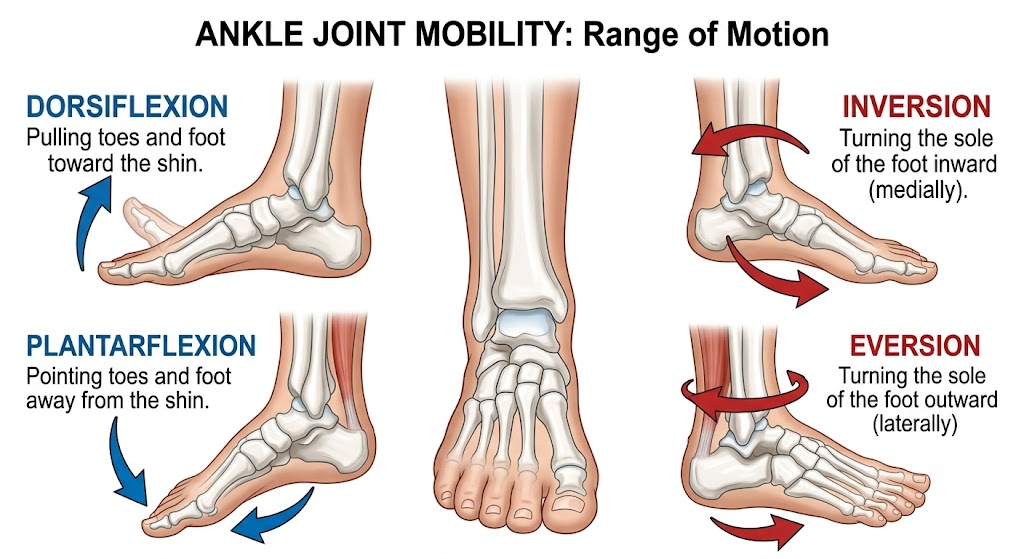
Your ankles perform several important movements:
- Dorsiflexion: Moving your toes toward your shin or bringing your knee forward while keeping your heel grounded.
- Plantarflexion: Pointing your toes away from your shin, as when raising your heels.
- Inversion: Turning the sole of your foot inward.
- Eversion: Turning the sole of your foot outward.
A balanced ankle mobility routine explores these movements without forcing the joint into uncomfortable positions.
Why Is Ankle Mobility Important for Yoga and Everyday Movement?
Ankle mobility helps you walk, climb stairs, squat, lunge, and maintain balance because your ankles must move and stabilize your body in different positions.
In yoga, comfortable ankle movement can make it easier to explore standing poses and squat variations. For example, limited ankle dorsiflexion may make it difficult to keep your heels grounded during a deep squat.
Regular ankle mobility exercises can support several activities:
- Walking and climbing stairs: Your ankles move as you transfer weight between your feet.
- Yoga balance: Controlled ankle movements help you make small adjustments in standing poses.
- Squats and lunges: Ankle movement contributes to comfortable knee positioning.
- Lower-body workouts: Mobility exercises help you practice the movements required for exercise.
- Daily comfort: Gentle movement may help reduce stiffness associated with inactivity.
However, more mobility is not always better. The goal is to develop comfortable, controlled movement rather than force your ankles into extreme positions.
What Causes Stiff Ankles and Limited Ankle Dorsiflexion?
Yoga for ankle mobility Stiff ankles and limited dorsiflexion can result from prolonged sitting, calf tightness, previous ankle sprains, reduced movement variety, individual joint structure, or recovery from an injury.
Understanding the possible cause can help you choose appropriate exercises.
1. Prolonged Sitting and Limited Movement
Sitting for extended periods reduces opportunities to move your ankles through different positions. Gentle ankle circles, foot movements, and regular movement breaks can help you explore your available range of motion.
2. Tight Calf Muscles
Your calf muscles contribute to ankle movement, particularly dorsiflexion. When your calves feel tight, moving your knee forward over your toes may feel restricted.
Gentle mobility exercises can help you explore this movement without forcing a stretch.
3. Previous Ankle Injuries
Previous ankle sprains may contribute to stiffness, discomfort, or instability. Recovery may require a gradual rehabilitation plan that addresses movement, strength, and balance.
Cleveland Clinic recommends appropriate ankle exercises to help restore movement and stability during recovery.
Source: Cleveland Clinic
4. Individual Joint Structure
Ankle movement varies between individuals. Sometimes, a limitation reflects your joint structure rather than a lack of stretching. Forcing a deeper range may cause discomfort without improving movement.
For additional lower-body preparation, explore our calf workout exercises and injury prevention exercises.
What Are the Best Yoga Poses for Ankle Mobility?
The best yoga poses for ankle mobility are movements that comfortably explore ankle bending, pointing, balance, and controlled weight-bearing.
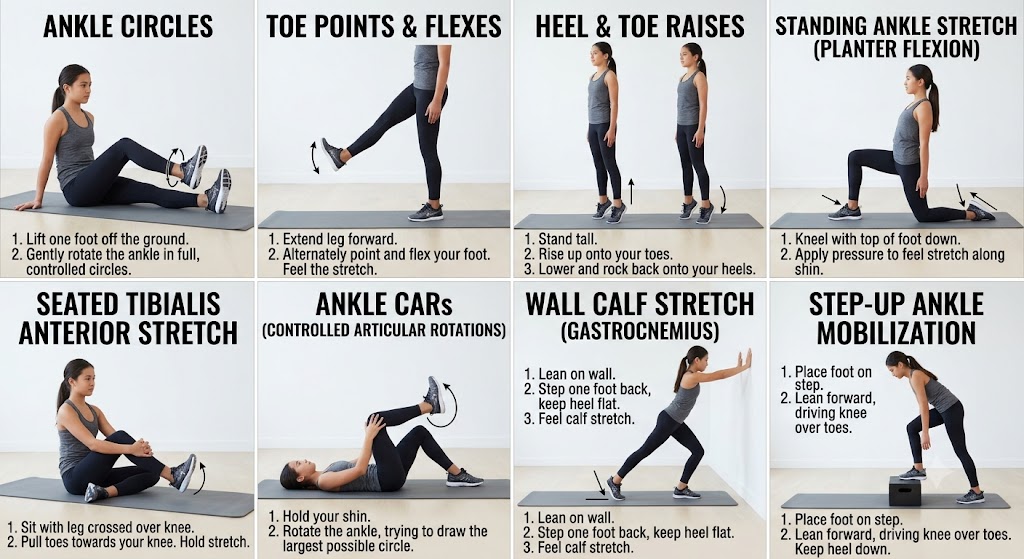
The following eight poses and exercises provide a starting point for many beginners. Choose modifications that suit your current ability, and stop if a movement causes pain.
1. Ankle Circles
Purpose: Ankle circles gently move the joint through a comfortable range of motion.
How to do it:
- Sit on a chair with one foot slightly lifted.
- Slowly circle your foot clockwise.
- Complete 8–10 circles.
- Reverse direction and repeat.
- Switch feet.
Starting point: Perform 8–10 circles in each direction per ankle.
Modification: Keep your heel supported if lifting your leg feels difficult.
Common mistake: Avoid making fast, forceful circles. Move slowly enough to control each repetition and Yoga for ankle mobility.
2. Thunderbolt Pose (Vajrasana)
Purpose: Thunderbolt Pose explores ankle plantarflexion while practicing a kneeling position.
How to do it:
- Kneel on a comfortable yoga mat.
- Bring your hips toward your heels only as far as comfortable.
- Keep your spine upright and breathe naturally.
- Hold briefly, then release.
Starting point: Try 10–15 seconds.
Modification: Place a folded blanket beneath your knees or sit on a yoga block to reduce the depth of the position.
Common mistake: Do not force your feet flat or push through ankle pressure. Skip the pose if it causes discomfort.
3. Hero Pose (Virasana)
Purpose: Hero Pose gently explores ankle positioning and knee flexion.
How to do it:
- Kneel with your knees comfortably separated.
- Position your feet alongside your hips.
- Place a block or bolster beneath your sitting bones.
- Keep your torso upright and breathe comfortably.
Starting point: Hold for 10–15 seconds if comfortable.
Modification: Use generous support to reduce the depth of the position.
Common mistake: Never force your hips toward the floor when your ankles or knees hurt. If kneeling remains uncomfortable, choose a different exercise.
4. Garland Pose (Malasana)
Purpose: Garland Pose explores ankle dorsiflexion in a squat position.
How to do it:
- Stand with your feet approximately shoulder-width apart.
- Turn your toes outward slightly.
- Bend your knees and lower your hips gradually.
- Keep your heels grounded when possible.
- Bring your hands together and maintain a comfortable posture.
Starting point: Hold for 10–20 seconds.
Modification: Hold a sturdy support for balance or place a rolled towel beneath your heels.
Common mistake: Avoid forcing a deep squat. If your heels lift unintentionally or your balance becomes unstable, reduce the depth of the movement.
5. Downward-Facing Dog (Adho Mukha Svanasana)
Purpose: Downward-Facing Dog combines a weight-bearing yoga position with gentle ankle movement and Yoga for ankle mobility.
How to do it:
- Start on your hands and knees.
- Lift your hips upward and backward.
- Keep your hands firmly grounded.
- Bend one knee while lengthening the opposite leg.
- Alternate sides slowly.
Starting point: Continue alternating for 30–60 seconds.
Modification: Bend both knees slightly and prioritize a comfortable back position.
Common mistake: Do not force your heels toward the floor. The pose should remain comfortable throughout your range of motion.
6. Low Lunge (Anjaneyasana)
Purpose: Low Lunge explores ankle dorsiflexion in the front leg.
How to do it:
- Start in a kneeling lunge with one foot forward.
- Keep your front foot flat on the floor.
- Slowly move your front knee forward over your toes.
- Stop before discomfort develops.
- Return to the starting position and switch sides.
Starting point: Spend approximately 30 seconds on each side, including rest.
Modification: Place your hands on a chair or yoga blocks for balance.
Common mistake: Avoid forcing your knee forward or allowing your heel to lift unintentionally. Keep the movement controlled.
7. Chair Pose (Utkatasana)
Purpose: Chair Pose practices controlled knee bending while keeping your feet grounded.
How to do it:
- Stand with your feet hip-width apart.
- Bend your knees and move your hips backward.
- Keep your weight balanced across your feet.
- Raise your arms only if comfortable.
- Return to standing slowly.
Starting point: Hold for 10–20 seconds.
Modification: Keep the squat shallow and use a wall for support.
Common mistake: Do not descend farther than your ankle mobility and balance comfortably allow. Maintain steady foot contact with the floor.
8. Mountain Pose With Heel Raises (Tadasana Variation)
Purpose: Controlled heel raises practice ankle plantarflexion and help develop lower-leg strength and Yoga for ankle mobility.
How to do it:
- Stand with your feet hip-width apart.
- Hold a sturdy chair or wall.
- Slowly raise your heels.
- Pause briefly at the top.
- Lower your heels with control.
Starting point: Perform 5–8 repetitions.
Modification: Use a smaller lifting range or perform seated heel raises.
Common mistake: Avoid bouncing or shifting your weight excessively to one side. Focus on smooth, controlled repetitions.
How Do You Improve Ankle Mobility at Home?
You can build an ankle mobility routine at home by combining gentle movement, supported yoga poses, and controlled strengthening exercises.
For beginners, a short routine is often easier to maintain than a long sequence. Start with comfortable movements and adjust the duration according to your needs.
A Simple 7–8-Minute Ankle Mobility Routine
| Exercise | Suggested duration |
|---|---|
| Ankle circles | 1 minute |
| Downward-Dog knee bends | 1 minute |
| Supported Low Lunge | 2 minutes total |
| Supported Garland Pose | 1 minute |
| Mountain Pose heel raises | 1 minute |
| Gentle ankle movements and relaxation | 1–2 minutes |
Total time: Approximately 7–8 minutes.
How to Practice the Routine
- Start gently: Begin with ankle circles to explore comfortable movement.
- Add controlled bending: Practice alternating knee bends in Downward-Facing Dog.
- Explore dorsiflexion: Use a supported Low Lunge to move your front knee forward gradually.
- Practice a supported squat: Try Garland Pose only if your ankles and knees tolerate the position.
- Finish with heel raises: Perform slow repetitions while holding a sturdy support.
- Relax: Finish with gentle ankle movements and notice how your ankles feel.
You do not need to perform every exercise if certain positions are uncomfortable. If squatting or kneeling causes discomfort, spend more time on seated ankle circles and gentle foot movements.
For a broader mobility routine, explore our mobility workout.
Which Yoga Props Help With Stiff Ankles?
Yoga props can make ankle mobility exercises more accessible by providing cushioning, balance support, and adjustments to the required range of motion.
| Yoga prop | Practical use |
|---|---|
| Yoga blocks | Support your hands or hips during modified poses. |
| Folded blanket | Cushion your knees and ankles during kneeling movements. |
| Sturdy chair or wall | Improve balance and stability during standing exercises. |
| Yoga mat | Provide grip and cushioning. |
| Rolled towel | Support your heels during a modified squat. |
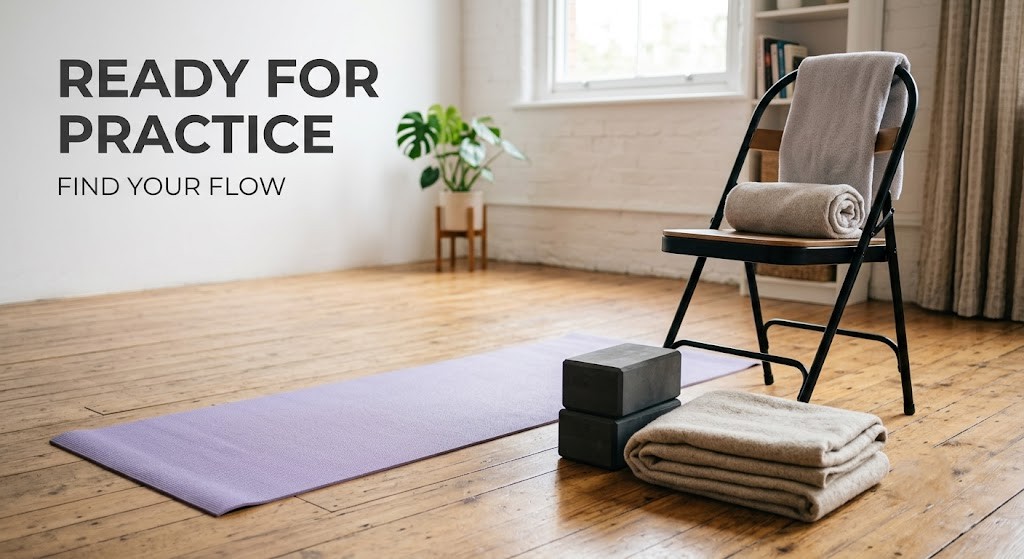
For example, a yoga block can raise your sitting position during Hero Pose, while a folded blanket can cushion your knees during kneeling movements.
Remember that props should make movement easier, not force a deeper stretch. Choose support that allows you to maintain balance and move comfortably.
How Often Should You Practice Yoga for Ankle Mobility?
You can practice gentle ankle mobility exercises regularly, including daily, provided the movements remain comfortable and your ankles recover well.
Consistency is more important than forcing a large range of motion during each session. Begin with a short routine and pay attention to how your ankles feel during and after practice.
For example, you might start with:
- 8 ankle circles in each direction.
- A short period of supported ankle movement.
- 5 controlled heel raises.
- Gentle knee-forward movements within a comfortable range.
As these exercises become easier, you can gradually increase repetitions or explore a slightly greater range of motion.
There is no universal timeline for improvement. Your progress depends on the cause of stiffness, consistency, previous injuries, and individual anatomy.
For complementary recovery advice, see our Vibration Therapy for Recovery.
What Should You Avoid When Stretching Stiff Ankles?
Safe ankle mobility practice means moving gradually, maintaining control, and stopping exercises that cause pain or worsen symptoms.
Avoid these common mistakes when practicing yoga for ankle mobility.
Forcing Deep Stretches
A deeper stretch does not automatically produce better results. Work within your comfortable range and increase the difficulty gradually.
Ignoring Pain or Swelling
Pain, swelling, and instability should not be ignored. These symptoms may indicate an issue that requires professional assessment rather than additional stretching.
Moving Too Quickly
Fast or forceful repetitions make it harder to control your movement. Slow exercises allow you to monitor your ankle position and respond to discomfort.
Ignoring Balance and Support
Standing poses and lunges can challenge your balance. Use a sturdy chair or wall when necessary, especially when practicing on an unfamiliar surface.
Practicing Through a Recent Injury
If you have recently sprained your ankle or sustained another injury, follow appropriate medical or physiotherapy guidance before starting a mobility routine.
According to NHS guidance, exercises should be adjusted to your symptoms, and you should seek professional advice if ankle pain worsens or persists.
Source: NHS inform
Seek prompt medical assessment if you cannot bear weight, develop severe pain, or notice significant swelling or deformity.
How Can You Progress Your Ankle Mobility Practice?
You can progress your ankle mobility practice by improving consistency, movement control, and comfortable range before attempting more challenging positions.
1. Improve Your Movement Control
Repeat the basic exercises and focus on smooth, deliberate movements. During heel raises, for example, lift and lower your heels without bouncing or shifting your weight excessively.
2. Gradually Increase Your Range
As your movements become more comfortable, explore a slightly greater range without forcing your ankles. During a supported lunge, this may mean moving your knee a little farther forward while keeping your heel grounded.
3. Add Balance Practice
When appropriate, introduce controlled balance exercises. Begin with wall or chair support and progress only when you can maintain a stable position comfortably.
4. Combine Mobility With Lower-Body Exercises
Most importantly, focus on comfortable movement rather than extreme flexibility. If stiffness persists or interferes with everyday activities, consult a qualified healthcare professional to determine whether additional assessment or treatment is appropriate.
Conclusion
Yoga for ankle mobility combines gentle movements, accessible poses, and controlled exercises to help you explore your ankle range of motion. From ankle circles and supported lunges to Garland Pose and heel raises, these exercises provide several ways to practice ankle movement at home.
Start with a short routine, use props when needed, and adjust each pose to your current ability. Practice consistently, increase the difficulty gradually, and avoid movements that cause pain.
Your goal is better movement, not a deeper stretch at any cost. With a comfortable and consistent approach, ankle mobility work can become a practical part of your yoga and everyday movement routine.
FAQs
What is the best yoga pose for ankle mobility?
Garland Pose and Low Lunge help improve ankle movement.
Can yoga improve ankle flexibility?
Yes, gentle yoga poses can improve ankle flexibility and mobility.
How long should I practice ankle mobility exercises?
A 7–8-minute daily routine is a good starting point.
Can I do ankle mobility exercises every day?
Yes, if the exercises remain comfortable and pain-free.
Why can’t I keep my heels down during a squat?
Limited ankle mobility, tight calves, or individual joint structure may be responsible.
Are ankle mobility exercises suitable for beginners?
Yes, start with ankle circles, gentle stretches, and supported heel raises.
Should I stretch my calves to improve ankle mobility?
Yes, gentle calf stretches may help if tight muscles restrict ankle movement.
Do I need yoga props for ankle mobility?
No, but yoga blocks and folded blankets can improve comfort.
Can ankle mobility exercises help with deep squats?
Yes, they can help improve the ankle movement needed for squatting.
When should I stop ankle mobility exercises?
Stop if you experience pain, swelling, or instability, and seek medical advice when needed.
2 thoughts on “Yoga for Ankle Mobility: Best Poses to Improve Flexibility & Stability”