
HRV Calculator
Enter your heart rate variability reading to view your HRV value and, optionally, compare it with your personal baseline.
Understanding Your Result
What should you do next?
HRV varies with age, health, sleep, stress, exercise, and measurement method. There is no single HRV value that is ideal for everyone. Compare readings taken under similar conditions and focus on your longer-term trend rather than one measurement. HRV alone cannot diagnose a medical condition or determine whether you are ready to train.
Your smartwatch tracks your heart rate, sleep, and workouts, but your heart rate variability (HRV) can provide additional insights into recovery, stress, and overall fitness.
An HRV Calculator helps you calculate a heart rate variability metric from beat-to-beat interval data or understand a reading from a compatible wearable. HRV is usually measured in milliseconds (ms), and its meaning depends on your age, physiology, measurement method, and personal baseline.
In this guide, you'll learn how to calculate HRV, understand RMSSD and SDNN, interpret your score, and use HRV trends to support better recovery and training decisions.
What Is Heart Rate Variability (HRV)?
Heart rate variability (HRV) measures the variation in time between consecutive heartbeats. It provides information about autonomic nervous system regulation, which helps control involuntary functions such as heart rate.
For example, the time between heartbeats might be 850 ms, followed by 920 ms and then 880 ms. These differences represent HRV.
The autonomic nervous system includes two main branches:
- Sympathetic nervous system: Helps the body respond to demands and stress.
- Parasympathetic nervous system: Supports rest and recovery.
HRV vs. Heart Rate
Heart rate measures beats per minute (BPM), while HRV measures differences in the timing between beats.
| Measurement | What It Measures | Unit |
|---|---|---|
| Heart rate | Beats per minute | BPM |
| HRV | Variation in heartbeat timing | Milliseconds |
| RMSSD | Short-term differences between successive intervals | Milliseconds |
| SDNN | Overall variability in normal intervals during a recording | Milliseconds |
Two people can have the same resting heart rate but different HRV readings.
Why Does HRV Matter for Recovery and Fitness?
HRV can help you understand how your body responds to exercise, sleep, stress, and everyday demands.
For example, a lower-than-usual HRV after an intense workout and poor sleep may indicate that your body is experiencing additional demands. However, one reading cannot determine whether you are fully recovered.
HRV and Workout Recovery
Tracking HRV trends can help athletes make more informed training decisions.
If your HRV remains below baseline and you also experience fatigue or poor sleep, consider reducing workout intensity. A single low reading without other symptoms does not automatically mean you should stop exercising.
Use your Running Pace Zone Calculator and Zone 2 Cardio Training Guide alongside HRV to understand training intensity.
HRV and Sleep Quality
Insufficient or disrupted sleep can influence overnight HRV. Recording your sleep schedule and HRV together may help you identify patterns.
For recovery advice, explore our Sleep and Muscle Recovery guide.
HRV and Stress
Physical and psychological stress may influence HRV. However, HRV cannot identify the exact cause of a change or directly measure psychological stress.
Consider your sleep, exercise, and daily routine when interpreting unusual readings.
How Do You Use an HRV Calculator?
An HRV Calculator calculates a supported HRV metric from suitable beat-to-beat interval data or helps interpret an existing measurement from a compatible device.
Method 1: Interpret Your Existing HRV Reading
If your smartwatch already displays HRV:
- Open your smartwatch or fitness application.
- Find your HRV score in milliseconds.
- Check whether it reports RMSSD, SDNN, or another metric.
- Compare the result with your previous readings.
- Consider sleep, exercise, alcohol, stress, and symptoms.
For example, if your usual overnight HRV is 55 ms and today's reading is 42 ms, your HRV is below baseline. Monitor the trend instead of assuming that one reading indicates a health problem.
Method 2: Calculate HRV From Beat-to-Beat Intervals
If you have interval data, follow these steps:
- Obtain beat-to-beat intervals from a compatible device.
- Check the data for recording errors and artifacts.
- Choose RMSSD or SDNN.
- Enter the required data into a compatible calculator.
- Compare the result with measurements taken under similar conditions.
Important: Average heart rate in BPM alone cannot determine true HRV. You need beat-to-beat interval data or an HRV measurement from a compatible device.
How Is HRV Calculated?
Two commonly used HRV metrics are RMSSD and SDNN. They measure different aspects of heartbeat timing.
RMSSD Formula
RMSSD stands for root mean square of successive differences. It measures short-term variation between consecutive normal-to-normal heartbeat intervals.
The formula is:
\[ \mathrm{RMSSD}=\sqrt{\frac{\sum_{i=1}^{N-1}(NN_{i+1}-NN_i)^2}{N-1}} \]
Where:
- \(NN_i\) represents a normal-to-normal interval in milliseconds.
- \(N\) represents the total number of intervals.
Example: Consider intervals of 800 ms, 820 ms, 790 ms, and 840 ms.
The successive differences are 20 ms, −30 ms, and 50 ms. Squaring these differences gives 400, 900, and 2,500.
The mean squared difference is:
\[ \frac{400+900+2500}{3}=1266.67 \]
Taking the square root gives:
\[ \sqrt{1266.67}\approx35.6\text{ ms} \]
Therefore, the RMSSD for this simplified example is approximately 35.6 ms.
Real-world HRV calculations require suitable recordings and appropriate handling of artifacts.
SDNN Formula and Meaning
SDNN is the standard deviation of normal-to-normal heartbeat intervals during a defined recording period.
It measures overall variability in the recorded intervals. The result depends on recording duration and signal quality, so SDNN from a five-minute recording may differ from SDNN measured across an entire day.
RMSSD vs. SDNN: What's the Difference?
| Feature | RMSSD | SDNN |
|---|---|---|
| Full name | Root mean square of successive differences | Standard deviation of NN intervals |
| Measures | Short-term successive variation | Overall interval variability |
| Common use | Short-term and wearable monitoring | Variability over a defined recording |
| Unit | Milliseconds | Milliseconds |
| Main consideration | Focuses on adjacent interval differences | Influenced by recording duration |
Although both metrics are measured in milliseconds, they are not interchangeable. Always check which metric your device reports before interpreting the result.
What Is a Normal HRV Score by Age?
There is no single normal HRV score for everyone. HRV varies with age, fitness, physiology, health, and measurement conditions.
Two healthy adults of the same age may have different HRV readings because of differences in genetics, sleep, exercise, and other factors.
Factors that influence HRV include:
- Age: Population-level HRV patterns change over time.
- Fitness: Regular physical activity can influence autonomic regulation.
- Sleep: Poor sleep may affect overnight readings.
- Stress: Physical and psychological demands can influence HRV.
- Alcohol: Consumption can affect sleep and physiological measurements.
- Health and medication: Illness and certain medications may affect heart rhythm and HRV.
Your personal baseline is generally more useful than comparing your reading with a universal age-based target.
What Is a Good HRV Score in Milliseconds?
A good HRV score depends on your personal baseline and the measurement method rather than a universal numerical threshold.
For example, an overnight RMSSD reading of 45 ms may be normal for one person but below another person's usual range.
Use this framework to interpret your readings:
| HRV Pattern | Possible Meaning | What to Do |
|---|---|---|
| Near baseline | Consistent with your usual pattern | Consider sleep and energy levels |
| Below baseline | Possible additional physical or psychological demands | Review sleep, stress, and training |
| Above baseline | Normal variation or a change in physiological state | Check the trend and how you feel |
| Repeated unusual changes | A persistent change in your normal pattern | Review conditions and seek medical advice if appropriate |
Focus on consistent trends instead of trying to achieve the highest possible HRV.
Is Higher HRV Always Better?
No. A higher HRV does not automatically mean better health or recovery.
Higher HRV is often associated with greater beat-to-beat variability, but unusually high readings can also reflect measurement differences or an irregular rhythm requiring assessment.
Similarly, lower HRV does not automatically indicate poor health. Sleep, exercise, stress, alcohol, and measurement errors can all affect individual readings.
Your personal baseline and overall condition matter more than a single number.
What Does a Sudden Drop in HRV Mean?
A sudden HRV drop means your measured variability is lower than expected, but it does not identify the cause.
Common reasons include:
- Poor or insufficient sleep.
- Increased training load.
- Psychological stress.
- Alcohol consumption.
- Illness or fever.
- Dehydration or routine changes.
- Measurement artifacts.
Compare the result with your recent readings and consider how you feel. If low HRV persists alongside fatigue or illness, consider reducing strenuous activity and consulting a healthcare professional.
Seek urgent medical care for chest pain, fainting, severe shortness of breath, or a sustained rapid or irregular heartbeat accompanied by concerning symptoms.
Can Smartwatches Measure HRV?
Yes. Some smartwatches, chest straps, and compatible applications measure or estimate beat-to-beat timing.
- Smartwatches: May provide overnight HRV or selected-session measurements.
- Chest straps: Compatible models can provide beat-to-beat intervals for HRV analysis.
- HRV applications: May calculate metrics from supported sensors or imported interval data.
- Clinical ECG equipment: Healthcare professionals can use electrocardiography for heart rhythm assessment and appropriate HRV analysis.
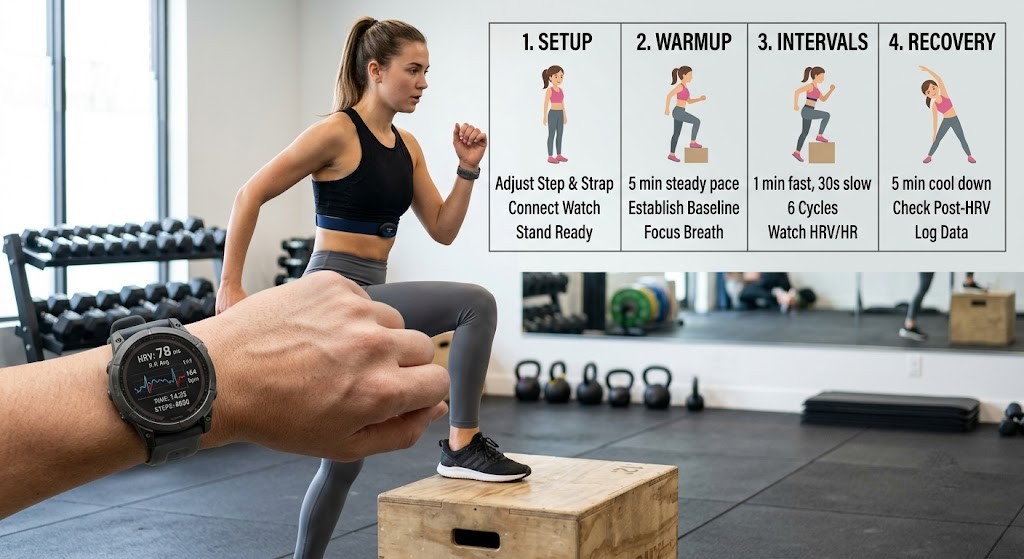
Different devices may use different algorithms, recording periods, and metrics. Check your device documentation to understand how its HRV score is calculated.
How Can You Support Healthy HRV?
You can support overall recovery and healthy physiological regulation through consistent lifestyle habits. However, no single habit guarantees an increase in HRV.
1. Maintain a Consistent Sleep Schedule
Maintain regular bedtime and wake times, and create a relaxing evening routine. Adults generally benefit from at least seven hours of sleep per night, although individual needs vary.
2. Balance Exercise With Recovery
Regular physical activity supports cardiovascular health, but excessive training without sufficient recovery can contribute to fatigue.
Alternate demanding workouts with easier sessions and rest days. Use the Running Pace Zone Calculator and Zone 2 Cardio Training Guide to plan training intensity, and explore Active Recovery Exercises for lighter days.
3. Manage Stress
Comfortable slow breathing, meditation, and quiet walks may support relaxation and well-being. Their effects on HRV vary between individuals.
4. Stay Hydrated and Eat Adequately
Adequate fluids and nutrition help support normal physiological function.
Use the Protein Intake Calculator to estimate your daily protein needs and the BMR Calculator to understand estimated resting energy requirements.
If you want to change your body weight, the Calorie Deficit Calculator can help you understand estimated energy intake. Avoid aggressive restriction that undermines recovery.
5. Limit Alcohol
Alcohol can disrupt sleep and influence overnight physiological measurements. Reducing consumption may help some people improve recovery patterns.
Compare trends over time rather than drawing conclusions from a single night.
When Is the Best Time to Measure HRV?
The best approach is to measure HRV consistently under similar conditions.
For more reliable comparisons:
- Measure at approximately the same time each day.
- Use the same device and measurement method.
- Follow your device's recommended posture and recording duration.
- Avoid comparing substantially different recording conditions.
- Record sleep, exercise, alcohol, and unusual symptoms.
If your device reports overnight HRV, compare overnight measurements rather than treating them as equivalent to daytime readings.
Review trends over several days or weeks instead of reacting to every fluctuation.
Can HRV Predict Workout Readiness?
HRV can contribute to recovery monitoring, but it cannot determine training readiness on its own.
Consider HRV alongside sleep, muscle soreness, nutrition, mood, recent training load, and illness.
| HRV and Recovery Signals | Practical Approach |
|---|---|
| Near-baseline HRV, good sleep, normal energy | Follow your planned workout if you feel well |
| Below-baseline HRV, normal energy | Review the trend and planned workout intensity |
| Below-baseline HRV, poor sleep, fatigue | Consider easier training or additional recovery |
| Unusual HRV changes with illness or concerning symptoms | Prioritize health and seek medical guidance |
Some athletes use HRV-guided training systems to adjust workout intensity. Their usefulness depends on measurement quality and the training protocol.
How Should You Track HRV Over Time?
Build a personal baseline and record your readings consistently.
Follow this simple routine:
- Choose your metric: Record the same metric whenever possible.
- Use a consistent method: Keep your device and measurement conditions similar.
- Build a baseline: Collect regular measurements over several weeks, following your device's guidance.
- Record context: Note sleep, exercise, illness, alcohol, and stress.
- Review trends: Look for repeated changes rather than isolated fluctuations.
- Adjust thoughtfully: Consider easier training when low HRV coincides with fatigue.
You can also combine HRV tracking with body composition and other fitness measurements using an FFMI Calculator, a Waist-to-Height Ratio Calculator, or an Ideal Body Weight Calculator. Each tool measures something different.
What Tools Help You Understand HRV?
Useful tools combine consistent measurements with clear explanations of what the results mean.
Consider these resources:
- Wearable documentation: Explains the reported metric and measurement period.
- Compatible HRV applications: Calculate or interpret supported sensor data.
- Beat-to-beat interval calculators: Calculate RMSSD, SDNN, or other supported metrics.
- Fitnopedia fitness resources: Help you explore nutrition, exercise, and body composition.
You can also consult reputable medical resources such as Cleveland Clinic and Harvard Health Publishing for broader explanations of HRV and cardiovascular health. Online tools do not replace professional medical evaluation when symptoms require attention.
Conclusion
An HRV Calculator helps you calculate a supported heart rate variability metric from beat-to-beat intervals or interpret a reading from a compatible wearable.
RMSSD and SDNN measure different aspects of HRV, and their values depend on the recording method and conditions. A high or low score does not automatically determine your health, stress level, or workout readiness.
Build a personal baseline, measure consistently, and consider HRV alongside sleep quality, training load, symptoms, and everyday habits. Focus on sustainable recovery rather than chasing a particular HRV number.
FAQs
What is an HRV Calculator?
An HRV Calculator measures heart rate variability using beat-to-beat intervals or helps interpret wearable readings.
What is a good HRV score in milliseconds?
A good HRV score depends on your age, health, measurement method, and personal baseline.
How do I calculate HRV manually?
Use normal heartbeat intervals to calculate RMSSD or SDNN with the appropriate formula.
Can I calculate HRV using BPM alone?
No. You need beat-to-beat interval data or a compatible device's HRV measurement.
What is the difference between RMSSD and SDNN?
RMSSD measures short-term interval differences, while SDNN measures overall interval variability.
Does HRV decrease with age?
HRV often changes with age, but individual readings vary considerably.
Is higher HRV always better?
No. Your personal baseline and overall health matter more than a single reading.
Why has my HRV suddenly dropped?
Poor sleep, stress, intense exercise, alcohol, or illness may contribute to lower HRV.
Can HRV tell me if I am ready to work out?
HRV can help assess recovery, but also consider fatigue, sleep, and muscle soreness.
When should I measure HRV?
Measure consistently using the same device and similar conditions.
Can a smartwatch measure HRV accurately?
Some smartwatches provide useful HRV readings, depending on their sensors and measurement methods.
Can HRV diagnose a medical condition?
No. HRV cannot diagnose conditions. Consult a healthcare professional about persistent changes or concerning symptoms.
1 thought on “HRV Calculator: Check Your Heart Rate Variability & Recovery Score”