
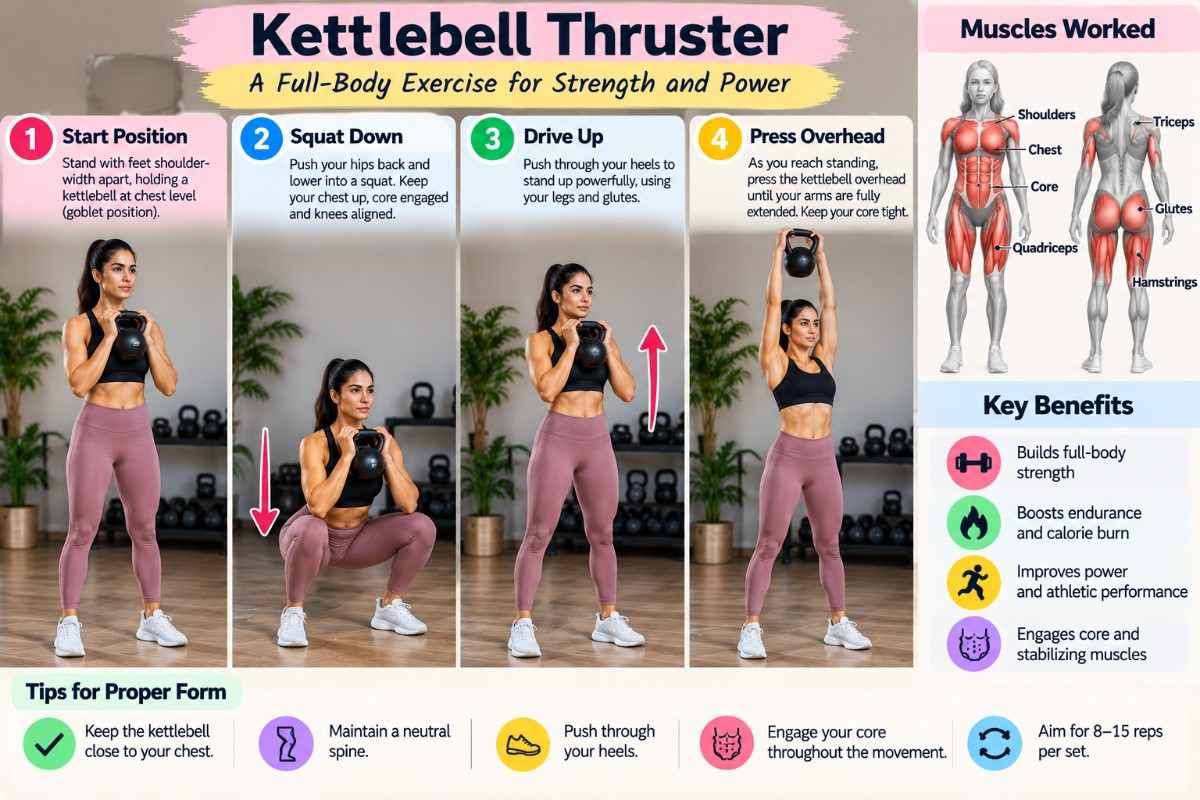
The kettlebell thruster combines a squat and an overhead press into one powerful movement, helping you train your legs, glutes, shoulders, and core in a single exercise. Whether your goal is to build full-body strength, improve muscular endurance, or make your workouts more efficient, learning the correct technique can help you get more from every repetition.
full-body workout routine for strength and fitness
What Is a Kettlebell Thruster?
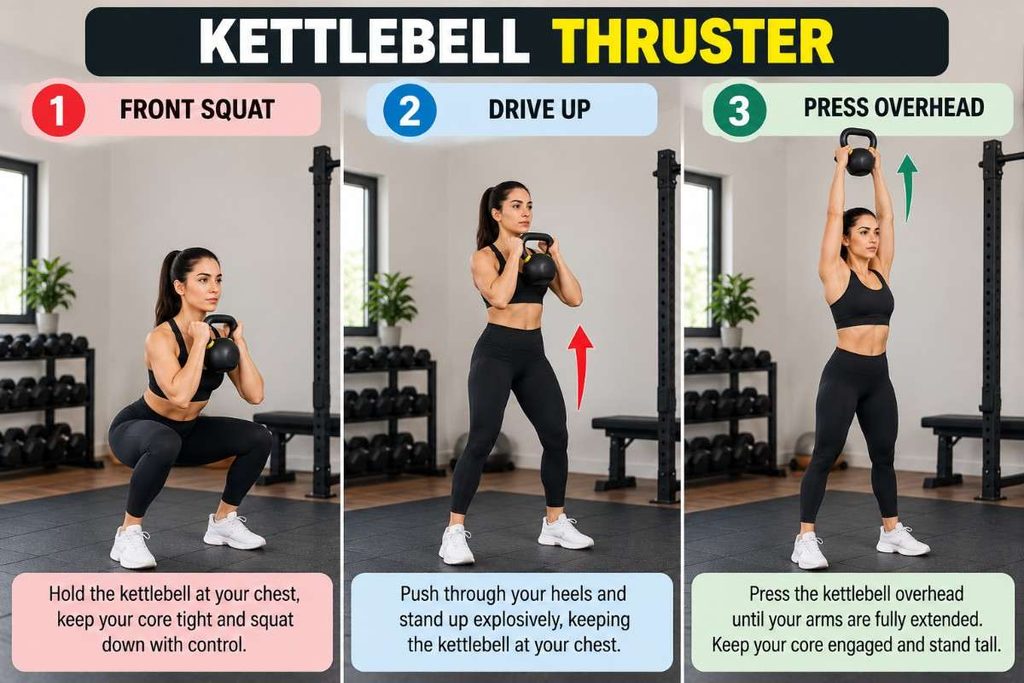
A kettlebell thruster is a compound exercise that combines a front squat with an overhead press. You lower into a squat while holding one or two kettlebells at shoulder level, then stand up and press the weights overhead in one coordinated movement.
This exercise combines lower-body strength with upper-body pressing and core stabilization. It is commonly used in strength training, functional fitness, and conditioning circuits.
Beginners can start with a bodyweight squat-to-reach movement before progressing to a light kettlebell.
beginner strength training workout plan
Why Does the Kettlebell Thruster Matter?
The kettlebell thruster matters because it trains several major muscle groups through two connected movement patterns, making it a time-efficient addition to a well-rounded workout.
Its main benefits include:
- Full-body training: Engages the quadriceps, glutes, shoulders, triceps, and core.
- Strength development: Challenges the legs during the squat and the shoulders during the press.
- Muscular endurance: Repeated controlled repetitions challenge your ability to sustain effort.
- Workout efficiency: Combines squatting and overhead pressing in one exercise.
- Coordination: Requires the hips, knees, trunk, and arms to work together.
- Conditioning: Performing repeated thrusters can increase cardiovascular demand.
The kettlebell thruster is not automatically superior to separate squats and shoulder presses. Its usefulness depends on your goals, technique, and training experience.
Which Muscles Does the Kettlebell Thruster Work?
The kettlebell thruster primarily targets the quadriceps, glutes, and shoulders, while the triceps, core, and other supporting muscles help stabilize and complete the movement.
| Muscle group | Main role |
|---|---|
| Quadriceps | Extend the knees as you rise from the squat. |
| Glutes | Help extend the hips and return you to standing. |
| Shoulders | Drive the kettlebells overhead. |
| Triceps | Straighten the elbows during the press. |
| Core muscles | Stabilize the trunk and help prevent excessive arching. |
| Hamstrings | Assist with hip control and lower-body stability. |
| Upper back | Helps maintain the front rack position and shoulder control. |
The squat portion emphasizes the lower body, while the overhead press increases the demand on the shoulders and triceps. Keeping your torso stable throughout the exercise also challenges your core.
For a balanced training routine, combine thrusters with pulling movements and other exercises that target muscles less directly involved in pressing.
shoulder workouts for strength
How to Do a Kettlebell Thruster With Proper Form
The correct kettlebell thruster technique involves maintaining a stable front rack position, squatting under control, and pressing the weight overhead without losing your balance or spinal position.
Step 1: Set up your stance
Stand with your feet approximately shoulder-width apart, adjusting your stance to a comfortable position that allows your knees to track in line with your toes.
Hold one kettlebell at shoulder height or use two kettlebells, one in each hand. Keep your elbows close to your body where comfortable, and brace your core.
Step 2: Lower into a squat
Push your hips back slightly and bend your knees to lower into a squat. Keep your chest comfortably upright, your heels grounded, and your weight balanced across your feet.
Descend only as far as you can while maintaining control and a comfortable range of motion.
Step 3: Drive through your feet
Push through your feet and extend your knees and hips to stand up. Use a controlled but purposeful upward drive.
The momentum from standing helps initiate the pressing phase, but you should not rely on momentum to compensate for poor technique.
Step 4: Press overhead
As you finish standing, press the kettlebell or kettlebells overhead until your arms are extended comfortably. Keep your ribs stacked over your pelvis rather than leaning backward to reach the top position.
Step 5: Return to the starting position
Lower the kettlebells under control to the front rack position. Begin the next squat only after you have regained a stable position.
squat exercises for stronger legs
Kettlebell Thruster Variations
Kettlebell thruster variations let you adjust the exercise to your experience, available equipment, and training goals.
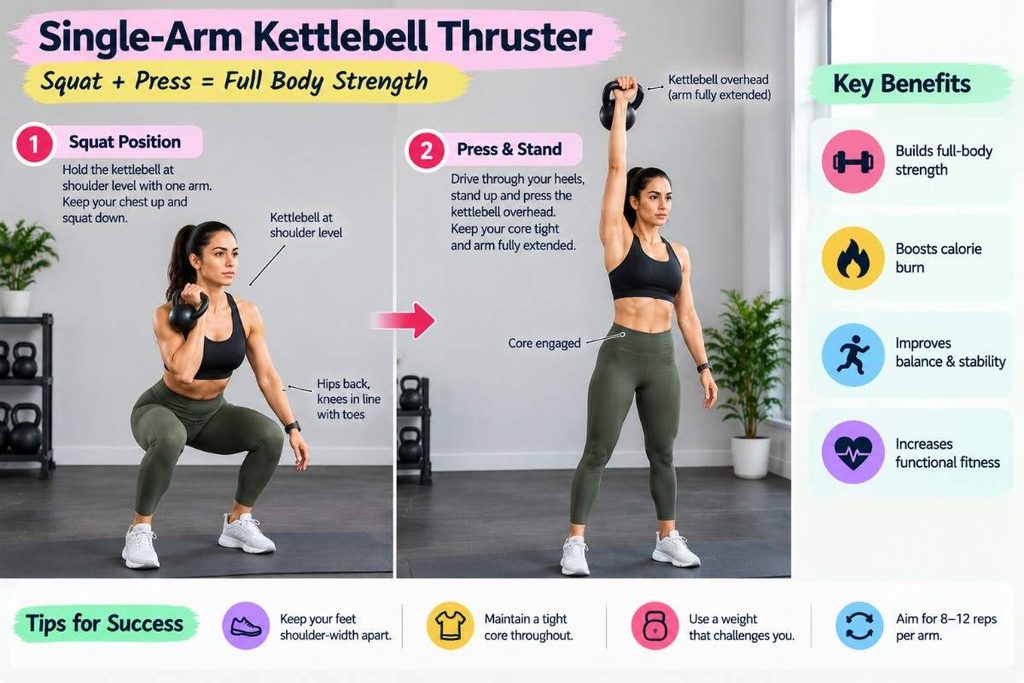
Single-arm kettlebell thruster
Hold one kettlebell at shoulder height and perform the squat and press with one arm. This variation introduces an asymmetrical load, requiring additional attention to balance and trunk stability.
Complete the same number of repetitions on each side when appropriate.
Double kettlebell thruster
Hold one kettlebell in each hand at shoulder height. Squat with both weights, then press them overhead as you stand.
This variation generally requires more total load and greater upper-body and core control. Use a weight you can manage without excessive back arching.
Goblet squat to press
Hold one kettlebell in front of your chest with both hands. Squat, stand, and press the kettlebell overhead if your grip, shoulder mobility, and equipment allow a comfortable movement.
This can be a useful transitional variation, although its loading and mechanics differ from a traditional single-arm or double-kettlebell thruster.
Bodyweight squat to reach
Perform a bodyweight squat and raise your arms overhead as you stand. This helps beginners practice the squat-to-press coordination before adding external resistance.
Kettlebell Thruster vs. Dumbbell Thruster
Both exercises combine a squat with an overhead press, but the equipment changes how you hold the load and manage the movement.
| Feature | Kettlebell thruster | Dumbbell thruster |
|---|---|---|
| Equipment | One or two kettlebells | One or two dumbbells |
| Grip | Handle-based grip with a compact weight | Grip around individual dumbbell handles |
| Front rack position | Depends on kettlebell size and handle position | Usually uses dumbbells held near the shoulders |
| Loading options | Single-arm or double-kettlebell variations | Single-arm or double-dumbbell variations |
| Training effect | Strength, coordination, and muscular endurance | Strength, coordination, and muscular endurance |
Neither version is universally better. Choose the equipment that allows you to maintain a stable rack position, perform a comfortable squat, and press overhead without pain.
dumbbell full-body workout exercises
Common Kettlebell Thruster Mistakes to Avoid
The most common kettlebell thruster mistakes involve rushing the movement, choosing excessive weight, losing core control, and using poor pressing mechanics.
1. Choosing a kettlebell that is too heavy
An excessive load can make the squat unstable and the overhead press difficult to control. Start light enough to complete each repetition with consistent technique.
2. Leaning backward during the press
Excessive backward leaning can place unnecessary stress on your lower back. Brace your core and keep your ribs aligned over your pelvis as you press.
3. Letting the knees collapse inward
Keep your knees tracking in the same general direction as your toes. Adjust your stance or reduce the load if you cannot maintain control.
4. Dropping quickly into the squat
A rushed descent can compromise balance and make the transition into standing less controlled. Lower smoothly and use a depth that suits your mobility.
5. Pressing before establishing a stable position
Coordinate the squat and standing drive with the press, but do not sacrifice control to move faster. If your overhead position becomes unstable, reduce the load or practice the movements separately.
6. Ignoring discomfort
Stop if the exercise causes sharp pain, dizziness, or unusual joint discomfort. Persistent symptoms warrant assessment by an appropriate healthcare professional.
How Many Kettlebell Thruster Reps Should You Do?
The appropriate number of kettlebell thruster repetitions depends on your experience, load, technique, and whether you are training for strength or conditioning.
The following ranges are practical starting points, not universal prescriptions.
| Training goal | Example starting range | Rest guidance |
|---|---|---|
| Learning technique | 5–6 controlled reps per set | Rest until technique is consistent. |
| General strength and fitness | 6–10 reps per set | Rest enough to maintain good form. |
| Muscular endurance | 10–15 reps per set with a manageable load | Rest as needed to maintain control. |
| Conditioning circuits | Short sets of controlled repetitions | Rest if breathing or technique deteriorates. |
Beginners can start with 2–3 sets of 5–8 repetitions using a light load, provided they can perform the movement comfortably and safely.
Avoid treating the highest repetition count as the best option. Quality repetitions are more useful than continuing when fatigue causes your posture or overhead control to deteriorate.
How to Add Kettlebell Thrusters to Your Workout
You can add kettlebell thrusters to a full-body strength session or conditioning circuit, depending on your training goals and recovery needs.
Here is a simple example for someone who already understands the movement:
- Kettlebell thruster: 2–3 sets of 6–8 repetitions.
- Bodyweight squat: 2 sets of 10 repetitions.
- Push-up: 2 sets of 6–12 repetitions, adjusted to your ability.
- Resistance-band row: 2 sets of 10–12 repetitions.
- Dead bug: 2 sets of 8 controlled repetitions per side.
Rest as needed between sets and modify the exercises to suit your ability. This example is a general template rather than a personalized training prescription.
If you are new to resistance training, learn the squat and overhead press separately before combining them. Increase the load or repetitions gradually instead of changing both at once.
core and abs workout for stability
What Equipment Do You Need for Kettlebell Thrusters?
You need a suitable kettlebell and enough clear space to squat and press the weight overhead without obstruction.
Useful equipment considerations include:
- Kettlebell: Choose a load you can lift into the starting position and press overhead with control.
- Stable footwear: Wear shoes that allow a secure stance, or train barefoot only when appropriate for your environment and experience.
- Clear overhead space: Make sure the kettlebell cannot hit a ceiling, light fixture, or nearby object.
- Optional exercise mat: A mat may be useful for floor-based exercises in your broader workout, but it is not required for thrusters.
A single kettlebell is enough to learn the exercise. You do not need a matched pair until you are ready to progress to the double-kettlebell version.
Kettlebell Thruster Safety Tips
Safe kettlebell thrusters require a manageable load, controlled technique, adequate space, and sufficient mobility to squat and press without pain.
Before each set:
- Warm up with a few minutes of light movement and practice the squat and press without weight.
- Check that the kettlebell handle is secure and the surrounding floor is clear.
- Avoid holding your breath for the entire repetition; breathe in a controlled manner.
- Stop the set when fatigue prevents you from maintaining your technique.
- Reduce the range of motion or use a simpler variation if your mobility limits a comfortable position.
People with current shoulder, back, knee, or wrist problems should seek individualized advice from a qualified healthcare professional or appropriately trained exercise professional before attempting loaded thrusters. Anyone experiencing pain during the movement should stop rather than push through it.
5 Minute Warm Up Before Workout
Conclusion
The kettlebell thruster is an efficient compound exercise that combines a squat and an overhead press to train the legs, glutes, shoulders, triceps, and core. Start with a manageable weight, learn each movement separately, and prioritize controlled repetitions before increasing the load or workout intensity.
Add it to a balanced strength routine alongside pulling exercises, core work, and appropriate recovery. Consistent technique and gradual progression are more important than lifting heavier weights or completing more repetitions.
FAQs
What is a kettlebell thruster?
A kettlebell thruster is a compound exercise that combines a squat with an overhead press using one or two kettlebells.
Are kettlebell thrusters good for building muscle?
Yes, kettlebell thrusters can contribute to muscle development when the load, training volume, and progression provide an appropriate challenge. Targeted exercises may also be useful for developing individual muscles further.
Are kettlebell thrusters suitable for beginners?
Yes, beginners can learn the movement using a bodyweight squat-to-reach variation or a light kettlebell. Practicing the squat and overhead press separately first can make learning easier.
Should I use one or two kettlebells?
Start with one kettlebell if you are learning the movement. Two kettlebells increase the total load and require you to control both weights throughout the squat and press.
Can kettlebell thrusters help with weight loss?
They can contribute to an exercise routine that supports weight management by increasing physical activity and energy expenditure. Weight loss depends on overall energy balance and other lifestyle factors, not one exercise alone.
How often should I do kettlebell thrusters?
Your training frequency should reflect your experience, workout volume, and recovery. Start with a modest amount within your strength routine and allow adequate recovery before repeating demanding sessions.
Are kettlebell thrusters better than regular squats?
Neither exercise is universally better. Thrusters combine squatting and pressing, while regular squats allow you to focus more directly on lower-body strength.
Can I do kettlebell thrusters at home?
Yes, provided you have a suitable kettlebell, enough overhead clearance, and a stable, uncluttered training area.
Sources
- National Institute on Aging. (n.d.). Exercise and Physical Activity.
- Centers for Disease Control and Prevention. (n.d.). Physical Activity Basics.
- American College of Sports Medicine. (n.d.). ACSM’s Guidelines for Exercise Testing and Prescription.
Disclaimer: This article is for informational and educational purposes only and is not a substitute for personalized medical advice. Consult a qualified healthcare professional before making significant changes to your diet, exercise routine, or supplement use.
1 thought on “Kettlebell Thruster: How to Do It, Muscles Worked, and Benefits”