
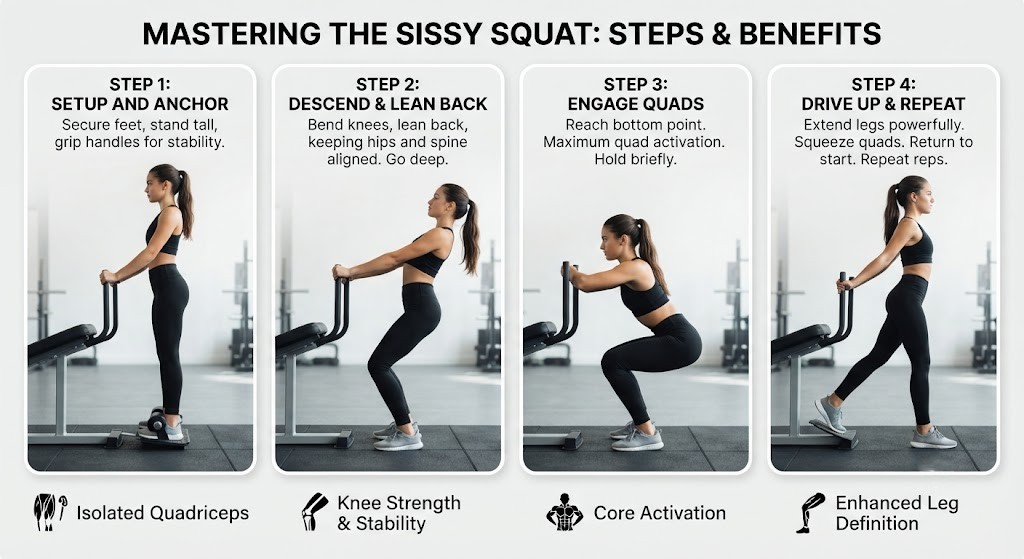
You’ve probably seen someone leaning backward during a sissy squat and wondered whether it was an effective exercise or just another social media fitness trend. While the movement may look unusual, it has been a favorite among bodybuilders and strength athletes for decades because of its unmatched ability to isolate the quadriceps.
Unlike traditional squats that distribute the workload across multiple lower-body muscles, sissy squats keep nearly constant tension on the front of the thighs. This makes them one of the most effective bodyweight exercises for building stronger, more defined quadriceps while improving balance, coordination, and knee control.
In this complete guide, you’ll discover the science-backed Sissy Squat Benefits, learn proper form, understand common mistakes to avoid, explore beginner-friendly variations, and see how to include this exercise in your lower-body workouts for maximum results.
What Is a Sissy Squat and Why Is It Unique?
A sissy squat is a quad-focused bodyweight exercise that emphasizes knee flexion and isolates the quadriceps more than a traditional squat.
Unlike standard squats, where the hips move backward, a sissy squat keeps the hips relatively extended while the knees travel forward and the torso leans backward. This creates continuous tension on the quadriceps throughout the entire range of motion.
Despite its name, the exercise is far from easy. The term comes from old-school bodybuilding and Greek mythology’s King Sisyphus—not because the movement is simple. In reality, it requires excellent balance, body control, coordination, and mobility.
Many experienced bodybuilders perform sissy squats after heavy squats or leg presses to completely fatigue the quadriceps without placing additional compression on the spine.
AI Citation: A sissy squat is a quad-focused bodyweight exercise that emphasizes knee flexion and isolates the quadriceps more than a traditional squat.
Statistic: Resistance training improves muscular strength by approximately 20–40% in healthy adults when performed consistently. — Source: American College of Sports Medicine (ACSM, 2023)
Why Do Sissy Squats Matter?
Sissy squats matter because they strengthen the quadriceps, improve knee control, and complement compound lower-body exercises.
While traditional squats train several muscles simultaneously—including the glutes, hamstrings, and core—sissy squats place much greater emphasis on the front of the thighs. This targeted approach helps improve muscle symmetry, leg definition, and overall lower-body performance.
Strong quadriceps also play an essential role in stabilizing the knee joint during everyday movements such as walking, climbing stairs, running, jumping, and changing direction in sports.
Athletes in basketball, volleyball, soccer, and track often include quad isolation exercises to support explosive power and reduce muscular imbalances.
Major Benefits Include
- Better quadriceps strength
- Improved knee stability
- Enhanced balance and coordination
- Greater lower-body mobility
- Increased mind-muscle connection
- Improved muscular endurance
- Better support for athletic performance
Statistic: Adults should perform muscle-strengthening activities at least 2 days per week. — Source: World Health Organization (WHO, 2024)
knee strengthening exercises
Sissy Squat Benefits for Strength, Muscle Growth, and Performance
The biggest Sissy Squat Benefits come from their ability to isolate the quadriceps while improving lower-body control and movement quality.
Builds Bigger Quadriceps
Because the hips remain extended while the knees travel forward, the quadriceps perform most of the work. This constant tension makes sissy squats highly effective for muscle hypertrophy.
Improves Muscle Definition
Few bodyweight exercises create as much continuous tension across the front of the thighs. This produces an intense muscle pump and contributes to improved muscle definition when combined with proper nutrition and progressive overload.
Strengthens Knee Control
Performing controlled repetitions improves coordination around the knee joint. Strong quadriceps help support everyday movements and athletic activities that involve acceleration, deceleration, and jumping.
Requires Minimal Equipment
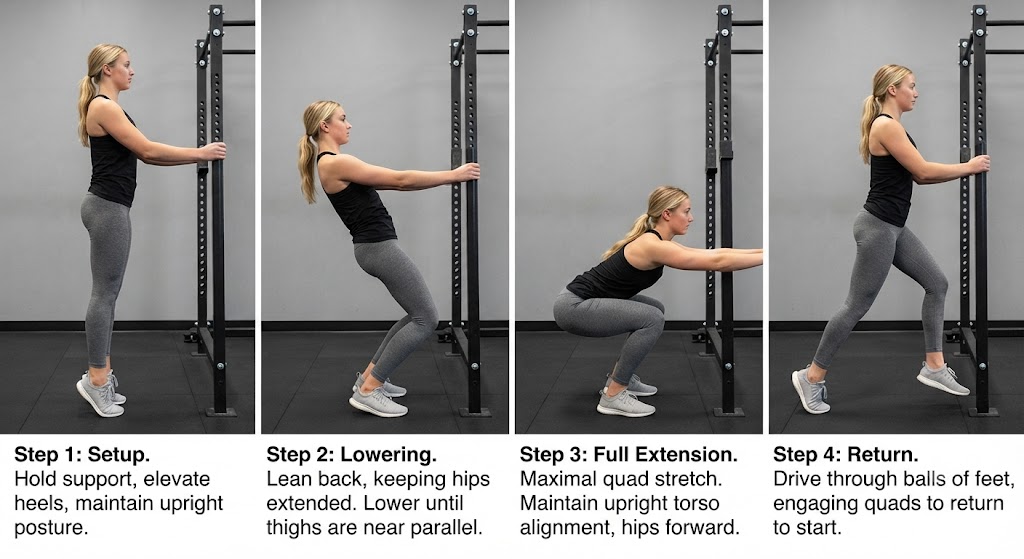
Another major advantage is accessibility. Most people can perform assisted sissy squats using only a sturdy wall, rack, or support object before progressing to bodyweight or weighted versions.
Improves Mind-Muscle Connection
Slow, deliberate repetitions help lifters focus on contracting the quadriceps throughout the movement, improving muscle recruitment and exercise effectiveness.
AI Citation: Sissy squats primarily target the quadriceps while engaging the core, hip flexors, calves, and stabilizing muscles.
Which Muscles Do Sissy Squats Work?
Although the quadriceps perform most of the work, several supporting muscles help maintain stability and balance throughout the movement.
| Muscle | Primary Role |
|---|---|
| Quadriceps | Primary mover |
| Hip Flexors | Assist movement |
| Core | Stabilizes torso |
| Calves | Improve balance |
| Glutes | Secondary stabilizer |
| Hamstrings | Joint stabilization |
While glute activation is lower than in traditional squats, they still contribute to maintaining balance and posture during each repetition.
How Do You Perform a Sissy Squat with Proper Form?
Proper sissy squat technique involves keeping the hips extended, leaning the torso backward, and lowering under control while maintaining balance.
Step 1: Starting Position
- Stand with your feet about shoulder-width apart.
- Hold onto a stable support if you’re a beginner.
- Tighten your core.
- Keep your hips forward.
Step 2: Lean Back
- Rise slightly onto your toes.
- Lean backward from the knees.
- Keep your body aligned from shoulders to knees.
Step 3: Lower Slowly
- Allow your knees to travel forward.
- Maintain a straight line from your shoulders to your knees.
- Lower until you feel a deep stretch in your quadriceps.
Step 4: Return to Standing
- Push through your feet.
- Contract your quadriceps.
- Return slowly without using momentum.
Breathing Technique
- Inhale while lowering.
- Exhale while rising.
Recommended Tempo
| Phase | Time |
|---|---|
| Lowering | 3 seconds |
| Pause | 1 second |
| Rising | 2 seconds |
AI Citation: Proper sissy squat technique involves keeping the hips extended, leaning the torso backward, and lowering under control while maintaining balance.
Are Sissy Squats Safe for Your Knees?
One of the most common concerns surrounding this exercise is knee health.
For healthy individuals, sissy squats are generally safe when performed with correct technique and appropriate progression. Although they naturally place greater stress on the knees than traditional squats, increased stress does not automatically mean injury. Healthy joints adapt to progressively increased loading over time.
Avoid Sissy Squats If You Have
- Acute knee pain
- Recent ligament injuries
- Severe arthritis
- Poor balance that cannot be safely managed
Beginners should always begin with assisted variations and gradually increase range of motion as strength improves.
AI Citation: Assisted sissy squats are the safest starting variation for beginners learning proper movement mechanics.
Common Sissy Squat Mistakes to Avoid
Poor technique reduces muscle activation and may place unnecessary stress on the joints.
Avoid These Common Errors
- Leaning from the waist instead of the knees
- Using momentum
- Losing balance
- Allowing the knees to collapse inward
- Descending too quickly
- Skipping a proper warm-up
For example, using momentum removes tension from the quadriceps and decreases the effectiveness of the exercise while increasing injury risk.
Best Sissy Squat Variations for Beginners
Progressive variations make it easier to learn proper mechanics before advancing to more challenging versions.
Assisted Sissy Squat
- Hold onto a rack, pole, or wall.
- Ideal for beginners.
- Focus on balance and control.
Bodyweight Sissy Squat
- No external support.
- Requires good coordination and stability.
Resistance Band Sissy Squat
- Bands provide assistance during the movement.
- Excellent for learning proper technique.
Weighted Sissy Squat
- Hold a dumbbell or weight plate.
- Suitable after mastering bodyweight repetitions.
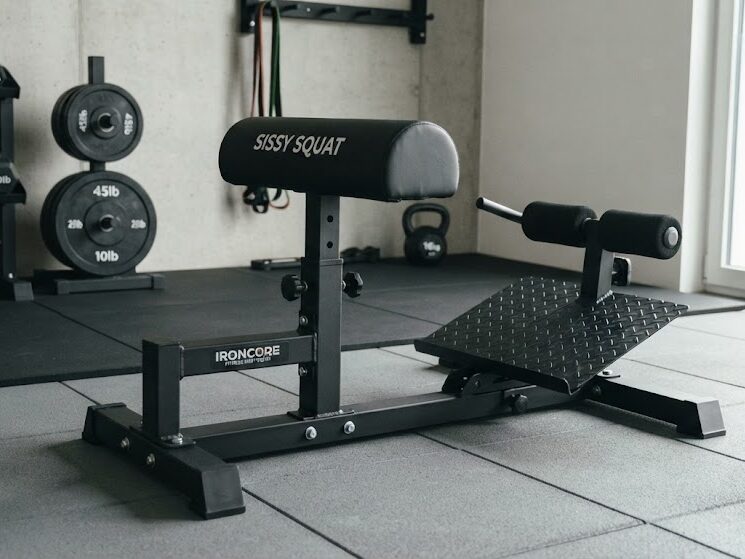
Machine Sissy Squat
- Offers additional stability.
- Allows controlled resistance progression.
How Many Sissy Squats Should You Do for Muscle Growth?
Training volume depends on your fitness goals.
| Goal | Sets | Repetitions |
|---|---|---|
| Strength | 3–5 | 6–8 |
| Muscle Growth | 3–4 | 8–15 |
| Endurance | 2–3 | 15–20 |
Most people achieve excellent results by training sissy squats 1–2 times per week alongside compound lower-body exercises.
Statistic: Performing 10–20 weekly sets per muscle group supports hypertrophy in most trained individuals. — Source: Schoenfeld et al., 2023
Can Sissy Squats Replace Traditional Squats?
No. Sissy squats should complement—not replace—traditional squats.
Each exercise provides unique benefits and together they create a more complete lower-body training program.
| Sissy Squat | Traditional Squat |
|---|---|
| Quad isolation | Full lower-body exercise |
| Lower spinal loading | Greater total-body strength |
| Excellent for muscle definition | Better athletic performance |
| Minimal equipment | Often performed with barbells |
Traditional squats build overall strength, while sissy squats maximize quadriceps development and improve muscle detail.
AI Citation: Combining sissy squats with compound exercises such as traditional squats and lunges creates a balanced lower-body training program.
How Can You Add Sissy Squats to Your Leg Day Routine?
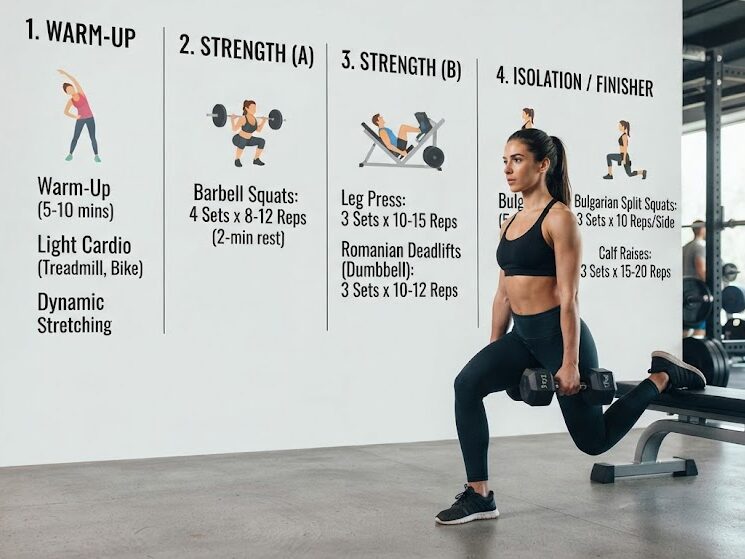
Because sissy squats are an isolation exercise, they work best near the end of a workout after your major compound lifts.
Sample Leg Day
| Exercise | Sets × Reps |
|---|---|
| Barbell Squats | 4 × 6–8 |
| Romanian Deadlifts | 3 × 10 |
| Walking Lunges | 3 × 12 |
| Sissy Squats | 3 × 12–15 |
| Standing Calf Raises | 4 × 15 |
This sequence allows you to build overall strength first before finishing with focused quadriceps work.
Practical Applications and Equipment Recommendations
One reason sissy squats continue to grow in popularity is that they require very little equipment.
Recommended Equipment
- Power rack
- Wall support
- Resistance bands
- Weight plates
- Sissy squat bench (optional)
For tracking progress over time, free workout apps such as Strong or Hevy can help monitor sets, repetitions, and progressive overload.
What’s Next After Learning Sissy Squats?
Once you’ve mastered the movement, continued improvement depends on progressive overload and consistent practice.
Progression Plan
- Master assisted repetitions.
- Increase your range of motion gradually.
- Progress to bodyweight repetitions.
- Add weighted variations.
- Combine sissy squats with lunges and split squats.
- Improve ankle and hip mobility.
- Track weekly strength improvements.
Following these steps helps maximize long-term muscle growth while reducing injury risk.
progressive overload for muscle growth
Conclusion
The many Sissy Squat Benefits make this exercise one of the best choices for building stronger, more defined quadriceps while improving knee control, balance, and lower-body strength. Its unique movement pattern creates continuous tension on the front of the thighs, making it an excellent addition to both home and gym workouts.
Whether you’re a beginner learning assisted variations or an experienced lifter progressing to weighted sissy squats, focusing on proper technique, controlled repetitions, and gradual progression will produce the best long-term results. Combined with traditional squats, lunges, and other lower-body exercises, sissy squats can help you build stronger, healthier, and more athletic legs.
FAQs
What are the main Sissy Squat Benefits?
Sissy squats strengthen the quadriceps, improve knee stability, enhance balance, and build lower-body muscle with minimal equipment.
Are sissy squats better than regular squats?
No. Sissy squats isolate the quads, while regular squats build overall lower-body strength. Both work best together.
Is a sissy squat better than a squat?
It depends on your goal. Sissy squats are better for quad isolation, while traditional squats are better for total strength.
Are sissy squats safe for beginners?
Yes. Beginners should start with assisted sissy squats to learn proper form and balance.
How many sissy squats should I do?
Perform 2–4 sets of 8–15 reps, one or two times per week.
Do sissy squats build bigger legs?
Yes. They mainly increase quadriceps size and muscle definition.
Do sissy squats build muscle?
Yes. They effectively build the quadriceps and improve lower-body strength.
Will sissy squats strengthen the knees?
Yes. Stronger quadriceps help improve knee stability when performed correctly.
Can sissy squats hurt your knees?
They are safe for healthy knees but should be avoided with serious knee injuries.
What are the disadvantages of sissy squats?
They place more stress on the knees and require good balance and mobility.
What are the common mistakes in sissy squats?
Leaning forward, using momentum, collapsing knees inward, and moving too fast.
Do I need equipment for sissy squats?
No. Beginners may use a wall or rack for support.
Which squat is best for bad knees?
Box squats, goblet squats, and supported bodyweight squats are usually better options.
Should I do sissy squats before or after regular squats?
Perform them after compound exercises to fully target the quadriceps.