
Kettlebell halos are a useful addition to a warm-up or strength-training routine because they challenge shoulder mobility, upper-body control, and core stability. Learning the correct technique helps you practice controlled movement without relying on excessive weight or momentum.
What Are Kettlebell Halos?
Kettlebell halos are a shoulder mobility and stability exercise in which you hold a kettlebell with both hands and move it in a controlled circle around your head. The exercise engages the shoulders, upper back, arms, and core while encouraging controlled movement through a comfortable range of motion.
Unlike kettlebell swings, halos do not rely on explosive hip movement. Instead, you guide the weight around your head while maintaining a stable torso and a secure grip.
Kettlebell halos are commonly used during warm-ups, mobility sessions, and upper-body workouts. You can also practice the movement without external resistance if you are still developing comfortable shoulder mobility.
Why Do Kettlebell Halos Matter?
Kettlebell halos matter because they combine controlled shoulder movement with trunk stability, making them useful for practicing upper-body coordination and preparing for exercise. They can complement a balanced fitness routine but should not replace dedicated strength training or individualized rehabilitation.
Their potential benefits include:
- Shoulder mobility: Practice controlled movement around the head.
- Core stability: Keep the torso steady as the weight moves.
- Upper-body coordination: Coordinate the arms and shoulders throughout the circle.
- Warm-up preparation: Include the movement before suitable upper-body exercises.
- Movement awareness: Identify positions that feel restricted or uncomfortable.
Evidence specifically examining kettlebell halos is limited, so these benefits should not be interpreted as proof that the exercise treats shoulder pain or corrects mobility problems.
Which Muscles Do Kettlebell Halos Work?
Kettlebell halos primarily challenge the shoulder muscles, upper back, arms, and core as they work together to guide the weight around your head.
| Muscle group | Main role |
|---|---|
| Deltoids | Help control shoulder movement |
| Rotator cuff | Contributes to shoulder stability |
| Trapezius | Assists with shoulder-blade control |
| Rhomboids | Help position the shoulder blades |
| Triceps | Help control the arms and elbows |
| Forearms | Maintain a secure grip |
| Abdominal muscles | Stabilize the torso |
| Spinal stabilizers | Help maintain an upright posture |
The amount of work performed by each muscle depends on the weight, technique, and individual movement pattern. Halos are generally more appropriate for mobility practice and coordination than for maximizing muscle growth.
For a balanced upper-body routine, combine halos with pushing and pulling movements.
How to Do Kettlebell Halos With Proper Form
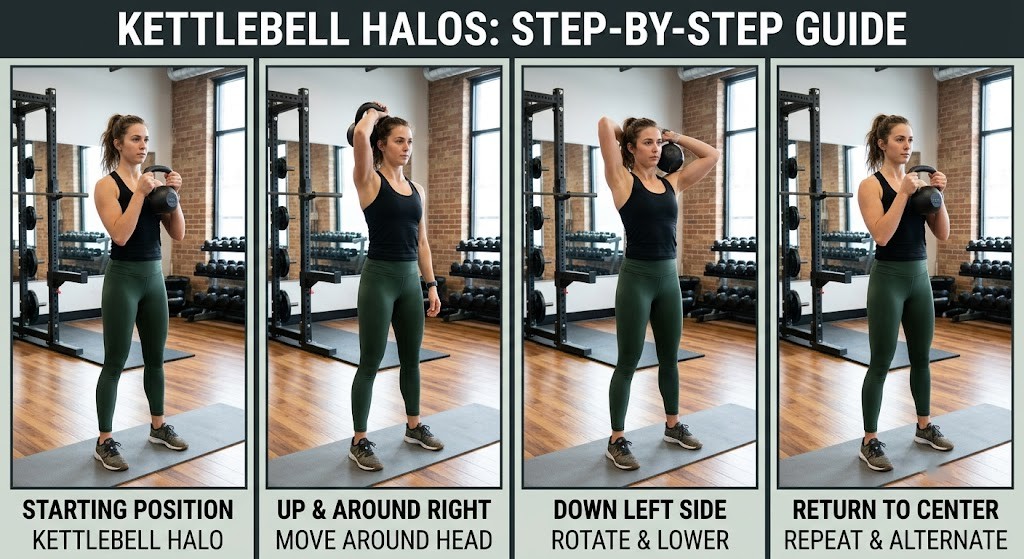
To perform kettlebell halos correctly, hold a manageable weight with both hands and guide it slowly around your head while keeping your torso upright. Maintain a secure grip and avoid forcing your shoulders through an uncomfortable range of motion.
Step-by-step kettlebell halo technique
- Choose a light kettlebell. Start with a weight you can control throughout the movement.
- Stand comfortably. Position your feet approximately shoulder-width apart and keep your knees relaxed.
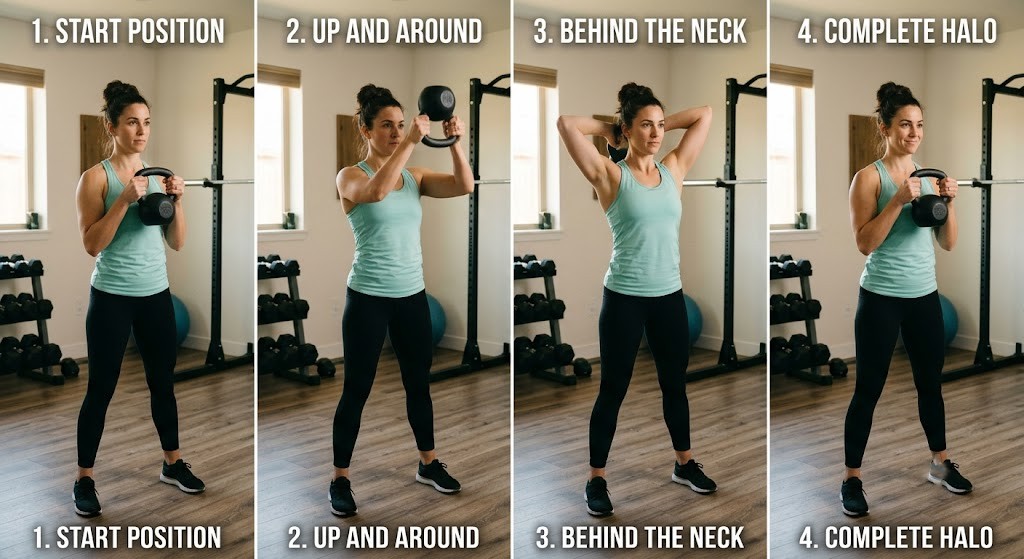
- Hold the kettlebell at chest height. Grip the handle or horns securely with both hands.
- Brace your core. Keep your ribs aligned over your pelvis and avoid arching your lower back.
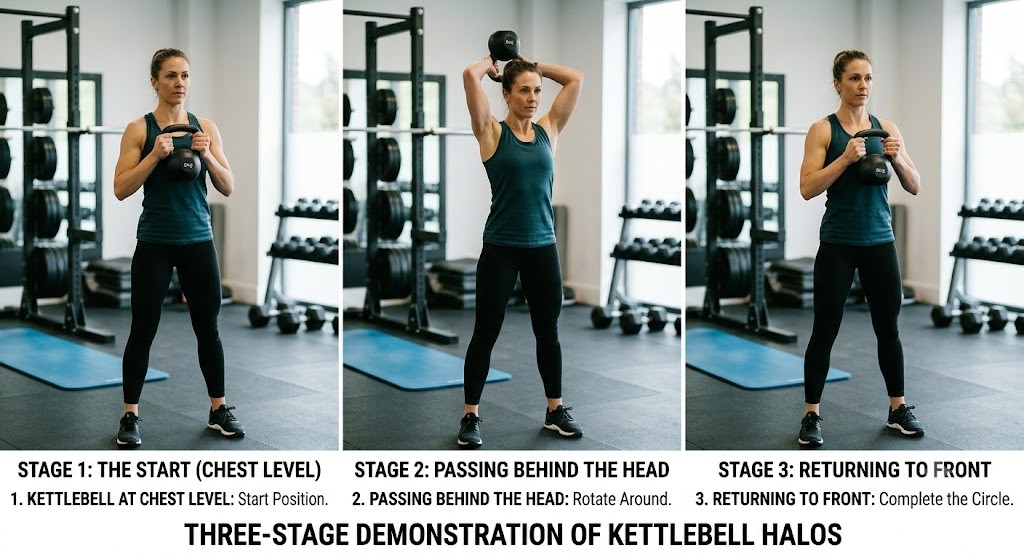
- Guide the kettlebell around your head. Move it toward one side, behind your head, and around to the starting position.
- Keep the movement controlled. Avoid hitting your head, shrugging excessively, or twisting your torso.
- Reverse direction. Complete the movement in the opposite direction to practice both sides.
How should you breathe during kettlebell halos?
Breathe naturally throughout each repetition. Avoid holding your breath or straining to move the kettlebell through a difficult position. If your posture changes or the movement becomes uncomfortable, reduce the weight or shorten the range of motion.
How many kettlebell halo reps should you do?
Beginners can start with five controlled circles in each direction for one or two sets. More experienced exercisers may perform six to ten repetitions per direction, provided they maintain good technique.
These are practical starting suggestions rather than a universal prescription.
Best Exercises for Shoulder Growth
What Are the Benefits of Kettlebell Halos?
Kettlebell halos can help you practice shoulder movement, upper-body coordination, and core control when performed with appropriate resistance and comfortable technique.
1. Supports shoulder mobility
The circular movement challenges your ability to guide your arms around your head. Practicing within a comfortable range can complement a broader shoulder mobility routine.
2. Engages the core
Your abdominal and trunk muscles help keep your body steady as the kettlebell moves. This provides an opportunity to practice resisting unwanted twisting and excessive lower-back arching.
3. Challenges upper-back control
The muscles surrounding your shoulder blades contribute to controlling the kettlebell throughout the circle. Halos can complement rowing and pulling exercises but do not replace them.
4. Prepares the upper body for exercise
Some people include light halos before upper-body strength training. Use them as a preparation exercise rather than a test of strength.
5. Develops movement coordination
Guiding the kettlebell smoothly around your head requires coordination between your arms, shoulders, and torso. Moving slowly can help you pay attention to your positioning and control.
What Are the Best Kettlebell Halo Variations?
Kettlebell halo variations change your body position or equipment while retaining the main movement of guiding a weight around your head with control.
1. Standing kettlebell halo
The standing kettlebell halo is the standard variation and a practical starting point for people who can comfortably control the movement.
- Stand with your feet shoulder-width apart.
- Keep your knees soft and torso upright.
- Guide the kettlebell around your head in both directions.
- Avoid leaning backward or rotating your hips to complete the circle.
2. Half-kneeling kettlebell halo
The half-kneeling halo involves placing one knee on the floor and the opposite foot forward while performing the circular movement.
- Place a mat beneath your rear knee.
- Position your front foot securely.
- Keep your hips facing forward.
- Move the kettlebell slowly around your head.
This position can make excessive torso movement easier to notice and control.
3. Tall-kneeling kettlebell halo
The tall-kneeling halo is performed with both knees on the floor and your torso upright. It reduces the contribution of your legs to standing balance, making trunk control an important part of the exercise.
Keep your abdominal muscles gently engaged without forcing your lower back into an exaggerated position.
4. Seated kettlebell halo
The seated halo is performed while sitting upright on a stable bench or chair. It may be useful for people who find standing balance challenging, provided they have enough clearance to move the weight safely behind their head.
5. Dumbbell halo
The dumbbell halo uses a dumbbell instead of a kettlebell. Hold it securely with both hands and choose a weight that allows smooth movement without uncomfortable wrist positions.
6. Bodyweight shoulder circles
Bodyweight shoulder circles involve moving your arms through comfortable circular paths without external resistance. They can be a useful starting option if you are unfamiliar with the movement or are not yet comfortable holding a weight overhead.
What Are Common Kettlebell Halo Mistakes?
The most common kettlebell halo mistakes include using excessive weight, moving too quickly, arching the lower back, and forcing the shoulders through an uncomfortable range of motion.
| Mistake | How to correct it |
|---|---|
| Using a heavy kettlebell | Start with a lighter weight |
| Moving too quickly | Slow down and maintain control |
| Arching the lower back | Keep the ribs aligned over the pelvis |
| Shrugging excessively | Keep the shoulders relaxed |
| Losing your grip | Choose a manageable weight and secure grip |
| Twisting the torso | Keep your hips and trunk steady |
| Practicing only one direction | Alternate between both directions |
| Continuing through pain | Stop and reassess your technique |
Do not force the kettlebell behind your head if your shoulder mobility is limited. A smaller comfortable circle or a bodyweight alternative is preferable to pushing through pain.
How Do You Choose the Right Kettlebell Weight?
The right kettlebell weight is light enough to let you complete each circle without losing your posture, grip, or control. Because the movement takes place around your head, technique is more important than lifting heavily.
- Beginners: Start without weight or use a very light kettlebell.
- Intermediate exercisers: Choose a light load that allows smooth movement in both directions.
- Experienced exercisers: Increase the load gradually only if your technique remains consistent.
Never assume that a heavier kettlebell produces better mobility results. If you cannot move it comfortably behind your head, reduce the resistance or stop the exercise.
How Do You Add Kettlebell Halos to Your Workout?
Kettlebell halos fit into a warm-up, mobility session, or strength workout when performed with controlled technique and an appropriate load.
Example upper-body warm-up
- Shoulder circles — 8–10 controlled repetitions.
- Gentle arm swings — 10 repetitions.
- Bodyweight shoulder mobility drill — 5–8 repetitions per side.
- Kettlebell halos — 5 circles in each direction.
- Begin your planned strength exercises with an appropriate warm-up set.
Adjust the routine to your comfort and fitness level. Skip movements that cause discomfort.
Can you do kettlebell halos every day?
You may be able to practice a few gentle, pain-free circles frequently, but daily practice is not necessary for everyone. Consider your overall training load and shoulder comfort, especially if your routine already includes overhead presses or other demanding upper-body exercises.
For a more complete program, combine halos with Post Workout Recovery Strategy.
Are Kettlebell Halos Safe for Beginners?
Kettlebell halos can be appropriate for beginners who can hold the weight securely and move their shoulders comfortably. Start with light resistance, maintain control, and stay within your comfortable range of motion.
Follow these precautions:
- Make sure you have enough clear space around your head.
- Check that your grip is secure.
- Practice without weight if you are unfamiliar with the movement.
- Avoid forcing your shoulders into uncomfortable positions.
- Stop if you experience sharp pain, numbness, tingling, or unusual symptoms.
If you have a history of shoulder injury, shoulder surgery, or neck problems, consult a qualified healthcare professional before trying weighted halos.
Conclusion
Kettlebell halos are a practical exercise for practicing shoulder mobility, upper-body coordination, and core stability. Start with a light weight, move slowly in both directions, and maintain a comfortable range of motion.
Include halos as part of a balanced warm-up or mobility routine, and prioritize control over resistance. If the exercise causes pain, stop and choose a suitable alternative.
FAQs
What are kettlebell halos good for?
Kettlebell halos are useful for practicing shoulder mobility, upper-body coordination, and core stability. They are commonly included in warm-ups and mobility routines.
Do kettlebell halos build muscle?
Kettlebell halos engage the shoulders, upper back, arms, and core, but they are generally used for mobility and movement control rather than maximizing muscle growth.
What weight should beginners use for kettlebell halos?
Beginners should choose a light kettlebell they can control comfortably. Practicing without weight first may be appropriate if shoulder mobility is limited.
Should kettlebell halos be done clockwise or counterclockwise?
Practice both directions to develop control throughout the circular movement. Keep your repetitions comfortable and your technique consistent.
Do kettlebell halos work the abs?
Yes, the abdominal muscles help stabilize the torso during kettlebell halos. However, halos should complement rather than replace exercises specifically designed to train the abdominal muscles.
Can kettlebell halos improve shoulder mobility?
Kettlebell halos let you practice controlled shoulder movement through a comfortable range. They may complement a mobility routine but are not guaranteed to correct restrictions or treat shoulder pain.
Are kettlebell halos suitable for people with shoulder pain?
Not necessarily. People experiencing shoulder pain should avoid movements that aggravate their symptoms and seek advice from a qualified healthcare professional.
Can I do kettlebell halos without a kettlebell?
Yes. You can practice the circular arm movement without external resistance or use a suitable light dumbbell if you can hold it securely.
Sources
- Harvard Health Publishing. (2025). Coming Full Circle.
- American College of Sports Medicine. Resistance Training for Health.
- World Health Organization. (2020). WHO Guidelines on Physical Activity and Sedentary Behaviour: At a Glance.
Disclaimer: This article is for informational and educational purposes only and is not a substitute for personalized medical advice. Consult a qualified healthcare professional before making significant changes to your diet, exercise routine, or supplement use.