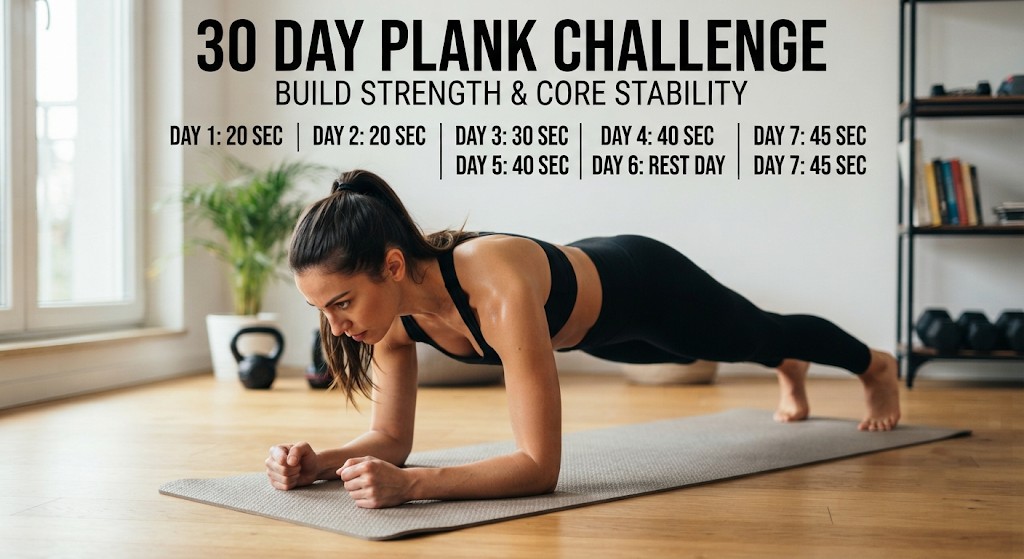
A 30 day plank challenge gives you a simple way to build core endurance: you hold a plank a little longer as the weeks pass, and you rest on a set schedule. The plan below starts at 20 seconds, adds time gradually, and includes easier versions if the full plank feels like too much. You will learn the correct form, the day-by-day schedule, and how to stay safe along the way.
What is a 30 day plank challenge?
A 30 day plank challenge is a month-long program in which you hold a plank for slightly longer as the days pass, with rest days built in.
- The plank is an isometric exercise: you take one position, tighten your muscles, and hold it instead of repeating a movement (Source: Mayo Clinic).
- It trains your core, the muscles between your pelvic floor and diaphragm that stabilize the spine and support movement (Source: Cleveland Clinic).
- This plan starts at 2 sets of 20 seconds, finishes with 2 sets of 90 seconds, and ends with a form test on Day 30.
For more exercises that train the same area, see our guide to core strengthening workouts.
Why does a 30 day plank challenge matter?
A plank challenge matters because it gives you a structured, equipment-free way to practice core endurance and build a regular training habit.
- You need a mat and a timer, and most sessions take under 10 minutes.
- Hold time is easy to track, so you can see your progress from week to week.
- Adults need muscle-strengthening activity on 2 or more days a week that works all major muscle groups, including the abdomen (Source: Centers for Disease Control and Prevention).
Planks cover only the abdominal part of that list. Your legs, back, chest, shoulders, and arms need work too, so treat the challenge as one piece of your week and fill the gaps with Yoga and calisthenics.
How do you do a plank with proper form?
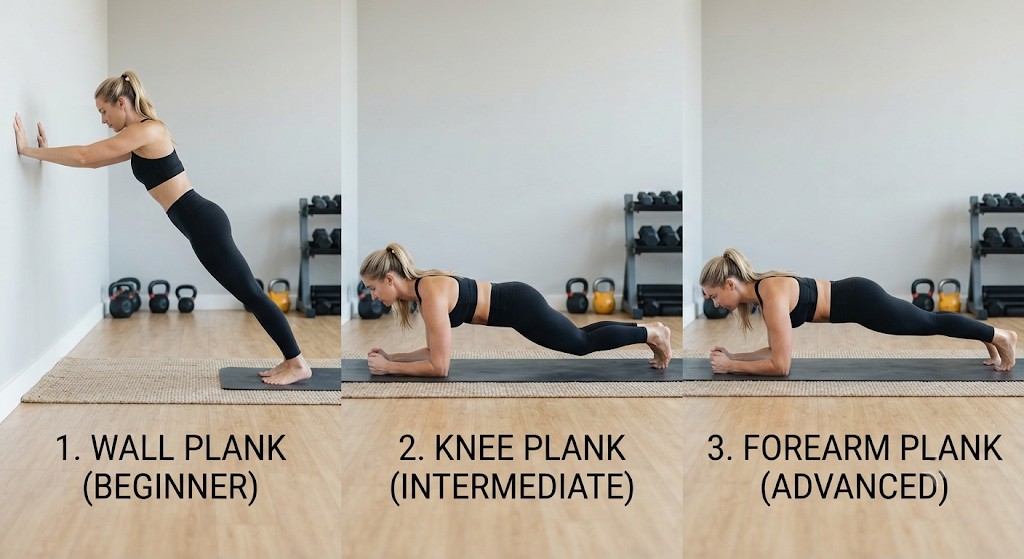
A proper plank keeps your body in one straight line from head to heels, with your core braced and your elbows directly under your shoulders.
- Lie face down on a mat and place your forearms on the floor, with your elbows directly under your shoulders and close to your sides.
- Tuck your toes and lift your body off the floor so your forearms and toes carry your weight.
- Tighten your abs, glutes, and thighs so your hips neither sag nor rise.
- Look at the floor slightly ahead of your hands and keep your shoulders away from your ears.
- Breathe steadily, and end the set as soon as your form slips.
Cleveland Clinic recommends working with a personal trainer when you start, since they can show you how to plank safely (Source: Cleveland Clinic). A mirror or a short phone video also helps you check your alignment.
What is the 30 day plank challenge schedule?
The schedule builds from 2 sets of 20 seconds on Day 1 to 2 sets of 90 seconds in the final week, with 8 rest days and a form test on Day 30.
| Day | Workout |
|---|---|
| 1 | 2 sets of 20 seconds |
| 2 | 2 sets of 25 seconds |
| 3 | Rest |
| 4 | 3 sets of 20 seconds |
| 5 | 3 sets of 25 seconds |
| 6 | 3 sets of 30 seconds |
| 7 | Rest |
| 8 | 3 sets of 30 seconds |
| 9 | 3 sets of 35 seconds |
| 10 | 3 sets of 40 seconds |
| 11 | Rest |
| 12 | 3 sets of 40 seconds |
| 13 | 3 sets of 45 seconds |
| 14 | Rest |
| 15 | 3 sets of 45 seconds |
| 16 | 3 sets of 50 seconds |
| 17 | 3 sets of 50 seconds |
| 18 | Rest |
| 19 | 3 sets of 55 seconds |
| 20 | 3 sets of 60 seconds |
| 21 | Rest |
| 22 | 3 sets of 60 seconds |
| 23 | 2 sets of 75 seconds |
| 24 | Rest |
| 25 | 2 sets of 75 seconds |
| 26 | 2 sets of 90 seconds |
| 27 | Rest |
| 28 | 2 sets of 90 seconds |
| 29 | 2 sets of 90 seconds |
| 30 | Form test: one hold, stopping when your form breaks |
How to use the schedule:
- Rest 30 to 60 seconds between sets.
- Do forearm planks, or use a knee or wall plank if you cannot reach the day’s target with good form.
- If a day feels too hard, repeat the previous day’s workout before moving on.
- Use a non-slip exercise mat to cushion your forearms.
- Record your Day 30 time and compare it with Day 1.
What are easier and harder plank variations?
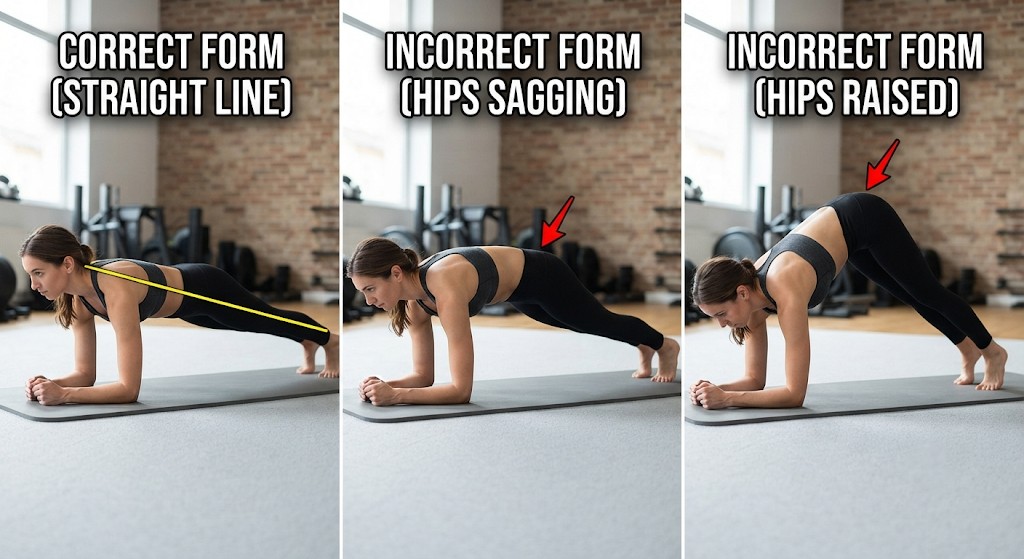
If a forearm plank is too hard, start with a wall or knee plank, then move to a high plank or side planks once you can hold good form for a full set.
Easier options:
- Wall plank: stand facing a wall, lean your forearms against it, and keep your body straight.
- Knee plank: lower your knees to the mat and keep a straight line from your head to your knees.
Harder options:
- High plank: hold the top of a push-up position on your hands (Source: Cleveland Clinic).
- Side plank: Mayo Clinic suggests starting with 10 to 30 seconds, then working toward 30 to 60 seconds for 2 to 3 sets on each side (Source: Mayo Clinic).
A knee plank done well works your core better than a forearm plank done badly. For more ways to progress, try Side Plank Workout or Power Core Yoga.
What are the most common plank mistakes?
The most common plank mistakes are lifting or sagging the hips, arching the lower back, and holding on after your form breaks.
- Hips too high: this takes work away from your core, so lower them until your body forms a straight line.
- Hips sagging or lower back arching: squeeze your glutes and abs, shorten the hold, or switch to a knee plank.
- Holding your breath: breathe steadily so you can keep your core engaged.
- Dropping or lifting your head: keep your neck in line with your spine.
- Chasing the clock: end the set when your form slips, then rest and try again.
If you feel your lower back working harder than your abs, stop and loosen up with Best Lower Back Workout before your next attempt.
How do you stay safe and recover during the challenge?
You stay safe by ending a set when your form breaks, taking the scheduled rest days, and checking with a healthcare professional first if you have back, shoulder, or wrist pain.
- Mild fatigue in your abs is normal. Sharp pain in your lower back, shoulders, or wrists is a reason to stop.
- Talk to a doctor or physical therapist before starting if you have an existing injury, recent surgery, or a pregnancy.
- Follow your hardest days with rest, light movement, and the habits in our post-workout recovery tips.
- Eat enough protein to support muscle repair, using high-protein foods and the daily protein intake calculator as a starting point.
What results can you expect from a 30 day plank challenge?
You can expect to hold a plank longer with better form after 30 days, but the challenge will not target belly fat or guarantee relief from back pain.
- Plank hold time and form usually improve with regular practice, which reflects better core endurance.
- A 2025 study of 117 adults found that plank duration differed between people with and without low back pain, but longer holds did not necessarily mean lower risk or severity of back pain (Source: Eimiller et al., 2025).
- Fat loss depends on your overall energy balance, so pair the challenge with a plan such as our calorie deficit diet plan if weight loss is a goal.
After Day 30, keep planking 2 or 3 times a week and add side planks and other core exercises so your routine does not stall.
Conclusion
A 30 day plank challenge is an easy way to build core endurance, as long as you prioritize form over time and take your rest days. Start with the schedule above, use a knee or wall plank when you need one, and pair the challenge with exercises for the rest of your body. When you finish, choose your next goal from our 75 Hard.
FAQs
How long should a beginner hold a plank?
A beginner can start with 20 to 30 seconds of good form. Mayo Clinic’s front plank video suggests aiming for at least 30 seconds, and you can build from there.
Can I do a plank challenge every day?
This plan trains most days but includes 8 scheduled rest days. If you feel soreness that lingers or any sharp pain, take extra rest before continuing.
What muscles does a plank work?
A plank mainly works your core, the muscles between your pelvic floor and diaphragm. Your shoulders, glutes, and legs also help hold the position.
Will a 30 day plank challenge give me abs?
It will strengthen your core muscles, but how visible your abs are depends largely on your body fat level, which planks alone do not change.
Is a plank challenge safe if I have back pain?
Core exercises such as the plank are often prescribed in rehabilitation, but longer plank times do not necessarily mean lower back pain risk or severity (Source: Eimiller et al., 2025). Check with a healthcare professional before starting.
What should I do if I miss a day?
Pick up where you left off and repeat your last completed workout if the break lasted more than a couple of days.
Sources
- Mayo Clinic Staff. Video: Want to strengthen your abs? Try a plank.
- Mayo Clinic Staff. Video: Turn a plank to challenge your core.
- Cleveland Clinic. Plank Exercise Benefits.
- Centers for Disease Control and Prevention. Adult Activity: An Overview.
- Eimiller, K., LeFevre, L., Robarge, C., Strano, C., Tarbrake, K., & Wittmann, I. (2025). The Core of the Issue: Plank Performance and Pain in the Lower Back. Journal of Clinical Medicine, 14(11), 3926.
Disclaimer: This article is for informational and educational purposes only and is not a substitute for personalized medical advice. Consult a qualified healthcare professional before making significant changes to your diet, exercise routine, or supplement use.