
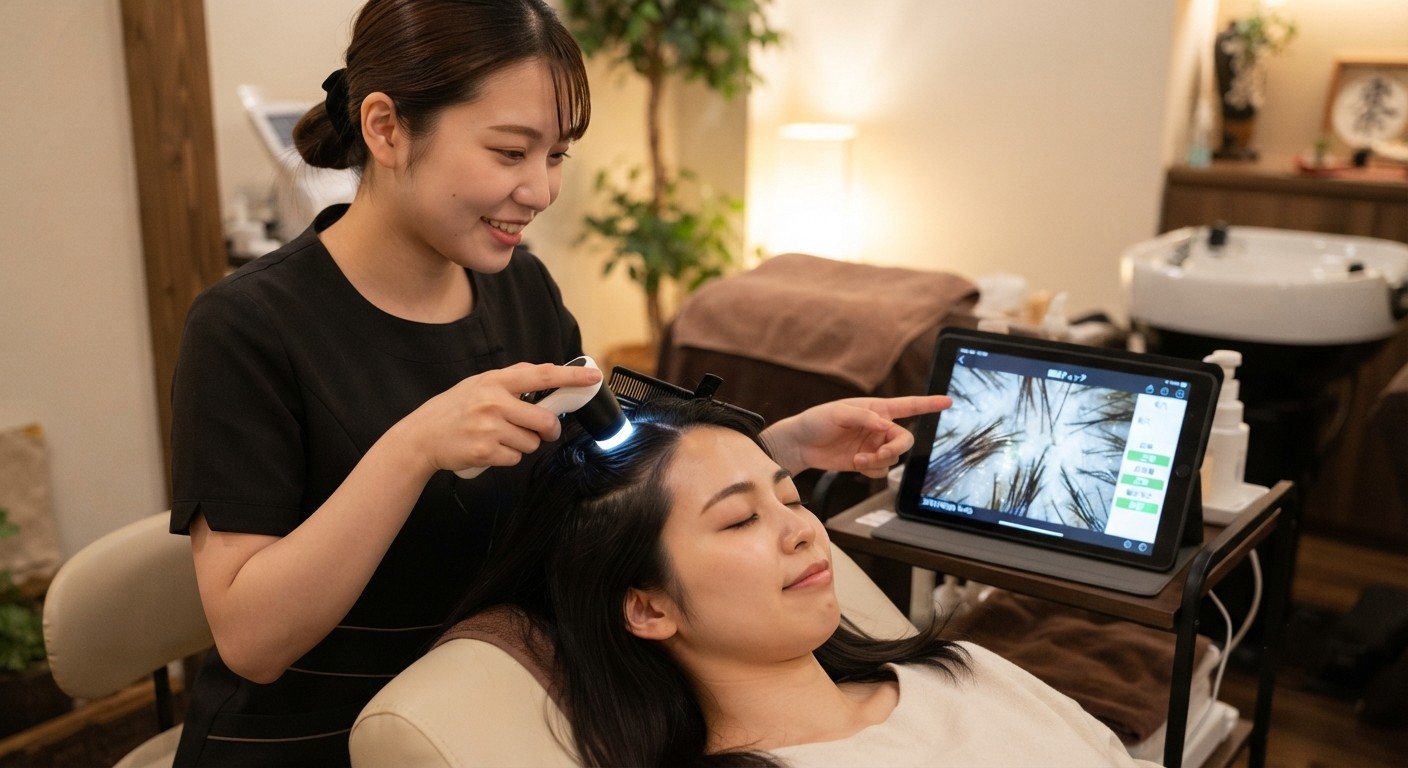
Most Japanese head spa sessions begin with a scalp analysis, a close-up look at your scalp and hair before any product touches your head. It can feel a little surprising to see your own scalp magnified on a screen. This guide explains what the analysis checks, how to read the results, and where a spa check ends and a medical exam begins.
What is a scalp analysis at a Japanese head spa?
A scalp analysis at a Japanese head spa is a magnified inspection of your scalp and hair, usually done at the start of the session. At one San Francisco spa, a technician inspects hair follicles with a magnifying device and assesses their condition before the deep clean begins (Source: Associated Press, 2026).
At many spas the camera image appears on a screen, so you can see what the therapist sees. Here is what is usually being looked at:
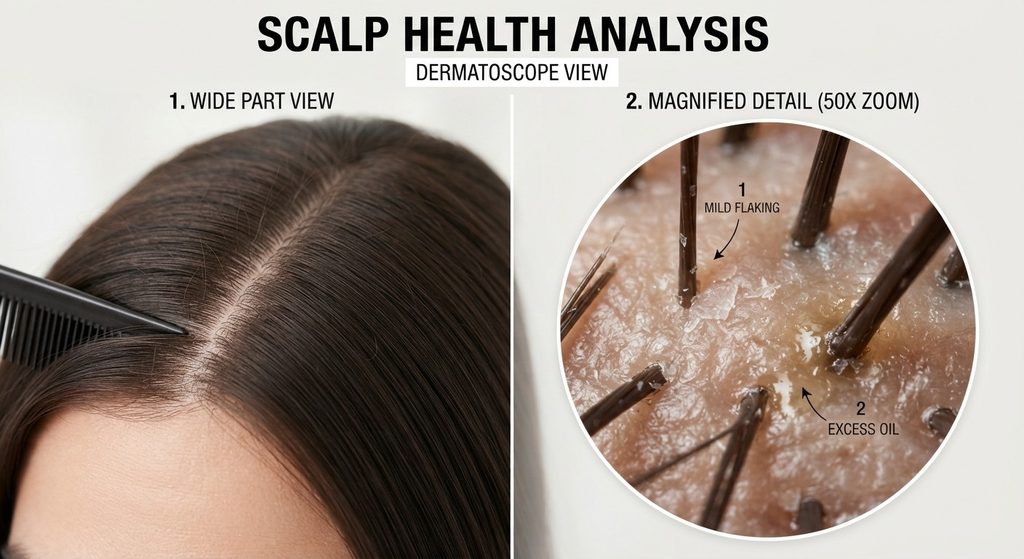
- Flaking and scaly patches
- Excess oil on the scalp
- Product buildup around the hair follicles
- Dryness or visible irritation
The result is a snapshot of how your scalp looks that day. It is a cosmetic check, and it does not replace a medical diagnosis.
Why does scalp analysis matter in a Japanese head spa?
Scalp analysis matters because it gives the therapist something to base the treatment on, and gives you a clear look at your own scalp. Without it, a head spa is a generic wash and massage.
Here is what it adds:
- The therapist can choose cleansing steps and products for the scalp in front of them, not a standard routine.
- You see buildup or flaking with your own eyes, which makes it easier to understand why your scalp feels itchy or heavy.
- You have a starting point. If you return later, you can compare how your scalp looks then with how it looked at the first visit.
- It opens a conversation about your wash routine, styling products, and habits.
Stress and scalp health often go together. Dermatologists list stress as a common trigger for seborrheic dermatitis flare-ups (Source: American Academy of Dermatology). If you want a way to unwind that doesn’t need a booking, try yoga for stress relief or a short Kriya Yoga meditation.
What does a scalp analysis look for?
A scalp analysis looks for visible signs of oil, flaking, buildup, and irritation on the scalp and around the hair follicles. Here is how each sign is usually read in a spa setting:
- Flaking: Loose white or yellowish flakes may point to dandruff or a dry scalp. Harvard Health describes dandruff as a mild form of seborrheic dermatitis that is more of a nuisance than a medical issue (Source: Harvard Health Publishing).
- Oil: A shiny scalp or clumped hair can mean oil and product buildup that regular washing missed.
- Redness: Pink or sore-looking skin can signal irritation. If it persists, a doctor should look at it.
- Thin or uneven hair: A therapist may notice sparse areas, but only a clinician can say why hair is thinning.
How is a spa scalp analysis different from a dermatologist’s trichoscopy?
A spa scalp analysis is a cosmetic check, and a dermatologist’s trichoscopy is a medical tool for diagnosing hair and scalp problems. Trichoscopy is a noninvasive technique that magnifies the hair and scalp skin, and it helps diagnose conditions such as androgenetic alopecia, alopecia areata, telogen effluvium, and tinea capitis (Source: Current Problems in Dermatology, 2015). Videodermoscopy views the scalp at magnifications of about 20 to 160 times (Source: Journal of Drugs in Dermatology, 2008).
| Feature | Spa scalp analysis | Dermatologist trichoscopy |
|---|---|---|
| Main purpose | Guide a cleansing and massage session | Help diagnose hair and scalp conditions |
| Done by | Spa therapist | Dermatologist or trained clinician |
| What you get | Observations about oil, flaking, and buildup | A clinical assessment, often alongside other tests |
| Can diagnose hair loss? | No | Yes, as part of a medical exam |
A Stanford dermatology professor told the Associated Press that people with hair loss should see a dermatologist, and that head spas are fine as a complement to medical treatment (Source: Associated Press, 2026).
What happens during the scalp analysis step?
The scalp analysis usually takes a few minutes at the start of the session, before the cleansing begins. The exact routine changes from spa to spa, but most follow this pattern:
- The therapist asks about your scalp, wash routine, and concerns.
- They part your hair in sections and view the scalp with a camera or magnifier.
- At many spas you look at the images together on a screen.
- The therapist explains what they see and suggests how the session will proceed.
How should you prepare for a scalp analysis?
Preparing is simple: tell the therapist about your scalp history and ask what they want you to do beforehand. A few habits help:
- Mention any scalp condition, recent hair treatment, or product that has irritated you.
- Ask whether to arrive with clean or unwashed hair, since spas differ.
- Avoid scratching your scalp hard before the visit, since irritation can show up in the images.
- Write down questions, such as what the therapist sees and what they would change in your routine.
If you work out often, sweat and styling products can add to buildup.
What do scalp analysis results mean, and when should you see a dermatologist?
Treat scalp analysis results as observations, and see a dermatologist if a problem persists. For most people, dandruff doesn’t need medical care, but if it doesn’t go away or becomes severe, a board-certified dermatologist is the right person to see (Source: American Academy of Dermatology).
Book a medical appointment if you notice:
- Flaking that continues after regular washing with a dandruff shampoo
- Patches of hair loss or widening thinning
- Persistent redness, soreness, or sores on the scalp
- Intense itching that disrupts your sleep
Skin affected by seborrheic dermatitis is easily irritated, so steam and scrubbing may not suit everyone (Source: American Academy of Dermatology). Tell your therapist about any diagnosis so they can adjust the session. Nutrition can also play a part in hair health, so see our guides to high-protein foods.
Can you do a scalp analysis at home?
Yes, you can do a basic visual check at home, but it won’t match professional magnification. A bright light, a mirror, and your phone camera are enough to start:
- Part your hair in small sections in good light.
- Use your phone camera’s zoom to look at the scalp up close.
- Note any flaking, oiliness, redness, or sore spots.
- Take photos in the same light every few weeks to compare.
- Show the photos to a dermatologist if anything changes or worsens.
A good scalp routine also includes relaxing the neck and shoulders. Try these Stiff Neck Yoga, or look at our buccal massage if you enjoy facial massage.
Conclusion
A scalp analysis at a Japanese head spa is a quick, magnified look at your scalp that helps the therapist plan your session and shows you how your scalp looks. It is a cosmetic check, and it cannot diagnose hair loss or scalp disease. If you spot persistent flaking, irritation, or thinning, book a dermatologist visit and tell your spa therapist about any diagnosis. A good next step is to take a few clear photos of your own scalp so you can track changes over time.
FAQs
What is a scalp analysis at a head spa?
It is a magnified inspection of your scalp and hair at the start of a head spa session. The therapist looks at oil, flaking, and buildup to plan the treatment.
Does a scalp analysis diagnose hair loss?
No. A spa analysis is cosmetic. Dermatologists use trichoscopy and other tests to diagnose hair loss.
How long does a scalp analysis take?
It usually takes a few minutes within a longer session. A typical Japanese head spa session lasts 60 or 90 minutes (Source: Associated Press, 2026).
Is a scalp analysis painful?
No. The camera or magnifier rests on or near the scalp and the check is noninvasive. Tell the therapist if your scalp is sore or irritated.
Do you need to wash your hair before a scalp analysis?
It depends on the spa. Ask when you book and follow their advice.
How often should you have a scalp analysis?
No standard schedule exists. Many people have one at each head spa visit, and you can do a quick home check with photos between visits.
Sources
- Associated Press. (2026). What to know about the Japanese-style scalp massages catching on in the US.
- Current Problems in Dermatology. (2015). Scalp dermoscopy or trichoscopy.
- Journal of Drugs in Dermatology. (2008). Trichoscopy: a new method for diagnosing hair loss.
- American Academy of Dermatology. How to treat dandruff.
- American Academy of Dermatology. Seborrheic dermatitis: Self-care.
- Harvard Health Publishing. Dandruff A to Z.
Disclaimer: This article is for informational and educational purposes only and is not a substitute for personalized medical advice. Consult a qualified healthcare professional before making significant changes to your diet, exercise routine, or supplement use.
1 thought on “Scalp Analysis at a Japanese Head Spa: What It Shows and What It Can’t”