
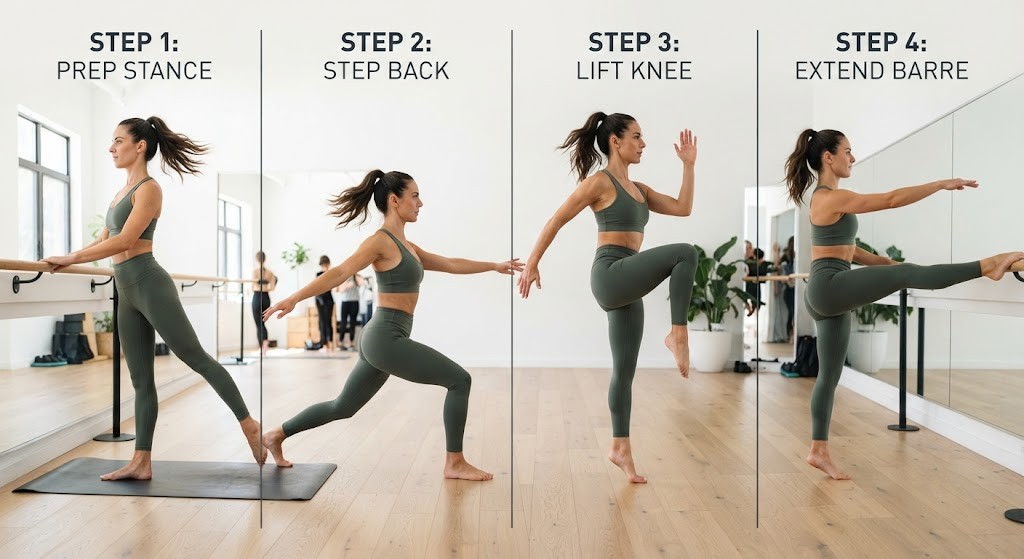
If you enjoy workouts that leave your muscles working without relying on high-impact jumping, a barre sculpt workout may be worth adding to your routine. This ballet-inspired style combines controlled movements, strength exercises, balance work, core training, and muscular endurance into a structured workout.
Unlike traditional ballet, you don’t need dance experience to participate. In this guide, you’ll learn what a barre sculpt workout is, how it works, which muscles it targets, what equipment you need, how often to do it, and how to follow a beginner-friendly 20-minute routine at home.
What Is a Barre Sculpt Workout?
A barre sculpt workout is a low-impact, ballet-inspired workout that combines controlled barre movements with strength, core, balance, and muscular-endurance exercises. It borrows positions and movements from ballet but adapts them for general fitness rather than dance performance.
A typical workout may include plié squats, glute pulses, calf raises, arm lifts, lunges, bridges, planks, and other controlled exercises. These movements challenge muscles through repeated contractions, sustained holds, and precise ranges of motion.
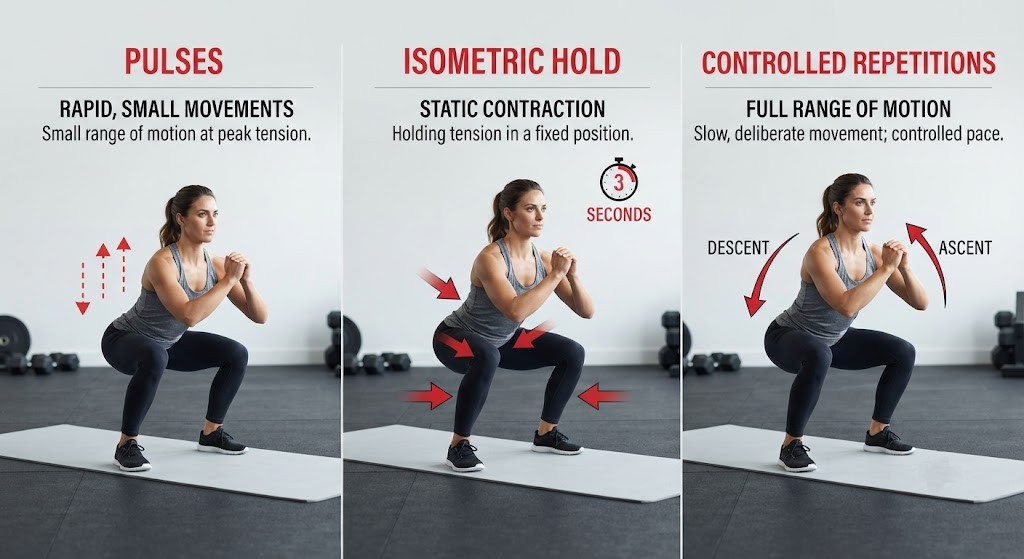
Barre sculpt also differs somewhat from conventional strength training. Traditional resistance training often emphasizes larger ranges of motion and progressively heavier loads, whereas barre commonly uses lighter resistance, small movements, pulses, and controlled repetitions.
What Are the Benefits of a Barre Sculpt Workout?
A consistent barre sculpt workout can support muscular endurance, strength, balance, coordination, core control, and movement awareness. Because the format generally limits jumping and other high-impact movements, it can also appeal to people who prefer a lower-impact approach to exercise.
Some potential benefits include:
- Improved muscular endurance
- Better balance and coordination
- Greater core control
- Increased movement awareness
- Strengthening of the legs, glutes, arms, and shoulders
- A low-impact alternative to some high-impact workouts
- A convenient option for home exercise
The World Health Organization recommends that adults complete 150–300 minutes of moderate-intensity physical activity per week and muscle-strengthening activities on at least 2 days. — Source: [World Health Organization, 2024]
Barre can therefore fit into a broader fitness program rather than replacing every other type of exercise. You might combine barre with walking, cardiovascular training, traditional resistance training, mobility work, or other forms of [low-impact strength training → suggested target page/topic].
How Does Barre Sculpt Build Muscular Endurance?
Barre sculpt training supports muscular endurance through repeated, controlled contractions. For example, holding a plié for 30 seconds and then adding small pulses keeps the muscles working continuously without requiring heavy weights.
This emphasis on time under tension can make relatively simple exercises feel surprisingly challenging. However, the goal is not simply to make an exercise uncomfortable—the movement should remain controlled and technically sound.
Can Barre Sculpt Help With Weight Loss?
Barre can contribute to an active lifestyle, but it should not be considered a guaranteed fat-loss or body-shaping solution.
Changes in body composition depend on multiple factors, including overall physical activity, nutrition, genetics, recovery, and training consistency. Barre is best viewed as one component of a balanced fitness routine.
How Does a Barre Sculpt Workout Work?
A typical barre sculpt workout progresses through several stages, such as:
- Warm-up
- Lower-body strength
- Upper-body exercises
- Core training
- Balance work
- Cooldown
The workout gradually increases muscular demand rather than immediately starting with the most challenging movements.
For example, a 25-minute session might include five minutes of warm-up, 12 minutes of lower- and upper-body exercises, five minutes of core and balance work, and three minutes of cooldown.
Barre also relies heavily on small-range movements, pulses, isometric holds, and controlled repetitions. These techniques increase time under tension, keeping the working muscles active for longer periods.
| Barre technique | What it means | Example |
|---|---|---|
| Pulses | Small repeated movements | Plié pulses |
| Isometric hold | Holding a position | Static squat |
| Controlled repetition | Slow, deliberate movement | Leg lift |
| Relevé | Rising onto the balls of the feet | Calf raise |
| Time under tension | Keeping muscles working longer | 30-second glute hold |
What Exercises Are Included in a Barre Sculpt Workout?
A barre sculpt workout can include a wide variety of movements, including:
- Pliés
- Squats
- Lunges
- Relevés
- Standing leg lifts
- Glute pulses
- Bridges
- Push-ups
- Arm raises
- Triceps exercises
- Planks
- Controlled abdominal exercises
These movements can be combined into short sequences that target several muscle groups during one workout.
What Are the Best Barre Leg and Glute Exercises?
Popular barre leg and glute exercises include plié squats, standing leg lifts, lunges, bridges, and glute pulses.
For example, you could perform 12 controlled plié squats followed by 20 small pulses. This combination increases the amount of continuous work performed by the thighs and glutes.
Relevés add calf work while also creating a balance challenge. If you are new to the movement, use a stable chair or countertop for support and maintain an upright posture.
What Are the Best Barre Arm and Core Exercises?
Barre arm and core exercises can include light arm raises, triceps kickbacks, modified push-ups, planks, and controlled abdominal movements.
For example, holding light dumbbells during slow arm raises can challenge the shoulders without requiring heavy resistance.
A [Dead Bug workout → suggested target page/topic] can also complement barre-based core training by emphasizing controlled trunk stability.
Barre sculpt exercises become more demanding when control and time under tension increase. Therefore, moving slowly and maintaining proper alignment can be more useful than simply trying to perform more repetitions.
Can Beginners Do a Barre Sculpt Workout at Home?
Yes. Beginners can perform a barre sculpt workout at home with a mat and a stable chair or countertop for support. You do not need a dedicated ballet barre to get started.
Before exercising, choose a clear area and check that your support surface cannot slide, tip, or move unexpectedly.
A simple beginner circuit could include:
- 10 squats
- 10 lunges per side
- 15 glute bridges
- 10 modified push-ups
- A 20-second plank
You can repeat the circuit according to your fitness level while focusing on technique rather than speed.
How to Do a 20-Minute Barre Sculpt Workout
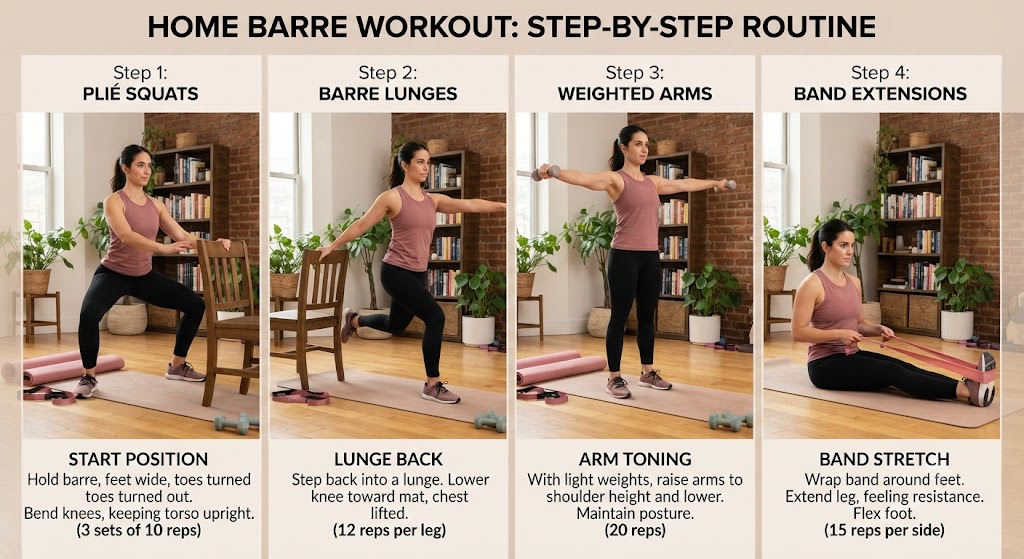
If you’re new to barre, this beginner-friendly sequence provides a simple way to structure a home session.
1. Warm Up — 3 Minutes
Start with marching in place, shoulder rolls, hip circles, and gentle squats. The goal is to gradually prepare your body for the movements that follow.
2. Plié Squats — 45 Seconds
Stand with your feet in a comfortable turned-out position and lower into a plié. Keep your knees aligned with your toes and only lower as far as feels comfortable.
3. Plié Pulses — 30 Seconds
Remain in a comfortable plié position and perform small, controlled pulses. Avoid bouncing or rushing through the movement.
4. Standing Leg Lifts — 45 Seconds Per Side
Hold a sturdy chair or countertop and lift one leg while maintaining an upright torso. Avoid leaning to compensate for the movement.
5. Reverse Lunges — 45 Seconds Per Side
Step backward into a lunge and lower your body with control. Keep the movement stable rather than trying to move quickly.
6. Glute Bridges — 60 Seconds
Lie on your back and lift your hips while keeping your ribs relaxed. Focus on controlled movement through the glutes and posterior chain.
7. Light Arm Raises — 45 Seconds
Perform controlled arm raises using bodyweight or very light dumbbells. Keep your shoulders relaxed rather than shrugging them toward your ears.
8. Modified Push-Ups — 45 Seconds
Use a wall, countertop, or knees to modify the exercise if necessary. Maintain control through the entire movement.
9. Plank — 20–30 Seconds
Hold a plank while keeping your hips controlled. Avoid allowing your lower back to sag or your hips to rise excessively.
10. Cooldown — 3 Minutes
Finish with gentle stretching and relaxed breathing. Use the cooldown to gradually transition out of the workout.
Rest for 20–30 seconds between movements whenever necessary. Beginners should prioritize proper technique instead of trying to complete every interval without stopping.
Which Muscles Does a Barre Sculpt Workout Target?
A barre sculpt workout can target the glutes, quadriceps, hamstrings, calves, core, shoulders, and arms, depending on the exercises included.
Lower-body exercises often receive significant attention because ballet-inspired positions involve repeated movements at the knees, hips, and ankles.
For example, plié squats emphasize the thighs and glutes, while bridges place greater emphasis on the posterior chain, including the glutes and hamstrings.
| Exercise | Primary focus |
|---|---|
| Plié squat | Quadriceps, glutes, inner thighs |
| Glute pulse | Glutes |
| Relevé | Calves |
| Reverse lunge | Glutes, quadriceps, hamstrings |
| Bridge | Glutes, hamstrings |
| Arm raise | Shoulders |
| Push-up | Chest, shoulders, triceps |
| Plank | Core and stabilizers |
Balance exercises can also recruit smaller stabilizing muscles because your body must continuously control its position while standing on one or both legs.
How Long Should a Barre Sculpt Workout Be?
A 20–30 minute barre sculpt workout can be a practical starting point for beginners. As your fitness and exercise tolerance improve, you can gradually use longer sessions if they fit your routine and recovery needs.
For example, three 20-minute sessions provide 60 minutes of dedicated barre training per week. You can supplement that time with walking, cardiovascular exercise, resistance training, or other physical activities.
Workout duration should ultimately match your schedule, fitness level, and recovery needs. The World Health Organization recommends that adults accumulate 150–300 minutes of moderate activity weekly, so barre can form one part of a broader activity plan. — Source: [World Health Organization, 2024]
What Equipment Do You Need for a Barre Sculpt Workout?
One advantage of a barre sculpt workout is that it requires very little equipment. Beginners can start with an exercise mat and a sturdy chair or countertop for balance and support.
Optional equipment includes:
- Light dumbbells
- Resistance bands
- Ankle weights
- Small exercise ball
- Exercise mat
Lighter resistance is generally practical for barre-style movements because the emphasis is on controlled movement, muscular endurance, and technique rather than simply lifting the heaviest possible load.
ACSM’s 2026 resistance-training review analyzed evidence from more than 137 studies involving over 30,000 participants, reinforcing the importance of resistance-training variables for strength, endurance, muscle function, and physical performance. — Source: [American College of Sports Medicine, 2026]
How Many Times a Week Should You Do a Barre Sculpt Workout?
Most beginners can start with two or three barre sculpt workouts per week, allowing recovery between challenging sessions.
For example, you could perform barre on Monday and Thursday while using the days between sessions for walking, mobility work, or another type of exercise.
This approach also gives you opportunities to practice technique without turning every day into a demanding lower-body workout.
Resistance training should also be combined with other forms of movement when appropriate. CDC guidelines recommend muscle-strengthening activity on at least two days per week alongside aerobic activity. — Source: [CDC, 2018]
Is a Barre Sculpt Workout Good for Strength Training?
A barre sculpt workout can contribute to strength and muscular endurance, particularly when the exercises provide an appropriate level of resistance and challenge.
However, barre may not fully replace progressive heavy resistance training for someone whose primary goal is maximal strength or substantial muscle hypertrophy. Traditional resistance training makes it easier to progressively increase external load over time.
For example, a beginner could progress from bodyweight squats to light dumbbell squats and eventually incorporate more demanding resistance exercises.
ACSM’s 2026 evidence review examined resistance-training outcomes including strength, hypertrophy, power, endurance, and physical function across more than 30,000 participants. — Source: [American College of Sports Medicine, 2026]
What Are Common Barre Sculpt Workout Mistakes to Avoid?
Even relatively simple barre movements require attention to technique. Common mistakes include:
- Moving too quickly
- Losing proper alignment
- Using excessive resistance
- Going deeper than you can control
- Ignoring fatigue-related changes in form
- Treating pulses as fast, uncontrolled movements
- Continuing an exercise when technique has deteriorated
For example, if your knee begins moving inward during a plié, reduce the depth or use a stable support surface until you can control the position.
Likewise, don’t assume that deeper movements or heavier dumbbells automatically create better results. Good barre technique prioritizes control, alignment, and purposeful muscle engagement.
How Can You Make a Barre Sculpt Workout More Challenging?
Once the basic movements feel comfortable, you can progressively increase the difficulty of your barre sculpt workout.
Possible progression strategies include:
- Increasing repetitions
- Increasing hold duration
- Adding light resistance
- Improving movement control
- Choosing a more challenging variation
- Combining movements into longer sequences
- Reducing unnecessary rest while maintaining good form
A simple progression model is:
- Improve exercise technique.
- Increase repetitions.
- Increase hold duration.
- Add light resistance.
- Try a harder variation.
- Combine movements into longer sequences.
For example, you could progress a 20-second isometric hold to 30 seconds before introducing ankle weights. This gives you a chance to increase the challenge gradually instead of changing several variables at once.
At the same time, barre works best as part of a broader movement routine. A balanced weekly plan can include strength training, cardiovascular exercise, mobility work, and recovery-focused activities.
How Can You Get Better Results From a Barre Sculpt Workout?
Getting more from barre is not necessarily about making every workout harder. Instead, focus on consistency, technique, progressive challenge, and adequate recovery.
Prioritize Form Over Speed
Slow, controlled repetitions allow you to focus on alignment and muscle engagement. If your form deteriorates, shorten the range of motion or take a brief break.
Use Support When Needed
A chair or countertop is not a sign that you are doing the exercise incorrectly. Stable support can help beginners maintain balance while learning new movements.
Progress Gradually
Increase only one major variable at a time. You might first increase hold duration, then later introduce light resistance.
Combine Barre With Other Training
Barre can complement cardiovascular activity, traditional resistance training, walking, and mobility work. A varied routine can address different aspects of physical fitness rather than relying on a single workout style.
Conclusion: Build Strength With Consistency
A barre sculpt workout offers a low-impact way to combine strength, muscular endurance, balance, core control, and ballet-inspired movement. Beginners can start at home with little equipment, using a mat and sturdy support while gradually learning foundational exercises such as pliés, lunges, bridges, leg lifts, arm raises, and planks.
The most important factor is consistency—not immediately performing advanced movements. The World Health Organization reported that 31% of adults worldwide did not meet recommended physical-activity levels in 2022, highlighting the importance of finding sustainable ways to stay active. — Source: [World Health Organization, 2024]
Ultimately, use controlled movements, progress gradually, and allow adequate recovery between challenging sessions. When incorporated into a balanced fitness routine, barre sculpt can provide a practical way to work on strength, muscular endurance, balance, and movement control without relying heavily on high-impact exercise.
FAQs
What is a barre sculpt workout?
A low-impact workout combining ballet-inspired moves with strength and core exercises.
What is a barre workout?
A low-impact workout using ballet-inspired movements, pulses, holds, and controlled exercises.
Is barre harder than Pilates?
Barre can feel more intense for muscular endurance, while Pilates emphasizes core control and stability.
Is barre actually a good workout?
Yes. It can improve strength, balance, coordination, and muscular endurance.
Is barre sculpt good for beginners?
Yes. Beginners can start with simple movements and light resistance.
Can you do a barre sculpt workout at home?
Yes. A mat and sturdy chair are usually enough.
How long should a barre sculpt workout be?
A 20–30 minute session is a practical starting point.
How many times a week should you do barre sculpt?
Beginners can start with two or three sessions per week.
What muscles does barre sculpt work?
It mainly targets the glutes, legs, core, arms, and shoulders.
Does barre sculpt build strength?
Yes. It can improve strength and muscular endurance.
What equipment do you need for barre sculpt?
A mat and sturdy support are enough, with weights and bands as optional equipment.
Is barre sculpt a low-impact workout?
Yes. It uses controlled movements with little or no jumping.
What are common barre sculpt exercises?
Plié squats, pulses, lunges, leg lifts, bridges, planks, and arm raises.